The High Cost of U.S. Health Care and What To Do About It


The United States spends 17.2% of GDP on healthcare costs, public and private, almost twice as much as any other developed country, and this percentage is gradually increasing.  In today’s New York Times there is a good discussion about these rising costs (see below).
Capture1My recent post, “Fixing Obamacare Rather Than Replacing It,” discusses a comprehensive new healthcare reform proposal by Avik Roy of the Manhattan Institute.  Mr. Roy’s plan both expands health insurance coverage beyond ACA levels as well as reining in the huge costs of healthcare. As Mr. Roy says “Among the industrialized member countries of the OECD, the average hospital stay cost $6,222 and lasted 7.7 days in 2009.  In the United States, the average hospital stay cost $18,142, despite lasting only 4.9 days.  In other words, the average daily cost of a hospital stay in the U.S. was 4.6 times the OECD average.”  Mr. Roy goes on to show that it is hospital system consolidation which is especially responsible for driving up the cost of health insurance.

CaptureThere is a clear example of this situation in Omaha NE where I live.  There are three hospital systems here: Catholic Health Initiatives, the Nebraska Health System and the Methodist Health System.  As stated by the CEO of Blue Cross and Blue Shield of Nebraska in the Omaha World Herald on August 28, 2014, “Our experience in addressing health care costs is precisely what led us to our current negotiations with Denver-based Catholic Health Initiatives.  CHI’s Alegent Creighton Health network of hospitals and physicians charges our members up to 30 percent more than other providers in Omaha for the same services. … These numbers reinforce a simple truth: We cannot allow one provider group to charge our members more for the same services they can receive elsewhere.”
We are fortunate in Omaha to have a choice of three different hospital systems and an insurance company with sufficient clout and integrity to fight price gouging by one of these systems.  But not every community is as fortunate as Omaha in this respect.  This is just one simple example of why cost control needs to be at the center of healthcare reform.
Five Sectors to Blame for Economic Weakness


Several of my recent blog posts have addressed various issues relating to our slow growing economy.  In particular I have proposed a simple way to speed up economic growth: namely, broad-based tax reform at both the individual and corporate levels.  The idea is to lower tax rates across the board, paid for by closing loopholes and shrinking deductions.  At the individual level this could have the effect of putting as much as $250 billion per year in the hands of the middle and lower income wage earners who will surely spend most of it, thereby giving the economy a big boost.  The U.S. corporate tax rate is not internationally competitive.
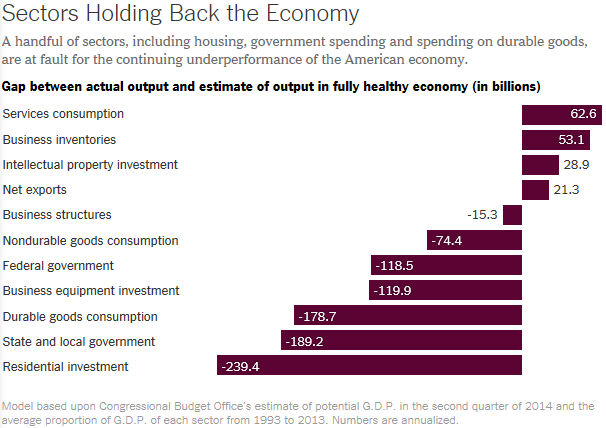
In today’s New York Times the economics writer, Neil Irwin, has an article “Why Is the Economy Still Weak?  Blame These Five Sectors.”  The five sectors are, in order of magnitude of effect: housing, state and local governments, durable goods consumption, business equipment investment, and federal government.  See the chart below.
CaptureLet’s look in turn at each of these top five barriers to faster economic growth:

  • Housing. Not at all surprising with 24 million people either unemployed or underemployed. Young people especially cannot afford to buy their first home today.
  • State and Local Governments. These governmental units have to balance their budgets. When people have more money to spend, tax revenues will increase and so will public spending.
  • Durable Goods Consumption. These same 24 million people aren’t buying much new furniture or many new cars either. It makes complete sense.
  • Business Equipment Investment.  Lower corporate tax rates will incentivize our multinational firms to bring their foreign profits back home for reinvestment.
  • Federal Government. Unfortunately nothing can be done about this category! Federal deficit spending is way too high as it is and must come down.

Conclusion:  Using broad-based tax reform to put a large amount of money in the hands of middle and lower-income wage earners, and also reforming corporate taxes, will boost spending for four of the five main barriers to faster economic growth.  Why don’t we do it?

How to Increase Growth and Decrease Inequality at the Same Time!


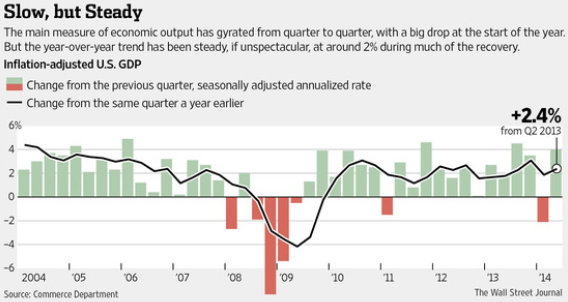
The Department of Commerce has just reported basic economic data for the second quarter of 2014.  As the chart below shows, the economy gradually lost steam from 2004 – 2008, sunk badly in 2008 and 2009, and has now grown at a slow but steady rate of about 2% during the period 2010 – 2014.
CaptureOne of my favorite journalists, the New York Times’ economics reporter Eduardo Porter, has just written again on the topic of inequality, “Income Inequality and the Ills behind It.”  He quotes the economist Tyler Cowen as saying “The right moral question is ‘are poor people rising to a higher standard of living?’  Inequality itself is the wrong thing to look at.  The real problem is slow growth.”  The economist Gregory Mankiw is quoted as saying that “Policies which address the symptom (of inequality) rather than the cause include higher taxes and a more generous safety net.  The magnitude of what we can plausibly do with these policy tools is small compared to the size of the growing income gap.”
What Mr. Cowen and Mr. Mankiw are both suggesting is that we can’t effectively attack income inequality without also increasing economic growth.  I believe that it is possible to address both problems at the same time by implementing broad-based tax reform as follows:

  • Individual income tax rates should be lowered across the board, paid for by closing loopholes and shrinking deductions, in a revenue neutral way.
  • The 64% of all taxpayers who do not itemize deductions will get a significant tax cut. Since they are largely the middle and lower-income wage earners with stagnant incomes, they will tend to spend their tax savings, thereby giving the economy a big boost.
  • At the same time the 36% of taxpayers who do itemize their deductions will, on average, see their income taxes go up. But these are, on the whole, the wealthier wage earners who can afford to pay higher taxes.
  • A plan such as this represents a shift of net after-tax income from more wealthy people to the less wealthy. It therefore reduces income inequality.

If we can cut tax rates, increase economic growth and reduce income inequality all at once, why can’t our national leaders come together and act along these lines?

The Truth behind the Latest Job Figures


Mortimer Zuckerman, writing a few days ago in the Wall Street Journal, “The Full-Time Scandal of Part-Time America,” points out that the latest employment figure of 288,000 net jobs created in June is highly misleading.  “Full-time jobs last month plunged by 523,000, according to the Bureau of Labor Statistics.  What has increased are part-time jobs.  They soared by about 800,000 to more than 28 million.” Mr. Zuckerman goes on to say, “Since 2007 the U.S. population has grown by 17.2 million, according to the Census Bureau, but we have 374,000 fewer jobs since a November 2007 peak and are 10 million jobs shy of where we should be.”
CaptureInterestingly, the New York Times discusses the same problem from a different point of view, ”A Push to Give Steadier Shifts To Part-Timers”.   The NYT does recognize that there are now about 7.5 million part-time workers who would prefer full time employment but are unable to find it.  But the emphasis is on giving them more advance notice for changes in work schedules.
The only way that we’ll get what we really need, more jobs, more good jobs and more fulltime jobs, is by faster economic growth beyond the anemic 2.2 average growth rate since the recession ended five years ago.  Here are several ways to accomplish this:

  • The most obvious and immediate thing we should do is to lower the corporate tax rate from its currently highest in the world level of 35%. This will stop the hemorrhaging of U.S. companies moving overseas and encourage multinational corporations to bring their profits home and reinvest them in the U.S.
  • Broad-based individual tax reform, with lower tax rates for all, offset by closing loopholes and shrinking deductions which primarily benefit the wealthy. This will put more money in the hands of the two thirds of Americans who do not itemize their tax deductions. Since these are the middle and lower income wage earners with stagnant incomes, they will spend their extra income thereby giving the economy a big boost.
  • The employer mandate in Obamacare is responsible for some of the shift from fulltime to part-time employment, and should be repealed (it has already been suspended for two years by the Obama Administration).

These are just common sense reforms which should be doable by Congress without a huge ideological fight.  We badly need leadership capable enough to do this!

Now Is the Time to Solve Our Illegal Immigration Problem!


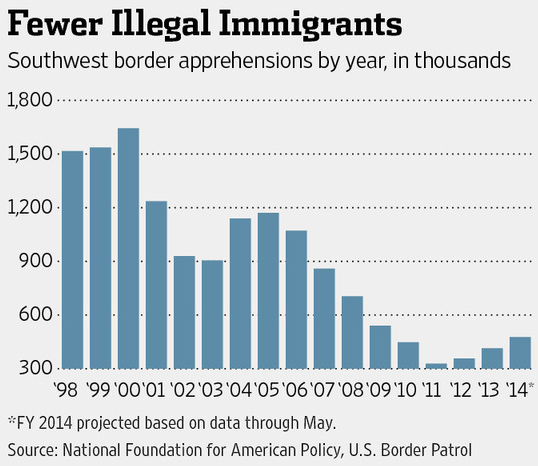
The sight of thousands of children from Central America sitting in camps at the U.S. border should knock some sense into those members of Congress who are dragging their feet on comprehensive immigration reform.  Overall, illegal border crossings are at their lowest level in many years (see chart below).  Now is the time to get things straightened out before the illegal traffic starts building up again.
CaptureWhen the New York Times, “The Border Crisis,” and the Wall Street Journal, “A Better Border Solution,” agree on an issue, I tend to agree with them.  Both newspapers say that the current crisis is the result of illegal immigrants in the U.S. trying to rescue their children from deplorable conditions back home.  If they had legal status they would go home themselves and bring their children back to the U.S. but they can’t risk doing this without a visa.
As I pointed out in a recent blog, “Immigration Reform Will Benefit Nebraska,” it shouldn’t be that hard to achieve a comprehensive solution as follows:

  • All businesses would compile a list of their current employees who are illegal. Everyone on this list, without a criminal record, would receive a guest worker visa as of a certain date. Visas would be transferable from one employer to another.
  • Companies would be authorized to hire additional foreign workers in their home countries who would then receive a guest worker visa to enter the U.S.
  • Once the system was set up and operational, all businesses would be required to periodically demonstrate the legal status of all workers.
  • Guest workers would be eligible to apply for citizenship after a relatively lengthy period of time.

America needs immigrant labor to do the hard low skilled physical work such as in agriculture, meatpacking, and construction, which most Americans don’t want to do.  An adequate guest worker system would virtually eliminate illegal immigration, thereby solving a huge current law enforcement problem.  It would also give the U.S. economy a big boost by providing all businesses with an adequate source of labor.
We have got to get beyond our hang-up about amnesty to solve this incredibly serious problem!

Why We Need a Carbon Tax VI. Because of China!


Over the past two months I have posted several blogs about the seriousness of global warming and demonstrated that the best way to address it is with a carbon tax of about $20 per ton of CO2 released into the atmosphere.  Here is a summary of my argument:

  • The reality of global warming can hardly be questioned. For example, the extent of summer ice in the arctic ocean is shrinking rapidly.
  • Expecting the Environmental Protection Agency to be able to administer an effective program by giving each state a target for CO2 emissions reductions is cumbersome and arbitrary.
  • The current EPA program of trying to reduce carbon emissions by 30% over the next 15 years will set up an economic incentive to substitute natural gas for coal and slow down the further development of nuclear energy and renewable energy sources such as wind and solar power. This is because natural gas is plentiful and inexpensive. But the burning of natural gas still releases half as much CO2 as coal and so will continue to contribute to global warming.

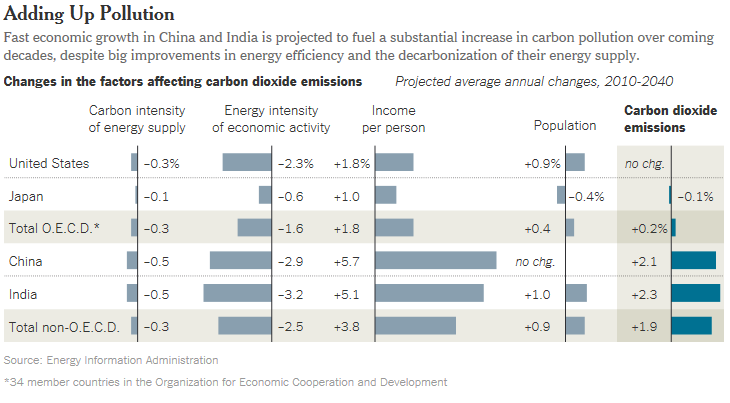
CaptureIn yesterday’s New York Times, the reporter Eduardo Porter in “China’s Hurdle to Fast Action on Carbon” calculates that even under conservative growth assumptions, China will almost double its carbon emissions between now and 2040.  And this doesn’t even consider all of the other developing nations which also will increase their use of inexpensive energy sources in order to increase their standards of living.
In other words, even if the EPA is able to force a big switch from coal to natural gas in the U.S., any such reduction in carbon emissions will be dwarfed by increases from other countries.
A carbon tax on CO2 emissions will not only give a big boost to all non-fossil fuels, it will also unleash American ingenuity to figure out how to accomplish carbon sequestration in the use of fossil fuels.  This will enable the U.S. to achieve a much greater reduction than 30% in carbon emissions over the next 15 years and beyond.  Furthermore the new technology which we develop to do this will be immediately available for use around the world.
With such a program the U.S. would actually be demonstrating how to effectively attack global warming instead of just advocating for it!

Does Economic Growth Depend on Healthcare Expansion?


Even though economic growth is much too slow, it has been steadily increasing since the end of the Great Recession at a rate of about 2.2% per year.  But our economy actually shrunk at a 2.9% rate in the first quarter of 2014.  Healthcare spending decreased by 6.9% in the first quarter and therefore contributed to this overall drop in GNP.
CaptureThe New York Times’ economic reporter, Neil Irwin, discusses the connection, ”Our Economic Growth Is a Mystery.  Obamacare is the Reason.” in yesterday’s paper.  Since healthcare makes up one-sixth of the economy, and the implementation of Obamacare is expanding the healthcare sector, it is not surprising that the economy stumbles if Obamacare stumbles.
But he continues “The United States also has the most expensive healthcare system in the world, without producing better health outcomes.  If the nation succeeds in reducing health care costs while also getting coverage for more people, it would be a huge win for the country’s long term competitiveness.  Overtime the dollars that aren’t being spent on overpriced or unneeded health services can go to other stuff which makes life better: houses, college education, restaurant meals and the like.”
Conclusion:  we need to try all the harder to figure out how to grow the economy faster.  The best single thing we can do about this is to implement fundamental tax reform whereby individual tax rates are cut across the board, paid for by closing many of the loopholes and deductions which primarily benefit the rich.  The two thirds of taxpayers who do not itemize deductions will automatically receive a tax reduction in this way.  Since they are middle and lower income wage earners, with largely stagnant incomes, they will tend to spend their tax savings, thereby boosting the economy.
The loopholes enjoyed by the wealthy are example of crony capitalism which both liberals and conservatives complain about.  Closing these loopholes and other deductions is a very good way to lessen income inequality.  Our leaders should be able to work together in this direction!

The President Plays Small Ball


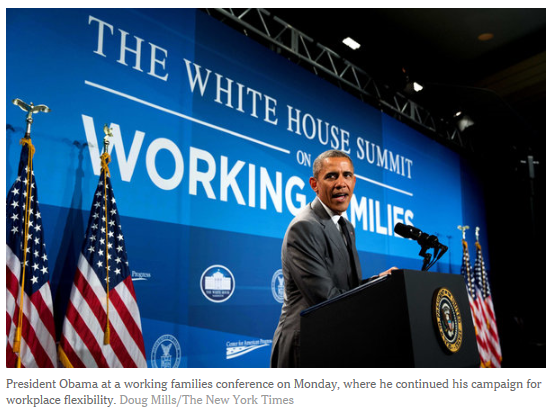
As reported in today’s New York Times, ”Personal Tack by Obama in an Effort to Aid Parents”, the President held an all-day conference yesterday for working families, saying that

  • “Family leave, child care, workplace flexibility, a decent wage – these are not frills – they are basic needs.”
  • “There is only one developed country in the world that does not offer paid maternity leave. And that is us. And that is not the list you want to be on by your lonesome.”
  • “We need you to tell Congress, don’t talk about how you support families: actually support families.”

Capture

The economic journalist, Robert Samuelson, pointed out in the Washington Post a few days ago, ”The Jobs Mystery”, that even though our unemployment rate has now dropped to 6.3%, there are still 9.8 million officially unemployed people, plus an additional 7 million who would like a job but are not looking.  There are also 7.3 million part-time workers who would like longer hours.  This gives a really quite shocking total of 24.1 million unemployed or underemployed workers.
Granted we had a bad recession which was not the President’s fault, but it ended in June 2009, a full five years ago.  In the meantime his administration has done much to retard economic growth (passing ObamaCare and the Dodd-Frank Act) and little, besides huge deficit spending, to boost it.  He and the Democratic Party should be held responsible for this neglect and they probably will be.
One thing which would do a lot to boost economic growth is apparently contrary to liberal ideology and therefore off the discussion table.  I am referring to fundamental, broad-based tax reform whereby individual tax rates would be lowered across the board, but in a revenue neutral manner, by closing or greatly shrinking the loopholes and deductions which primarily benefit the wealthy.  The two-thirds of Americans who do not itemize their tax deductions would get a big boost in take home pay.  Since they are primarily middle and lower income workers whose wages have been stagnant since the recession began, they will tend to spend this extra income, thereby giving the economy a big boost.
If the President were to sincerely ask the House Republican leadership to work with the Democratic Party to boost economic growth, something along this line could be acted upon.  This is the way to really aid families.  Why doesn’t he do it?

Why We Need a Carbon Tax IV. The Economic Risks of Climate Change


I have now posted more than 200 entries on my blog.  I have discussed a wide variety of fiscal and economic issues in the last year and one-half.  But there are really, in my opinion, just a fairly small number of basic themes in my posts, such as:

  • Eliminating deficit spending so that we can shrink our national debt over time to a substantially lower level than the current 73% of GDP.
  • Boosting our economy in order to put more people back to work as well as bringing in more tax revenue.
  • Maintaining an activist foreign policy including a sufficiently strong military force to protect our free and democratic way of life.
  • Maintaining high citizen morale by addressing other critical domestic issues such as economic mobility and increasing income inequality.
  • Addressing natural threats to our way of life such as global warming.

Capture Today’s New York Times has an excellent article on global warming “The Coming Climate Crash” from a surprising source, former Secretary of the Treasury, Henry Paulson.  He was in office when the credit bubble burst in 2008 and is therefore an expert on crisis management.  His argument is that global warming presents a strong economic threat as well as an environmental threat.  It therefore should be addressed by an effective economic policy, such as a carbon tax.  He points out that:

  • Global warming is a far more intractable problem than a credit bubble, not at all amenable to a relatively quick fix by government action.
  • A threat from nature like global warming is not an ideological issue because it affects all of us in the same way, conservatives and liberals alike.
  • A future with more severe storms, deeper droughts, longer fire seasons and rising sea levels creates huge economic risks which we ignore at our great peril.
  • A carbon tax doesn’t outlaw the use of fossil fuels but rather creates a huge economic incentive for developing carbon sequestration when fossil fuels are burned.

Government regulation of fossil fuels by the Environmental Protection Agency represents a timid and arbitrary half measure that won’t have nearly the impact of a sound economic incentive like a carbon tax.  Let’s get serious and do things the right way!

Crony Capitalism and Economic Growth


“If there is one thing that populists on the left and right can agree upon, it is disdain for crony capitalism.  It is a distaste for the cesspool of Washington influence in which big-business lobbyists canoodle with lawmakers to get their way.  It is anger at corporate welfare enriching America’s biggest companies at the expense of the little guy.”  So says the economics journalist Neil Irwin in today’s New York Times, “Why we’re All Crony Capitalists, Like It or Not”.
Specifically he is talking about the current debate in Congress over whether or not the Export-Import Bank of the United States should be continued.  It mostly helps big corporations like Boeing and General Electric finance sales to other countries.  But there’s a trade off.  If it shuts down, then American corporations will be at a disadvantage compared with international competitors who get help from their own governments.
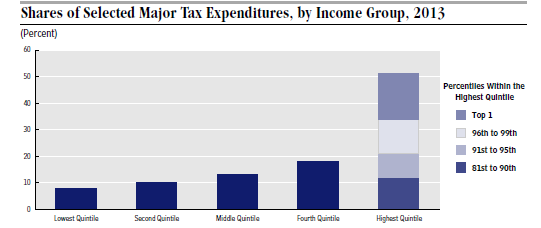
CaptureIn fact, crony capitalism has a much wider scope than this.  Each year deductions and loopholes in the U.S. tax code, referred to euphemistically as tax expenditures, total $1.2 trillion in lost tax revenue.  As the above chart from the Congressional Budget Office shows,  50% of these tax reductions are enjoyed by the highest earning 20% of all U.S. households, with 30% of the benefits going to just the top 5%.
Many experts say that our stagnant economy is caused by a lack of consumer demand, in turn caused by the huge loss of wealth during the Great Recession.  If lower and middle income people had more money, they would surely spend it and our economy would grow faster.  This line of reasoning suggests a way forward!
We should enact fundamental, broad-based tax reform, whereby individual tax rates are lowered across the board, in a revenue neutral way, paid for by greatly shrinking the deductions and loopholes enjoyed by the top 5% of wage earners.  The two-thirds of taxpayers who do not itemize their deductions will receive a correspondingly significant increase in income which they are most likely to spend.
A plan like this would not only boost the economy but also boost public morale by lessening inequality.  A win, win plan!