What Will Trump Do?


I did not vote for Donald Trump because of his often crude remarks and sleazy behavior. But I am now cautiously optimistic about the prospects for his presidency based on the quality of his nominees for important government posts.  Like many of his voters, I “take him seriously but not literally.”

capture97
Here is what I think he will do:

  • Economic Policy. He will try to speed up economic growth, well above the average 2.1% annual GDP growth of the past 7½ years. This can be accomplished with tax reform (lowering tax rates paid for by shrinking deductions), regulatory reform (including paring back Dodd-Frank and the ACA), immigration reform and tougher trade policies. Faster growth benefits the whole country and especially the blue-collar workers who voted for him.
  • Improving life in the inner cities. K-12 education is a disaster in many inner cities and Betsy DeVos will be a reformer in the Education Department. Ben Carson grew up in public housing and is an excellent choice for HUD.
  • Foreign Policy. Mr. Trump wants changes from China on currency and trade practices. He also wants more cooperation from Russia in fighting terrorism. He wants our NATO partners to bear a bigger share of their own defense. His Secretary of State designee, Rex Tillerson, supports arming Ukraine against Russia and also supports the TPP trade agreement with Asia. This all sounds good to me.
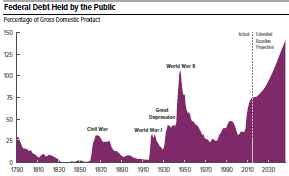
  • Fiscal Policy. My biggest concern at this point is our national debt, now 76% of GDP (for the public part on which we pay interest) which is historically high and steadily getting worse. The House Republicans are serious about shrinking deficit spending and hopefully Mr. Trump will support their efforts.

Conclusion. Donald Trump has a highly unconventional (but very effective) style of communication. If it leads to progress in addressing our biggest problems as above, then he’ll have a very successful presidency.

Follow me on Twitter
Follow me on Facebook

Trumponomics Is Taking Shape


As the readers of this blog well know, I am very concerned about the fiscal and economic direction our country has been taking in recent years. I voted for Hillary Clinton in the 2016 presidential election because of Donald Trump’s crude and sleazy behavior.  However we need basic change in the U.S. and Mr. Trump is clearly a change agent.
As the new Trump administration begins to take shape, here is what I see happening:

  • Treasury Secretary designee, Steven Mnuchin, says that tax cuts for both upper-income and middle class taxpayers will be offset by “less deductions that pay for it.”  Revenue neutral tax rate cuts will increase both consumer and investment spending, without increasing our debt, and will give the economy a huge boost.
  • Health and Human Services Secretary designee, Rep Tom Price, is an expert on health-care and wants to replace the Affordable Care Act with a new healthcare program which provides more consumer choice at a much lower cost.

    capture83

  • The Great Rebuilding Infrastructure investment is needed but it should be accomplished with a lower corporate tax rate and repatriated profits of multinational corporations to avoid increasing the deficit.
  • Holdback on excessive fiscal stimulus.  With the unemployment rate down to 4.6%, a dollar which has already appreciated 40% since 2011, and tax cuts on the way, inflation and higher interest rates are in the offing. Let’s not overdo it.

    capture84

  • Living on borrowed time.  As shown in the above chart, interest rates are very, very low and are likely to rise significantly in the near future. When this happens, our massive public debt (on which we pay interest) of 76% of GDP will become very expensive to service. Ouch!


Conclusion.  One can see a Trump agenda emerging which has the potential to be very successful if it is coupled with overall spending restraint.

Follow me on Twitter
Follow me on Facebook

What to look for in President Trump’s First Budget


As a new administration prepares to take office in January, one of the key indicators of President Trump’s approach to government will be his first budget. This is especially true since the Republican controlled Congress is likely to take a Republican President’s budget seriously.

capture79
One of our nation’s chief fiscal watchdogs, the Concord Coalition, has summarized the most important things to look for:

  • What is the overall fiscal target? President Obama’s recent budgets have aimed at stabilizing the debt as a share of the economy. House Republicans have aimed for a more ambitious goal of balancing the budget within ten years, gradually reducing the debt as a share of the economy. What path will Mr. Trump recommend?
  • What specific tax cuts will be proposed and what are the likely revenue effects? During the campaign Mr. Trump proposed tax cuts amounting to $5.9 trillion in revenue loss over ten years. Even with dynamic scoring, taking the stimulatory effects of his tax cuts into effect, the revenue loss is still $3.9 trillion over ten years. Such huge revenue losses will make our debt much worse than it is already and won’t be approved by Congress.
  • What will the budget recommend for the federal debt limit? Currently the debt limit is suspended until March 16, 2017 when it will return at whatever level it is on that date. Congress will then have several months to reset it. Whatever the President recommends will send a strong signal, positive or negative, to the financial markets.
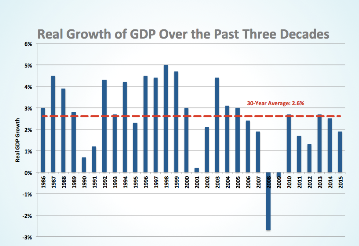
  • What economic growth rates will the budget assume?   GDP growth has averaged 2.6% for the past 30 years. Any predicted long term growth rate higher than this will lack credibility without strong justification.

Conclusion. Mr. Trump has the opportunity to institute the change in course which so many Americans would like to see. His first budget will set the tone and provide an important clue as to whether or not he is serious about doing this.

Follow me on Twitter
Follow me on Facebook


Can the Economy Grow Faster without Increasing Our Debt?


As I have been saying over and over on this blog for several years, America’s two major fiscal and economic problems are:

  • Slow Economic Growth, averaging just 2% since the end of the Great Recession in June 2009.
  • Massive Debt. Our public debt, on which we pay interest, is now $14 trillion or 76% of GDP, the highest it has been since the end of WWII.

President-elect Donald Trump campaigned on the issue of slow economic growth and will surely work with the Republican Congress to institute various tax and regulatory reform measures needed to speed up growth.

capture15But during the campaign Mr. Trump also introduced a specific tax reform plan which would lead to an estimated $4.4 trillion in new debt over the next ten years. Such a very large amount of new debt is highly undesirable and hopefully will be rejected by Congress.
In fact, as described by the Tax Foundation, there are some very good ways to use tax reform to improve growth without increasing debt. Fox example:

  • Allowing the full and immediate expensing of capital investments will grow the economy by 5.4% at a cost of $881 billion over ten years.
  • Lowering the top corporate tax rate to 20% will grow the economy by 3.3% at a cost of $718 billion over ten years.
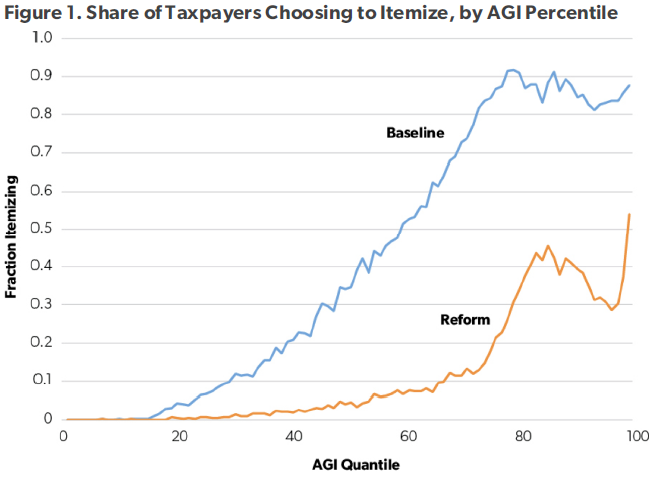
  • Eliminating all itemized deductions except the charitable and mortgage interest deductions will slow economic growth by only .4% and increase tax revenue by $2,268 billion over ten years.

Conclusion. Just these three specific tax reform measures would grow the economy by about 8% while producing $600 billion in new tax revenue over a ten year period.  There are other ways as well of achieving similar growth and revenue levels.  The point is that the changes our country needs can be accomplished without increasing the national debt and perhaps even reducing it instead.

Follow me on Twitter
Follow me on Facebook

What Trumponomics Will Look Like (Hopefully!)


Donald Trump won the presidential election because of his strong support from blue-collar workers who feel aggrieved by the U.S. economic system. Many have lost their jobs in recent years due to technology and globalization.  Many others have suffered wage stagnation.  Helping this large group of voters is surely Mr. Trump’s primary mandate from the election.

capture79
The best way to do this is to make the economy grow faster by implementing smart policies such as:

  • Corporate tax reform. Reducing the top rate from 35% to about 20% will make the U.S. competitive with other developed countries and induce American multinational companies to bring their overseas profits back home for reinvestment. This will create more jobs and better paying jobs. This can be paid for by eliminating various deductions.
  • Business tax reform. Allow full expensing of capital investments, paid for by eliminating the deductibility of interest payments. This will strongly encourage more business investment and therefore increase worker productivity.
  • Individual tax reform. Lower marginal tax rates across the board by 10%, paid for by eliminating most deductions. This would give an automatic increase in pay to the two-thirds of taxpayers who do not itemize deductions and, since most of the pay increase would be spent, grow the economy by stimulating demand.
  • Regulatory reform. Much can be done to alleviate the regulatory burden on business, see here and here.
  • International trade rules. “Tearing up NAFTA” would be a huge mistake because the U.S. exports $600 billion annually to Canada and Mexico with a trade deficit of only $40 billion. But NAFTA can be updated with side agreements to address concerns of fairness. Expand retraining programs for workers who lose their jobs to foreign competition.
  • Immigration reform. Secure our southern border and deport the illegal immigrants who are lawbreakers as Mr. Trump wants to do. Then give guest worker visas to law-abiding employees of legitimate businesses and use eVerify to enforce them.

Conclusion. Changes such as these will give a big boost to the economy and therefore create many new jobs and better paying jobs.

Follow me on Twitter
Follow me on Facebook


Disruption Involves Taking Chances


I am a fiscal conservative (I want to balance the budget) and a social moderate. I voted for Hillary Clinton for president because Donald Trump is a sleazy person and has such a volatile temperament.  But I’m also in favor of making big changes and Mr. Trump will certainly do this.

capture79As the Economist points out, “his voters took Mr. Trump seriously but not literally, even as his critics took him literally but not seriously.”  The Economist goes on to point out some of the risks involved in making the kinds of changes Mr. Trump is talking about:

    • If Obamacare is repealed, 20 million Americans will lose their health insurance. Yes, but it’s not going to happen this way. Obamacare will end up being modified and improved, not abolished.
  • His tax cuts would chiefly benefit the rich and would greatly increase our national debt. Yes, but the House of Representatives has a much better plan to do this and it is Congress, not Mr. Trump, which will develop a detailed plan.
  • Even if he does not actually deport illegal immigrants, he will foment the divisive politics of race. The illegal immigration problem needs to be solved and Mr. Trump is likely to get this done, with or without a wall.
  • Mr. Trump has demanded trade concessions from China and NAFTA. If he causes a trade war, the fragile world economy could tip into a recession. Blue collar workers, his strongest base of support, have had stagnant incomes for years and deserve some help. If he can increase our exports, blue collar workers will benefit.
  • He wants to reverse the Paris agreement on climate change which would harm the planet and undermine America as a negotiating partner. Global warming is real but the Paris accord does essentially nothing to slow it down. Increased coal use in China and India will more than negate what the U.S. and Western Europe are doing to cut back on fossil fuels.
  • Mr. Trump has demanded that other countries pay more towards their security or he will walk away. NATO members should be doing more on their own and if he can prod them to do this, then NATO will be stronger as a result.


Conclusion. Mr. Trump’s expressed views should be interpreted as initial bargaining positions. They are likely to have the effect of leading to progress on many serious problems which need to be addressed.  The risks involved in the negotiation process are worth taking

Follow me on Twitter
Follow me on Facebook

We Need Fundamental Change and Now We’re going to Get It!


I want to emphasize that I voted for Hillary Clinton on Tuesday because Donald Trump has such a sleazy and mercurial personality. But Mr. Trump was clearly the change candidate and we need change big time.  His strongest base of support is the white working class which has not really recovered from the Great Recession of 2008-2009 and he will surely try to help out these people.

capture79
Here are the changes we need in order of importance:

  • Grow the economy faster. Tax reform, individual and corporate, and regulatory reform are what are most needed. Mr. Trump and the House Republicans are in rough agreement on both of these major initiatives and hopefully the new Republican led Senate will go along. The best kind of tax reform means to lower tax rates and shrink deductions enough to avoid losing tax revenue. This can be accomplished if a real effort is made to do it this way.
  • Begin to shrink our massive debt. This can only be done by major entitlement reform, meaning to control the costs of Social Security, Medicare and Medicaid. Medicare should be transitioned over from a single payer system to a premium support system, consistent with a reformed Affordable Care Act. Healthcare costs can only be contained by giving consumers more skin in the game, meaning higher deductibles supplemented with health savings accounts.
  • More assertive foreign policy. Worldwide peace and stability depend on our own economic and military strength. Right now China, Russia and Iran think they can push us around. President Trump will not let this happen.
  • Trade and immigration policy. Most knowledgeable people agree that international trade is generally beneficial. We simply have to do a better job of retraining American workers who lose their jobs to foreign competition. The key to immigration reform is tougher border security plus an effective guest worker visa program.

Conclusion. The Republican House of Representatives has an excellent plan, “A Better Way,” for American economic, fiscal and social renewal and Mr. Trump is largely supportive of it. This augers well for fundamental progress in the next four years.

Follow me on Twitter
Follow me on Facebook

Clinton Is Not As Bad As Trump


I’ve been saying for several months that I would endorse one of the two main presidential candidates before the election and that “Donald Trump Should Withdraw from the Presidential Race” because of his personal sleaziness and that, in any case, I could not vote for him.
But it is worse than this.  As the Wall Street Journal stated recently, “Mr. Trump would start out with more than half of the country disliking him, and most of his advisors lack governmental experience.  Too many blunders or an early recession (especially one caused by trade restrictions) could cause voters to sweep out the GOP Congress in 2018, setting up a return to an all-progressive government in 2020.” In other words the disaster of 2009-2010, when President Obama had a filibuster-proof Congress, could easily happen all over again.

capture79
Mrs. Clinton has said that she wants, ”higher taxes, more spending on entitlements, more subsidies and price controls in ObamaCare, more regulations on business, more limits on political speech, and more enforcement of liberal cultural values on schools and churches.”  The likely result of such an agenda would be more lost years of slow economic growth.  And “the costs of slow growth are corrosive.  Flat incomes lead to more social tension and political enmity.  The fight to divide a smaller pie would get uglier in a country that once was accustomed to rising possibilities.”  This is a highly conceivable result of four years of a Clinton presidency.
Conclusion. I am not exactly enthusiastic about Mrs. Clinton.  But she is predictable and much less risky than Mr. Trump.  As long as the House of Representatives remains under Republican control, which is very likely, Mrs. Clinton will have to negotiate with it to implement much of her agenda.  This could conceivably lead to bipartisan progress on such major issues as tax reform and entitlement cost control.

Follow me on Twitter
Follow me on Facebook


How to Get Our Economy Back on Track III. Tax Reform


Both political parties, both presidential candidates, most prominent economists and economics journalists, in other words, most opinion makers, favor faster economic growth. I have had several recent posts on this topic, here and here, pointing out especially the need to increase the rate of growth of worker productivity which in turn is heavily influenced by the rate of new business investment.
One of the most valuable policy changes in this respect is tax reform, with lower marginal rates paid for by closing loopholes and shrinking deductions. The Republican House of Representatives has developed an excellent plan, “A Better Way,” which includes such extensive tax reform.

capture77
The American Enterprise Institute has recently analyzed the House plan and describes the positive impact it would have on our economy:

  • Simplification. The seven current individual tax rates would be reduced to just three: 12%, 25% and 33%. All deductions would be eliminated except for mortgage interest and charitable contributions. The standard deduction would be almost doubled. A 50% exclusion for capital gains, dividends and interest income would lower those tax rates in half.
  • Business taxes. The corporate tax rate would be cut from 35% to 20%, again by eliminating most deductions, and a territorial system adopted whereby taxes are only paid in the country where business is conducted. Immediate expensing for new investment would replace multiyear depreciation.
  • Effects. Base broadening by eliminating deductions will add 6.5 million new taxpayers. The number of taxpayers taking the standard deduction will increase by 37 million (from 70% to 95%). Total tax revenue will decrease by $227 billion over ten years. The effective marginal tax rate is slightly lower for most income groups.

Conclusion. The overall lower tax rates will boost economic growth. The ten year loss of tax revenue, while relatively small, is still a detriment and should be eliminated by shrinking the remaining mortgage interest deduction (which primarily benefits the wealthy).

Follow me on Twitter
Follow me on Facebook

How to Get Our Economy Back On Track II. Entrepreneurship!


As many commentators, including myself, have pointed out, we need faster economic growth in order to create more and better paying jobs and also to bring in more tax revenue to shrink our huge budget deficits.
The rate of economic growth equals the growth of labor productivity plus the growth of employment.  The problem is that both productivity growth and the labor force participation rate have dropped steeply in recent years.

capture63
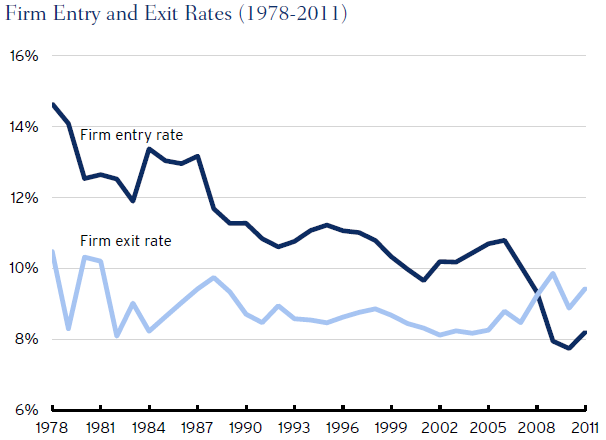
As I have pointed out in previous posts, the U.S. economy has become less entrepreneurial in recent years in the sense that there are now more firms going out of business than new firms going into business.
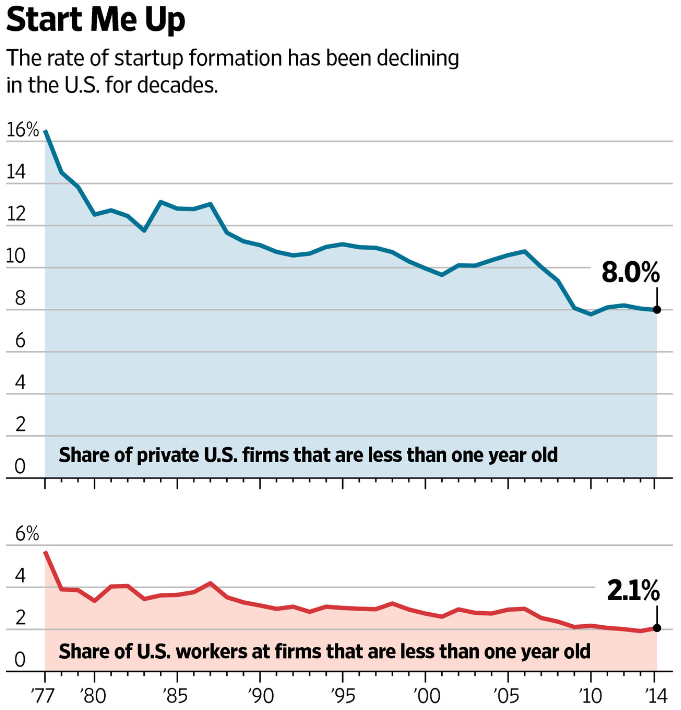
An article in yesterday’s Wall Street Journal has another way of looking at this.  The rate of startup formation has been declining in the U.S. for decades (as shown just below). It is obvious that figuring out how to boost entrepreneurship would do a lot to spur economic growth.

capture75
This can be accomplished with:

  • General growth measuresTax reform (lower marginal rates paid for by shrinking deductions), regulatory reform and simplification, maximum free trade to open markets, immigration reform to bring in more skilled workers, entitlement reforms to prevent a debt explosion.
  • Business tax incentives. Immediate write-off (i.e. expensing) of business investment. This encourages more investment by eliminating the need for depreciation over an arbitrary number of years. It is paid for by eliminating the deduction for interest expense to finance such investment.

Conclusion. Lots of voices are saying that technological innovation is slowing down and that only fiscal stimulus by the government can speed up growth.  Such pessimistic views will predominate unless the private sector is given the tools it needs to achieve growth in the most productive way.

Follow me on Twitter
Follow me on Facebook