The Key to Solving our Healthcare Cost Problem


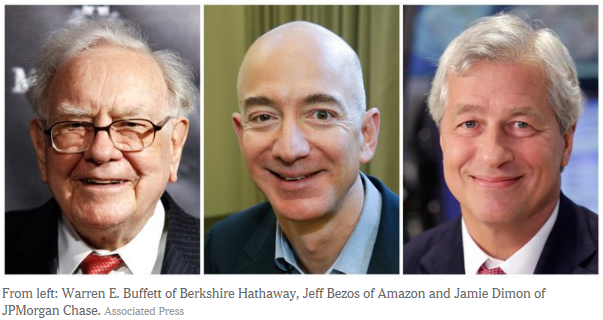
My last three posts: herehere, and here, are concerned with the high cost of American healthcare and how this is so closely tied in with our very large and badly out-of-control national debt. In particular, three giant American companies: Amazon, Berkshire Hathaway, and JP Morgan Chase are forming an independent healthcare company to try to hold down healthcare costs for their combined one million employees in the U.S.


Dr. Elizabeth Rosenthal, an MD and editor-in-chief of Kaiser Health News, points out that this new company may help its own members but end up hurting the rest of us:

  • Previous efforts along the same line by Safeway and Boeing have held down costs for the companies own employees but are too small scale to have had broader impact.
  • The new company, much larger in size, may be able to negotiate lower prices from labs and hospitals for its own members. But then these same labs and hospitals will charge more for everyone else.

Moreover, in general, employer based healthcare insurance has lots of problems:

  • It diminishes incentives to reduce costs by insulating workers from the full price of their benefits.
  • It discourages changes that could displease even a small number of workers, thereby creating incentives to minimize disruption.
  • The pervasiveness of employer health insurance makes it more difficult for individuals to buy health insurance on their own, thus discouraging entrepreneurship.

Conclusion. Given the inherent flaws in employer provided health insurance, it is unlikely that more innovation by individual companies, or groups of companies, will lead to an overall solution to the exorbitant cost of American healthcare.
The solution lies in a different direction: ending or at least modifying the ACA’s employer mandate.  See here for details.  More later!

National Debt and the Cost of Healthcare Go Hand in Hand


My last two posts, here and here, point out that:

  • The cost of employer-provided healthcare is going through the roof, now averaging $26,944 for a family of four
  • Medicare beneficiaries are now spending 44% of their average Social Security income on healthcare spending.

Yesterday we learned that three corporate behemoths: Amazon, Berkshire Hathaway and JPMorgan Chase will form an independent healthcare company to try to hold down healthcare costs for their combined one million employees in the U.S.


And last night, President Donald Trump, in his generally well-received State of the Union Address, failed to mention our nation’s biggest problem by far: our surging national debt.
And moreover, it is precisely the public cost of healthcare which is driving our debt.
Our country could soon be overwhelmed by a trifecta of huge costs:

  • The cost of healthcare for individual company employees and also for retirees.
  • The cost of healthcare subsidies paid by the federal government.
  • Our rapidly growing and badly out-of-control national debt.

Conclusion. Is it not exceedingly clear that our two polarized political parties must stop spending their time bickering about less important problems and come together to address our huge debt problem and the very high cost of healthcare which is driving it?

The Urgency of Reducing the Cost of American Healthcare


Just a few days ago I announced my candidacy in the Republican Primary for U.S. Senate against the incumbent Deb Fischer who is doing nothing to reduce our badly out-of-control national debt and, in fact, just voted to increase it by $1 trillion over the next decade.
It is the high cost of government spending for Medicare, Medicaid and the tax exemption for employer-provided care which is the main driver of federal debt.
But healthcare is also getting very, very expensive for American workers and retirees as well.  In my last post, I reported that:

  • A family of four paid $26,944 for healthcare expenses last year which was 44% of median family income of $59,039.

And now the Kaiser Family Foundation has reported that:

  • In 2013 a Medicare beneficiaries’ average out-of-pocket healthcare spending was 41% of their average per capita Social Security income. This will rise to 50% in 2030.

Conclusion.  American healthcare is expensive for workers, retirees and taxpayers. In other words, it is expensive all the way around, for everybody.  There isn’t a lot of slack left to give way.  The cost of healthcare will impoverish our whole country if we can’t get it under control.  Stay tuned for proposed solution.

The Outrageously High Cost of American Healthcare

On January 24 I announced my candidacy in the Republican Primary for U.S. Senate against the incumbent Deb Fischer who is doing nothing to reduce our badly out-of-control national debt and, in fact, just voted to increase it by $1 trillion over the next decade.
It is the high cost of government healthcare spending for Medicare, Medicaid and the tax exemption for employer-provided care which is the main driver of federal debt.


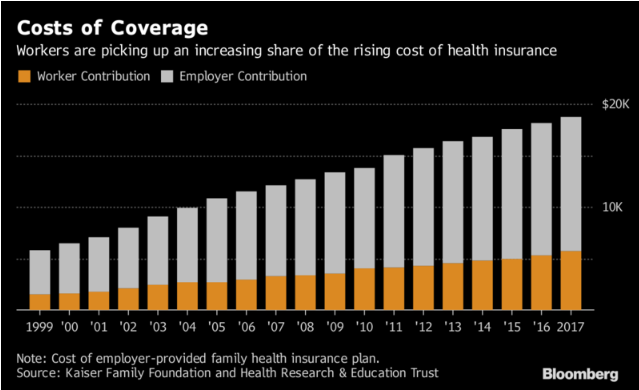
But now look at a recent report from Bloomberg Markets on the outrageously high cost of employer-provided health insurance for American workers:

  • The average worker paid $5,714 in 2017 out of a total cost of $18,764 for a family plan. Deductibles last year averaged $5,950 per individual and double that per family.
  • In the past five years insurance premiums increased by 19% while worker pay increased by 12% and inflation increased by just 6%.
  • A family of four paid $26,944 for healthcare expenses (including out-of-pocket) last year which was 44% of median household income of $59,039.
  • Health insurance premiums are up 11% in 2018.

Conclusion. I have been predicting a fiscal crisis in the relatively near future over federal debt. But we actually have an immediate crisis on our hands over the horrendous cost of employer-provided healthcare.

Why My Campaign for U.S. Senate Is Focused on the Debt Issue


Today I announced my candidacy in the 2018 Republican Primary for U.S. Senate against the incumbent Deb Fischer because she is doing nothing to reduce our national debt which is badly out-of-control. My announcement speech was completely focused on the magnitude of our debt problem and what I think can and should be done about it.


Several members of the press who covered the event asked why I didn’t talk about other issues as well.  My response to them:

  • The debt issue is why I am in the race, what clearly distinguishes me from Fischer, and where I think she is vulnerable.
  • Of course there are other important issues and I am willing to discuss them when asked.
  • But to bring up other issues on my own diminishes the fundamental importance of the debt issue.

Conclusion. I am an unconventional candidate. I am running more against the debt than I am running against Deb Fischer.  I have nothing against her.  I merely want to get our debt problem fixed before it does great damage to our country and she is standing in the way.

An Example of What High Debt Will Do to Our Country


Tomorrow morning I will officially announce as a candidate in the Republican Primary for the U.S. Senate seat now held by Deb Fischer, because she is making no effort to reduce our national debt which is badly out of control.
So I will be making a transition from blogger  to candidate . My posts will become shorter as I spend more time on campaign activities.


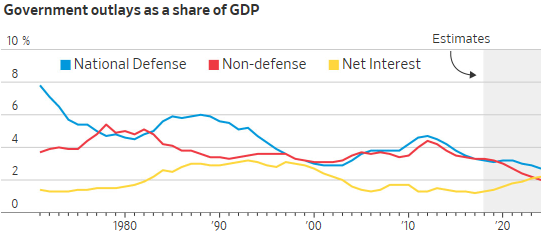
Today take a look at a WSJ article comparing outlays for defense, non-defense and net interest payments on our debt.  It shows how interest payments on our debt are likely to exceed spending on all discretionary non-defense programs by 2022.
Conclusion. This is a dire warning of how our spending priorities will become highly distorted if we are unable to shrink our debt.

Ignoring the National Debt Endangers Our Country


Here is the preliminary version of my campaign announcement, now scheduled for Wednesday, January 24, for the Nebraska Republican Primary for U.S. Senate:

“This may sound overly dramatic but if we ignore the debt much longer, it will endanger the future of our country.

This is exactly what the new tax law does, in spite of its otherwise good features, by increasing the debt by $1 trillion over the next decade.  And 51 Republican Senators voted for this new law, including Nebraska’s Deb Fischer who is running for reelection this year.  I am running for her seat to challenge her about our ballooning debt because she is doing nothing about it and has just voted to make it worse!

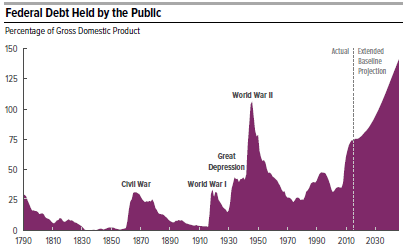
First of all, the chart below shows why our debt situation is so serious. It now sits at 77% of GDP (for the public part on which we pay interest), the highest since WWII, and is predicted by the Congressional Budget Office to keep getting steadily worse, hitting almost 100% of GDP by 2027.


Right now interest rates are so low, less than 2%, that our debt is almost “free” money.  But this cannot and will not last much longer.  Inflation has already started to increase and the Federal Reserve has started to raise interest rates.

Rising interest rates mean much higher interest payments on our debt. This will put an enormous strain on the federal budget, choking off spending for many of the things such as education, scientific and medical research, infrastructure and social programs which so enhance our quality of life.

And furthermore, these much higher interest payments on the debt will continue, and even grow worse, indefinitely into the future, placing a huge burden on future generations, our children and grandchildren.

The solution is to shrink our annual deficits ($668 billion in FY2017 and likely over $700 billion for 2018) down to a much more manageable level so that our debt will also shrink as a percentage of GDP.

I emphasize that this can be done in a sensible, non-disruptive way by simply curtailing spending increases in most government programs without actual budget cuts, and thereby reducing our huge annual deficits over a period of several years.

The Affordable Care Act expands access to healthcare (which is good!) but does nothing to control cost (which is bad!).  American healthcare needs major changes.  One way to do this is to abolish the employer mandate and migrate from employer provided health insurance to personal insurance with age-based, instead of income based, tax credits.  Medicaid can move to the same age-based (refundable) tax credit system. Also fix Medicare by making Medical Savings Accounts readily available for Medicare Advantage plans and then encouraging migration from regular Medicare to Medicare Advantage.

Such major changes as I have proposed above likely will be considered controversial.  However, which is better, to implement major changes in a rational, careful manner while there is time or rather to wait for a new fiscal crisis, much worse than the Financial Crisis of 2008, which will inevitably occur down the road if we continue to ignore the debt?

Summary. The U.S. has a horrendous debt problem which is getting worse all the time.  We badly need representatives in Congress who will stop ignoring our debt and make reducing it a very top priority.  This is why I am challenging Deb Fischer as she runs for reelection. “

Follow me on Twitter 
Follow me on Facebook 

Why We Cannot Wait to Fix the Debt


A Letter from Birmingham Jail   Why we cannot wait  Martin Luther King, Jr., April 16, 1963

Yesterday was Martin Luther King Day and every year at this time we are reminded of his eloquent letter from the Birmingham Jail, “Why we cannot wait,” written to some of his hesitant supporters in the Spring of 1963.
African-Americans were tired of waiting so long for equal rights in their own country.  On my own personal scale, I am so frustrated by the inability of our political system to address our massive debt problem, that I am getting organized to enter the 2018 Nebraska Republican Senate Primary against the incumbent Deb Fischer who has just voted (with the new tax law) to increase our debt by $1 trillion over the next decade.
Basically I am saying that our debt is so large and growing so fast that it will soon be out of control if we don’t take action to start reducing it very soon.


Consider:

  • The public debt (on which we pay interest) is now 77% of GDP, the highest since WWII, and projected by the Congressional Budget Office to keep getting steadily worse. It will grow by $11.5 trillion in just 10 years to almost 100% of GDP and will reach 150% of GDP, double the current level, by 2047, without major changes in current policy.
  • A fiscal crisis, much worse than the Financial Crisis of 2008, will occur long before 2047 if nothing is done to greatly shrink our annual deficits which are again rapidly approaching the trillion dollar per year level.
  • The new tax law increases deficits by an average of $100 billion per year, and therefore makes it that much harder to shrink them down substantially. It is imperative for the two parties, Democrats and Republicans, to work together to figure out how to do this.

Conclusion. Our national debt is so large and growing so fast that it is virtually out of control. We need prompt and fairly strong action to turn the situation around.  I have often discussed one major way to do this.

Follow me on Twitter 
Follow me on Facebook 

It Is Awfully Easy to Get Discouraged about Our Debt Problem


Six years ago I was a candidate for the Republican nomination for Nebraska’s Second District Congressional seat. I lost in the May 2012 Primary.  After the November 2012 national election I began writing this blog It Does Not Add Up focused on fiscal and economic issues, mainly our large and rapidly growing national debt. I have now been blogging on this issue for over five years and the debt problem is just getting worse and worse.  Here is where we are right now:

  • All 52 Republican Senators voted for the new tax law which, in spite of its beneficial tax reforms, adds $1 trillion to our debt over the next decade (after growth is taken into account).
  • The Congressional Budget Office projects our debt to grow by $11.5 over the next ten years. In FY2019, just one year from now, CBO projects the deficit will exceed  will exceed $1 trillion and equal 4.7% of GDP.  By 2047 federal debt will reach 150% of GDP, almost double the current 77%.

  • In our polarized Congress, Republicans insist on increasing defense spending, Democrats insist on increasing domestic spending and trying to put any limits on entitlement spending is very difficult. Republicans are willing to cut taxes but there is little enthusiasm for raising them.
  • The present stalemate will eventually lead to a new fiscal crisis, much worse than the Financial Crisis of 2008, without major changes in current policy. The thought of having to drastically cut many different spending programs in the middle of a huge fiscal crisis is horrifying.
  • Are there any alternatives? Calling a Constitutional Convention for balancing the budget, establishing term limits and/or limiting Congressional power (Convention of States), have created much interest but are long shots which may never happen.

Conclusion. Somehow or other we need to light a fire under enough members of Congress to persuade them to take our rapidly accumulating debt very seriously. Let me know (jackheidel@yahoo.com) if you are willing to work with me to do something along these lines!

Follow me on Twitter 
Follow me on Facebook 

Why Am I So Fixated on Our Debt Problem?


In a few days I expect to announce my candidacy for the Republican nomination for the U.S. Senate seat now held by Deb Fischer. She is running for reelection and apparently is quite popular in Nebraska.  But she has one huge liability as far as I’m concerned.  First of all, she is a big spender.  But now as well she has just voted for the new tax law which will increase our debt by $1 trillion over the next decade. In other words she is flagrantly guilty of ignoring our very serious debt problem even as it continues to get worse.


People sometimes ask me why I am so fixated on the debt.  After all, there are plenty of other important issues that we should be concerned about. The answer is that uncontrolled debt affects almost everything else government does because as interest rates increase, eventually interest payments on the debt will skyrocket.

  • Defense spending, so critical to our role as the world’s major superpower, which maintains peace and stability in the world, will be threatened.
  • Run-away inflation is likely to result from the buildup of the debt bubble and this will erode the economic security which is so important to our way of life.
  • The international standing of the dollar, so critical to our leadership role in the financial world, will be weakened.
  • Spending for programs such as education, research and infrastructure, so important to our quality of life, will be threatened.
  • By focusing so strongly on the debt issue, hopefully I will be able to persuade large numbers of people that I am really serious about taking strong action to address it effectively.

Conclusion. There are lots of issues which will come up on the campaign trail in a Senate race. But my campaign will be focused on our gigantic debt problem.  If we can’t get our debt under control, then our entire way of life is threatened.  It is that simple.

Follow me on Twitter 
Follow me on Facebook