America’s Most Serious Problem: Excessive and Growing Debt


I know that I repeat myself a lot. I am a fiscal conservative and social moderate.  This puts me in the middle of the political spectrum from left to right.  I support social welfare programs if they are legitimately helping the less fortunate among us.  I am especially supportive of programs for African-Americans because of the racial bias they experience.


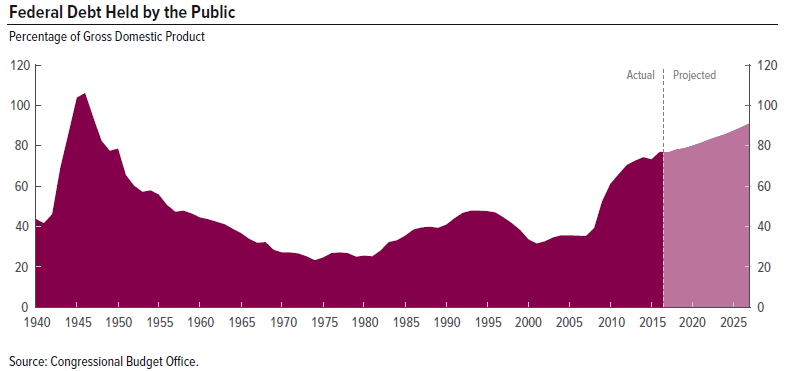
Unfortunately our national leaders have collectively lost a sense of fiscal responsibility in recent years.  Looking at the standard debt chart (above) produced by the Congressional Budget Office, it is clear that indifference to debt commenced under President Reagan and has waxed and waned ever since.  The debt has been growing especially fast ever since the Great Recession in 2008 and now stands at 77% of GDP, the highest since the end of WWII.  Shrinking the debt (as a percentage of GDP) is now America’s most urgent problem.


As I have discussed before, it is the entitlement programs of Social Security, Medicare and Medicaid, as well as interest payments on our increasing debt which will continue to worsen the debt problem in the coming years  without strong corrective action.
All entitlement programs need to be reformed to impose cost control. Right now the two healthcare bills in Congress propose that the funding mechanism for Medicaid be changed so that it will be on a fixed (federal) budget from now on, rather than be continued in its current open-ended form.
Medicare is an even more expensive program than Medicaid.  It would be better to fix both of these programs at the same time, but it is better to fix Medicaid alone than to do nothing at all.
It would be even better to replace our employer provided healthcare system with a uniform, but limited, health insurance tax credit for all (including for the self-employed) and to make all of these major changes at the same time.  This would be the fairest way to proceed.

Conclusion. The current GOP plan to curtail healthcare costs could be much improved.  It is only a small step in the right direction.

Follow me on Twitter 
Follow me on Facebook 
The Need to Put Medicaid on a Budget II. Our Growing Debt


Most of the controversy generated by the healthcare bill passed by the House, and the one now being considered by the Senate, concerns the way Medicaid is funded. The current system whereby states are reimbursed by the federal government for a percentage (national average 53%) of their Medicaid expenses would be replaced by putting the federal contribution on a strict per-capita basis, indexed to the annual rate of inflation.
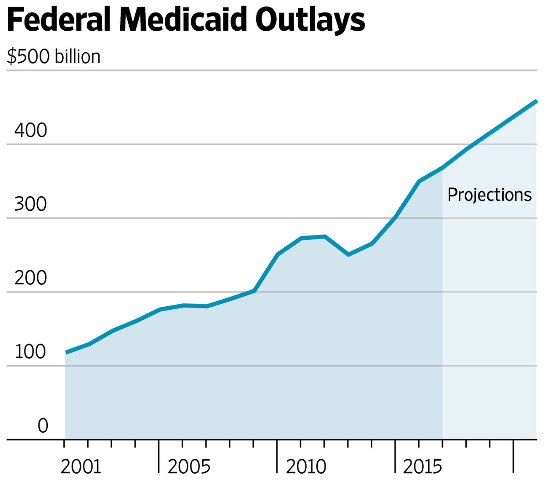
Medicaid is a vast program now serving 73 million low-income and disabled Americans and is doing a good job especially for the elderly and the disabled with special needs. But it costs the federal government nearly $400 billion per year and the cost is growing rapidly.  It is essential to get open-ended Medicaid spending under much better control and one good way to do this is to put the federal contribution on a fixed budget.


The Congressional Budget Office has just issued its latest Budget and Economic Outlook report.  It shows the ever-worsening fiscal condition for the U.S., unless current policy is changed.


For example:

  • The deficit for 2017 is predicted to be $693 billion or 3.6% of GDP.
  • Deficits will grow dramatically over the next decade with trillion dollar deficits returning by 2022.
  • Debt held by the public (on which interest is paid) will grow by $11.2 trillion between now and 2027, from $14.3 trillion today.
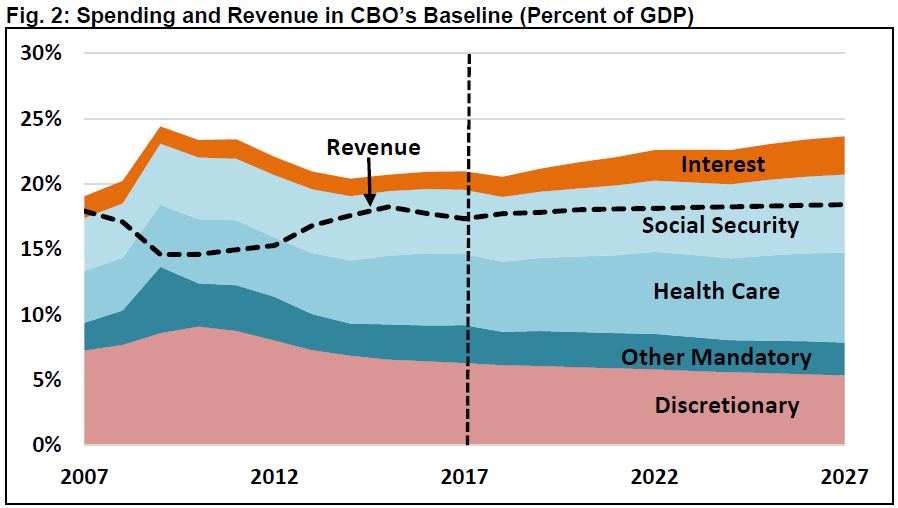
  • Spending will grow from 20.9 percent of GDP in 2016 to 23.6 percent in 2027, while revenues will rise from 17.8 percent in 2016 to 18.4 percent by 2027.
  • The vast majority of spending growth over the next decade (83%) is the result of rising costs for health care, Social Security, and interest on the debt.

    Conclusion.  
    The national debt is growing much too fast. The only way to turn this dangerous situation around is to reform all entitlement programs, including Medicaid, to get their costs under much better control.

Follow me on Twitter: https://twitter.com/jack_heidel
Follow me on Facebook: https://www.facebook.com/jack.heidel.3

The Need to Put Medicaid on a Budget

The GOP healthcare plan, both the House version and the Senate version, are highly imperfect. Yet they each do one thing which is badly needed. They put Medicaid on a budget. The current open-ended Medicaid program, whereby each state is reimbursed by the federal government for a percentage of its costs (the average is 53%), would be replaced by an annual per-capita payment which would increase only at the rate of inflation. It is estimated that the new per-capita budget would reduce federal Medicaid payments by about 25% after 10 years.


In order to get the federal debt under control, all three major entitlement programs, Social Security, Medicare and Medicaid, must be reined in and the current GOP plan would start doing this for Medicaid.
Reining in spending like this will force states to alter the way they regulate and administer Medicaid and the New York Times columnist Ron Lieber points out some of the challenges which will arise if Medicaid has to operate more efficiently:

Nursing homes. One third of people who turn 65 will eventually end up in a nursing home. Furthermore, 62% of nursing home residents cannot pay for nursing homes on their own. The average annual cost of a semi=private room is $82,000.
Home and community-based care. Medicaid is required to pay for nursing homes and may also pay for home and community-based care which is much less expensive and lets seniors stay in their own homes.
Optional services for low-income people and the disabled. Optional services besides long-term home care include dental care for adults, therapy for disabled children at school, prosthetic limbs and prescription drugs.

Conclusion. Changing Medicaid from open-ended funding to a strict federal budget which grows at the rate of inflation will put a large burden on state Medicaid administrators and require some difficult tradeoffs to control spending. But this is absolutely essential as a first step towards controlling the rapid increase of entitlement spending.

Follow me on Twitter:
Follow me on Facebook:

Can the GOP Produce on Healthcare?


The House of Representatives, after much struggle, was finally able to pass a healthcare bill, The American Health Care Act.  Now it’s the Senate’s turn to pass its own version and it, too, is turning out to be a struggle.


The healthcare policy expert, Avik Roy, considers the Senate bill to be a huge step forward:


  • Medicaid is finally put on a budget with annual increases in spending, starting in 2025, tied to the overall rate of inflation. In return, states will gain substantial latitude to use funds more effectively and efficiently.
  • Tax Credits in the Senate bill are means adjusted and will also encourage younger people to enroll for coverage. This is an improvement over the AHCA.
  • Expanded coverage. Mr. Roy predicts that passage of the Senate bill would increase (not decrease as the CBO predicts) the number of Americans with health insurance five years from now. This will result because the near poor in states like Texas and Florida, which have not expanded Medicaid, will be eligible for the new means-tested tax credits.
  • The 10th Amendment is strengthened because so much more authority for regulating healthcare insurance is transferred to the states. This represents huge progress because states are so much more fiscally responsible than the federal government (they have to balance their budgets)!


Conclusion. There are certainly many imperfections in the Senate bill.  It does nothing to limit tax credits for employer-sponsored insurance.  This is sorely needed to put the overall cost of American healthcare on a sustainable course.  It does nothing to help low income people who struggle with high deductibles (for example, by helping to set up Health Savings Accounts). It also does nothing to rein in the cost of Medicare, such as by introducing means adjusted premiums and allowing Medicare to negotiate lower drug prices.
Nevertheless it is a huge step forward in controlling excessive healthcare costs as well as expanding health insurance coverage to more Americans in a fiscally responsible way.

Follow me on Twitter: https://twitter.com/jack_heidel
Follow me on Facebook: https://www.facebook.com/jack.heidel.3


Is the U.S. Military Big Enough?


An Op Ed in the Wall Street Journal recently by former vice president Dick Cheney and his daughter Liz, “Congress and Obama Depleted the Military,” argues that the Trump budget request of $603 billion for Defense for the 2017 – 2018 FY is not nearly enough to build an adequate U.S. military force.  Furthermore, the Cheneys argue that the Budget Control Act of 2011, which set up the ten year sequestration plan for discretionary budget items, should be repealed.
According to the Cheneys, “Providing for the defense of America is the most sacred constitutional obligation of the U.S. Congress.  If Congress fails in this, no balanced budget, no health-care reform, no tax reform, no entitlement reform will matter.”


The Cheneys are correct that the defense of America is the highest priority of our federal government.  But fiscal responsibility is also a high priority, especially when our public debt (on which we pay interest) now stands at 77% of GDP, the largest it has been since the end of WWII, and rising.
So the real question is: how large should our defense budget be to provide for a secure defense of our national interests?  A recent article in the New York Times  points out that:

  • Our current defense budget of $596 billion is more than the total of the next seven highest defense budgets combined.
  • We have 1.3 million active duty troops with 200,000 deployed in more than 170 countries.
  • The U.S. has 2,200 fighter jets, 193 of which are fifth generation, F-35 Lightening II aircraft.
  • The U.S. Navy has 275 surface ships and submarines, including 11 aircraft carriers, far more than any other single country.

Conclusion. The current U.S. military force is large and diversified. In fact there is strong evidence that it could operate more efficiently.  It is more than adequate to defend our crucial national interests.

Follow me on Twitter 
Follow me on Facebook 

Redesigning the American Health Care System to Lower its Cost II. Medicare


By far the biggest problem our country faces is long term debt. The public debt (on which we pay interest) is now 77% of GDP, the highest since the end of WWII, and steadily growing worse.  The fundamental driver of our debt problem is the cost of healthcare, public and private.
My last post describes two major reforms which are needed to get the cost of healthcare under control. The first, and most important, is to replace the tax exemption for employer provided care by a universal tax credit limited to the cost of catastrophic health insurance (with a high deductible).  This fundamental change would be accompanied by allowing tax preferred Health Savings Accounts for use in paying routine medical expenses.  The purpose here is to make all of us more responsible for the cost of our own healthcare.


The second big change which is needed is a

  • Redesign of Medicare. Medicare is currently being subsidized by the federal government at a net cost (after FICA taxes and premiums paid) of over $400 billion per year, and this cost will continue to increase rapidly without a change in policy.

The best way to reform Medicare is to first modify the tax exemption for employer provided care, as mentioned above, and then gradually migrate Medicare onto this new system.  However, in the meantime there are more direct ways to make Medicare less expensive:

  • Community-rated premiums. Medicare premiums should not vary based on age or health status but they should vary based on an enrollee’s income.
  • Defined contributions and beneficiary choice. Enrollees would apply the government contribution to their choice among competing options for Medicare coverage.
  • Facilitating healthcare savings. Tax-preferred Health Savings Accounts would be made available to Medicare enrollees to pay for routine medical expenses up to a deductible amount.

Conclusion. The current Medicare program is rapidly becoming too expensive for the federal government to fund with general tax revenues. A few simple and sensible changes will put Medicare on a sustainable course.

Follow me on Twitter 
Follow me on Facebook 


Redesigning the American Health Care System to Lower its Cost


Recently I have been discussing the high cost of American healthcare and the urgent need to lower this cost.  The current GOP plan, the American Health Care Act, partially addresses this problem by reforming the funding mechanism for Medicaid.
But much more needs to be done.  All Americans will have to be involved in the solution and not just the poor. There are two main facets to the problem, neither of which is addressed by the AHCA:

  • The tax exemption for employer provided health insurance should be replaced by a universal (and refundable) tax credit limited to the cost of catastrophic health insurance (with a high deductible).
  • Medicare needs to be redesigned so that well-off retirees pay for more of their health care. Details to follow soon.

The U.S. spends 18% of GDP on healthcare, public and private, about $3 trillion per year, and almost twice as much per capita as any other developed country. Furthermore this already enormous relative cost will continue to get worse without major changes in policy.
The main reason for the huge cost is that free market forces are not operating properly.  More specifically, it is because most of us, as individual healthcare consumers, do not have enough “skin in the game.”


This conundrum is caused by our third party health insurance system whereby most of us receive health insurance through our employers.  This gives us as individuals little incentive to pay attention to the cost of our own care and to try to keep these costs as low as possible.
A good way to fix this problem is to limit the exemption for employer provided insurance to the cost of catastrophic care with a high deductible.  Routine medical expenses would be handled through individual (tax preferred) health savings accounts. The self-employed can be included by granting them a (refundable) tax credit also equivalent to the cost of catastrophic care.

Conclusion. Americans are fortunate to have access to high quality health care. But we are paying unsustainably high prices for it.  If we cannot figure out a rational and sensible solution to this problem, our healthcare system will soon collapse from its own deadweight and we will end up with a tightly controlled, government run, single payer system.

Follow me on Twitter 
Follow me on Facebook 

The Fundamental Flaw in the GOP Healthcare Plan


The Democratic Affordable Care Act expands access to health insurance for millions of Americans. This is its great virtue.  However it does nothing to rein in overall costs  which is a huge deficiency.
The Republican American Health Care Act, passed by the House and being considered by the Senate, has both strengths and weaknesses, as I have previously discussed.   Primarily, it puts Medicaid on a budget by block-granting it to the states with sufficient flexibility for the states to operate it much more efficiently.  This needs to be done and is a big money saver.
The major problem with the AHCA is that all cost savings come from just one program, namely Medicaid, and this is a program for people with low incomes.  Simple fairness, as well as the need for much bigger savings, dictates that financially well-off people should also have to share in solving the healthcare cost problem. This can and should be done in two different ways:

  • The tax exemption for employer provided health insurance should be replaced with a universal (and refundable) tax credit sufficient to pay for catastrophic health insurance (with a high deductible). Also tax preferred Health Savings Accounts for all can be subsidized based on income. The purpose here is to force all of us to pay attention to, and take responsibility for, the cost of our own healthcare.
  • Redesign of Medicare. Medicare is already being subsidized by the federal government at a net cost (after FICA taxes and premiums paid) of over $400 billion per year, and this overall cost will continue to increase as the number of retirees increases and the net subsidy per retiree also increases (see chart). Details of possible redesign will be discussed later.

Conclusion. The ACA needs to be improved in many ways to get the cost of healthcare under control. The AHCA bill currently being considered by Congress needs major changes so that all Americans, rich and poor and in between, are part of the solution of our healthcare cost problem.

Follow me on Twitter 
Follow me on Facebook 

The Urgent Need to Lower the Cost of American Healthcare


Our country faces many serious problems (terrorism, global warming, income inequality, etc.) but the most serious of all in the long run is our rapidly growing national debt and the inability (unwillingness?) of our national leaders to address it.
Furthermore, the fundamental driver of our debt problem is the cost of healthcare, public and private.  The Affordable Care Act, established in 2010, expands access to healthcare but does not address the cost problem (see chart below).


I have previously discussed how to repair the ACA to make it more cost efficient, by, for example, repealing both the individual and employer mandates, establishing a universal (and refundable) tax credit for catastrophic care, migrating Medicare and Medicaid to the new universal system, etc.
But there are lots of other things, less political contentious, that we can do as well.  I have just read an astonishing new book, “An American Sickness” by Elizabeth Rosenthal, an MD who works as a healthcare journalist, which provides a vivid and compelling description of our overly expensive and dysfunctional healthcare system. According to Ms. Rosenthal here are a few of the things we could do collectively to get costs under much better control:

  • Reform malpractice insurance to place limits on noneconomic damages.
  • Breakup oversize hospital conglomerates so that hospitals don’t have such huge monopoly pricing power.
  • State insurance regulators could do a much better job of enforcing transparency and accuracy for provider directories, in-network and out-network fees, etc.
  • Insurance companies could do a better job on reference (i.e. standardized) pricing, encouraging bundling of services, tying the size of co-payments to a procedure’s medical worth and urgency, etc.
  • Congress should permit Medicare to negotiate national drug prices.

Conclusion. Repairing the ACA, as is now being done in Congress, will go a long way towards much better cost control of healthcare. But there are many other common sense steps which can also be taken towards this goal.

Follow me on Twitter 
Follow me on Facebook 
 

What Should the Federal Government Do about Infrastructure?


President Trump has proposed spending $1 trillion over the next decade on public and private investment in infrastructure. The CATO Institute’s Ryan Bourne has just published an excellent analysis of the whole issue.  Here are the highlights:

  • Any new federal spending must take into account that federal public debt now stands at 77% of GDP and is likely to keep rising given the demographic pressures on entitlement spending. This means that the long-term outlook for public finances is dire.
  • With a current low unemployment rate of 4.4% and a high of 6 million job openings, the economy does not need more government stimulus at the present time.

  • Bridge quality has improved substantially since 1990 (see chart) although roadway congestion has become more acute (second chart). Rail and transit systems appear to be the main areas with observable deterioration.

  • The difference between state highways (which are in good condition), local roads (which are in fair condition) and transit systems (which are in poor condition) is simple: state road maintenance is paid almost entirely out of user fees (gasoline taxes), local road maintenance is paid for by a combination of taxes and user fees (motor vehicle registrations and parking meters) while transit maintenance is paid for almost entirely out of taxes.

The above indicates that the following policy framework should be followed:

  • Privatize areas where government is not needed such as airports, air traffic control systems and railways (Amtrak).
  • Localize decision making as far as possible such as decentralizing responsibility for transportation infrastructure back to the states.
  • Remove payment barriers for charging users. This could reduce the cost of capital investment required for highway systems by 30%.
  • Level the playing field for private sector funding. Currently interest income received for investing in municipal bonds is tax free which is not the case for private debt.

Conclusion. “Rather than imposing further costs on taxpayers, the Trump Administration should prioritize localizing decision making, removing regulatory barriers to private investment, encouraging use of user fees and removing tax exemptions for public investment.”

Follow me on Twitter 
Follow me on Facebook