Why the U.S. Needs True Health Care Reform


The Affordable Care Act has improved access to healthcare by already enrolling over 7 million Americans who were previously uninsured.  It is estimated that there will be a total of 20 million new enrollees by the end of this decade.
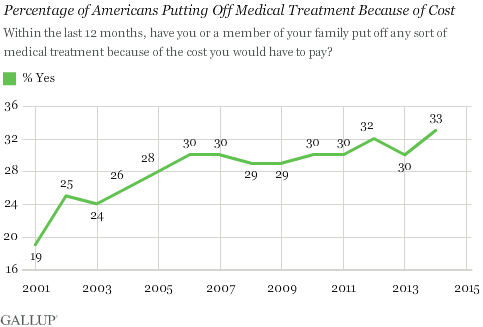
CaptureBut as the above chart from a recent Gallup survey indicates, the cost of healthcare is now a big barrier for an increasing number of people with health insurance.
The University of Chicago economist, Casey Mulligan, discusses the cost issue in a recent Wall Street Journal article “The Myth of ObamaCare’s Affordability” as well as in a new book.  He makes the following points:

  • Although the ACA helps specific populations by giving them a bigger piece of the economic pie, the law diminishes the pie itself by reducing the amount that American’s work and making their work less productive.
  • 35 million men and women currently work for employers who don’t offer health insurance. These tend to be small and midsize businesses with lower paid employees. The result of penalizing businesses for hiring and expanding will be less hiring and expanding.
  • The “29er” phenomenon is a good example of how the law harms productivity. If a business has 50 or more employees who work over 30 hours a week, it is required to offer health insurance. Many employers have thus adopted 29-hour work schedules which lessens overall productivity.
  • Mr. Mulligan estimates that the ACA’s long-term impact will include about 3% less weekly employment, 2% less GDP and 2% less labor income. He also claims that these effects will be visible and obvious in just a few years by 2017!
  • The ACA is thus weakening the economy. For the large number of people who continue to pay for their own healthcare, healthcare is now less affordable.

Conclusion: we need true healthcare reform which addresses cost as well as access and this can be achieved by fixing Obamacare.  It is not necessary to repeal it.  The Manhattan Institute’s Avik Roy has developed a plan to do this: ”Transcending Obamacare.”  Mr. Roy’s Plan would keep the exchanges, end both the individual and employer mandates, and migrate both the Medicare and Medicaid programs onto the exchanges over time.  These features will greatly reduce the cost of American healthcare.  Check it out and see for yourself!

What Happens When We All Live to 100?


This is the title of an article in the current issue of Atlantic. Of course, it is a rhetorical question, but it raises a very serious issue.  There are 43 million Americans age 65 or older today and this number is expected to reach 108 million by 2050.  How will society cope with so many more senior citizens?
CaptureThis blog is concerned with the most critical fiscal and economic problems facing our country.  The biggest fiscal problem we have is how to pay for the three major entitlement programs: Social Security, Medicare and Medicaid.  Social Security can be shored up with small adjustments to either the benefits formula or by raising taxes a little bit.  Medicaid can be kept under control by block-granting the program to the states.  But Medicare is a much bigger problem.
Capture1The cost of healthcare, both public and private, is rising rapidly as shown in the above chart from the New York Times.  We badly need a new approach to control costs and Avik Roy from the Manhattan Institute has given us such a plan “Transcending Obamacare: A Patient-Centered Plan for Near-Universal Coverage and Permanent Fiscal Solvency.”
The problem is that, as Mr. Roy explains, “by creating a universal, single-payer health care program for every American over 65, regardless of financial or medical need, the drafters of Medicare made the program extremely difficult to reform.”  But now we have to reform it because the costs are becoming so huge.  How do we do it?
First of all, Mr. Roy’s plan keeps the exchanges created by the Affordable Care Act and turns them all into state-based exchanges.  It also eliminates both the individual and employer mandates, replacing these mandates with financial incentives.
Mr. Roy’s core Medicare reform is very simple.  The plan increases the Medicare eligibility age by four months each year.  The result is to preserve Medicare for current retirees, and to maintain future retirees – in the early years of their retirement – on their exchange-based or employer-sponsored health plans.  In other words, retirees will gradually be migrated to the same system, with the same level of subsidy, as for working people.
Everyone, workers and retirees alike, will be treated the same. Not only is this an eminently fair system, it insures that Medicare remains affordable, for both retirees and the whole country.

Why I Support Jim Jenkins for the U.S. Senate from Nebraska


I have been writing this blog for almost two years because of my great concern about the direction our country is headed on fundamental fiscal and economic issues. Federal spending has been out of control for over thirty years and the situation is getting progressively worse.  Our national debt is over $17 trillion and growing at a rate of $500 billion per year.  And it will soon be growing much faster than this if we don’t make big changes.  Economic growth has been stuck at the anemic rate of 2.2% of GDP ever since the end of the Great Recession over five years ago.
Our national leaders are simply not doing the job they were elected for.  Democrats blame the Republicans and Republicans blame the Democrats but excuses are not good enough.  We need people in Washington who can figure out how to navigate within the system and actually find solutions to our very serious problems.
CaptureI believe that Jim Jenkins, a registered independent from Callaway, is the best qualified candidate to do what needs to be done.  Check out his website, Jenkins for Senate, and decide for yourself.  Here are a few of his views on important issues:

  • Fixing the Debt. Jim supports the recommendations of the Simpson-Bowles Commission which calls for dramatically cutting federal spending especially for entitlements and also raising taxes if necessary in order to drastically shrink our annual deficits.
  • Tax Reform. Jim supports lower tax rates achieved by eliminating many of the tax expenditures (credits, deductions and exclusions) embedded in the code. This is what is needed to boost economic growth.
  • Affordable Care Act. Jim believes that the ACA has many rough edges but that it is possible to fix them rather than repealing it and starting over.
  • Immigration Reform. Jim supports comprehensive immigration reform which includes securing our borders but at the same time expanding the number of guest worker visas to meet the needs of business and agriculture.
  • Veterans Administration. Jim supports setting up a plan to enable veterans to obtain medical care from health professionals within their own communities.

Compare these common sense views with the far more ideological positions of the other candidates in this race. I think that you will agree with me that Jim Jenkins is the person we want representing us in Washington!

Our Dire Fiscal Situation I. The Facts

Capture

Take a look at the front page of a new report from the Congressional Budget Office, “The 2013 Long-Term Budget Outlook”.  It shows very clearly the huge fiscal mess confronting our country in the near future.
First of all, our national debt has almost doubled as a percentage of GDP in the last five years, from about 38% of GDP at the end of 2008 to 73% today.  Although the debt is actually projected to dip to 68% of GDP in 2018, it then begins a steady climb because of increasing interest costs as well as increasing spending on Social Security and government healthcare programs (Medicare, Medicaid and the Affordable Care Act).  The debt will be back to 71% of GDP by 2023 and then climb rapidly to about 100% of GDP by 2038.
Notice from the graph that federal tax revenues have just about recovered from the recession and will soon level off at their historical level of about 19.5% of GDP.  But federal spending will resume a steady climb, reaching 26% of GDP by 2038.  As the gap between revenue and spending gets wider and wider, the national debt grows faster and faster.  This is the enormous fiscal problem we are faced with in the next 25 years.   The worse it gets the harder it becomes to turn around.  It is imperative to address this problem without delay.
In order to reduce the debt from its current level of 73% of GDP down to the historical average of 38% by 2023, Congress would have to pass an additional $4 trillion in spending cuts or tax increases over the next decade.  The only way such enormous savings can be achieved is by reining in entitlement spending: Social Security, Medicare, Medicaid and ACA.  I will outline one way to do this in my next post!