The Major Challenges Facing the U. S. II. National Debt


My last post, “The Major Challenges Facing the United States,” came to the conclusion that, while the U.S. has many big problems to address, our national debt is the biggest problem of all, because it will be so hard to deal with through the political process.
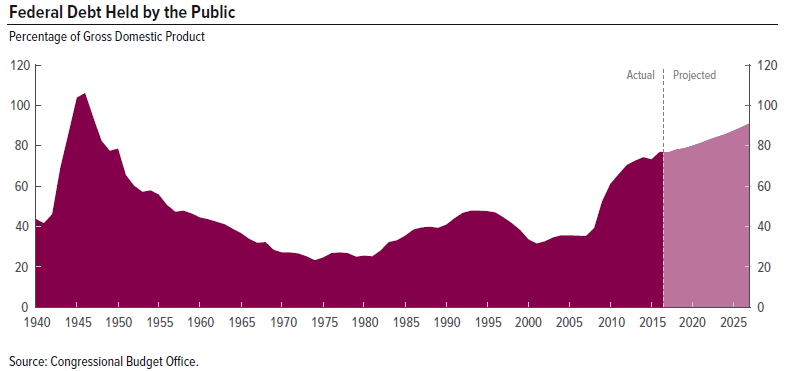
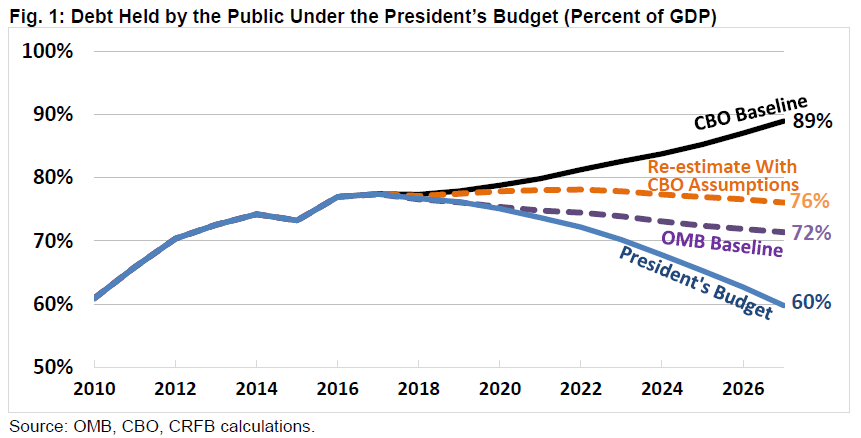
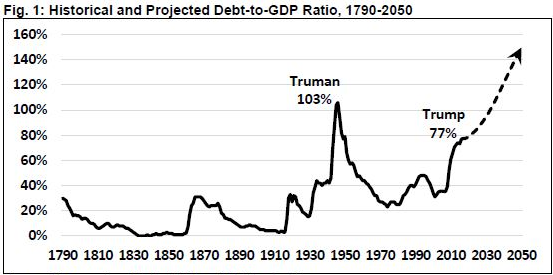
Our total national debt is now $19.9 trillion. The so-called public debt, on which we pay interest, is $15 trillion, or 77% of GDP, the highest it has been since right after WWII.  Furthermore it is predicted by the Congressional Budget Office to keep getting steadily worse, reaching 90% of GDP by 2025 and 150% of GDP by 2047 unless current policy is substantially changed.
Right now our debt is almost “free” money since interest rates are so low.  But when interest rates return to more normal levels, interest payments on the debt will skyrocket by hundreds of billions of dollars per year, likely leading to a new fiscal crisis, much worse than the Financial Crisis of 2008.
The only sane solution to this humongous problem is to start shrinking our annual deficits, this year at about $685 billion, down close to zero over a period of several years.  This will require a painful combination of spending curtailments and perhaps some tax increases as well.
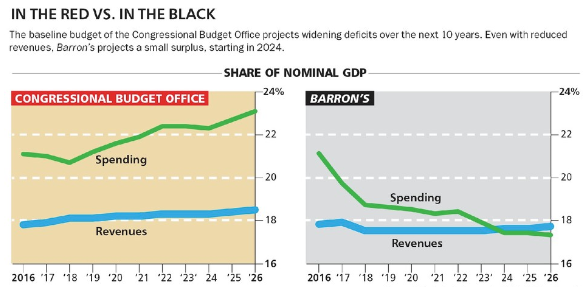

One possible way to accomplish this herculean task has been laid out by Barron’s economic journalist Gene Epstein, see here and here.  Mr. Epstein’s plan would balance the budget in ten years by decreasing projected spending by $8.6 trillion, with 60% of spending curtailments coming from the entitlement programs of Social Security, Medicare and Medicaid and the rest from both military and domestic discretionary programs.
It needs to be strongly emphasized that under the Epstein plan spending would not actually decrease from one year to the next, but would rather grow at a slower rate, from $3.9 trillion in 2016 to $4.7 trillion in 2026.  His plan would decrease the public debt from 77% of GDP today to 58% in 2026.

Conclusion. The U.S. faces the very unpleasant problem of excessive debt which will just keep getting worse and worse without making some relatively unpleasant adjustments in the way that the federal government spends money. The sooner we get started in this process the better off we will be.

Follow me on Twitter 
Follow me on Facebook 

How to Achieve Sensible Tax Reform


Experts across the political spectrum agree that the U.S. tax code is a huge mess and needs to be reformed as well as simplified.  It is also generally accepted that lower tax rates will lead to faster economic growth.
As Congress turns its attention to tax reform, Senate Democrats have stated the basic principles which they would like to see included in any changes which are made:

  • Increase the wages of working families. This could be accomplished by lowering tax rates for all individuals across the board, paid for by eliminating (or at least shrinking) many of the personal deductions in the tax code. The approximately two thirds of all taxpayers who do not itemize deductions would then receive a tax cut, equivalent to a wage increase.
  • Promote domestic investment and improve middle class job growth. Lower tax rates will give businesses and entrepreneurs a bigger incentive to invest in business expansion and therefore grow the economy faster and create more new jobs.

  • Modernize our outdated business and international tax system. Our corporate tax rate at 35% is the highest in the developed world and, at the same time, produces below average revenue (see chart). Another reform would be to adopt business expensing (immediate tax write-off for new investment). Again, all such changes should be paid for by eliminating loopholes and shrinking deductions.
  • Any rewrite of the tax code must be deficit neutral. As important and valuable as tax reform is, it has to take into account our country’s most fundamental problem: our huge and rapidly growing national debt and therefore end up being deficit neutral overall.

Conclusion. The above principles, stated by the Senate Democrats, represent a sound approach to reforming the U.S. tax system. I hope that the Republicans are willing to recognize the validity of these proposals and include the Democrats in developing a bipartisan tax reform plan.

Follow me on Twitter 
Follow me on Facebook 

The Democrats and the Economy II. A Path Forward


On Monday the Democratic Congressional leadership held a rally in rural Berryville, Virginia. They laid out a program designed to appeal to the middle class and blue-collar workers who voted for Donald Trump.  However many of their proposals involve expensive government programs and therefore would add significantly to the national debt.


What is needed is a greater emphasis on free-market ways of helping middle- and low-income workers such as:

  • Increasing basic economic growth which has stalled to a relatively slow 2% per year of GDP since the end of the Great Recession in June 2009. For example:
  • Revenue neutral tax reform, lowering rates for both individuals and corporations, paid for by closing loopholes and shrinking deductions, would have many benefits. It would stimulate business investment, create new demand by lowering the taxes paid by the approximately 2/3 of taxpayers who do not itemize deductions, and provide an incentive for multinational corporations to bring their foreign profits back to the U.S. for reinvestment.
  • Targeted deregulation of the financial sector by exempting main street banks from the onerous requirements of the Dodd-Frank Act would enable these smaller banks to lend more money to small businesses.
  • Fundamental healthcare reform to lower costs from the current 18% of GDP to the approximate 12% average of other developed countries. This would save the American economy $1 trillion annually which could be spent far more productively. The Democrats are on the right track here by refusing to accept Republican half measures.
  • Improve educational opportunities such as early childhood education for low-income families, expanded career education and job training in high school and community colleges, and more emphasis on income-based repayment for student college debt. There would be some cost involved here.
  • Modest increase in the national minimum wage from the current level of $7.25 per hour to perhaps $10 per hour and then index it to inflation going forward. The Democratic proposal for a national $15 per hour minimum wage would put too many people out of work.

Conclusion. This collection of proposals involves both Democratic and Republican ideas and should be implementable with a bipartisan effort.

Follow me on Twitter 
Follow me on Facebook 


It’s Time for a Bipartisan Approach to Healthcare Reform


The Affordable Care Act was passed by a Democratic Congress in 2010 with no Republican support. It expands access to healthcare but does nothing to control costs which have now reached 18% of GDP and climbing.
The current Republican Senate bill to replace the ACA does attempt to control costs but is unable to attract enough support to pass.
The problem is to achieve both broad access and much lower costs at the same time.  In general, Democrats prefer a single payer system while Republicans want to retain a free market approach.  So compromise will be required.


For example:

  • The tax exemption for employer provided health insurance should be replaced by a universal (and refundable) tax credit for all limited to the cost of catastrophic health insurance (with a high deductible). This will preserve expanded access as well as requiring everyone to pay attention to costs.
  • Tax preferred health savings accounts for routine healthcare expenses should be authorized and further subsidized for low-income families through the ACA exchanges.

  • Medicaid (for poverty-level families) should be put on a fixed federal budget to control runaway costs. States should be given much greater flexibility to direct resources to those with the greatest needs.
  • Redesign of Medicare. Medicare is currently being subsidized by the federal government (after FICA taxes and premiums paid) at over $400 billion per year.  Introducing a defined contribution element into this single payer program will help to hold down costs.

  • Pre-existing Conditions can be covered with suitable enrollment windows and state-run high-risk pools.

Conclusion. The ACA has achieved nearly universal access to healthcare in the U.S. But costs continue to rise sharply.  A universal tax credit combined with health savings accounts for the private market combined with a defined contribution single payer Medicare system has a good chance of getting overall healthcare costs under much better control.

Follow me on Twitter 
Follow me on Facebook 

Time to Start Over on Healthcare Reform


The Affordable Care Act, established in 2010, greatly expanded access to healthcare in the U.S. However, in spite of its name, it has done nothing to control the rapidly increasing cost of healthcare which is the core of our debt problem.


The new Senate plan, struggling to gain enough support to pass, puts Medicaid on a budget but doesn’t even attempt to address wider aspects of the healthcare cost problem.
A wider approach is the best way to proceed and perhaps now it is the only way to succeed in getting something done. Mr. Peter Suderman, who writes for Reason magazine, proposes several principles for a new approach:

  • Work for broader coverage but not necessarily universal coverage. This allows focusing on other important features such as:
  • Unification, not fragmentation, is what should be emphasized. Medicare and Medicaid are paid for directly by the government. Employer provided coverage, subsidized through the tax code and costing $250 billion per year, is the biggest problem in the U.S. healthcare system. It incentivizes employers to provide ever more generous insurance while insulating individuals from the true cost of care. It discourages job switching and entrepreneurship. Medicare ends up paying out far more than individuals have paid in.
  • Health insurance coverage is not the same as healthcare. For non-catastrophic, non-emergency expenses, affordability should be emphasized, rather than subsidies. Health savings accounts are a good way to accomplish this.
  • Focus on government assistance for the poorest and sickest. This means upgrading Medicaid, and coverage for pre-existing conditions, at the same time as putting Medicaid, Medicare and employer provided care all on a fixed, but reasonable, budget.

Conclusion. The cost of American healthcare is a huge problem. Hopefully the Senate will begin to address this fundamental problem as it struggles to pass a healthcare reform bill.

Follow me on Twitter 
Follow me on Facebook 


America’s Most Serious Problem: Excessive and Growing Debt


I know that I repeat myself a lot. I am a fiscal conservative and social moderate.  This puts me in the middle of the political spectrum from left to right.  I support social welfare programs if they are legitimately helping the less fortunate among us.  I am especially supportive of programs for African-Americans because of the racial bias they experience.


Unfortunately our national leaders have collectively lost a sense of fiscal responsibility in recent years.  Looking at the standard debt chart (above) produced by the Congressional Budget Office, it is clear that indifference to debt commenced under President Reagan and has waxed and waned ever since.  The debt has been growing especially fast ever since the Great Recession in 2008 and now stands at 77% of GDP, the highest since the end of WWII.  Shrinking the debt (as a percentage of GDP) is now America’s most urgent problem.


As I have discussed before, it is the entitlement programs of Social Security, Medicare and Medicaid, as well as interest payments on our increasing debt which will continue to worsen the debt problem in the coming years  without strong corrective action.
All entitlement programs need to be reformed to impose cost control. Right now the two healthcare bills in Congress propose that the funding mechanism for Medicaid be changed so that it will be on a fixed (federal) budget from now on, rather than be continued in its current open-ended form.
Medicare is an even more expensive program than Medicaid.  It would be better to fix both of these programs at the same time, but it is better to fix Medicaid alone than to do nothing at all.
It would be even better to replace our employer provided healthcare system with a uniform, but limited, health insurance tax credit for all (including for the self-employed) and to make all of these major changes at the same time.  This would be the fairest way to proceed.

Conclusion. The current GOP plan to curtail healthcare costs could be much improved.  It is only a small step in the right direction.

Follow me on Twitter 
Follow me on Facebook 

The Need to Put Medicaid on a Budget II. Our Growing Debt


Most of the controversy generated by the healthcare bill passed by the House, and the one now being considered by the Senate, concerns the way Medicaid is funded. The current system whereby states are reimbursed by the federal government for a percentage (national average 53%) of their Medicaid expenses would be replaced by putting the federal contribution on a strict per-capita basis, indexed to the annual rate of inflation.
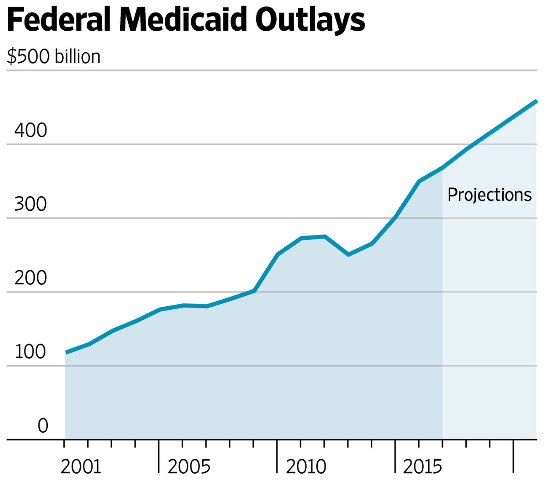
Medicaid is a vast program now serving 73 million low-income and disabled Americans and is doing a good job especially for the elderly and the disabled with special needs. But it costs the federal government nearly $400 billion per year and the cost is growing rapidly.  It is essential to get open-ended Medicaid spending under much better control and one good way to do this is to put the federal contribution on a fixed budget.


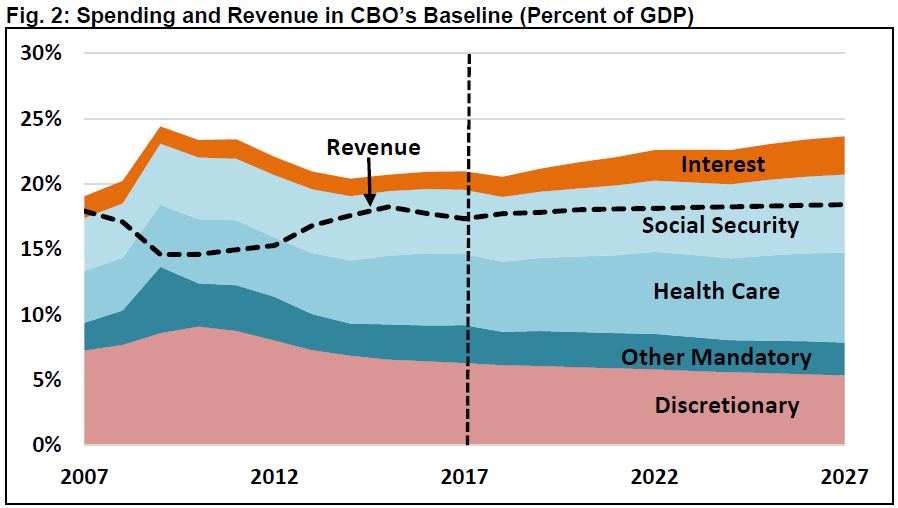
The Congressional Budget Office has just issued its latest Budget and Economic Outlook report.  It shows the ever-worsening fiscal condition for the U.S., unless current policy is changed.


For example:

  • The deficit for 2017 is predicted to be $693 billion or 3.6% of GDP.
  • Deficits will grow dramatically over the next decade with trillion dollar deficits returning by 2022.
  • Debt held by the public (on which interest is paid) will grow by $11.2 trillion between now and 2027, from $14.3 trillion today.
  • Spending will grow from 20.9 percent of GDP in 2016 to 23.6 percent in 2027, while revenues will rise from 17.8 percent in 2016 to 18.4 percent by 2027.
  • The vast majority of spending growth over the next decade (83%) is the result of rising costs for health care, Social Security, and interest on the debt.

    Conclusion.  
    The national debt is growing much too fast. The only way to turn this dangerous situation around is to reform all entitlement programs, including Medicaid, to get their costs under much better control.

Follow me on Twitter: https://twitter.com/jack_heidel
Follow me on Facebook: https://www.facebook.com/jack.heidel.3

How to Achieve a Balanced U.S. Budget


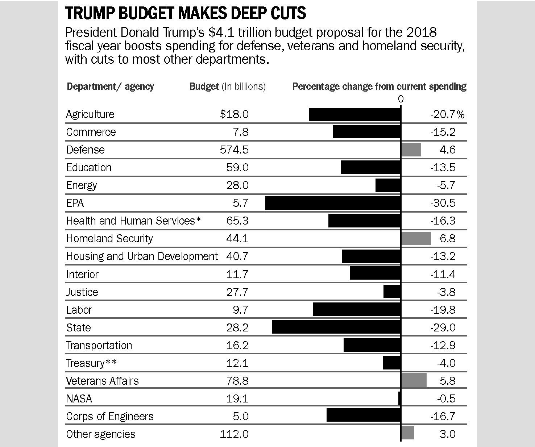
President Trump’s proposed 2018 Budget lays out a plan to achieve a balanced budget over a ten year period. I strongly endorse this goal whether or not the Trump budget is a realistic way to get this done.
The virtue of the Trump budget is to tackle waste and inefficiency across many different domestic programs (see chart below).


Its main defect is that neither healthcare reform nor tax reform has yet been implemented and the cost and/or savings of these two major initiatives are not yet known.
In the meantime the only way to think about balancing the budget is conceptually in terms of how it might be done.  Barron’s economic analyst Gene Epstein has done this recently.


Mr. Epstein proposes:

  • $8.6 trillion worth of spending cuts over ten years, of which 40% would come from programs other than Social Security and healthcare. By achieving a balanced budget in ten years it would lower our public debt (on which we pay interest) from 77% today to 58% in 2027.
  • By raising the age limit for full SS benefits to 67 (already enacted) at a faster pace, and indexing initial benefits to price inflation rather than wage inflation, $200 billion can be saved over ten years. Another $300 billion can be saved by phasing in a 25% reduction in SSDI benefits.
  • Cutting the estimated improper payment rate for Medicare of 12.1% in half would save $400 billion over ten years. Raising the premiums for Medicare Part B and Part D to 35% of costs from the current 25% of costs would save $400 billion.
  • Another $600 billion would be saved by turning Medicaid into a block grant program to the states and giving the states much more flexibility in how it is spent.
  • $950 billion could be cut from the military budget by cutting back on overly expensive new weapon systems as well as closing unnecessary military bases, both foreign and domestic.
  • Many cuts in government subsidies to individuals and businesses would save $1 trillion. Grants in aid to sates could be cut by $500 billion.

Conclusion. There are many different ways to curtail federal spending. It has to be done and the sooner we get started the less painful it will be for all concerned.

Follow me on Twitter
Follow me on Facebook


Objections to the Trump Budget


President Trump’s budget for 2018 presents a plan to achieve a balanced federal budget in ten years, by 2027.  This is a highly desirable goal but there is much skepticism about whether or not his budget is realistic, see here and here.


My thoughts on this important matter are:

  • Fiscal restraint is a common sense necessity, and is not austerity. Our public debt (on which we pay interest) now stands at 77% of GDP, the highest since WWII, and will continue to increase without major changes in public policy. Right now the debt is almost “free” money because interest rates are so low. As interest rates inevitably go up in the near future, interest payments on the debt will skyrocket and become a huge drain on our federal budget and make annual deficits even worse than they already are.
  • 3% annual GDP growth, as assumed in the Trump budget, is almost certainly too optimistic. However the Trump Administration is on track to achieve significant deregulation  and averaging 2.5% growth over the next ten years is doable.
  • Insufficient entitlement reform is a big drawback for the budget. It will be very difficult, essentially impossible, to achieve and sustain a balanced budget without modifying Social Security and Medicare to make them self-financing. Turning Medicaid into a block grant program to the states would finally put Medicaid on a sensible budget.
  • Requiring able-bodied welfare recipients to work is a good idea and is the basis for cutbacks in social welfare programs.
  • The Departments of State, Interior, Education and Justice should be able to absorb cutbacks and operate more efficiently.

Conclusion. There are many good initiatives built into the Trump budget. Unfortunately there are also some invalid assumptions and glaring omissions.  It does not represent a bona fide plan to balance the budget in ten years but at least it recognizes the importance of doing so.

Follow me on Twitter
Follow me on Facebook

Is Trump Serious about Shrinking the Debt?

The newly released Trump budget for Fiscal Year 2018 claims that it will lead to a balanced budget in ten years.  This is a highly desirable goal.  However the projected $4.5 trillion in spending cutbacks for many popular programs, as well as the projected 3% GDP growth for the next ten years, are both unrealistically optimistic.  Nevertheless, at least the Trump Administration is moving in the right direction.


Here is a good summary by Donald Marron in National Affairs of why it is so important to keep deficits and debt under control:

  • Prolonged deficits and mounting debt will undermine economic growth by interfering with investment in the private sector.
  • Prolonged deficits risk fueling inflation as the government lowers the value of the dollar by printing more of them.
  • High levels of debt held by foreign lenders put us at the mercy of foreign countries.
  • The growing debt exposes America to greater “rollover” risk with the increasing reliance on short term debt which frequently has to be rolled over.
  • Rising debt limits flexibility for increased spending in times of recession or other emergency. For example, when the Financial Crisis occurred in 2008, the debt level was just half of its current level. This meant the government could risk higher deficit spending in order to stimulate the economy.
  • Deficits have an unfortunate tendency to feed on themselves. Our current deficit level of approximately $500 billion per year is so large that it can only be significantly reduced with great pain. The only possible way to make deficit reduction politically feasible is to spread this pain widely amongst the public as shared sacrifice. This will be very hard to do.
  • Deficits and debt are grossly unfair to future generations who are stuck with servicing the debt and/or struggling to pay it down.

Conclusion. The Trump Administration recognizes the strong need to get deficits and debt under control. Unfortunately its current budget just submitted is not a realistic plan to get this done.

Follow me on Twitter
Follow me on Facebook