How Progress Has Led to Discord


We were reminded by Robert Samuelson in yesterday’s Washington Post that America has made amazing progress in the last half century.
Consider that in 1960:

  • Men and Women held rigid gender roles.
  • African-Americans were restricted by legal segregation in the South and informal segregation almost everywhere else.
  • Homosexuality was virtually under the radar.
  • There was little environmental regulation.
  • Immigration was not an issue.
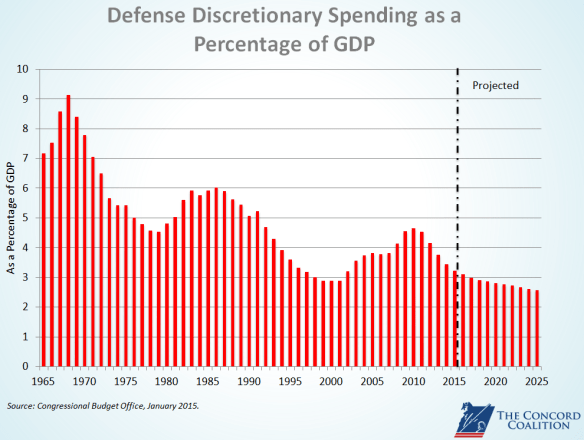
  • Defense made up 52% of government spending.
    Capture17

Think about all the (mostly) positive changes which have taken place in the meantime:

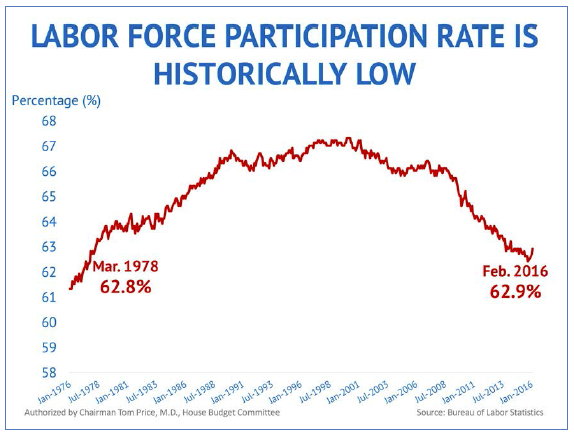
  • Women have taken paying jobs by the millions.
  • Racial segregation has been outlawed.
  • Gay rights have been established.
  • Environmental regulation has exploded.
  • Immigration, both legal and illegal, has increased.
  • Social spending has soared.
  • Defense is down to 16% of the federal budget in 2015.

Consider how our national politics is now stalemated:

  • The political system favors extremes.
  • Minorities live largely in big cities where they produce Democratic super-majorities.
  • Rural areas produce Republican super-majorities.
  • Incumbents are insulated from general election challenges which might pull them towards the center but are perpetually vulnerable to primary challenges from extremists who pull them towards the fringes.
  • Ideological purity trumps pragmatism. In the internet and cable-news era, politicians are constantly reassuring their constituents that they haven’t sold out.
  • The center sags and paralysis prevails.

Meanwhile serious national problems are getting much worse and not being addressed. Our public debt (on which we pay interest) is 74% of GDP, the highest since WWII.  The U.S. economy is growing only slowly at the rate of 2.1% per year ever since the end of the Great Recession seven years ago.  Neither presidential candidate has a credible plan to deal with these two most aggravating problems.
As a country we are in a huge mess.  How do we break out of it?  I wish I knew!

Follow me on Twitter
Follow me on Facebook


Can the U.S. Economy Do Better? V. Entitlement Reform


My last several posts, e.g. here, have discussed the question as to whether or not the U.S. economy can grow faster. Even though there are many headwinds to faster growth, there are still various measures to take which will help significantly. Beyond specific policy directions, such as aiding small business and cleaning up and simplifying our tax code, another very important step is to get our fiscal problems, i.e. massive debt, under much better control.
Capture7As made clear in the above chart, there is really only one way to do this.  It is entitlement reform.  In the last 50 years, from 1965 – 2015, mandatory, i.e. entitlement, spending has grown from 26% of the federal budget to 62% and this percentage will just keep growing until something is done to stop it. Along this line, an excellent new report from the American Enterprise Institute, “Increasing the Effectiveness and Sustainability of the Nation’s Entitlement Programs” lays out some basic principles for entitlement reform. They are:

  • Personal Responsibility for Retirement Savings. The idea is to move toward turning Social Security into a universal flat benefit for all U.S. residents age 65 and older. Anyone could supplement this basic income with additional private savings.
  • Market Discipline in Health Care. The idea here is to keep the ACA exchanges with subsidies for low-income households. Employer provided care would have no mandates and a rational and equal tax credit for all. Health Savings Accounts would be liberalized to encourage widespread participation. Both Medicare and Medicaid would provide premium support for basic care. The point is to bolster the consumer’s role in the marketplace in order to slow down the rising cost of healthcare.
  • Promotion of Work for Safety-Net Programs. The federal government spends about $400 billion annually to fight poverty (not counting healthcare programs) with much overlap of federal and state programs. Reform efforts should emphasize work as the key to improved economic prospects as well as greater state control over resources to allow for better coordination of efforts. Two major reform concepts, block grants to states as well as wage subsidies, should be implemented.


We have to get our fiscal house in order, so entitlement reform is not optional. Delay, moreover, could be catastrophic.  If we wait until another crisis hits, then it will no longer be possible to design reforms with gradual adjustments. Now is the time to act!

Follow me on Twitter
Follow me on Facebook

How Will America Solve Its Biggest Problems?


As I repeat over and over again, our two biggest national problems, in my opinion, are slow economic growth (only 2.1% annual increases in GDP for the past seven years) and massive public debt (now 74% of GDP, the highest it has been since right after WWII).
Capture11Are these problems being addressed by our political system?

  • Our 2016 presidential race is clearly touching on them to some extent. The “Sandernistas” think that the Obama economic policies are not progressive enough and need to be doubled down on. Middle-income “Trumpsters” are revolting against the stagnant and falling wage growth of the past fifteen years.
  • The political scientist James Piereson thinks that the Democratic-welfare regime, in place since 1932, has now run its course and will necessarily be superseded by America’s Fourth Revolution which is imminent.
  • The social scientist Yuval Levin thinks that our “Fractured Republic” can heal itself peacefully if the left is willing to accept a less centralized, more federalist, governmental approach to solving economic and fiscal problems and the right is willing to accept that modern America is highly diverse and individualistic and where a significant degree of cultural fracturing, family breakdown and estrangement from tradition are inevitable.

My own opinion is that our huge and rapidly growing public debt (on which we pay interest) is unsustainable and will lead to another crisis much worse than the Great Recession of 2008-2009 unless it is curtailed. Without an adequate response in the meantime, the new crisis will occur when interest rates inevitably rise significantly and therefore lead to huge increases in interest payments on our larger and larger accumulated debt.
To avoid such a calamity we need to do a much better job of controlling federal spending.  It would also help to speed up economic growth in order to increase tax revenue.  Furthermore, faster growth would create more jobs and better paying jobs.  This would take much of the steam out of the appeal of populist candidates such as Bernie Sanders and Donald Trump.
I can’t foresee exactly how we will be forced to change course but it’s going to happen fairly soon.

Follow me on Twitter
Follow me on Facebook
Thank God for the Republican House of Representatives


It is now almost certain that Hillary Clinton will be the Democratic nominee for President and that Donald Trump will be the Republican nominee. The two biggest problems facing our country today are:

  • Slow economic growth, averaging just 2.1% since the end of the recession in June 2009, seven years ago. Even though unemployment is down to 5%, stagnant wages for the middle class have not nearly recovered from their pre-recession high.
  • Massive debt. The public debt (on which we pay interest) is now at 74% of GDP and rising. When interest rates go up, as they surely will eventually, debt payment will rise by hundreds of billions of dollars per year and be a huge drain on government revenues.

The likely Presidential nominees are not adequately addressing these problems:

  • Hillary Clinton wants to increase government spending by about $100 billion per year to be spent on various new programs and raise the top tax rate to 45% to pay for them. This will do nothing to either grow the economy faster or shrink our already sizable deficit.
  • Donald Trump has promised to keep entitlements as they are and spend more on infrastructure and defense. He also sees debt as useful. “I probably understand debt better than anybody” he has stated. His tax plan (which he says is negotiable) will create massive new debt.

If Clinton is elected, she may pull the Senate Democratic along with her. But either way the House of Representatives will likely remain Republican with Speaker Paul Ryan.
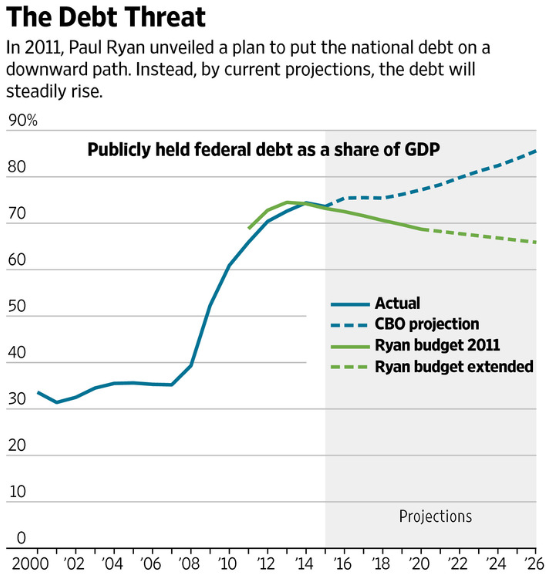
Capture3Since the Republicans took over the House in 2010, they have consistently proposed budgets each year to shrink the deficit and produced a balanced budget within ten years.  The new President, either Clinton or Trump, will have to negotiate their own ideas on spending and taxes with a fiscally conservative House.
The country is indeed very fortunate for this circumstance.

Follow me on Twitter
Follow me on Facebook


Why Faster Economic Growth Is So Important


The main topic of this blog is addressing America’s two biggest problems which are:

  • Slow economic growth, averaging 2.1% since the end of the Great Recession in June 2009, and
  • Massive public (on which we pay interest) debt, now 74% of GDP and growing, the highest it has been since right after WWII.

In a recent post, “Is America’s Middle Class Really Shrinking?” I showed that middle-income households did very well from 1971 – 2001, while our economy was growing on average at a rate of 3.5% per year.  Middle-income households then stood still from 2001 – 2008, and have lost ground since.
Capture2A vivid example of what has happened in the last 15 years is provided in the article, “My Secret Shame” in the current issue of the Atlantic magazine.  The author describes his own financial hardships supplemented with pertinent data from several sources:

  • In 2013, 47% of Americans responded to a survey that they would have great difficulty coming up with $400 to handle an emergency.
  • The inflation-adjusted net worth of a typical (median level) household in 2003 was $87,992. By 2013 it had declined to $54,500, a 38% drop.
  • A family headed by someone of prime working age, between 24 and 55 years old, and with an income of $50,000, could continue to self-fund its current consumption, if the family were to lose its current income, presuming the liquidation of all financial assets except home equity, for only six days!

As this data clearly shows, many Americans are in a precarious financial situation! The solution to this very serious problem is to speed up the growth of the American economy.  I have discussed how to do this over and over again in previous posts, i.e. here and here.
It is both surprising and disturbing that the presidential candidates are either ignoring this problem or making unserious proposals for how to solve it.

Follow me on Twitter: https://twitter.com/jack_heidel
Follow me on Facebook: https://www.facebook.com/jack.heidel.3

The Fundamental Driver of Our Debt Problem: the Cost of Healthcare


How to grow the economy faster. How to get our rapidly growing national debt under control.  These are the two main problems facing our country which I address over and over again on this blog.  Finding satisfactory solutions to these two problems will determine our future strength and prosperity as a nation.  Today’s discussion is about the major cause of our debt and deficit problem.
CaptureI recently came across the above chart showing the steady rise of overall American healthcare spending (public and private).  In 1960 it was less than 6% of GDP.  Now it is approximately 18%, a tripling, compared to the overall size of the economy, in just 55 years. Of course it is the cost of public healthcare programs such as Medicare, Medicaid and the Affordable Care Act which directly contribute to our growing deficits and to the accumulated debt.
However we will never be able to limit the cost increases of these public programs until we get the fundamental drivers of private healthcare costs under control. As pointed out (in the chart below) by several scholars from the American Enterprise Institute, the basic reason for the high cost of private American health care is that “we don’t have enough skin in the game” as shown by the chart just below.  We are paying less and less of total healthcare costs out of our own pockets because more costs are paid directly by third party insurers.  This means we have less incentive to control our own healthcare costs.
Capture2The AEI has suggested several reform measures to improve this situation such as:

  • Placing an upper limit on the tax exemption for employer-paid insurance premiums.
  • Expanding the use of Health Savings Accounts to be used in conjunction with high deductible plans.

We have a stark choice in front of us. Either we move in this direction in the near future or we will face another, much worse, financial crisis.  In the latter case we will end up with an inferior healthcare system, much less responsive to our wants and desires.

Follow me on Twitter: https://twitter.com/jack_heidel
Follow me on Facebook: https://www.facebook.com/jack.heidel.3

Another Way to View the Presidential Candidates

As regular readers of this blog well know, I constantly advocate for two major changes in government policy:

  • Speeding up economic growth, which has averaged an anemic 2.1% per year since the end of the Great Recession in June 2009. This will create the new and higher paying jobs that country so badly needs.
  • Shrinking annual deficits, ideally down to zero, so that our huge public debt (on which we pay interest) will begin to decrease as a percentage of GDP over time.

My last post compared the President’s proposed budget for 2017 with a proposal from the House Budget Committee. Basically the President’s budget increases both taxes and spending while the House budget keeps revenues at a steady 18.2% and leads to a balanced budget after ten years.
Capture2The non-partisan Committee for a Responsible Federal Budget has just produced an interesting report, ”How Much More Would Government Spend Under the Next President?” It compares the spending plans of the remaining five presidential candidates from both parties.  It finds that:

  • Only John Kasich would actually decrease spending over the next decade from 22.1% of GDP (under current law) to 21.5%.
  • The other four candidates would all increase spending: Hillary Clinton (to 22.5%), Donald Trump (to 22.7%), Ted Cruz (to 23.4) and Bernie Sanders (to 29.5%).

Mr. Kasich’s spending restraint would amount to a 2% decrease over current law while Ms. Clinton, for example, would increase spending by 2%.
As I showed a year ago,  reining in spending by 2% per year over current law is a major achievement and will lead to a balanced budget in ten years. In other words, Mr. Kasich’s spending plans are in sync with the latest House Budget Committee proposal.  Perhaps this should not be surprising since Mr. Kasich served as Chair of this House Committee in the 1990s!
Easy question: Which presidential candidate and which chamber of Congress are acting in the most fiscally responsible manner?

Follow me on Twitter: https://twitter.com/jack_heidel
Follow me on Facebook: https://www.facebook.com/jack.heidel.3

Solving America’s Most Basic Problems


My last two posts, here and here, argue that America’s two most critical problems are:

  • Speeding up economic growth in order to create more jobs and better paying jobs, especially for middle- and lower-income workers whose wages have been stagnant for the past 15 years.
  • Getting our large and rapidly growing national debt under control by shrinking annual deficit spending. This will put our debt on a downward path as a percentage of GDP.

Many Facebook comments on these posts inquire about how these goals will be accomplished. If tax reform is the best way to increase economic growth, how can this be done in a way that is fair to the non-wealthy. If spending cuts are necessary to balance the budget, what cuts should be made?  Here is a summary of my views on these questions:

  • Growing the economy with tax reform. The best way to spur investment and business expansion is with the lowest possible tax rates on owners and investors. Broad-based tax reform, with lower tax rates for all, paid for (i.e. in a revenue neutral way) by closing loopholes and shrinking deductions, will accomplish this. The 64% of taxpayers who do not itemize deductions will increase their income with tax rate cuts. Lower tax rates for the affluent will be offset by shrinking deductions and closing loopholes.
  • The corporate tax rate should also be cut to internationally competitive levels, again paid for by drastically shrinking, if not totally eliminating, all deductions. This way all corporations (including GE!) would pay the same tax rate. And American companies would have much less incentive to move overseas.
    Capture0
  • Reducing our national debt. We have got to drastically shrink our annual deficits (now running about $500 billion per year) in order to put our national debt on a downward course, as a percentage of GDP. The House Budget Committee has recently passed a plan to balance the budget within ten years. Not everyone will agree with the details, but at least it’s a starting point. An alternative approach is to adopt a Balanced Budget Amendment to the U.S. Constitution. This would require Congress to make tradeoffs annually between either restraining spending or raising taxes.  A BBA will force them to do what they should be doing anyway!

Follow me on Twitter: https://twitter.com/jack_heidel
Follow me on Facebook: https://www.facebook.com/jack.heidel.3

Why I Lean Republican II. Priorities for the Next President


In my last post, “Why I Lean Republican,” I endorse the ten year budget plan just released by the House Budget Committee which will lead to a balanced budget within ten years.  It represents an excellent starting point towards addressing one of our country’s most serious problems, our huge and rapidly growing national debt.
Capture1
Jim Vanderholm responded to this post by giving his own top priorities for the next President. They are:

  • Job Formation. All sorts of other problems would be addressed in the process. Record high numbers of unemployed and underemployed. Record numbers of people on 85 different welfare programs at a cost of over $1 trillion per year.
  • Highly targeted education/training of the workforce to fill the newly created jobs with American citizens.
  • Reducing annual deficits. Growing the economy by putting more people back to work will bring in more tax revenue. Along with slowing the growth of spending this will lead to lower annual deficits. Once the deficit is reduced by half or more of its current value (about $500 billion), then the debt as a percentage of GDP will begin to shrink.
  • Reduced focus on divisive social issues. The basic structural problems referred to above will not be solved by more gun control, higher carbon tax, shuttering the coal industry, free pre-school and college education, or discontinuing tax-payer funding to Planned Parenthood.

In other words, we need a new President who will focus on basic economic and fiscal issues and not be distracted by divisive social issues. In fact, an ideal division of labor would be for the House Budget Committee to take the lead in getting spending under control while the new President attempts to implement policies to get the economy growing faster. This would lead to real progress on both fronts!

Follow me on Twitter: https://twitter.com/jack_heidel
Follow me on Facebook: https://www.facebook.com/jack.heidel.3

The Strengths and Weaknesses of the U.S. Economy


If the U.S. is going to be able to solve its serious economic and fiscal problems, there needs to be a realistic understanding of what they are. My last post, “Is the U.S. Economy Really in Good Shape?” discusses a recent Op Ed in the Wall Street Journal by Martin Feldstein.  Mr. Feldstein makes the case that it is in pretty good shape right now even though there are big problems on the horizon. Unfortunately, such an assessment is likely to lead to complacency and inaction towards our long term problems.
Capture0Let’s look at the overall situation.

Our Economic Strengths:

  • The world’s largest economy, twice as large as our nearest competitor, China. The 2.2% GDP growth since the Great Recession ended in June 2009 is not especially robust but it’s among the best in the developed world.
  • World leadership. The U.S. dominates international finance, technology, higher education and popular culture. Everybody else wants to emulate us and to have what we have.
  • The U.S. Dollar dominates world currency because of its strength and stability. This protects the value of the dollar relative to other currencies.

Our Economic Weaknesses:

  • Massive Debt. The public debt (on which we pay interest) now stands at 74% of GDP, the largest since right after the end of WWII. As our currently low interest rates inevitably continue to rise, interest payments on the debt will skyrocket creating a huge burden on future generations.
  • Demographic Challenges. Payouts for Social Security, Medicare and Medicaid are continuing to grow rapidly, thereby putting upward pressure on annual deficits as well as accumulated debt.
  • Slow Growth Environment. The economist Robert Gordon makes a persuasive case that the explosive economic growth which the U.S. enjoyed from 1870 – 1970 will be very difficult, perhaps even impossible, to duplicate in the future.


The big picture is that we are going to have to work hard to achieve the degree of economic growth which will be needed to propel American society forward in the future as it has in the past.

Follow me on Twitter: https://twitter.com/jack_heidel
Follow me on Facebook: https://www.facebook.com/jack.heidel.3