The High Cost of Less Austerity


All eyes are focused on the drama playing out in Greece.  The Greeks have just voted not to accept Europe’s latest offer to keep the credit flowing, amounting to a 5% of Greek GDP income transfer from their European neighbors, in return for additional economic reforms to put the country on a path to self-sufficiency.

Capture1The New York Times declares, “For Europe’s Sake, Keep Greece in the Eurozone,”  that the European Union should “offer some path forward for the Greek economy, starting by writing down its huge and unpayable debts.”  More than likely EU leaders will work out a new agreement with Greece to enable it to remain in the EU and the Eurozone.  Greece is lucky to be in such a position.
In a recent post, “Could the U.S. End up Like Greece? II. How Long Will It Take?”, I pointed out that the U.S. is likely to have a public debt of 175% of GDP by 2040, the same level as the Greek debt today.  Furthermore interest rates are likely to be higher than their unusually low level today which means that we will be making proportionally higher interest payments at that time.  In other words, we are likely relatively soon, within 25 years, to have a painfully high level of debt.
Who is going to bail us out when our own debt becomes “unpayable”?  Obviously, no one!  Right now the austerity and pain caused by the Greek debt is confined to the 11 million people in Greece.
Which is better?  For us to bite the bullet now and get our fiscal house in order by, for example, moving towards annual balanced budgets Or to wait until our debt becomes unbearable and there is no one to bail us out?
We are so big that if this ever happens and drastic measures have to be taken, much of the world will be drawn into the suffering along with us.  It won’t be a pretty sight!
The Land of the Free and the Home of the Brave


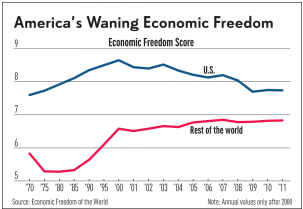
As we celebrate the 239th anniversary of the signing of the Declaration of Independence in 1776, Americans have much to be thankful for.  It is often said that the United States is the strongest, wealthiest and freest country the world has ever known.  Although this may be somewhat of an exaggeration (see below), it is still indicative of how fortunate we are compared to the rest of the world.
CaptureAs we celebrate our good fortune, we need to be acutely aware that our continued success as a great nation is not automatically assured.  In fact we face a number of troubling and persistent problems which are not likely to disappear unless we take strong action to address them.  For example we have:

  • A stagnant economy with only 2.2% annual growth since the end of the Great Recession. And the Congressional Budget Office predicts no speed up over at least the next ten years, based on current policy. Such slow growth condemns 20 million unemployed and underemployed citizens to unfulfilling lives, as well as lackluster pay raises for many more tens of millions.
  • Massive debt. Our public debt (on which we pay interest) is now at 74% of GDP, highest since the end of WWII, and predicted by the CBO to grow rapidly under current policies. When interest rates return to the normal 5% level, interest payments on the debt will skyrocket, making it much more difficult to fund all of the federal programs we depend on for our quality of life.
  • Increasing Income Inequality is real even if overhyped in the media. America is still a land of great opportunity but basic fairness demands that all citizens be able to share in our national abundance.
  • Threats from abroad. ISIS now controls much of Iraq, Syria and northern Africa and must be defeated. NATO needs our very strong support, all the more so with the Eurozone and European Common Market under increasing pressure from within.


As the strongest nation in the world we have much responsibility for continued world peace and prosperity.  We can’t fulfill this role adequately unless our own internal fiscal and economic policies are in fundamentally sound shape.
Let’s be thankful for what we have and bear down hard to insure that we keep it!

Could the U.S. End Up Like Greece? II. How Long Will It Take?


My last blog post, “Could the U.S. End Up Like Greece?” compares Greece’s present fiscal situation (public debt at 180% of GDP) with our own current fiscal situation (public debt at 74% of GDP and rising fast).  The Congressional Budget Office predicts that, under current policy, the U.S. debt will not reach 180% until about 2055, forty years from now.  One could (wrongly!) conclude from this that we are okay for the time being.
CaptureHowever, this is not true!  The Peter G. Peterson Foundation has taken a closer look at the most recent CBO report.  Under a less optimistic, but more realistic, Alternative Fiscal Scenario, the U.S. debt will reach 175% in 2040.  The Alternative Fiscal Scenario assumes, for example, that:

  • About 50 expiring tax breaks will continue to be extended year by year, as they were in 2014 and have been repeatedly in the past. These “tax extenders” increase the deficit by over $40 billion per year.
  • Discretionary spending will soon rise back up to its historical share of GDP. In other words, the sequester, which is currently holding down the growth of discretionary spending, may be overridden or at least relaxed.

Greece, with its debt at 180% of GDP, is only being required by the European Central Bank to pay 1.7% interest on this debt indefinitely into the future.  Thanks to the low interest rate policy of the Federal Reserve, 1.7% is also the current rate of interest being paid on the U.S. debt.  But this historically low interest rate is unlikely to continue much longer without setting off a much higher rate of inflation.
In other words, we’ll likely be in the same situation as Greece is currently, in much less than 25 years.  Furthermore, Germany and the other EU countries have been keeping Greece afloat for years and may continue to do so.
Who is going to bail us out when we get to where Greece is now?  China?  Unlikely.  We’ll be on our own and it won’t be pretty!

Could the U.S. End Up Like Greece?


The whole world is watching while Greece decides between two unpleasant alternatives.  Will it further tighten its belt in order to stay in the Eurozone?  Or will it default on its massive debt, reintroduce the drachma and go through a severe recession likely accompanied by hyperinflation?   Greece has put itself into this precarious position by accumulating a debt of 180% of GDP.  It’s current situation would be much worse if it were not getting by with the low interest rate of 1.7% from the European Central Bank.
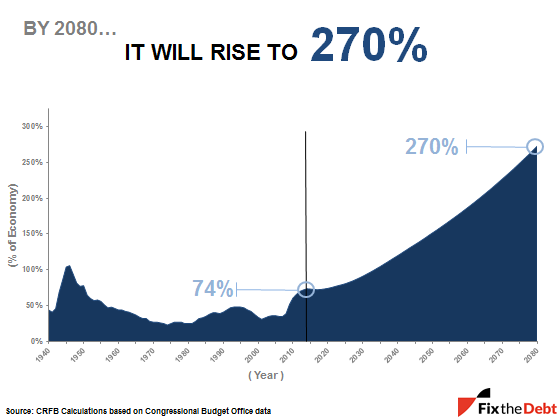
CaptureCompare Greece (see chart above) with the U.S. debt situation.  Our current public debt (on which we pay interest) is 74% of GDP.  This is the highest it has been since the end of WWII.  And, thanks to Federal Reserve policy, we are now paying an historically low interest rate of 1.7% on this debt.
The problem is that (under current policy) our debt will keep growing larger and larger until, by 2080, it would reach the enormous level of 270 % of GDP.  Our very low interest rate level of 1.7% will almost surely rise in the near future to a more normal level of 5%.  As interest rates do begin to rise, and long before the debt reaches 270%, interest payments on the debt will have increased to a much higher level, crowding out other spending.
Notice that, according to the above chart, our debt will reach the Greek level of 180% around the year 2055.  But with higher interest rates, it would be exceedingly reckless to assume that we won’t arrive at Greece’s currently perilous state much sooner than that.
Understanding that we have a very serious long term debt problem, it is imperative to begin to address it now, because the longer we wait:

  • the older our population gets
  • the higher the debt will rise
  • the less time we’ll have to phase in changes
  • the slower our economy will grow, and
  • the fewer tools we will have to fix it

The answer to the question in the title is: Yes, we could easily end up like Greece if we are foolish enough to postpone action on our own debt problem for much longer.

The Fiscal Time Bomb Is Still Ticking!


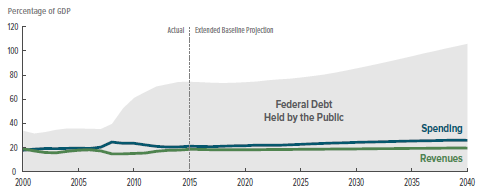
The Congressional Budget Office is by far the most objective source of detailed information about the federal budget, playing a valuable role in the super-charged political atmosphere of Washington D.C.  It has just released a new annual report, “The 2015 Long-Term Budget Outlook,” projecting our fiscal health for the 25 year window, 2015-2040, based on current policy. It is a scary scenario indeed.
CaptureAs shown in the above chart, our public debt (on which we pay interest) has increased from 38% of GDP at the beginning of the Great Recession in 2008 to 74% today.  Although it will remain steady at this high level for about five years, it will then resume a steady increase, reaching a level of about 100% of GDP by 2040.
As many observers, including myself, have pointed out, when interest rates eventually return to their normal historical level of around 5%, interest payments on this huge, and rapidly increasing, debt will double or triple from their current low level, causing a very painful budget shortfall.
Simple prudence suggests that the only responsible course of action is to put our debt on a downward path, as a percentage of GDP, in order to minimize this looming problem to the greatest possible extent.
Capture1CBO gives some useful guidelines for what is required to do this:

  • Just to keep the debt at its current value of 74% of GDP by 2040 would require an annual 6% increase in revenue or a 5½% decrease in spending. This would amount, for example, to a $210 billion spending cut for 2016.
  • To reduce the debt to 38% of GDP by 2040, its average over the past 50 years, would require an annual 14% increase in revenues or a 13% decrease in spending. The spending cut for 2016 would be $480 billion.

These examples show the enormity of the fiscal mess we have gotten ourselves into.  Under current policy it will require a big effort just to stay even with where we are right now, without showing any debt reduction over the next 25 years!
Our only hope is to change current policy.  But how?

Fixing the Debt: Creating a Greater Sense of Urgency II. An Example


My last post, ”Fixing the Debt: Creating a Greater Sense of Urgency,” expresses my dismay that our huge debt problem does not receive enough serious attention from the American people.  Yes, most Americans deplore the national debt and the deficit spending that leads to it, but it only too seldom affects how they vote for candidates for federal office, thus giving a pass to the big spenders in Congress.
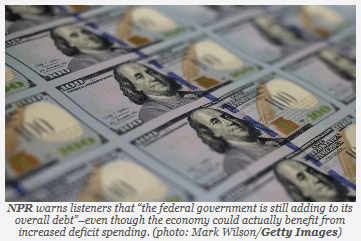
CaptureHere is a good example of this refusal to take the debt seriously.  The advocacy group FAIR (Fairness and Accuracy in Reporting) ridicules NPR for addressing this problem, “Look a Deficit: How NPR Distracts You From Issues That Will Actually Affect Your Life.”  Here is what FAIR is saying:

  • Interest on the national debt is projected to be only 2% of GDP in 2016 and 3% of GDP in 2024, which is tiny. (But this is because the interest rate for the debt is now abnormally low, approximately 1.7%).
  • If the Fed keeps interest rates low, then interest on the debt will continue to stay low indefinitely and so the debt will continue to be a trivial problem. And the President appoints 7 of the 12 voting members of the Fed Open Market Committee which sets interest rates.
  • The reason the Fed raises interest rates is to slow the economy and keep people from getting jobs.  (Actually the real reason is not to keep people from getting jobs but to keep inflation under control. Once inflation takes off, it is very difficult to bring it back down as we painfully discovered in the late 70s and early 80s).
  • Anyhow, if the Fed raises interest rates to keep the labor market from tightening, as it did in the late 1990s, this would effectively be depriving workers of the 1.0 – 1.5 percentage points in real wage growth they could expect if they were getting their share of productivity growth. (A rise in interest rates need not choke off economic growth which is primarily affected by supply and demand. Fiscal policy (tax rates and spending), established by Congress, has a far greater effect on the rate of economic growth than does monetary policy).


If our debt is not soon placed on a sustainable downward path, we will soon have another financial crisis, much worse than the Great Recession of 2008.  This will affect everyone’s life in a substantial and very unpleasant way.

Fixing the Debt: Creating a Greater Sense of Urgency


As I have mentioned before, I am a volunteer for the nonpartisan Washington D.C. think tank “Fix the Debt.”  As such I give presentations to civic organizations in the Omaha area about our debt problem and what we can and should do about it.  I have now given four such talks and have another one coming up next week.
Capture
What is most difficult for me is to try to convey a sense of urgency about addressing this problem. Most people deplore deficit spending in a general sense but not nearly enough people think that dealing with it should take priority over current presumably pressing spending needs such as, for example, depletion of the highway trust fund, expanding military spending, or improving early childhood education, just to be specific.
So here is how I am going to try to create a greater sense of urgency.  Several months ago I had a post entitled, “The Slow Growth Fiscal Trap We’re Now In” in which I said (in brief summary) that our current economic condition of

  • slow growth means
  • low inflation which leads to
  • low interest rates which in turn leads to
  • massive debt which eventually leads to a new and much more severe
  • fiscal crisis.

This is the predicament we’re now in.  Do we consciously maintain a slow growth economy, with all the unemployment pain and stagnant wages which this entails, or do we speed things up, enabling more people to go back to work, and also deal with the higher inflation and interest rates which this will entail?
Faster growth may well eventually come on its own anyway and then we’ll be forced to fix our fiscal problems at a time when they’ll be much worse than they are now.
Isn’t it clear that it is much better to act now in a responsible manner rather than to wait and have to react hurridly later on when the problem is much worse?

Are Economics and Social Progress Related to Each Other?


“Your (last post) is one of the most active and positive that I have read of yours. You do put your time to where your values are. Those of us who see you as too economically focused and ourselves as more humanely concerned need to act as well. Thanks for your focus and attention.”
from a reader of my blog

I am a fiscal conservative and a social moderate. The primary reason I write this blog is because I am so concerned about the fiscal recklessness of our national leaders. Our national debt is much too large and still growing too fast. We need to either cut spending or raise taxes (or do both).
But I am also a social progressive. I voted in favor of Nebraska raising its minimum wage last fall. I support gay marriage as a civil right. I support having Nebraska expand Medicaid in order to cover more low-income people (where Medicaid needs to be fixed is at the federal level).
CaptureThere is in fact a very close connection between having a sound economy and social progress. As the above chart shows, the U.S. ranks very high in both GDP per person and social progress. All of the countries which are most socially progressive also have sound economies. This is not a coincidence.
My last post talks about what society can do to help blacks improve their socio-economic status. This includes improving educational opportunity in the inner city. But improved educational opportunity needs to be closely directed toward improved economic opportunity. This means, for example, having good jobs available for new high school and community college graduates. But this, in turn, means having strong economic growth with intelligent tax and regulatory policies to encourage entrepreneurship and business expansion.
In short, a sound economy is essential for social progress.

My Moral, Social and Political Values


About a month ago I wrote a post about a book by Dennis Prager, “Still the Best Hope: why the world needs American values to triumph.”  According to Mr. Prager, there are three ideologies competing for the allegiance of humankind.  They are: Islamism, Leftism and Americanism.  He defines American values as 1) Liberty, 2) In God We Trust and 3) E Pluribus Unum, the three expressions which appear on all American coins.  His trinity of ideologies and values helps me understand my own political framework.
CaptureI consider myself to be a cultural Christian meaning that I identify with Christian values such as practicing the Golden Rule and trying to be a Good Samaritan rather than believing in any particular theological doctrines.
My social values are based on my moral and religious values.  Americans have the good fortune to live in a very prosperous country with much personal liberty.  But along with our freedom and prosperity comes responsibility.  First of all, we are responsible for our own behavior.  If we make bad choices, we have to accept the consequences and try to learn from our mistakes.  We have greatly benefitted from the hard work of our forebears.  In return it is our responsibility to leave the world a better place than we found it.
Just as my social values are consistent with my moral values, so do my social values determine my political values.  I am a fiscal conservative and a social moderate.  I consider it highly irresponsible for my generation to leave a huge, and growing, national debt for future generations.  Either government should cut back on spending or it should raise taxes to pay for what it spends.
But I also consider it to be America’s responsibility, as well as in its own self-interest, to promote freedom and responsibility around the world.  This is demanding,  expensive and sometimes controversial but we need to be willing to do it.  Likewise, we need to provide an adequate safety net for those among us who are truly unable to cope for themselves.
This is my first public attempt to describe the underlying values around which I organize and conduct my life.  It’s a start but I’m pretty sure that I’ll be coming back to this theme again in the future!

Can We Solve All Our Fiscal and Economic Problems at the Same Time?


This website, It Does Not Add Up, is devoted to discussing our country’s most serious economic and fiscal problems.  They are:

  • Stagnant Economy. Since the end of the Great Recession in June 2009, the economy has been growing on average at the historically slow rate of about 2.3%. Slow growth means higher unemployment, stagnant wages and less tax revenue.
  • Massive Debt. U.S. public (on which we pay interest) debt is now 74% of GDP (highest since WW II) and projected by CBO to grow rapidly unless strong measures are taken to reduce it. This puts our country’s future wellbeing and prosperity at great risk.
  • Increasing Income Inequality. Incomes for the high-skilled and well-educated are increasing much faster than for the low-skilled and less-educated workers.

The new Republican majorities in Congress are stirring the waters by proposing a ten year plan to shrink the deficit down to zero, i.e. to balance the budget by 2025.  The opposition claims that this would “sharply cut the scale of domestic spending, which would mostly fall on the poor.”
Capture1But the American Enterprise Institute’s James Pethokoukis points out that social spending in the U.S., both public and private, is very generous and second only to France in the entire OECD. So here is how we could proceed to address our basic problems in a unified manner:

  • Balance the Budget by a combination of Republican spending cuts and cutting back on two major tax deductions: Employer-sponsored Health Insurance (cost: $250 billion per year) and Mortgage Interest (cost: $70 billion per year).
  • Boost Economic Growth by expanding the Earned Income Tax Credit to encourage more people to accept low paying, entry level jobs. Increase the Social Security eligibility age from 67 to 70, thereby keeping near retirees in the workforce for three additional years (this will also extend the solvency of the Social Security Trust Fund).
  • Decrease Income Inequality. Cutting back on tax deductions, in part to pay for expansion of the EITC, lessens income inequality as well as shrinking the deficit. A faster growing economy also lessens inequality by providing more opportunities for upward mobility.

In other words, addressing each of these fundamental problems in an intelligent manner contributes to solving the remaining problems as well.  This creates a virtuous circle for economic progress!