Donald Trump’s First Year as President


As I gear up to enter the 2018 Nebraska Republican Primary for U.S. Senate, see here  and here, I am focusing on what I consider to be the overwhelmingly most critical and urgent issue facing our country: our rapidly growing national debt, now 77% of GDP (for the public part on which we pay interest), and steadily getting much worse. Nevertheless, just over a year ago an unexpected political earthquake shook the country as Donald Trump was elected President.  As I become a candidate myself for national office, I need to make clear what I think about Mr. Trump.  I will start out by saying that I did not vote for him because of his sleazy behavior towards women.
I will try to be objective about his accomplishments in office, both positive and negative.
On the positive side:

  • He is standing tough on North Korea, working with the U.N., China and other Asian countries to impose strong sanctions on the North Korean economy. He is upgrading U.S. missile defense, as a smart precaution against a North Korean attack on the U.S.

  • He has worked with many other countries to eliminate the ISIS physical caliphate.
  • He has cajoled NATO members into contributing an additional $12 billion towards our collective security.
  • The economy is now growing at a 3% annual rate thanks (at least in part) to his efforts at regulatory reform.

However, on the negative side:

  • The new tax law, which he signed, is likely to kick off higher inflation with the trillion dollar artificial stimulus from increased debt. This will lead to much higher interest rates which will make our huge debt far more costly.
  • His noxious tweets undermine his presidency, by overshadowing his achievements. His personal popularity has dropped from 46% right after the election to 35% today.

Conclusion. The best way for a member of Congress (or candidate for same) to respond to President Trump’s erratic behavior is by being objective, agreeing with him if possible and not hesitating to call him out when necessary. This is what I will try to do.

Follow me on Twitter 
Follow me on Facebook 

There Is Really Only One Way to Reduce Our Debt


In 2012 I was a candidate in the Republican Primary for U.S. Congress, Nebraska District 2. My platform at that time was to “Eliminate the Deficit.” Today I am about to enter the 2018 Nebraska Republican Primary for the U.S. Senate.  My platform will be to “Fix the Debt.” (http://www.fixthedebt.org/)
Our current debt ($15 trillion for the public part on which we pay interest) is now 77% of GDP, the highest since right after WWII, and steadily getting worse.  At the present time it is essentially “free” money because interest rates are so low. But that is already starting to change.  Every 1% increase in interest rates will increase interest payments by $150 billion per year.  A huge upsurge in inflation (which can happen at any time), followed by a corresponding rise in interest rates, will become a huge drain on the federal budget and likely lead to a new crisis much worse than the Financial Crisis of 2008.


With healthcare spending, both public and private, now almost 18% of GDP, and growing rapidly, there is really only one practical way of getting our national debt under control: stabilize the cost of healthcare in the U.S.
Consider the following data:

  • Our national health expenditure grew 4.3% (much faster than inflation) to $3.3 trillion in 2016, $10,348 per person, and accounted for $17.9% of GDP.
  • National health spending is projected to grow at an average rate of 5.6% for 2016 – 2015, and reach 19.9% of GDP by 2025.

  • Federal Medicare Outlays were $588 billion in 2016 or 15% of federal outlays.
  • Federal Medicaid outlays were about $390 billion in 2016 or 10% of federal outlays.
  • The federal tax exclusion for employer provided health insurance was $250 billion in 2016.
  • Summary: the federal government spent almost $1.23 trillion on healthcare in 2016, over 30% of all federal spending of $3.9 trillion.

Conclusion. The only practical way to get our nation’s debt under control is to limit the growth of healthcare spending. Right now federal spending on healthcare is defined benefit (i.e. open ended).  We simply must move to a defined contribution system where all of us as healthcare consumers assume responsibility for our own healthcare spending.  Detailed proposal forthcoming!

Follow me on Twitter 
Follow me on Facebook 

The New Tax Bill Is Likely to Take Us over a Fiscal Cliff


The Republican tax bill has now come out of conference and will soon be voted on by both the House and the Senate. It is expected to easily pass both chambers and be signed by the President. As I have discussed extensively on this blog, I have no argument with the individual features of this bill.  They will definitely increase economic growth which is highly desirable.
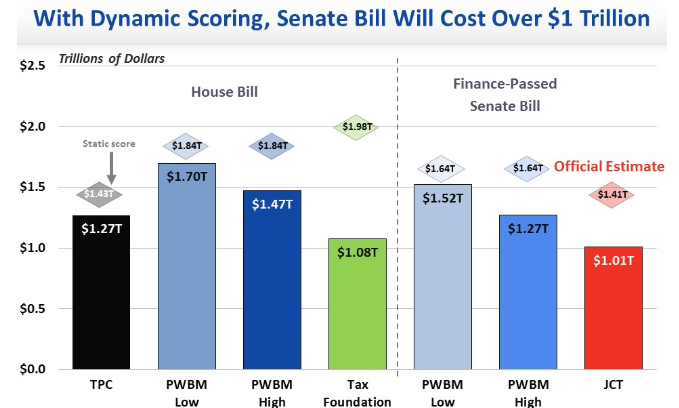
The problem is that the tax bill will also add $1 trillion to the debt over ten years (as scored by the JCT).  It is simply outrageous for the GOP to consciously add $1 trillion to our already $15 trillion debt (the public part on which we pay interest), which at 77% and climbing, is the highest it has been since right after WWII.


But the damage will be even worse than this.  The trillion dollar artificial stimulus is likely to overheat an already briskly growing economy.  As the Economist reports in its latest issue:

  • Second quarter growth of 3.1% and third quarter growth of 3.3% are very strong.
  • Median household income grew 5.2% in 2015 and 3.2% in 2016.
  • The average net worth of households in the middle income quintile grew by 34% between 2013 and 2015.
  • The wages and salaries of production workers grew at a 3.8% pace in the third quarter of 2017.
  • The unemployment rate at the end of 2018 is likely to be between 3.4% and 3.8%.

Economic growth is good because it raises living standards across the board. But faster growth also means higher inflation which means higher interest rates as the Federal Reserve responds.  Higher interest rates mean higher interest payments on our massive debt. Every time the Federal Reserve raises interest rates by ¼ %, the interest payments on our debt will increase by about $38 billion per year.  A 2% increase in interest rates, likely within two years, means a $300 billion increase in annual interest (on top of the $266 billion paid in FY 2017).  Our massive debt will soon become a huge burden for the federal budget.

Conclusion. Adding $1 trillion to the debt on top of the existing debt is a terrible idea. Such artificial stimulus at a time when GDP growth is already picking up will drive up interest rates all the faster and greatly speed up the day of reckoning for extreme fiscal irresponsibility.

Follow me on Twitter 
Follow me on Facebook 

What Are the Good Features in the Republican Tax Bill?


I have made very clear in recent posts that one negative feature of the tax bill, increasing national debt by $1 trillion over ten years, greatly outweighs its good features.  For this reason I ask Nebraska Senator Deb Fischer to put the welfare of our country ahead of the demands of her Republican colleagues and vote against the bill.


Nevertheless, the tax bill does have beneficial features and I would like to acknowledge them here.  Major ones are:

  • Lowering the corporate tax rate from 35% to 21% and moving to a territorial system, making us far more internationally competitive and encouraging our multinational corporations to bring their foreign profits back home.
  • Establishing immediate expensing of capital investment, thereby speeding up business investment and increasing economic growth.
  • Reducing itemized deductions for state and local taxes and mortgage interest, but not eliminating them as should be done for much greater revenue savings.
  • Increasing the standard deduction to $12,000/$24,000 (for singles/couples) which will reduce the number of individual taxpayers who itemize deductions from 30% to just 6%. This single feature alone achieves major simplification.
  • Measuring inflation adjustments for income thresholds by the Chained Consumer Price Index (CCPI) rather than the current CPI. CCPI takes consumer behavior into account when computing inflation and will lead to an increase in tax revenue over time.
  • Eliminating the individual mandate for the ACA which will lead to fewer healthy people signing up for health insurance. This begins a process of healthcare cost reform which must continue much further to significantly reduce the cost of American healthcare. Much more later.

Conclusion. The good features in the tax bill do not nearly outweigh the awfulness of adding $1 trillion to our debt over the next ten years. The Republican Party should be ashamed of itself for such poor fiscal and economic stewardship.  What is it thinking?

Follow me on Twitter 
Follow me on Facebook 

Senator Fischer, if You Vote for the Awful Tax Bill, There Will Be Political Consequences!


Congressional Republicans have agreed on a compromise tax bill, details to be released soon. After scoring by the Joint Committee on Taxation, it will be voted on separately by the House and Senate, sometime next week.  It is likely to reach the President, and be signed into law, before Christmas.


As I have previously discussed at great length, this is a very bad bill for the following reasons:

  • Lowering the corporate tax rate to 21% is actually a good idea because it will encourage U.S. multinational companies to bring their foreign profits back home for reinvestment as well as encouraging foreign companies to set up shop in the U.S.
  • Adding $1 trillion to the debt over ten years, as previously scored by JCT and likely on rescoring, is what is so awful about the tax plan. It is also sad because this could be avoided.  Our debt (the public part on which we pay interest) is already, at 77% of GDP, the highest it has been since right after WWII, and is predicted by the Congressional Budget Office to keep getting worse without major changes in current policy.
  • As interest rates rise, interest payments on the debt will grow dramatically (right now our debt is almost “free” money). Eventually this will lead to a new financial crisis, much worse than in 2008.
  • Overheating the economy, now growing at 3% per year for the last two quarters, makes the tax bill even worse. The last thing our economy needs right now is a trillion dollars of artificial stimulation. This will force the Federal Reserve to raise interest rates faster than it would otherwise.
  • Nebraska Senator Deb Fischer, who is up for reelection in 2018, voted for the Senate version of the tax plan. She should reconsider for the final combined bill and vote no.

Conclusion. If Senator Fischer votes for the final version of this bill, and if it passes and is signed into law by the President, then she is personally responsible for the devastation it will wreak on our economy. What can I as an individual Nebraskan do about this?  It should not be hard to figure out.  Stay tuned!

Follow me on Twitter 
Follow me on Facebook 


Who Is Responsible for the Atrocious GOP Tax Bill?


I want to emphasize as strongly as possible that cutting the corporate tax rate from 35% to 20% is a very good idea. It makes the U.S. much more competitive with other developed countries and thereby encourages our multinational companies to bring their foreign profits back home for reinvestment in the U.S.  It will also encourage international companies from other countries to set up shop here and thereby contribute to more jobs and better paying jobs in the U.S.
As I pointed out in my last post, the tax plan needs to be revenue neutral to be beneficial.  Very unfortunately, the current plan adds $1 trillion to our already out-of-control debt over the next ten years.  Furthermore, our currently hot economy (3% growth for two quarters in a row) is likely to overheat from an artificial stimulus of $1 trillion.  This will cause inflation to speedup more quickly and force the Federal Reserve to raise interest rates precipitously to head it off.  This will lead to much higher interest payments on our debt which, in turn, will lead to a new and much worse fiscal crisis in the relatively near future.


I live in Omaha and most of my blog readers likewise live in Nebraska.  The Republicans hold a 52-48 majority in the Senate.  One Republican Senator, Bob Corker, from Tennessee, has already announced his opposition to the Tax Plan (now in Conference Committee) because he “will not vote to add even one more cent to the deficit.”  Thus the Republicans will not be able to pass this atrocious tax bill if they lose even two more votes (fifty votes needed with the VP able to break a tie).
If this awful legislation does become law, and Nebraska Senators Deb Fischer and Ben Sasse vote for it, we will be justified in holding each of them personally responsible.

Conclusion. The GOP is on the verge of making a very bad mistake. The party with a reputation for fiscal responsibility is on the verge of throwing it away for what will turn out to be a very short term gain.

Follow me on Twitter 
Follow me on Facebook 

The GOP Tax Plan: Bad Economic Policy and Bad Fiscal Policy


It is a very good idea to cut the top corporate tax rate to 20% or so from its current 35% level. This will make the U.S. competitive with other developed countries and encourage our multinational companies to bring their foreign profits back home for reinvestment in the U.S.  It will also encourage other foreign companies to set up shop in the U.S.
My last post, however, strongly criticizes the current GOP tax plan, now in Conference Committee, because it will add $1 trillion to our already huge debt:

  • Current national debt, at 77% of GDP (for the public part on which we pay interest) is the highest it has been since right after WWII, and is already predicted by CBO to keep getting worse, without major changes in current policy. When interest rates eventually return to more normal and higher levels, interest payments on the debt will skyrocket. And this will continue indefinitely, eventually leading to a new fiscal crisis, much worse than the Financial Crisis of 2008.

This means that the GOP tax plan, by adding an additional $1 trillion to our debt, is terrible fiscal policy. But the situation is even worse than this.  It is also bad economic policy:

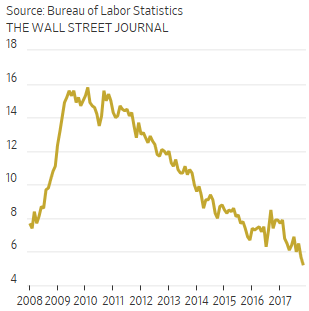
  • Economic growth is finally becoming robust.  We now have had two quarters in a row of 3% growth. In 2015 median household income grew by 5.2% with another 3.2% added in 2016. Blue collar wages are beginning to take off (see chart).  The overall unemployment rate has dropped to 4.1%. Even the unemployment rate for Americans age 25 and older, without a high school diploma, has dropped to 5.2% (see second chart).

Conclusion. The last thing our economy needs right now is the artificial stimulus caused by a deficit-financed tax cut. It is likely to overheat an already hot economy and thereby ignite inflation which will force the Federal Reserve to raise interest rates much faster than would otherwise be necessary.

Follow me on Twitter 
Follow me on Facebook 


Ignoring Massive Public Debt Is Morally Unacceptable


The House and Senate have now each passed their own versions of tax reform and a conference will come up with a single version acceptable to both legislative chambers. Each of the individual bills has been scored to add $1 trillion to the national debt over a ten year period and so the final bill will probably have the same feature.  This is a badge of dishonor on the controlling Republican Congress for the following reasons:

  • Yes, economic growth at 2.1% of GDP since the end of the Great Recession is too slow and has caused stagnant wages for millions of middle- and lower-income workers. Even though the unemployment rate has now dropped to 4.1% and the economy has grown at a rate of 3% for the past two quarters, there is still much labor slack to make up for.
  • Yes, the corporate tax rate is too high and encourages multinational companies to invest overseas. Immediate expensing for new business investment would also speed up growth and thereby create new jobs and higher wages.
  • Revenue neutral tax reform is “easily” accomplished by “simply” offsetting all tax rate cuts by closing loopholes and shrinking deductions by an equal amount. Since two thirds of taxpayers do not itemize deductions, it is primarily the higher income taxpayers who benefit from tax deductions and they can afford to pay higher taxes.

  • Current national debt, at 77% of GDP (for the public debt on which we pay interest), is the highest it has been since right after WWII, and is already predicted by the CBO to steadily keep getting worse. When interest rates eventually return to more normal and higher levels, interest payments on the debt will soar. And this will continue indefinitely, eventually leading to a new fiscal crisis, much worse than the Financial Crisis of 2008.

The GOP tax plan should be killed. Although a revenue-neutral tax plan could be put together and would be beneficial, the current plan makes our debt much worse and should be killed. We simply must make shrinking the debt a very high priority and not be distracted from getting this done.

Follow me on Twitter 
Follow me on Facebook 

The Republicans are Making a Huge Mistake with the Current Tax Plan by Appearing to be Fiscally Irresponsible


The House and Senate have now each passed their own similar tax bills and a conference will come up with a single unified plan. Each of the individual bills has been scored to add $1 trillion to the national debt over a ten year period and so the final plan will almost surely have this same feature.
With our public (on which interest is paid) debt now 77% of GDP, the highest since right after WWII, and already growing rapidly, this is an extremely unattractive, and even dangerous, feature of the tax plan.
One of our most cherished principles in the U.S. is “liberty and justice for all.”  But consider the normally perceived philosophical differences between the two political parties:

  • The Republicans are the party of liberty concentrating on providing maximum opportunity for people to succeed in life by realizing their full potential. This means fostering strong economic growth in order to have lots of opportunities for self-betterment. It also means keeping government at all levels as lean and efficient as possible, so as to minimize interference with private initiative. Excessive public debt is a particular anathema by creating a huge public burden, especially on future generations.

  • The Democrats are the party of justice concentrating on helping to provide the less fortunate members of society with the necessities of life by means of public support programs. This also means working to oppose all forms of prejudicial behavior based on race, gender, sexual orientation, etc. In addition it means trying to alleviate the inevitable income inequalities which arise in a free and dynamic society like ours, primarily with redistribution of tax revenues.

Conclusion. Both parties have fundamentally important principles. They gain and keep adherents by fighting for what they believe in. If the national Republican Party becomes lackadaisical about our huge national debt, as it appears to be right now, it risks losing its reputation for fiscal responsibility.  This will do it great damage.

Follow me on Twitter 
Follow me on Facebook 

What Ever Happened to Fiscally Responsible Tax Reform?


“I think this level of national debt is dangerous and unacceptable. My preference on tax reform is that it be revenue neutral.  What I’m hoping we will avoid is a trillion dollar stimulus.  Take you back to 2009.  We borrowed $1 trillion and nobody could find that it did much of anything.  So we need to do this carefully and correctly, and the issue of how to pay for it needs to be dealt with responsibly”

Senator Mitch McConnell (R, KY), 2016

Here is where we are today:

  • The world has seen remarkable human progress over the past 200 years. What has brought this about is specialization and trade, i.e. economic growth.
  • Since the end of the Great Recession in June 2009, economic growth in the U.S. has averaged just 2.1%, a remarkably slow recovery by historical standards. This has led to stagnant wage growth especially for blue collar workers. Finally growth is up over 3% for the past two quarters and wage growth is surging.
  • The U.S. corporate tax rate at 35% is not internationally competitive and encourages multinational corporations to move their operations overseas. A lower rate of 20% or so would encourage U.S. multinationals to bring their profits home and also encourage foreign companies to set up shop in the U.S.
  • What all of this means is that we still need tax reform (i.e. lower tax rates) but not fiscal stimulus.
  • The Republican tax plan now moving through Congress will increase our already outrageously excessive debt by $1 trillion over ten years, according to the Joint Committee on Taxation, the official scorekeeper for the U.S. Senate.
  • The Republican Congress will be making a huge mistake by implementing the current plan which has now passed both the House and the Senate. The GOP will no longer be able to make a credible case that it is the party of fiscal responsibility.

Conclusion. With a (public, on which we pay interest) debt of $15 trillion, and growing rapidly, the U.S. is approaching fiscal insolvency. The Republican tax plan will add an additional $1 trillion to this debt over the next ten years.  This is unconscionable behavior.

Follow me on Twitter 
Follow me on Facebook