The Economic Damage Caused by Very Low Interest Rates


As is well known, the Federal Reserve’s main tool in responding to the Financial Crisis in 2007 – 2009 has been quantitative easing (to lower long term interest rates) and direct reduction of the Federal Funds Rate (to lower short term interest rates). These measures definitely limited the severity of the Great Recession resulting from the Financial Crisis.  But the recession ended in June 2009, more than seven years ago.
Capture37In the meantime the continuation of such low interest rates is having many detrimental effects such as:

  • Pension funds, both public and private, have become greatly underfunded,  creating crises especially for state and local governments with defined contribution plans.
  • Retirement plans for millions of seniors have been upset by erosion of savings.
  • Inequality has increased as affluent stock owners benefit from the rapid increase of asset prices as investors reach for yield.
  • An immense misallocation of capital towards bond issuers at the expense of small business is taking place.
  • Federal debt is soaring as low interest rates make it much easier for Congress to ignore large budget deficits.
  • The next recession, when it inevitably arrives, will leave the Fed in a bind. The only tools remaining are a new round of quantitative easing (additional bond purchases) and even lower (i.e. negative) interest rates.
  • The Fed’s dual mandate of low unemployment (currently 4.9%) and price stability (low inflation) is being met but is accompanied by anemic GDP growth averaging only 2% since the end of the Great Recession. Such slow economic growth is largely responsible for the populist revolt in the 2016 presidential race.

Conclusion. Monetary policy can only accomplish so much. It is critical for the Fed to wind down its $4.5 trillion balance sheet as its bond holdings mature and to keep raising short term interest rates.  This will force Congress to step up to the plate with the changes in fiscal policy which are needed to stimulate economic growth.
Follow me on Twitter
Follow me on Facebook

How to Solve the Student Debt Problem: Grow the Economy Faster!


Based on a post I wrote last fall, “Solving the Student Debt Problem,” and a recent Op Ed by the economics journalist, Robert Samuelson, “Good News on the College Debt Front,” here is where I think we are on this serious problem:

  • The unemployment rate is very low for college graduates, about 2.5%. We should strongly encourage post-secondary education for all.
  • Since 1996 outstanding student loans have risen from $200 billion to $1.3 trillion.
  • Counting both community colleges, four year colleges and universities, 56% of college students borrow money to pay for college costs.
  • For undergraduates who attended two and four year colleges, more than half of loans were less than $20,000. Only 10% exceeded $40,000.
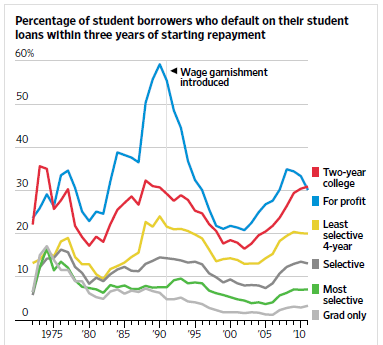
  • The highest default rates occur at community colleges (23% in 2012) and at for-profit colleges (18%). Hurt worst are low-income and minority students who never graduated but have unpaid debts.
  • The Federal Reserve Bank of New York has found a close correlation between subsidized loan and Pell Grant limits and the rapid increase of college tuition costs.

It seems clear that the way to address this problem is to focus on where it is worst: for the low-income and minority students who attend community colleges and for-profit colleges.
Capture36In other words:

  • Place a strict lid on the total amount of subsidized loans available for undergraduates, say $25,000 to $30,000 per person.
  • Use the savings achieved in doing this to increase the size of Pell grants for the lowest income students who need help the most.
  • Overall faster economic growth will help college graduates and dropouts alike find better paying jobs and make it easier for them to pay back their college debts.
  • On an individual basis, urge all students, but especially low-income and minority students, to avoid debt as much as possible in the first place!

Conclusion: Careful analysis of the student debt problem shows that there are very useful steps to take which will not cost the federal government more money.

Follow me on Twitter
Follow me on Facebook

Rising Prosperity around the World


My last post responds to a reader who is pessimistic about the future of our country and in fact of the whole world.  He thinks that the environment is deteriorating, that rapid economic growth is unsustainable and that there is too much income inequality between high and low wage earners.
My response to him is to refer to the recent book, “The Rational Optimist: how prosperity evolves” by Matt Ridley.  Mr. Ridley persuasively argues that not only has the human race made huge strides in recent times but that this progress is intrinsic to evolved human nature and is likely to continue indefinitely:

  • Since 1800 the population of the world has multiplied six times, yet average life expectancy has more than doubled and real income has risen more than nine times.
  • Between 1955 and 2005, the average human on earth earned nearly three times as much money (adjusted for inflation), ate one-third more calories of food, and could expect to live one-third longer, all this while world population doubled.
  • The rich have got richer but the poor have done even better. For example, the Chinese are ten times as rich, one-third as fecund, and 28 years longer-lived than fifty years ago. (Also see the above chart).
    Capture31
  • The spread of IQ scores has been shrinking steadily – because the low scores have been catching up with the high ones. This is known as the Flynn effect.
  • The four most basic human needs – food, clothing, fuel and shelter – have grown markedly cheaper during the past two centuries.
  • The most notorious robber barons of the late 19th century: Cornelius Vanderbilt, John D. Rockefeller, and Andrew Carnegie, got rich by making things cheaper.
  • Exchange and specialization, not self-sufficiency, is the route to prosperity.

Conclusion. As long as human beings are free to engage in exchange (trade) and specialization (acquisition of skills), prosperity will continue to evolve and human life will become better and better.

Follow me on Twitter
Follow me on Facebook

Optimism or Pessimism for the Future: Which Is More Justified?

Comments from a blog reader:

I also am concerned about consumption and waste/pollution – plastic in oceans getting into the food chain, CO2 affecting climate with animals not adapting quickly enough so that we are in the 6th great extinction. Is there a non-debt based economy, or conservation/conserve (vs consumption encouraged) economy that we can transition to?

I am a financial conservative, but have lost faith in the business community and financial sector because of the obscene multiples of pay for upper management vs worker pay. Government is not efficient but there needs to be a counter weight to multinationals and the concentration of wealth. Service and products lose value when they are given to people so a monetary incentive is needed, but the current capitalist model trajectory is not sustainable.

This is why I disagree with your desire to replicate post WWII production increases and growth. The context has changed since we do not have to rebuild from the destruction and disruption of WWII. The continued push for people to consume and take on debt makes one a slave to debt.                                                                                                                             

My response to these thoughtful comments will be divided into two parts. First of all I refer to the book, “The Rational Optimist: how prosperity evolves” by Matt Ridley. Mr. Ridley makes a powerful argument that life all over the world is getting better all the time. The two evolved habits of exchange and specialization, starting thousands of years ago, have created a collective brain that sets human living standards on a rising trend.
Capture31For example, referring to the first paragraph above:

  • Emissions from U.S. air pollutants such as carbon monoxide, nitrogen oxides and sulphur dioxide have been cut in half since 1980.
  • Species extinctions are at most 2.7% per century.
  • Suppose that temperatures rise by the IPCC’s most likely scenario of 3 degrees C by 2100. This means that the sea level will rise by one foot, the Greenland ice cap will melt by 1%, fresh water will increase because of more evaporation, and in a warmer, wetter world habitat lost to cultivation will shrink from 11.6% today to 5% in 2100.
  • A revenue neutral carbon tax is by far the best way to sort out the optimal response to global warming.

Conclusion: The environment is likely to be much improved by 2100. The world will also be much more prosperous in 2100 as I will discuss in my next post.

Follow me on Twitter
Follow me on Facebook

The Democrats Are Half Right (and Half Wrong!) on the Economy


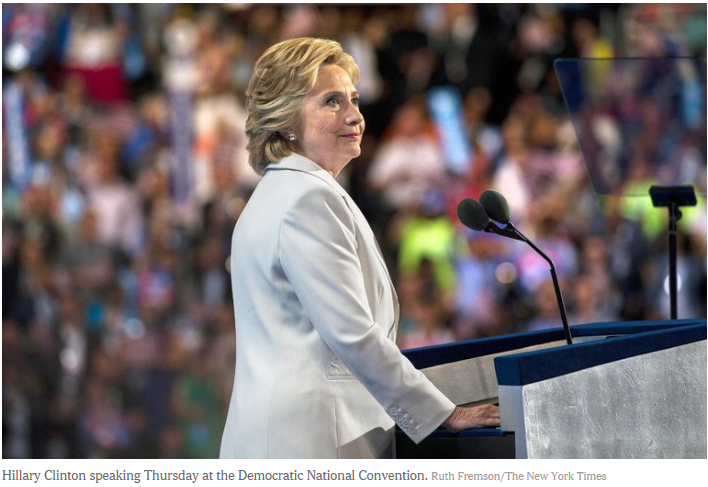
In my opinion both of the two main presidential candidates have overall poor economic plans.  But at least several major Democratic figures such as Hillary Clinton, the NYT columnist Thomas Friedman, and the economist Larry Summers do understand the importance of economic growth.
In particular, says Mr. Summers, “What is unfortunate is that many (progressives), in their eagerness to focus on fairness, neglect the single most important determinant of almost every aspect of economic performance – the rate of growth of total income, as reflected in the gross domestic product.”
Furthermore,

  • More growth means more employment. For each 1 point increase in adult male employment, the employment of young black men rises by 7%.
  • More growth reduces the need for desperation monetary policies that risk future financial stability.
  • If U.S. growth continues to have a 2% ceiling, it is doubtful if we will achieve any of our major national objectives. If we can boost growth to 3%, interest rates will normalize, middle-class wages will rise faster than inflation, debt burdens will continue to melt away and the power of the American example will be greatly enhanced.
  • The question is not whether business success is desirable. The question is how it can be achieved.

All of the above is very positive on the part of Mr. Summers. But then he adds, “What is needed is more demand for the product of business.  This is the core of the case for policy approaches to raising public investment and increasing workers’ purchasing power.”  In other words Mr. Summers is ignoring that:

  • Our national debt is huge and growing way too fast.
  • Wages are now increasing fairly rapidly which increases demand by itself.

    Capture27

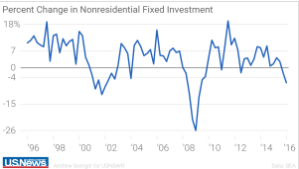
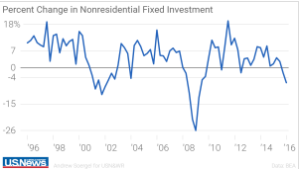
  • Investment in new business structures, equipment and intellectual property has now fallen for three quarters in a row.

    Capture28

Conclusion. The way to achieve the faster rate of growth which Mr. Summers (and almost everyone else) wants is not more public investment but rather more private investment. The House Republicans have a plan to accomplish exactly this.

Follow me on Twitter
Follow me on Facebook

Why We Should Be Deeply Worried about Our National Debt


My last post is highly critical of the economist and New York Times columnist, Paul Krugman, for encouraging massive new deficit spending to stimulate our under-performing economy.
Debt and the slow growth of our economy are the two main topics of this blog which I have now been writing for almost four years.  How to speed up growth is a complicated and highly charged political issue about which reasonable and well informed people can differ.  However avoiding excessive debt is to me a moral issue whose resolution should not be that difficult, at least in a conceptual sense.
Capture2 I have often used the above chart from the Congressional Budget Office to illustrate our debt problem because it clarifies the problem so vividly.  Here are its main features:

  • Our public debt (on which we pay interest), now about $13 trillion, is 75% of GDP, the highest since right after the end of WWII. And it is projected to keep getting steadily worse under current policy.
  • Note the decline in the debt from the end of WWII until about 1980. This doesn’t mean that the debt was actually paid off but rather that it shrank as a percentage of GDP as the economy grew fairly rapidly during this time period.
  • From 1980 – 2008 the debt level fluctuated and increased somewhat but did not get badly out of control.
  • Debt shot up rapidly with the Great Recession and has been continuing to grow ever since.
  • The current GDP of our economy is about $19 trillion. At a current growth rate of 2.1%, this adds $400 billion of GDP per year. This means that a $400 billion deficit for 2016 would stabilize the public debt at 75% of GDP. But our 2016-2017 deficit is projected to be almost $600 billion (and rising). This is not good enough!

Conclusion. In order to begin to shrink the size of the public debt, it is imperative that annual spending deficits be reduced to well below $400 billion per year. This will be difficult for our political process to achieve but it is the only way to avoid a new and much worse financial crisis in the relatively near future.

Follow me on Twitter
Follow me on Facebook

The Republican Party beyond Donald Trump


My last several posts have discussed the strengths and weaknesses of the U.S. economy and where the presidential candidates stand on the main issues.  As Donald Trump now slides further and further behind in the polls due to his juvenile tit-for-tat personality, his personal views matter less and less.
Capture31What does matter now is how the Republican Party will use the Trump disruption to broaden its appeal in the future. Here is a restatement of several of my ideas, influenced by two recent articles in the New York Times, here and here:

  • Reject tax cuts for the wealthy. But rather support tax rate cuts across the board, paid for by shrinking deductions which primarily benefit the wealthy. Such tax reform will give a sorely needed big boost to the economy.
  • Help workers displaced by foreign trade with expanded retraining programs and wage insurance. Increased globalization will also boost economic growth but it will stall without greater public support.
  • Acknowledge that universal health care is here to stay but push for market-oriented changes such as eliminating the mandates required by the ACA.
  • Disavow mass deportations but set up a firm border security program along with an adequate guest worker program to provide businesses the workers whom they are unable to hire locally. Again, legitimate immigration reform will boost the economy.
  • Admit that Invading Iraq was a mistake but nevertheless insist on a muscular foreign policy. U.S. economic and military strength provide peace and stability for the whole world including us.
  • Loosen up on social policy. Insist on restrictions on abortion (e.g. a 20 week cutoff) rather than abolition and work requirements for social welfare recipients rather than cutbacks in aid. In general turn over more social policy regulation to the individual states.

Conclusion. The U.S. badly needs more fiscally conservative national leaders. But conservatives will not prevail in the political process without using more common sense.

Follow me on Twitter
Follow me on Facebook

Amazing! Some Progressives May Actually Understand Economics


I have to constantly remind my readers that I am a non-ideological fiscal conservative. I simply want our national leaders to address our two most serious fiscal and economic problems which are:

  • Massive Debt. Our (public, on which we pay interest) debt is now 75% of GDP, the largest since WWII and steadily getting worse. When interest rates go up, as they surely will before long, interest payments on the debt will increase by hundreds of billions of dollars per year and become a huge drain on the federal budget, eventually leading to a new financial crisis, much worse than the last one.
  • Slow Economic Growth. The economy has grown at the average rate of only 2.1% since the end of the Great Recession in June 2009. Such slow growth means fewer new jobs for the unemployed and underemployed and smaller raises for all workers.

My last several posts, here and here have pointed out that neither of our two main presidential candidates is adequately addressing these issues.  Both of them claim that they want faster growth but their policy proposals will just make our humongous debt even worse.
Capture31So I was quite surprised by a column in yesterday’s New York Times by Thomas Friedman, “How Clinton could knock Trump out,” trying to “push Clinton to inject some capitalism into her economic plan.”  Says Mr. Friedman:

  • Clinton could be reaching out to center-right (and anti-Trump) Republicans with a real pro-growth, start-up, deregulation, entrepreneurship agenda.
  • If Clinton wins, she will need to get stuff done, not just give stuff away.
  • The concerns of the Sanders supporters with fairness and inequality can only be addressed with economic growth; the rising anti-immigration sentiments can be defused only with economic growth; the general anxiety feeding Trumpism can be eased only with economic growth.

Conclusion. I am pleased to hear such sensible thoughts from one of the leading columnists of the NYT. If Clinton wins the election (as I expect) and if the Republicans continue to hold the House of Representatives (as I fervently hope), there could be much common ground for constructing an intelligent agenda going forward.

Follow me on Twitter 
Follow me on Facebook

What Is Right and Wrong With the U.S. Economy


My last several posts have discussed the poor economic proposals of both major presidential candidates. Today’s New York Times has an excellent article by Neil Irwin, “Here’s What’s Going Right and Wrong in the U.S. Economy.”  According to Mr. Irwin and the NYT:

  • GDP Growth Disappointing. GDP growth was only 1.2% in the second quarter of 2016 and in fact has now averaged only 1.2% for the past year, much lower than the 2.1% average growth since the end of the Great Recession in June 2009.Capture30
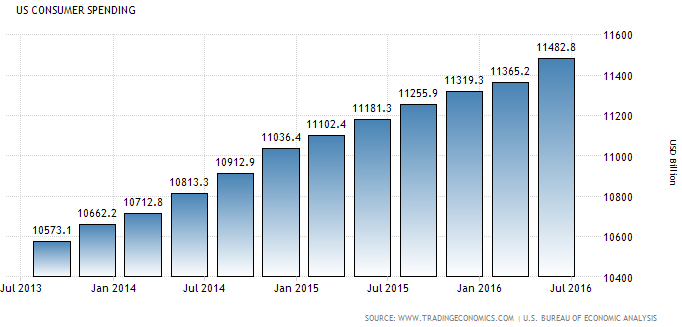
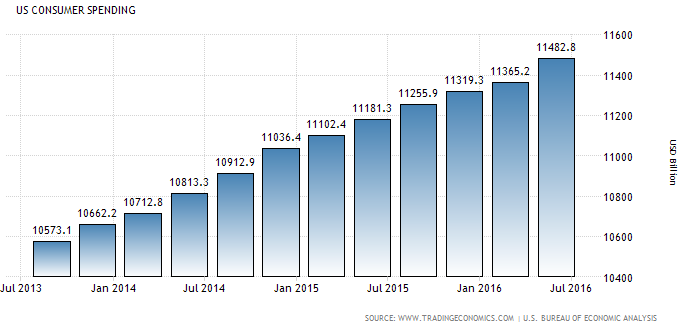
  • Consumers Spending Money. Consumer spending was up 4.2% in the second quarter continuing a long term trend. This means that there is plenty of demand for new products in the economy.Capture26
  • Wages Rising More Quickly. Total compensation is not only rising but the wage and salary component, not counting benefits, is up 2.5% over one year ago. This means that consumers have more money to spend.Capture27
  • Investment Shrinking. Investment in new business structures, equipment and intellectual property has now fallen for the third consecutive quarter.  Eventually, if not turned around, this decrease in new investment will lead to fewer jobs and less consumer spending.Capture28
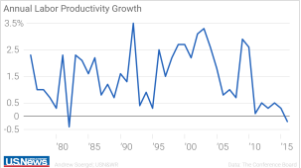
  • Poor Productivity Growth. Labor productivity fell .6% in the first quarter of 2016, a continuing slide. Weak productivity growth is a grave threat to long term prosperity in the U.S.Capture29

Conclusion. Wages are going up and consumers have money to spend. But worker productivity can only increase when business makes new investment.  This is not happening nearly fast enough. The House Republicans have an excellent plan to encourage business investment.
Is either presidential candidate paying attention to this opportunity to speed up economic growth?
I, for one, am waiting to find out!

Follow me on Twitter
Follow me on Facebook


The Presidential Candidates Are Clueless on the Economy


My last several posts, here and here, have discussed the economic plans of both Hillary Clinton and Donald Trump.  In short,

  • Ms. Clinton wants “equitable” growth meaning huge new public spending on such things as infrastructure, free public college tuition universal pre-K education as well as increasing the minimum wage to $15 per hour nationally and mandating paid family leave. More public spending and new mandates will provide only minimal economic growth.
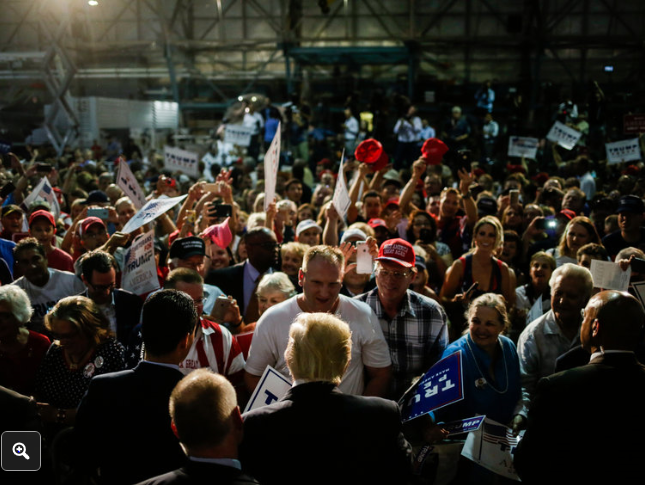
  • Mr. Trump wants to restrict the labor force with immigration controls and raise the price of imports with new tariffs. He would also cut tax rates across the board (good idea) but in such a way that would increase the national debt by $10 trillion over the next ten years (very bad idea).

They both need to take our actual current economic situation into account as follows:

  • The U.S. is in its weakest recovery since post WWII. The average growth rate of 2.2% for 2012 – 2015 has now stalled in the past year to just barely 1%.

    Capture25

  • Consumer spending has been increasing steadily and rose 4.2% in the second quarter of 2016. In other words, consumer demand is at a high level.

    Capture26

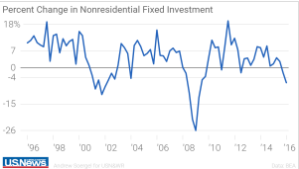
  • The problem is that business investment, i.e. supply, has decreased.

    Capture24

The House Republicans have “a better way.” Their tax reform plan, among many other good features, would

  • Lower the top corporate tax rate from 35% to 20% and establish a territorial system, to encourage multinational corporations to produce in the U.S. as well as bringing their foreign earnings back home for reinvestment.
  • Provide a tax-free return on new investment by allowing, for the first time ever, for full and immediate write-offs.

Conclusion. The House Republicans have a sensible plan for getting our country back on a much faster economic growth track. Regardless of who is elected president, the House is likely to stay under Republican control.  I am waiting to see if either of the presidential candidates will figure this out and adjust their campaign messages accordingly.

Follow me on Twitter
Follow me on Facebook