What the Federal Reserve Can and Can’t Do


I have a good impression of Ben Bernanke, chair of the Federal Reserve from 2006-2014. Partly because he comes across as being both competent and honest and partly because Sheila Bair, chair of the Federal Deposit Insurance Corporation from 2006-2011, and whom I greatly admire, gives him high marks in her book, “Bull by the Horns,” about the financial crisis.
CaptureMr. Bernanke has an excellent Op Ed in yesterday’s Wall Street Journal, “How the Fed Saved the Economy,” clearly describing what the Federal Reserve both can and can’t do. What it can do is:

  • Make recessions less severe. The unemployment rate has been steadily dropping and now is apparently almost back to normal at 5.1% even though the relatively low labor-force participation rate and lack of wage pressure indicate remaining weakness.
  • Keep inflation low and stable. The Fed’s expansionary monetary policy has helped bring down unemployment without igniting inflation whose underlying rate is currently only 1.5%.

Mr. Bernanke states that “the Fed has little or no control over long-term economic fundamentals – the skills of the workforce, the energy and vision of entrepreneurs, and the pace at which new technologies are developed and adapted for commercial use.” He goes on to say that “further economic growth will have to come from the supply-side, primarily from increases in productivity. … Fiscal-policy makers in Congress need to step up” by adopting policies to:

  • Improve worker skills. (how about immigration reform, better vocational education, reforming SSDI and expanding the EITC to boost incentives to work)
  • Foster capital investment. (how about both individual and corporate tax reform and relaxing Dodd-Frank regulations on main street banks)
  • Support research and development. (how about making life easier for entrepreneurs with fewer regulations)

Mr. Bernanke has a very good handle on our current financial situation. The Federal Reserve has done and is doing its job. It’s time (long past time!) for fiscal policy makers (i.e. Congress and the President) to adopt policies, such as above, to speed up economic growth.

The Second Republican Presidential Debate


Although I am a registered Independent, I lean strongly conservative on fiscal and economic issues. I hope the Republican Party ends up with a nominee who can make a compelling case for fundamental reform.
CaptureHere is my take on last night’s debate and the current state of the race.

  • Rand Paul. He stands up strongly for the Tenth Amendment (State’s Rights) but he is much too isolationist to take over after eight years of Obama.
  • Mike Huckabee. His social conservatism appeals to evangelicals but he has a weak grasp of economic and fiscal issues.
  • Marco Rubio. He is certainly a gifted political communicator. He is able to talk tough while also appearing moderate and reasonable at the same time. But some of his policy ideas are gimmicky.
  • Ted Cruz. He claims to be a true conservative because he won’t compromise on his basic principles, even if they lead to government shutdown. As such he is much too radical for my taste.
  • Ben Carson. I don’t see what his attraction is outside of a compelling personal story. His grasp of issues is quite weak.
  • Donald Trump. Leading in the polls, he is the wild card for the 2016 election cycle. As much as he disgusts me, his performance is improving. He has pledged to support the eventual party nominee, and not run as an independent. He also hurled fewer insults in the second debate than in the first.
  • Jeb Bush. Policy-wise, with his detailed tax plan and generally moderate views, he is outstanding. But it’s not clear that he can overcome the populist, anti-elite mood of the electorate.
  • Scott Walker. His outstanding record in Wisconsin gave him an early boost. But he hasn’t made the transition to national policy issues very well.
  • Carly Fiorina. She expresses herself in a crisp manner and has a good, general grasp of the issues. She’s rising in this campaign but still has a long way to go.
  • John Kasich. He has a superb background as a former Congressman and now as a very successful two term governor of Ohio. He expresses compassion for ordinary people. He deserves to climb in the polls but will he?
  • Chris Christie. He’s tough talking but his record in New Jersey isn’t that great. His obesity and reputation as a bully are turnoffs for me.

In short, I don’t want Trump to be the Republican nominee but who is going to emerge from the pack to defeat him? It isn’t clear if anyone will be able to do this.

Jeb Bush’s Tax Plan: Both Good and Bad


Republican presidential candidate Jeb Bush has just released his tax reform proposal, “My Tax Overhaul to Unleash 4% Growth.” It has many good features such as:

  • Lowering and consolidating seven current tax brackets into three: 10%, 25% and 28%.
  • Essentially doubling the standard deduction for most filers, thereby achieving huge simplification for millions of average income filers.
  • Eliminating the state and local income tax deductions and capping all others, except for charitable deductions, at 2% of Adjusted Gross Income.
  • Doubling the Earned Income Tax Credit for childless filers, thus encouraging more low income people to work.
  • Exempting taxpayers over the age of 67 from the employee-side payroll tax, encouraging them to stay in the workforce longer.
  • Cutting the corporate tax rate from 35% to 20%.
  • Allowing 100% immediate expensing for all capital investments, including inventories.
  • Creating a territorial tax system so that multinationals are not taxed on foreign earnings, and therefore incentivized to bring their foreign profits home.
  • Eliminating the deductibility of interest expenses.

The lower individual and corporate tax rates, together with the separate investment and work incentives, will create a significant economic stimulus estimated to raise GDP by at least .5% per year or higher, depending you who ask.
According to the Tax Foundation, however, the plan would reduce federal revenue on a static basis by $3.66 trillion over ten years, and even by $1.6 trillion on a dynamic basis, taking into account the new tax revenue generated by the plan.
CaptureThis is, of course, a huge problem. We badly need to speed up economic growth but we also need to lower, not increase, our annual deficit spending in order to put our debt on a downward path as a percentage of GDP.
The resolution of this quandary is to tighten up on those deductions, such as for mortgage interest, remaining in the code and also lessening the amount of the tax cuts if necessary in order to achieve overall revenue neutrality for the plan.

The Slow Growth Economy We’re Stuck In


We have very high debt and Paul Krugman says in “Debt Is Good” that we need more! The Congressional Budget Office’s latest report this week, “An Update to the Budget and Economic Outlook: 2015 – 2025” predicts slow economic growth for the next ten years, averaging 2.1% per year (see chart below).
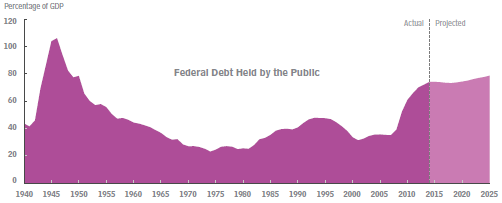
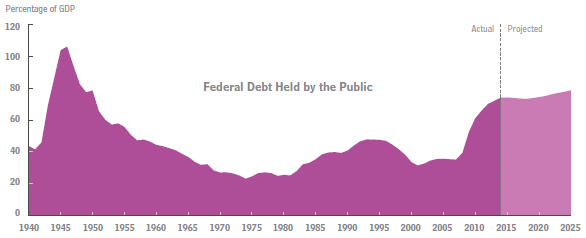
CaptureUnfortunately, high debt and slow growth are a deadly, self-reinforcing, combination. Today’s Wall Street Journal has a chart (pictured below) showing clearly how budget deficits are likely to increase over the next ten years. The public debt (on which we pay interest) is predicted to grow from 74% of GDP today to 77% of GDP in 2025, increasing by a total of $7 trillion over this time period.
Capture1Here is another connection between slow growth and high debt:

  • Slow Growth means higher than necessary unemployment and under-employment as well as minimal raises for employed workers. The resulting economic slack leads to
  • Low Inflation. But low inflation means that the Federal Reserve can maintain
  • Low Interest Rates to try to encourage more borrowing to stimulate the economy. This means, in turn, that Congress can run up huge deficits without having to pay much interest on this almost “free” money. This eventually leads to:
  • Massive Debt. But what happens when inflation does take off, which has happened before and is likely to happen again? Then the Federal Reserve is forced to raise interest rates quickly and we are stuck with huge interest payments on our accumulated debt. And meanwhile entitlement spending on Social Security, Medicare and Medicaid is also growing rapidly. At this point debt increases very rapidly which leads to a severe
  • Fiscal Crisis.

Of course things don’t have to happen like this. Congress might become more responsible and either cut spending and/or raise taxes and start shrinking our huge deficits. Or perhaps slow growth really is the new normal and interest rates will remain low indefinitely. But slow growth is not pain free; there are many millions of unemployed and under-employed Americans who want to work and whose lives are stunted otherwise.
Slow growth is a very destructive path to be following. We badly need to adopt policies to speed it up!

Paul Krugman: “Debt Is Good”


Every Monday and Friday morning when I pick up the New York Times, I immediately turn to the OP-ED page to see what liberal icon Paul Krugman is saying. In his most recent column, “Debt Is Good,” he says that “what ails the world economy right now is that governments aren’t deep enough in debt.”
CaptureHere is my response to his argument:

  • “The federal government can (now) borrow at historically low interest rates. So this is a very good time to be borrowing and investing in the future.” Our public debt (on which we pay interest) is now $13 trillion or 74% of GDP, the highest since the end of WWII, as shown in the above chart from the Congressional Budget Office. It is likely that interest rates will soon begin to go up. Every 1% rise will increase interest payments on our already existing debt by $130 billion per year. Where are the hundreds of billions of new dollars for debt service going to come from in an already tight budget? The more we add to the debt, the worse this problem will become.
  • “Having at least some government debt helps the economy function better.” I agree! But $13 trillion is way beyond what is needed for this. It is outrageously excessive!
  • “What we need are policies that would permit higher (interest) rates in good times without causing a slump. And one such policy would be targeting a higher level of debt.” The problem here is the conceit of Keynesians, like Mr. Krugman, that monetary policy alone can restore us to economic and fiscal health. Rather than accepting that the economy has entered a “new normal” with a permanently slow growth rate of about 2% (as has been the case since the end of the Great Recession in June 2009), we need policy changes such as individual and corporate tax reform (revenue neutral to be sure) and changes in the Affordable Care Act and Dodd-Frank Act to remove their job killing features.


Anybody with an ounce of common sense knows that excessive borrowing will eventually lead to disaster. Mr. Krugman seems to think that by constantly ridiculing his opponents, he can get away with denying this simple truth.

How to Avoid a New, and Much Worse, Financial Crisis


Is it possible for the U.S. to effectively address its enormous debt problem in today’s contentious political environment? Two weeks ago I discussed in “America’s Fourth Revolution” why the political scientist James Piereson thinks this is impossible. He is very persuasive but I think he is too pessimistic.
CaptureSince then I have discussed several different things we should do to turn around this perilous situation:

  • If spending for just Medicare and Medicaid (two very expensive entitlement programs) alone fell by 25% over ten years, as a percentage of GDP, and then stayed in line with GDP after that, the U.S. would actually have a budget surplus in 2040.
  • Just recognizing the magnitude of our debt problem would do wonders in public awareness.
  • If the Tea Party were able to grow beyond a protest movement and unite the country behind a majoritarian agenda of work, mobility and opportunity, it would be much more effective in achieving its fiscally conservative goals.
  • Another significant way to save money, and get better results at the same time, is to turn over more and more programs to the states. A good way to do this is with block grants to the states for federal programs in such areas as welfare, education and Medicaid. This would give the states more flexibility to get the job done in an efficient and cost saving manner.

What we need to do to turn our debt situation around is to greatly shrink our annual deficits below their current level of about $450 billion per year. If the debt is growing slower than the economy, then it will shrink as a proportion of the economy. This is what happened after WWII (see above chart) and it needs to happen again now!

Prominent Myths about Our National Debt


As the 2016 presidential election contest begins to heat up, the Committee for a Responsible Federal Budget and its outreach arm, Fix the Debt, have issued a new “Fiscal FactChecker: 16 Budget Myths to Watch Out For in the 2016 Campaign.”  Here are four of the major myths:

  • We Can Continue Borrowing Without Consequences. “Low interest rates are a temporary consequence of the struggling global economy and near term Federal Reserve actions – not a permanent fixture.”

    Capture4

  • There is No Harm in Waiting to Solve Our Debt Problems. “The longer policy makers wait to control debt, the more difficult it will become. For example, reducing debt to around the historical average of about 40% of GDP by 2040 would require tax increases or spending cuts of about 2.6% of GDP per year, if enacted today, or starting at $1,450 per person per year. Waiting a decade to begin would require adjustments of over 4% of GDP.”
  • Deficit Reduction is Code for Austerity, Which Will Harm the Economy. “Most advocates of fiscal responsibility in the U.S. have called for gradual reductions in long-term deficits so that the debt grows slower than the economy. These changes tend to have minimal near-term effects as well as the potential to significantly grow the size of the economy over the long term.”
  • We Can Fix the Debt Solely by Taxing the Top 1%. “The top 1% of earners, households that make at least $450,000 annually, earn a substantial share of national income, about 13% on an after tax basis, and further tax increases on this group could help. But these increases would need to be combined with reductions in spending growth and/or broader tax increases to fully address the nation’s fiscal challenges.”

Just a few days ago, I described a persuasive argument, “America’s Fourth Revolution,” that our hyper-partisan and dysfunctional political system will be unable to rectify our debt problem until we have another and much more severe financial crisis. The above discussion of budget myths from CRFB actually suggests a way forward to solve our debt problem.
We have a choice. Which path will we take?

Can America’s “Fourth Revolution” Be Avoided?


My last post, “America’s Fourth Revolution,” presented a persuasive argument by the political scientist, James Piereson, that our currently dysfunctional political system will be unable to solve our most fundamental problems of massive debt, accompanied by a rapidly aging population and slowing economic growth. This will result, according to Mr. Piereson, in a severe crisis leading to a fourth revolution, overthrowing the New Deal liberal consensus which has prevailed since 1932.
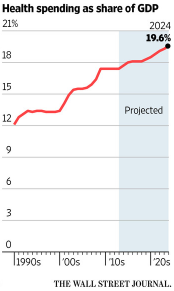
It is commonly understood that entitlement spending: Social Security, Medicare and Medicaid, is the main driver of our rapidly growing national debt. A recent report from the Centers for Medicare and Medicaid Services, summarized in the Wall Street Journal, shows that U.S. healthcare spending is likely to rise from just under 18% today to 19.6% of GDP in 2024.
Capture2Barron’s editor, Thomas Donlan, has just reported that the Director of the Congressional Budget Office, Keith Hall, stated in a recent hearing of the Senate Budget Committee that if spending for Medicare and Medicaid, as a percentage of GDP, fell by 25% over ten years, and then stayed in line with GDP after that, the U.S. would have a budget surplus of 2% of GDP in 2040 instead of the otherwise projected deficit of 6.6% of GDP. Furthermore debt held by the public would fall to 24% of GDP, a remarkable achievement.
This is significant because one country, The Netherlands, spends 12% of GDP on healthcare, and every other country in the world (except for the U.S.) spends less than 12%.
Conclusion: all the U.S. needs to do, so to speak, is to bring healthcare costs in line with the rest of the world and our entire deficit spending problem would be solved! Nobody is claiming that this will be easy but it certainly is within the realm of possibility. It is also far superior than waiting to act until we have another fiscal crisis and thus risking a huge change, a revolution, in our way of life.

America’s Fourth Revolution


The Manhattan Institute’s James Piereson has written a fascinating new book, ”Shattered Consensus: The Rise and Decline of America’s Postwar Political Order” in which he argues that the New Deal liberal consensus has broken down and will soon be replaced by a new model containing several specific features. The coming new model will be the result of a Fourth Revolution of comparable scope to the first three:

  • A Democratic-expansionist regime from 1800 until 1860 which dissolved in the midst of the slavery and secession crisis.
  • A Republican-capitalist regime from 1860-1930, which was brought down by the Great Depression.
  • A Democratic-welfare regime from 1932 until the present, although with faltering support after 1980.

America’s third regime is in the process of fading out or collapsing for three reasons:

  • Debt. The national debt of $18 trillion today, at about 100% of GDP, is comparable to the debt at the end of WWII. But once the war ended the government cut spending and stopped borrowing and the U.S. economy grew at 4% for the next 20 years. Nothing comparable to this major debt reduction is in sight today.
  • Demography. Today there are about 160 million people in the U.S. workforce of whom 120 million have full time jobs. The workforce will grow by 1 million per year for the next ten years while the number of people turning 65 will grow at nearly twice that rate. The nation will soon reach a point where 150 million working people will be paying payroll taxes to support 80 million people on Social Security and Medicare. Political leaders are doing nothing to address this looming crisis.

    Capture5

  • Slowing Economic Growth. The chart above shows how the U.S. economy has been slowing since the 1960’s. Since the end of the Great Recession in 2009, GDP has grown at only 2.2% and is likely (CBO) to continue growing indefinitely at this slow rate under current policies. The second chart shows the enormous difference between 2% growth and, for example, even 3% growth over time.

    Capture6Why don’t Congress and the President deal with these problems now, before they reach the point of crisis?   It’s because Congress has become increasingly polarized, with Democrats having moved leftward and Republicans moving rightward. Polarization is characteristic of regimes as they begin to tear themselves apart in conflicts which defy resolution within the existing structure of politics.
    My approach on this blog is that these very severe problems can be solved by politicians working together in a cooperative way. Mr. Piereson makes a very persuasive case that this is not likely to happen and that it will take a huge new crisis, a revolution, to straighten things out.
    I hate to say so but he may be right.

Richer and Poorer


As I often remind readers, this blog is primarily concerned with three basic fiscal and economic problems facing the U.S. They are: 1) our stagnant economy, 2) our massive debt, and 3) income inequality. Today I discuss inequality. The March 16 2015 issue of the New Yorker contains an extensive article on this topic by Jill Lapore, “Richer and Poorer.” However it suffers a common defect of only presenting one side of a complex issue.
There are facts about inequality which more people need to be aware of. For example:

  • The scope of income inequality is greatly reduced once incomes are adjusted for government transfers and federal taxes as shown in the following chart from the Congressional Budget Office.
    Capture
  • There is a strong correlation between inequality and growth as shown by the second chart just below from the World Bank.
    Capture2
  • Globalization has had a dramatic effect on incomes world-wide as low skill work has shifted from the developed world to the developing world as shown in the chart below from the Wall Street Journal. Hundreds of millions of people in the developing world have been lifted out of poverty at the cost of lost jobs to low skill workers in the U.S. and other developed countries.
    Capture3Any effective strategy for decreasing income inequality needs to be reality based. Yes, it exists but its severity is exagerated. The Americans who need help the most are the ones unlikely to either attend or graduate from college. What they need most is vocational training to prepare them for the millions of high skill jobs going begging in the U.S.
    The best thing we can do to decrease income inequality in the U.S. is to get our economy growing faster. Since the end of the Great Recession in June 2009, it has grown at the historically slow rate of 2.2% of GDP and this slow rate of growth is predicted (by the CBO) to continue indefinitely under current government policies. A return to the historical 3% growth rate would create jobs and better jobs for millions of the unemployed and under-employed as well as providing bigger raises for the middle class as employers have to compete for qualified workers.
    How can we make the economy grow faster? I have addressed this critical issue many times and will return to it soon.