Do We Need a New School of Economics?


“Consider the following scenario. You are an airline pilot charged with flying a planeload of passengers across the Atlantic. You are offered the choice of two different aircraft. The first aircraft has been prepared by chief engineer Keynes and the second by chief engineer Hayek.
You have to choose which plane to use, so naturally you ask the advice of the two engineers. Keynes urges you to use his aircraft, offering a convincing explanation of why Hayek’s plane will crash on take-off. Hayek urges you to use his aircraft, offering an equally convincing explanation of why Keynes’s plane will crash on landing.

At loss as to which plane to choose, you seek the advice of two leading independent experts – Karl Marx and Adam Smith. Marx assures you that it does not matter which aircraft you choose as both will inevitably suffer catastrophic failure. Similarly, Smith also reassures you that it does not matter which aircraft you choose, as long as you allow your chosen craft to fly itself.”
Thus begins a fascinating new book, “Money, Blood and Revolution: How Darwin and the doctor of King Charles I could turn economics into a true science,” by the fund manager and economist, George Cooper.
CaptureMr. Cooper sets up a circulatory model of democratic capitalism whereby rent, interest payments and profits flow from low income people at the bottom of the pyramid to the wealthy at the top. And then tax revenue (collected mostly from the wealthy) is redistributed downward in the form of government programs.
According to Mr. Cooper, the financial crisis was caused by a combination of lax regulation and excessive credit and monetary stimulus. The question is what to do about it. Mr. Cooper says:

  • Stop adding to the problem. High student debt and high mortgage debt are still being supported by government programs.
  • Change the course of the monetary river. Quantitative easing does not work because it just puts money into the hands of the wealthy and they have no incentive to spend it.
  • Change the course of the fiscal river. Instead put money into the hands of the people at the bottom of the pyramid with expanded government spending on infrastructure (paid for by taxing the wealthy).

Without endorsing all of Mr. Cooper’s suggestions, he nevertheless has many good ones and expresses them in a highly entertaining style!

Who Are the Enemies of the Poor?


In his usual provocative fashion, New York Times columnist Paul Krugman says that Republicans are “Enemies of the Poor” because “they’re deeply committed to the view that efforts to aid the poor are actually perpetuating poverty, by reducing incentives to work.”
CaptureBut the Heritage Foundation’s Robert Rector has recently pointed out in the Wall Street Journal, “How the War on Poverty Was Lost”, that “the typical American living below the poverty line in 2013 lives in a house or apartment that is in good repair, equipped with air conditioning and cable TV.  He has a car, multiple color TVs and a DVD player.  The overwhelming majority of poor Americans are not undernourished and did not suffer from hunger for even one day of the previous year.”  In fact we are now spending $600 billion a year of our $3.4 trillion federal budget and another $230 billion by the states to fight poverty.  The poverty rate was 19% in 1964 and is 16% today (when government benefits are included).
Mr. Rector reminds us that “LBJ’s original aim (in initiating his antipoverty program) was to give poor Americans ‘opportunities, not doles’.  It would attack not just the symptoms of poverty but, more important, remove the causes.  By that standard, the war on poverty has been a catastrophe.  The root ‘causes’ of poverty have not shrunk but expanded as family structure disintegrated and labor force participation among men dropped.”
So what should our poverty agenda look like going forward?  We are already providing the basic necessities of life.  Our future efforts should therefore be focused on improving the quality of life for the poor.  This means more effective education and job training.  It means more effort to keep families together by reducing marriage penalties.  But most of all it means providing more opportunities for employment and job advancement.  This requires faster economic growth.  There are many ways to accomplish this.  Back to square one!
The true enemies of the poor are those who refuse to accept the progress which has been made in the War on Poverty and the need to change our approach in order to make further progress.

How Do We Increase Economic Mobility?


As the Wall Street Journal reported several days ago, “Economic Mobility Is the New Flashpoint”.  “Both parties agree the opportunity gap is widening, but the proposed solutions are starkly different.”  The Democrats want to increase the minimum wage, extend unemployment benefits, and expand access to college.  The Republicans suggest a whole potpourri of approaches such as reforming welfare (including food stamps), extending school choice, cutting taxes, and relaxing regulations on new businesses.
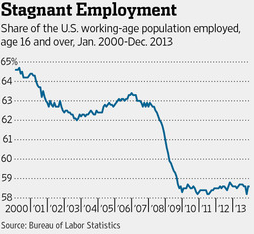
A look at the latest jobs report from the Labor Department should provide the focus which Congress needs to figure out how to increase economic opportunity.  Although the unemployment rate dropped substantially to 6.7% from 7.0% at the beginning of December, only 74,000 new jobs were created in December.  The explanation is that 347,000 left the labor force last month.  The labor force participation rate, the share of the U.S. working-age population employed, age 16 and over, has dropped from 64.5% in 2000, to just under 63% at the beginning of 2008 to near a post-recession low of 58.6% last month (see chart below).
CaptureIn other words, Congress should be totally focused on speeding up economic growth in order to create more jobs.  Since new businesses create the most new jobs, we should indeed relax as many regulations as possible which impede entrepreneurship.  We should lower the corporate tax rate from its very high current value of 35% to get American multinational companies to bring their trillions of overseas profits back home for reinvestment in the U.S.  Moving to a national consumption tax (see the Graetz Plan discussion in my January 7 post), could mean dropping the corporate tax rate to as low as 15%.
Isn’t is obvious that the best thing we can do to give low income people an opportunity to rise up the economic ladder is to just give them a job in the first place?  If they’re ambitious they’ll take any opportunity they can get and run with it!

Why a High Corporate Income Tax Is So Damaging to Our Economy


My previous post, “Fundamental Tax Reform Is the Key to Solving Our Economic and Fiscal Problems II.  The Graetz Plan”, describes a tax reform plan which establishes a 14% national consumption (VAT) tax, exempts families earning under $100,000 from paying any income tax and also reduces the Corporate Income Tax to 15%.  All of this is done in a revenue neutral manner while also preserving all of the progressivity of our current income tax system.
CaptureA recent Op Ed column in the New York Times, by the economist Lawrence Kotlikoff, “Abolish the Corporate Income Tax”, makes the case that such a proposal “might sound like a gift to the rich, but it would actually help workers. … Apple’s tax return says it all:  The company, according to one calculation, paid only 8% of its worldwide profits in United States corporate income taxes, thanks to piling up most of its profits and locating far too many of its operations overseas.”
Our corporate income tax rate, at 35%, is one of the highest in the world and this is what encourages American multinational companies to move their business to other countries.  Whether we abolish the corporate income tax entirely, or just reduce it to 15%, is less important than recognizing the need to overcome popular prejudice about big business and make fundamental changes in our tax structure.
Solving our country’s many problems, from rising inequality at home to projecting adequate strength around the world, requires that the U.S. have a strong economy.  An annual growth rate of 2% of GDP is not nearly good enough to end our current economic stagnation.  To accomplish this will require overcoming the strong headwinds of increasing global competition and the replacement of people with machines.  We will need innovative thinking and initiative to break out of the old ways of doing things which are holding us back.
Are the American people “exceptional” enough to accomplish this challenging task?

How to Get the Economy Back on Track


Harvard Economist, Martin Feldstein, has an Op Ed column in yesterday’s New York Times, “Saving The Fed From Itself”, which gets our current economic situation half right.  First of all, Mr. Feldstein says that the Fed’s quantitative easing policy is inadequate because “the magnitude of the effect has been too small to raise economic growth to a healthy rate.  … The net result is that the economy has been growing at an annual rate of less than 2 percent.  … Weak growth has also meant weak employment gains.  … Total private sector employment is actually less than it was six years ago.  … While doing little to stimulate the economy, the Fed’s policy of low long-term interest rates has caused individuals and institutions to take excessive risks that could destabilize the economy just as it did before the 2007-2009 recession.”  So far he’s right on the button!
But then he goes on to say, “To get the economy back on track,” Congress should enact a five year plan to spend a trillion dollars or more on infrastructure improvement and that this would “move the growth of gross domestic product to above three percent a year.”  An artificial stimulus like this might work temporarily but then it ends and we’re back where we started.  We need a self-generating stimulus that will keep going indefinitely on its own.  How do we accomplish this?
The answer should be obvious.  We do it by stimulating the private sector to take more risk in order to generate more profits. In the process they will hire more employees and boost the economy.
How do we motivate the private sector?  By lowering tax rates and loosening the regulations which stifle growth.  Closing tax loopholes and lowering deductions (which will raise revenue to offset the lower tax rates) has the added benefit of attacking the corporate cronyism which everyone deplores.
We really do need to put first things first.  If we can jump start the economy by motivating the private sector to invest and grow, we will have more tax revenue to spend on new and expanded government programs as well as shrinking the federal deficit.
Why is this so hard for so many people to understand?

Should the Employer Mandate Be Repealed?


In last Sunday’s New York Times the columnist Ross Douthat makes an excellent case in “A Hidden Consensus on Health Care”,  that Obamacare’s employer mandate, recently postponed for one year until January 1, 2015, should be repealed altogether.  The reason for delaying its implementation is because of the complexity of the process for the government to gather all the necessary information about a company’s employees and coordinating with IRS tax returns to verify incomes.  This is, of course, a mammoth job.
Furthermore, small and medium sized companies, near the 50 employee cutoff for mandatory coverage, will not have to immediately slow down their growth, in order to avoid the health insurance requirement.  This could help boost the economy in the short turn.
In addition, as Mr. Douthat points out, it is the tax exemption for employer provided health insurance which is the biggest impediment for getting the cost of healthcare under control.  It means that employees are shielded from the true costs involved in receiving care and therefore have little, if any, incentive to hold down the cost of their own care.
If this tax exemption was eliminated, perhaps as part of a broad based tax reform initiative, then employers could still offer an optional health insurance benefit to their employees but it would be taxed as part of their total pay.  This would give employees an interest in holding down the cost of their own insurance.  And they would also have the option to shop around on the private market, perhaps on the new exchanges, for a better deal.
The Employer Mandate is thus altogether a dead weight on our struggling economy.  It’s certainly beneficial to have it postponed for a year.  Let’s go the rest of the way and repeal it altogether!   This would be a significant step towards true healthcare reform!

Why is Healthcare so Expensive?

Time Magazine has just published its longest article ever, a 25,000 word piece by Steven Brill, entitled Bitter Pill: Why Medical Bills Are Killing Us.  The article contains one example after another of outrageous medical bills being charged to people who are the least able to pay, either the indigent or the uninsured.  Mr. Brill’s solution to this horrible mess is for the government, i.e. the bureaucracy now being expanded by the Affordable Care Act, to do a much better job of using its clout to control costs.

But there is another point of view about what is wrong with our healthcare industry and what can and should be done to make it far more efficient and enable it to provide us with quality care at a much lower cost.  David Goldhill provides a roadmap to a consumer-driven healthcare system with his new book, Catastrophic care: How American Health Care Killed My Father and How we Can Fix It

Mr. Goldhill’s proposal is to introduce true competition, not quasi competition dictated by over-burdensome bureaucratic rules, into the American healthcare system.  In other words, let the marketplace figure out what works best by trial and error, rather than expecting even the brightest and most well-meaning experts to be able to figure it out a-priori.  There would still be massive government sponsored programs, such as cradle-to-grave catastrophic insurance and mandatory health accounts, to provide universal care for all.  But the myriad details would be left to the consumers and providers of healthcare to work out over time.

The healthcare crisis in the United States is not just about controlling the rapidly increasing costs of Medicare and Medicaid, as serious as this problem is.  It is also about controlling the costs of private healthcare which is retarding the growth of prosperity for the entire middle class.  Fundamentally we have two basic ways to proceed. We can either move toward a single payer government run program, like much the rest of the developed world, or we can set up a minimally controlled (to insure universal access) system where each of us has the primary responsibility for our own health.

Updated Simpson Bowles Plan versus the February 2013 CBO Report

Erskine Bowles and Alan Simpson have just released an updated version of their two year old plan to bring our national debt under control.  The new plan is called A Bipartisan Path Forward to Securing America’s Future.   It is very worthwhile to compare their new plan with a recent Report from the Congressional Budget Office.

Bowles and Simpson propose additional deficit reduction of $2.4 trillion over 10 years (which includes the $1.1 trillion in the sequester cuts currently scheduled to take effect on March 1, 2013).  This would have the effect of reducing the national debt from its current level of 76% of GDP in 2013 to 73% in ten years.  The CBO report presents three different scenarios.  Their middle route would require an additional $2 trillion in deficit reduction over and above current law (i.e. assuming  that the $1.1 trillion in sequester spending cuts will take place as scheduled).  This CBO middle route would reduce the Debt/GDP ratio to 67% by 2023.

In other words, for an additional deficit reduction of $700 billion over ten years, we’ll get an additional 6% of Debt/GDP reduction.  These numbers have huge practical significance.  Simpson-Bowles says that we need an additional $1.3 trillion in deficit reduction over and above the sequester cuts, which presumably will soon be enacted,  just to stabilize the national debt over a ten year period at the historically very high level of 73% of GDP.  That’s $130 billion a year for ten years.  Many people are complaining about the approximately 5% cuts in discretionary spending which will be required by the sequester.  But just to stabilize, not really shrink, the Debt/GDP ratio over ten years will require more than twice as much deficit reduction as the sequester.

To even mildly shrink the Debt/GDP ratio to 67% by 2023 will require yet an additional deficit reduction of $70 billion per year.  In other words, we will essentially have to triple the size of the sequester effect in order to achieve real debt reduction over ten years.  And all of this assumes favorable economic conditions such as steady growth and continued low inflation.

Do our national leaders have the will to do what should be easily understood as needed by anyone looking at the numbers with any degree of objectivity?  Let’s hope so because the future of our country depends on it!

One Cheer for Lee Terry

Congress has averted the immediate Fiscal Cliff but no significant action was taken to address our long term fiscal problems.  According to the Wall Street Journal, the deficit will shrink slightly below $1 trillion for a few years and then continue its inexorable rise. The can was kicked down the road for two months by delaying sequestration until March 1.  In other words this was a bad deal and Republicans in the House of Representatives should have voted it down and held out for a much better deal.

At least, Nebraska’s 2nd District Congressman, Lee Terry, voted against it.  Speaker John Boehner declared that the new 113th Congress would make the federal debt and deficit its singular focus.  Let’s hope that Mr. Boehner means what he says and that Mr. Terry supports him when the chips are down.

One year ago Mr. Terry voted to extend the payroll tax holiday for two months (annual cost $110 billion) and then voted against a full year extension two months later, after the die was cast.  Shenanigan’s like this are unacceptable and should be interpreted as complacency and deviousness about addressing serious problems.

House Republicans are in an incredibly difficult position.  We’ve just re-elected a President whose basic economic policy is more artificial stimulus (government spending), which just makes the deficit and debt that much worse.  The Republican House is now the sole bastion of common sense economic and fiscal policy.  We have to hold their feet to the fire.  Our survival as a strong nation depends on it.

What do we need to do to avoid the fiscal cliff?

Although Republicans need to be prepared to jump off the cliff, at the same time they also need to make every reasonable effort to avoid taking this drastic action.  Mr. David Walker, the CEO of Comeback America and former Comptroller General of the United States, has described very clearly, on the Politico website, what kind of deal the Republican House of Representatives should be looking for.

In return for raising taxes on the wealthy, the House should insist on two concessions from the President and the Senate.  First of all, there must be an immediate and significant down payment on the spending cuts required by the sequester.  Comprehensive tax and social insurance reforms, a so-called Grand Bargain, would be deferred until a set date in 2013, to give the new Congress time for careful deliberation.  The debt ceiling limit would be raised just enough to get by until the new deadline next year.   A fail-safe hammer would be put in place to kick in if the deadline is not met.

Mr. Walker suggests that the long term goal, say by 2024, should be to reduce debt to 60% of the economy.  This will require an approximately $4 trillion combination of revenue increases and spending cuts over the next ten years.  There would be appropriate interim milestones set up to be met along the way.  My personal preference is to hold out for a balanced budget by a date certain but the main thing is to negotiate an ironclad agreement to put our fiscal policy on a sustainable path.  Anything less will lead to a dangerous fiscal crisis in the very near future, far worse than the present danger of going off the cliff.