Globalization Is a Messy Process


Globalization is having a dramatic effect on income distribution around the world as I discussed in a previous post. Middle incomes in the developed world are stagnating while at the same time they are growing rapidly throughout much of the rest of the world.
At the same time as western world economies are stagnating, turmoil and instability are breaking out elsewhere, especially in eastern Europe, the Middle East and northern Africa.  Fortunately the U.S. and its allies are stepping in with military force to help maintain local order in many parts of the world where it is breaking down.
In short, at the same time, whether connected or not, the postwar geopolitical system is breaking down and the economic stability of the Great Moderation has given way to the Great Recession and its aftermath of macroeconomic volatility.
An interesting article by Chrystia Freeland in the latest issue of The Atlantic, “Globalization Bites Back” addresses both of these issues together.  She says “I believe that capitalist democracy has proved itself to be the only compelling, universalist vision of how to live the good life.  But the stable world order many of us assumed this thesis foretold has not come to pass.”
CaptureAs the above chart shows, one very positive result of this messy process is likely to occur.  The middle class worldwide is predicted to grow from 1.8 billion in 2009 to 4.9 billion in 2030.  All of this enormous growth in the size of the middle class will occur outside of North America and Europe.
The implications for the continued prosperity and world leadership of the U.S. are clear.  We need to get our own economy back on track, growing at a faster rate.  We also need to get our fiscal house in order so that the dollar will continue to be the international currency of choice.
Our dominant role in world affairs is beneficial to all but it is by no means assured without much effort on our part.

My Moral, Social and Political Values


About a month ago I wrote a post about a book by Dennis Prager, “Still the Best Hope: why the world needs American values to triumph.”  According to Mr. Prager, there are three ideologies competing for the allegiance of humankind.  They are: Islamism, Leftism and Americanism.  He defines American values as 1) Liberty, 2) In God We Trust and 3) E Pluribus Unum, the three expressions which appear on all American coins.  His trinity of ideologies and values helps me understand my own political framework.
CaptureI consider myself to be a cultural Christian meaning that I identify with Christian values such as practicing the Golden Rule and trying to be a Good Samaritan rather than believing in any particular theological doctrines.
My social values are based on my moral and religious values.  Americans have the good fortune to live in a very prosperous country with much personal liberty.  But along with our freedom and prosperity comes responsibility.  First of all, we are responsible for our own behavior.  If we make bad choices, we have to accept the consequences and try to learn from our mistakes.  We have greatly benefitted from the hard work of our forebears.  In return it is our responsibility to leave the world a better place than we found it.
Just as my social values are consistent with my moral values, so do my social values determine my political values.  I am a fiscal conservative and a social moderate.  I consider it highly irresponsible for my generation to leave a huge, and growing, national debt for future generations.  Either government should cut back on spending or it should raise taxes to pay for what it spends.
But I also consider it to be America’s responsibility, as well as in its own self-interest, to promote freedom and responsibility around the world.  This is demanding,  expensive and sometimes controversial but we need to be willing to do it.  Likewise, we need to provide an adequate safety net for those among us who are truly unable to cope for themselves.
This is my first public attempt to describe the underlying values around which I organize and conduct my life.  It’s a start but I’m pretty sure that I’ll be coming back to this theme again in the future!

Can We Solve All Our Fiscal and Economic Problems at the Same Time?


This website, It Does Not Add Up, is devoted to discussing our country’s most serious economic and fiscal problems.  They are:

  • Stagnant Economy. Since the end of the Great Recession in June 2009, the economy has been growing on average at the historically slow rate of about 2.3%. Slow growth means higher unemployment, stagnant wages and less tax revenue.
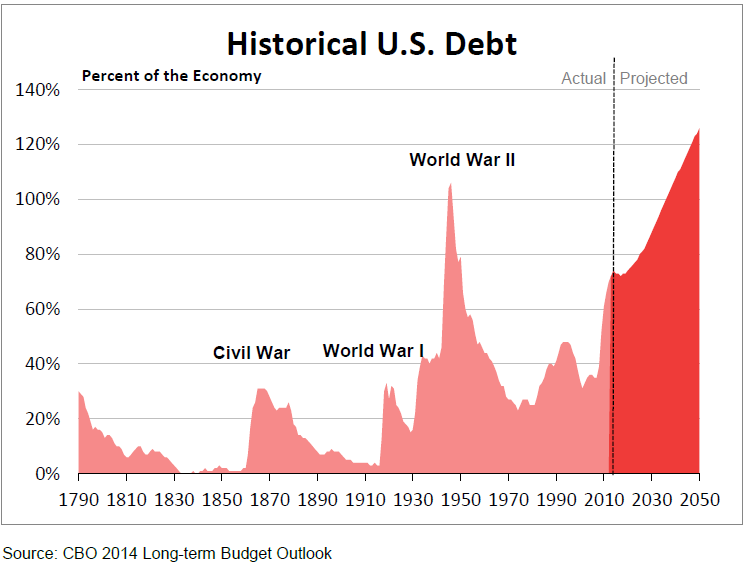
  • Massive Debt. U.S. public (on which we pay interest) debt is now 74% of GDP (highest since WW II) and projected by CBO to grow rapidly unless strong measures are taken to reduce it. This puts our country’s future wellbeing and prosperity at great risk.
  • Increasing Income Inequality. Incomes for the high-skilled and well-educated are increasing much faster than for the low-skilled and less-educated workers.

The new Republican majorities in Congress are stirring the waters by proposing a ten year plan to shrink the deficit down to zero, i.e. to balance the budget by 2025.  The opposition claims that this would “sharply cut the scale of domestic spending, which would mostly fall on the poor.”
Capture1But the American Enterprise Institute’s James Pethokoukis points out that social spending in the U.S., both public and private, is very generous and second only to France in the entire OECD. So here is how we could proceed to address our basic problems in a unified manner:

  • Balance the Budget by a combination of Republican spending cuts and cutting back on two major tax deductions: Employer-sponsored Health Insurance (cost: $250 billion per year) and Mortgage Interest (cost: $70 billion per year).
  • Boost Economic Growth by expanding the Earned Income Tax Credit to encourage more people to accept low paying, entry level jobs. Increase the Social Security eligibility age from 67 to 70, thereby keeping near retirees in the workforce for three additional years (this will also extend the solvency of the Social Security Trust Fund).
  • Decrease Income Inequality. Cutting back on tax deductions, in part to pay for expansion of the EITC, lessens income inequality as well as shrinking the deficit. A faster growing economy also lessens inequality by providing more opportunities for upward mobility.

In other words, addressing each of these fundamental problems in an intelligent manner contributes to solving the remaining problems as well.  This creates a virtuous circle for economic progress!

The Republican Budgets Focus on Entitlement Savings


Last week, both the House and the Senate passed ten year budget plans which would bring the federal budget into balance by 2025.  I have devoted several recent blog posts to discussing these budget proposals and how they address our very serious debt and deficit problems.
CaptureThere are several important points to make:

  • Under both of these Republican plans, overall spending will continue to increase by an average of 3.3% per year, from $3.8 trillion in 2016 to just over $5 trillion in 2015. The President’s budget would increase spending to $6.17 trillion by 2025 and would achieve no balance between spending and revenue.
  • Most of the savings in the Republican budgets, as indicated in the above chart, come from the mandatory (entitlement) programs of Social Security, Medicare and Medicaid. Medicare would be transformed into a subsidy program along the lines of the exchanges set up under the Affordable Care Act. Medicaid would be turned into a block grant program administered by the states. Social Security would be studied by a bipartisan commission to recommend operating efficiencies.
  • Other social welfare programs would be affected to a much smaller extent. For example, the Supplemental Nutrition Assistance Program (SNAP), or Food Stamps, has seen a growth of recipients of 69% between 2008 and 2013 while the poverty rate increased by just 16.5% during the same period. The Republican budgets would block grant Food Stamps to the states in order to achieve operating efficiencies.
  • It is true that both the House and Senate budgets would increase military spending by about 10%. But so would the President’s budget and we live in a very dangerous world. Military defense is one of the most very basic functions of our federal government.

Our country is in dire fiscal condition with large annual deficits projected indefinitely into the future, contributing to an exploding national debt.  It is heartening that our political system is responding to this threat to our future security and prosperity.  Let’s hope that House and Senate majorities continue to keep a sharp focus on the urgent task of fiscal restraint.

An Open Letter to Representative Brad Ashford


You’re off to a great start in Congress!  You’ve clearly established that you’re independent minded and that you vote your conscience.  I expected that you would act in this way and that is why I supported you during last year’s election campaign.  We need more people like you in Congress.
As you perhaps know, I am a non-ideological fiscal conservative and social moderate.  I am, like you, mainly interested in finding practical, workable solutions to difficult and complicated problems.  But I do have one guiding principle to which I strongly adhere.  I believe that, as a general rule, every level of government should refrain from spending more money than what it can pay for with tax revenue.
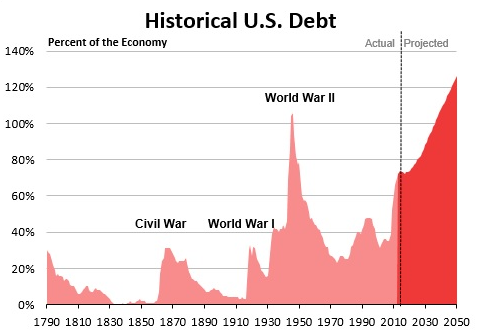
CaptureUnfortunately our federal government has gotten away from this principle in recent years.  This is clearly demonstrated in the above chart which shows an already very large national debt getting much, much worse in the coming years.
There is a movement in the new 114th Congress to address this perilous situation which we have gotten ourselves into.  I am referring to the bills drafted by the Budget Committees of both the House of Representatives and the Senate which would produce balanced budgets over the ten year period, 2015 – 2025.
It was reported in today’s Wall Street Journal that the full House voted yesterday to approve the budget bill by a 228-199 margin but without any Democratic votes.  This means that either you voted against the Budget Bill or you did not vote on it.
I don’t believe that any one vote is so important that it constitutes a decisive litmus test determining my support of a candidate in a future election.  However, as I mentioned above, I feel very strongly that we must greatly shrink our very large budget deficits and that now, not later, is the time to get started on this urgent task.
I hope to be able to support your re-election campaign in 2016 and beyond.  That is why I am writing to you at the present time.

It’s Paul Krugman Who Is Being Irresponsible!


The New York Times columnist, Paul Krugman, writes provocatively on fiscal and economic issues and is well-known as a liberal icon.  Usually I ignore his diatribes.  But his column yesterday, “The Long-Run Cop-Out” goes way overboard.
CaptureI will refute several of the statements from this column.

  • “Think about it: Faced with mass unemployment and the enormous waste it entails, for years the beltway elite devoted all most all its energy not to promoting recovery, but to Bowles-Simpsonism – to devising “grand bargains” that would address the supposedly urgent problem of how we’ll pay for Social Security and Medicare a couple of decades from now.” Worrying about our enormous and rapidly increasing national debt, does not mean ignoring our sluggish economy and the high unemployment it causes. The way to increase economic growth is to enact broad based tax reform by lowering tax rates, offset by closing loopholes and limiting deductions. This will further boost the economy in the same way that lower gasoline prices is already doing.
  • “Many projections suggest that our major social insurance programs will face financial difficulties in the future (although the dramatic slowing of increases in health costs makes even that proposition uncertain).” Healthcare costs dropped to 4.1% in 2014 but this is still more than double the inflation rate of 1.7%. This isn’t nearly good enough.
  • “Why, exactly, is it crucial that we deal with the threat of future benefit cuts by locking in plans to cut future benefits?” The point is to protect benefits, not curtail them. If we act now, to increase revenue and/or slow down the growth of entitlement spending, then we won’t have to cut future benefits.
  • “So why the urge to change the subject (from austerity) to structural reform? The answer, I’d suggest, is intellectual laziness and lack of moral courage.” $6 trillion added to our debt in the last six years is profligacy, not austerity. It is immoral to burden future generations with such massive new debt.
  • “In today’s economic and political environment, long-termism is a cop-out.” Preparing for the future is just plain common sense. Should we ignore festering problems like global warming, illegal immigration and increasing poverty until they get much worse? Of course not. We should address these problems now and get our debt under control at the same time.  

What Will It Take to ‘Fix the Debt’?


I have recently become a volunteer for the national bipartisan organization, Fix the Debt. It is the outreach arm for the Washington think tank, Committee for a Responsible Federal Budget, which is an offshoot of the Simpson-Bowles Commission from several years ago.
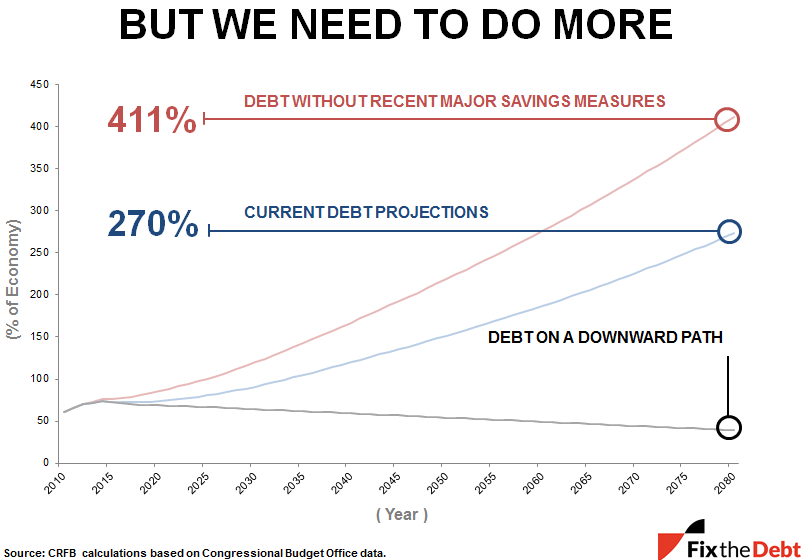
As such, I give presentations to local civic organizations about our national debt and what needs to be done to get it under control. Typically the audience will readily appreciate the seriousness of our debt problem.  What they want to talk about are practical ways to address it.  They have their own ideas and want to know what I think as well.  My first message is that we don’t have to pay off the debt or even balance the budget going forward.  Realistically we need to shrink our annual deficits in order to put the debt on a downward course as a percent of our growing economy,  as shown in the chart just below.

Capture It will be a huge challenge to accomplish even this!  Here are my ideas, in very general outline, on how to get this done:

  • Entitlements (Social Security, Medicare and Medicaid) are the biggest single problem because our population is aging so fast. Furthermore, in order to control the growth of Medicare and Medicaid, we have to do a much better job of controlling the overall cost of healthcare in the U.S. For example, even though healthcare costs slowed down to an increase of only 4.1% in 2014, this is still more than twice the rate of inflation!
  • The second thing we need to do is to make our economy grow faster than the roughly 2.3% growth we have achieved since the end of the Great Recession. The main way to get this done is through broad-based (and revenue neutral) tax reform at both the individual and corporate levels, by reducing tax rates, paid for by closing loopholes and limiting deductions.
  • Finally, there is enormous waste and inefficiency in the federal budget, with huge redundancy and overlap of programs between different federal departments. Responsibility for such programs as education, community development, transportation and social welfare, for example, should be returned to the states with block-grant funding to replace rigid federal control.

I have discussed each of these major reform ideas in much detail in previous blog posts and will continue to do so.  As large as our fiscal problems are, I remain optimistic that they can and will be successfully addressed.

Where Should the New 114th Congress Focus Its Attention?


The two main themes of this website are how to boost economic growth and how to get our national debt under control.  Faster economic growth will put more people back to work by creating more jobs.  Faster growth will also bring in more tax revenue and therefore potentially reduce deficit spending.
The latest monthly unemployment rate, 5.8% for November 2014, is much higher than it should be almost six years after the end of the Great Recession in June 2009.  The best thing that Congress could do to boost economic growth is to adopt broad-based tax reform, lowering tax rates in a revenue neutral way by closing loopholes and limiting deductions.  I’m still in favor of doing this but I no longer consider it to be the top priority for the following reason.
The huge drop in the price of gasoline is already providing a big economic stimulus.  At the current price of $2 per gallon, the average American family will save about $750 per year in driving expenses.  This is even more relief than a tax cut would provide.  The economy has already picked up steam in 2014 and is predicted to grow at the rate of 3% in 2015.  This will keep the unemployment rate decreasing steadily throughout 2015 and beyond, which represents much progress.
Capture1It’s now time for Congress to focus more strongly on putting the debt on a downward path.  This can only be done by shrinking our annual budget deficits well below the $483 billion deficit for the last (2014) budget year.  As the above chart from Fix the Debt shows, our current fiscal path leads inexorably to a growing debt which is completely unsustainable in the long run.  Annual deficits will have to be at least cut in half to be able to turn the debt trajectory downwards.
Getting this done will require much dedication and hard work by Congress.  Many programs will have to be eliminated.  Surviving programs will need to operate more efficiently.  The entitlement programs of Social Security, Medicare and Medicaid will have to be greatly tightened up.
Is Congress up to this task?  The future of our country depends on it!

The Legacy of Senator Tom Coburn


Oklahoma’s Senator Tom Coburn has just retired from Congress after serving six years in the House of Representatives and ten years in the Senate.  He will be sorely missed because his achievements were legion.
By ridiculing the “Bridge to Nowhere” in Alaska in 2006, he eventually prevailed upon Congress to totally eliminate earmark spending by 2011.
Beginning in 2010 his staff compiled an annual “Wastebook” each year listing numerous examples of wasteful spending by the federal government.  The “2014 Wastebook” gives 100 such examples totally $25 billion ranging from laughing classes for college students to a State Department program to dispel the perception abroad that Americans are fat and rude!
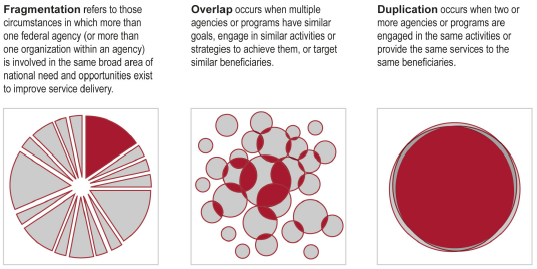
CaptureBeginning in 2011, Senator Coburn has prevailed upon the Government Accounting Office to issue annual reports entitled “Actions Needed to Reduce Fragmentation, Overlap and Duplication and Achieve Other Financial Benefits.”  Now, after four years, a total of 226 specific actions have been recommended by the GAO.  GAO’s Action Tracker shows that the government has addressed about 19% of the efficiency recommendations made by the GAO.  Be thankful for small progress!
His latest, finest and presumably last major effort along these lines is a 320 page report, the “Tax Decoder” which is intended to “decode the tax code for every taxpayer.  It reveals more than 165 tax expenditures costing over $900 billion this year.”  Although more than $1.7 trillion in tax revenue was collected by the government in 2014, the IRS will be unable to collect an additional $500 billion that is owed.  This would have been enough to cover the $483 billion deficit for fiscal year 2014!
As Senator Coburn points out in the introduction to this document, “ideally Congress would throw out the entire tax code and start over.  But at the very least, Congress should make the tax code simpler, fairer and flatter.”
It is rare that a single member of Congress makes such an extraordinary contribution to our country’s welfare!

Status Quo on the Budget Is Not Good Enough II. Look at the Big Picture!


In my last post, “Status Quo on the Budget Is Not Good Enough,” I discussed a report from the outgoing chair of the Senate Budget Committee, Patty Murray (D-WA), and explained how it epitomizes the lack of progress made on the massive debt problem which has developed since the Great Recession of 2008 -2009.
CaptureThe basic problem is that Senator Murray’s analysis simply does not recognize the seriousness of our debt problem as shown in the above chart.  Right now our public debt (on which we pay interest) is “sitting” at 74% of GDP for a year or two, before it continues its rapid increase.  This projection assumes an historically “normal” growth rate of 3% and no new recessions, neither of which assumption is assured.  It also assumes that the sequester budget cuts and new top tax rate of 39.6% stay in effect.  In other words it is a best case scenario based on current policy.
Breaking it down, the debt will continue to increase because annual deficits will continue to exceed the rate of growth of the economy.  The main driver of these increasing deficits is the cost of the health care entitlements of Medicare and Medicaid.  Medicare costs will increase rapidly because of the aging of the American people.  Medicaid costs will increase rapidly because: 1) more low-income people are being covered by the ACA and 2) since the recession there are more low-income people to be covered.  I certainly support expanded healthcare coverage but we have to figure out how to pay for it!
How do we contain the increasing costs of Medicare and Medicaid?  We do it by controlling the overall rapid growth (at twice the rate of inflation) of healthcare costs in general, i.e. for private healthcare. How do we do this?  See a couple of my recent posts either here or here.
Senator Murray, along with many other progressives, argues that we need more deficit spending in order to stimulate the economy and create new jobs.  More jobs are badly needed but more deficit spending is the wrong way to get them.  Then how?  With tax reform among other things.
Based on the outcome of the 2014 elections, I am optimistic that something along the lines of what I have just described will be tried by the next Congress.  We’ll soon find out!