Time to Start Over on Healthcare Reform


The Affordable Care Act, established in 2010, greatly expanded access to healthcare in the U.S. However, in spite of its name, it has done nothing to control the rapidly increasing cost of healthcare which is the core of our debt problem.


The new Senate plan, struggling to gain enough support to pass, puts Medicaid on a budget but doesn’t even attempt to address wider aspects of the healthcare cost problem.
A wider approach is the best way to proceed and perhaps now it is the only way to succeed in getting something done. Mr. Peter Suderman, who writes for Reason magazine, proposes several principles for a new approach:

  • Work for broader coverage but not necessarily universal coverage. This allows focusing on other important features such as:
  • Unification, not fragmentation, is what should be emphasized. Medicare and Medicaid are paid for directly by the government. Employer provided coverage, subsidized through the tax code and costing $250 billion per year, is the biggest problem in the U.S. healthcare system. It incentivizes employers to provide ever more generous insurance while insulating individuals from the true cost of care. It discourages job switching and entrepreneurship. Medicare ends up paying out far more than individuals have paid in.
  • Health insurance coverage is not the same as healthcare. For non-catastrophic, non-emergency expenses, affordability should be emphasized, rather than subsidies. Health savings accounts are a good way to accomplish this.
  • Focus on government assistance for the poorest and sickest. This means upgrading Medicaid, and coverage for pre-existing conditions, at the same time as putting Medicaid, Medicare and employer provided care all on a fixed, but reasonable, budget.

Conclusion. The cost of American healthcare is a huge problem. Hopefully the Senate will begin to address this fundamental problem as it struggles to pass a healthcare reform bill.

Follow me on Twitter 
Follow me on Facebook 
 

America’s Most Serious Problem: Excessive and Growing Debt


I know that I repeat myself a lot. I am a fiscal conservative and social moderate.  This puts me in the middle of the political spectrum from left to right.  I support social welfare programs if they are legitimately helping the less fortunate among us.  I am especially supportive of programs for African-Americans because of the racial bias they experience.


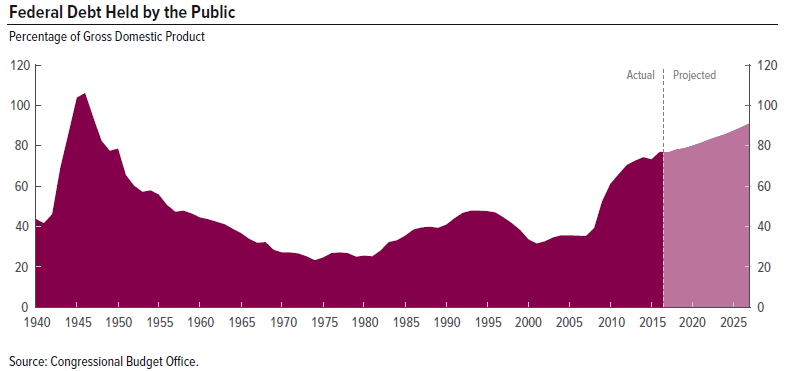
Unfortunately our national leaders have collectively lost a sense of fiscal responsibility in recent years.  Looking at the standard debt chart (above) produced by the Congressional Budget Office, it is clear that indifference to debt commenced under President Reagan and has waxed and waned ever since.  The debt has been growing especially fast ever since the Great Recession in 2008 and now stands at 77% of GDP, the highest since the end of WWII.  Shrinking the debt (as a percentage of GDP) is now America’s most urgent problem.


As I have discussed before, it is the entitlement programs of Social Security, Medicare and Medicaid, as well as interest payments on our increasing debt which will continue to worsen the debt problem in the coming years  without strong corrective action.
All entitlement programs need to be reformed to impose cost control. Right now the two healthcare bills in Congress propose that the funding mechanism for Medicaid be changed so that it will be on a fixed (federal) budget from now on, rather than be continued in its current open-ended form.
Medicare is an even more expensive program than Medicaid.  It would be better to fix both of these programs at the same time, but it is better to fix Medicaid alone than to do nothing at all.
It would be even better to replace our employer provided healthcare system with a uniform, but limited, health insurance tax credit for all (including for the self-employed) and to make all of these major changes at the same time.  This would be the fairest way to proceed.

Conclusion. The current GOP plan to curtail healthcare costs could be much improved.  It is only a small step in the right direction.

Follow me on Twitter 
Follow me on Facebook 

The Need to Put Medicaid on a Budget II. Our Growing Debt


Most of the controversy generated by the healthcare bill passed by the House, and the one now being considered by the Senate, concerns the way Medicaid is funded. The current system whereby states are reimbursed by the federal government for a percentage (national average 53%) of their Medicaid expenses would be replaced by putting the federal contribution on a strict per-capita basis, indexed to the annual rate of inflation.
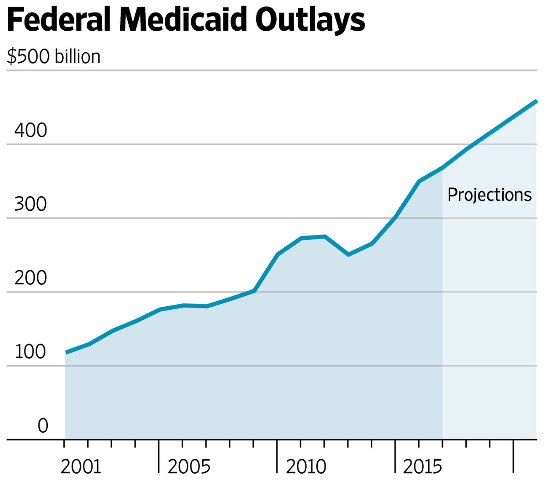
Medicaid is a vast program now serving 73 million low-income and disabled Americans and is doing a good job especially for the elderly and the disabled with special needs. But it costs the federal government nearly $400 billion per year and the cost is growing rapidly.  It is essential to get open-ended Medicaid spending under much better control and one good way to do this is to put the federal contribution on a fixed budget.


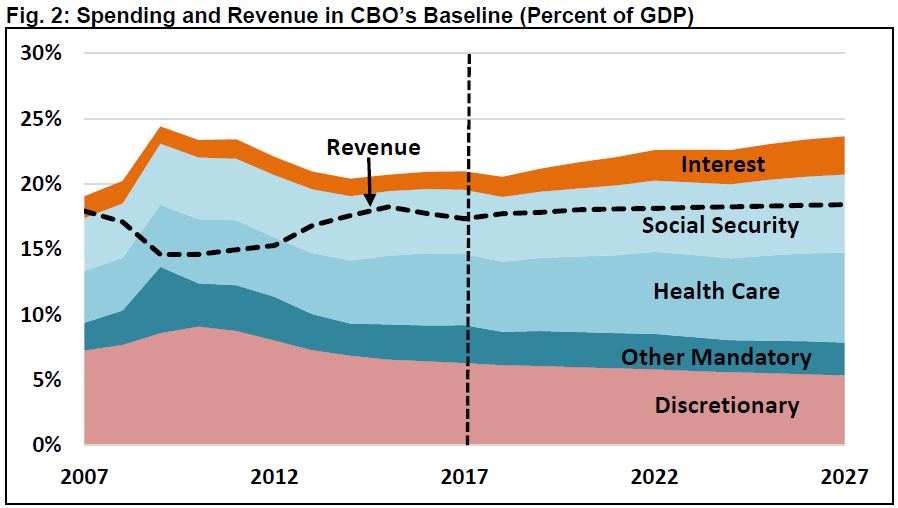
The Congressional Budget Office has just issued its latest Budget and Economic Outlook report.  It shows the ever-worsening fiscal condition for the U.S., unless current policy is changed.


For example:

  • The deficit for 2017 is predicted to be $693 billion or 3.6% of GDP.
  • Deficits will grow dramatically over the next decade with trillion dollar deficits returning by 2022.
  • Debt held by the public (on which interest is paid) will grow by $11.2 trillion between now and 2027, from $14.3 trillion today.
  • Spending will grow from 20.9 percent of GDP in 2016 to 23.6 percent in 2027, while revenues will rise from 17.8 percent in 2016 to 18.4 percent by 2027.
  • The vast majority of spending growth over the next decade (83%) is the result of rising costs for health care, Social Security, and interest on the debt.

    Conclusion.  
    The national debt is growing much too fast. The only way to turn this dangerous situation around is to reform all entitlement programs, including Medicaid, to get their costs under much better control.

Follow me on Twitter: https://twitter.com/jack_heidel
Follow me on Facebook: https://www.facebook.com/jack.heidel.3

The Need to Put Medicaid on a Budget

The GOP healthcare plan, both the House version and the Senate version, are highly imperfect. Yet they each do one thing which is badly needed. They put Medicaid on a budget. The current open-ended Medicaid program, whereby each state is reimbursed by the federal government for a percentage of its costs (the average is 53%), would be replaced by an annual per-capita payment which would increase only at the rate of inflation. It is estimated that the new per-capita budget would reduce federal Medicaid payments by about 25% after 10 years.


In order to get the federal debt under control, all three major entitlement programs, Social Security, Medicare and Medicaid, must be reined in and the current GOP plan would start doing this for Medicaid.
Reining in spending like this will force states to alter the way they regulate and administer Medicaid and the New York Times columnist Ron Lieber points out some of the challenges which will arise if Medicaid has to operate more efficiently:

Nursing homes. One third of people who turn 65 will eventually end up in a nursing home. Furthermore, 62% of nursing home residents cannot pay for nursing homes on their own. The average annual cost of a semi=private room is $82,000.
Home and community-based care. Medicaid is required to pay for nursing homes and may also pay for home and community-based care which is much less expensive and lets seniors stay in their own homes.
Optional services for low-income people and the disabled. Optional services besides long-term home care include dental care for adults, therapy for disabled children at school, prosthetic limbs and prescription drugs.

Conclusion. Changing Medicaid from open-ended funding to a strict federal budget which grows at the rate of inflation will put a large burden on state Medicaid administrators and require some difficult tradeoffs to control spending. But this is absolutely essential as a first step towards controlling the rapid increase of entitlement spending.

Follow me on Twitter:
Follow me on Facebook:

Can the GOP Produce on Healthcare?


The House of Representatives, after much struggle, was finally able to pass a healthcare bill, The American Health Care Act.  Now it’s the Senate’s turn to pass its own version and it, too, is turning out to be a struggle.


The healthcare policy expert, Avik Roy, considers the Senate bill to be a huge step forward:


  • Medicaid is finally put on a budget with annual increases in spending, starting in 2025, tied to the overall rate of inflation. In return, states will gain substantial latitude to use funds more effectively and efficiently.
  • Tax Credits in the Senate bill are means adjusted and will also encourage younger people to enroll for coverage. This is an improvement over the AHCA.
  • Expanded coverage. Mr. Roy predicts that passage of the Senate bill would increase (not decrease as the CBO predicts) the number of Americans with health insurance five years from now. This will result because the near poor in states like Texas and Florida, which have not expanded Medicaid, will be eligible for the new means-tested tax credits.
  • The 10th Amendment is strengthened because so much more authority for regulating healthcare insurance is transferred to the states. This represents huge progress because states are so much more fiscally responsible than the federal government (they have to balance their budgets)!


Conclusion. There are certainly many imperfections in the Senate bill.  It does nothing to limit tax credits for employer-sponsored insurance.  This is sorely needed to put the overall cost of American healthcare on a sustainable course.  It does nothing to help low income people who struggle with high deductibles (for example, by helping to set up Health Savings Accounts). It also does nothing to rein in the cost of Medicare, such as by introducing means adjusted premiums and allowing Medicare to negotiate lower drug prices.
Nevertheless it is a huge step forward in controlling excessive healthcare costs as well as expanding health insurance coverage to more Americans in a fiscally responsible way.

Follow me on Twitter: https://twitter.com/jack_heidel
Follow me on Facebook: https://www.facebook.com/jack.heidel.3


Redesigning the American Health Care System to Lower its Cost


Recently I have been discussing the high cost of American healthcare and the urgent need to lower this cost.  The current GOP plan, the American Health Care Act, partially addresses this problem by reforming the funding mechanism for Medicaid.
But much more needs to be done.  All Americans will have to be involved in the solution and not just the poor. There are two main facets to the problem, neither of which is addressed by the AHCA:

  • The tax exemption for employer provided health insurance should be replaced by a universal (and refundable) tax credit limited to the cost of catastrophic health insurance (with a high deductible).
  • Medicare needs to be redesigned so that well-off retirees pay for more of their health care. Details to follow soon.

The U.S. spends 18% of GDP on healthcare, public and private, about $3 trillion per year, and almost twice as much per capita as any other developed country. Furthermore this already enormous relative cost will continue to get worse without major changes in policy.
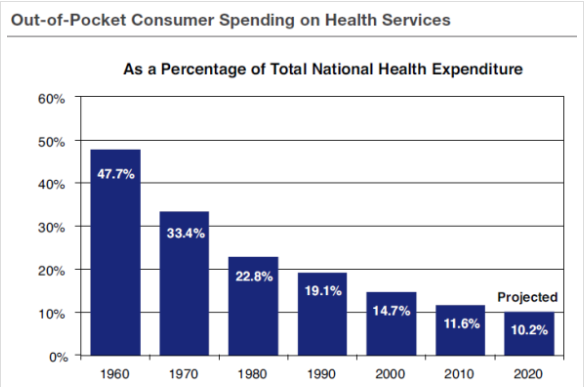
The main reason for the huge cost is that free market forces are not operating properly.  More specifically, it is because most of us, as individual healthcare consumers, do not have enough “skin in the game.”


This conundrum is caused by our third party health insurance system whereby most of us receive health insurance through our employers.  This gives us as individuals little incentive to pay attention to the cost of our own care and to try to keep these costs as low as possible.
A good way to fix this problem is to limit the exemption for employer provided insurance to the cost of catastrophic care with a high deductible.  Routine medical expenses would be handled through individual (tax preferred) health savings accounts. The self-employed can be included by granting them a (refundable) tax credit also equivalent to the cost of catastrophic care.

Conclusion. Americans are fortunate to have access to high quality health care. But we are paying unsustainably high prices for it.  If we cannot figure out a rational and sensible solution to this problem, our healthcare system will soon collapse from its own deadweight and we will end up with a tightly controlled, government run, single payer system.

Follow me on Twitter 
Follow me on Facebook 
The Fundamental Flaw in the GOP Healthcare Plan


The Democratic Affordable Care Act expands access to health insurance for millions of Americans. This is its great virtue.  However it does nothing to rein in overall costs  which is a huge deficiency.
The Republican American Health Care Act, passed by the House and being considered by the Senate, has both strengths and weaknesses, as I have previously discussed.   Primarily, it puts Medicaid on a budget by block-granting it to the states with sufficient flexibility for the states to operate it much more efficiently.  This needs to be done and is a big money saver.
The major problem with the AHCA is that all cost savings come from just one program, namely Medicaid, and this is a program for people with low incomes.  Simple fairness, as well as the need for much bigger savings, dictates that financially well-off people should also have to share in solving the healthcare cost problem. This can and should be done in two different ways:

  • The tax exemption for employer provided health insurance should be replaced with a universal (and refundable) tax credit sufficient to pay for catastrophic health insurance (with a high deductible). Also tax preferred Health Savings Accounts for all can be subsidized based on income. The purpose here is to force all of us to pay attention to, and take responsibility for, the cost of our own healthcare.
  • Redesign of Medicare. Medicare is already being subsidized by the federal government at a net cost (after FICA taxes and premiums paid) of over $400 billion per year, and this overall cost will continue to increase as the number of retirees increases and the net subsidy per retiree also increases (see chart). Details of possible redesign will be discussed later.

Conclusion. The ACA needs to be improved in many ways to get the cost of healthcare under control. The AHCA bill currently being considered by Congress needs major changes so that all Americans, rich and poor and in between, are part of the solution of our healthcare cost problem.

Follow me on Twitter 
Follow me on Facebook 
The Urgent Need to Lower the Cost of American Healthcare


Our country faces many serious problems (terrorism, global warming, income inequality, etc.) but the most serious of all in the long run is our rapidly growing national debt and the inability (unwillingness?) of our national leaders to address it.
Furthermore, the fundamental driver of our debt problem is the cost of healthcare, public and private.  The Affordable Care Act, established in 2010, expands access to healthcare but does not address the cost problem (see chart below).


I have previously discussed how to repair the ACA to make it more cost efficient, by, for example, repealing both the individual and employer mandates, establishing a universal (and refundable) tax credit for catastrophic care, migrating Medicare and Medicaid to the new universal system, etc.
But there are lots of other things, less political contentious, that we can do as well.  I have just read an astonishing new book, “An American Sickness” by Elizabeth Rosenthal, an MD who works as a healthcare journalist, which provides a vivid and compelling description of our overly expensive and dysfunctional healthcare system. According to Ms. Rosenthal here are a few of the things we could do collectively to get costs under much better control:

  • Reform malpractice insurance to place limits on noneconomic damages.
  • Breakup oversize hospital conglomerates so that hospitals don’t have such huge monopoly pricing power.
  • State insurance regulators could do a much better job of enforcing transparency and accuracy for provider directories, in-network and out-network fees, etc.
  • Insurance companies could do a better job on reference (i.e. standardized) pricing, encouraging bundling of services, tying the size of co-payments to a procedure’s medical worth and urgency, etc.
  • Congress should permit Medicare to negotiate national drug prices.

Conclusion. Repairing the ACA, as is now being done in Congress, will go a long way towards much better cost control of healthcare. But there are many other common sense steps which can also be taken towards this goal.

Follow me on Twitter 
Follow me on Facebook 


How to Achieve a Balanced U.S. Budget


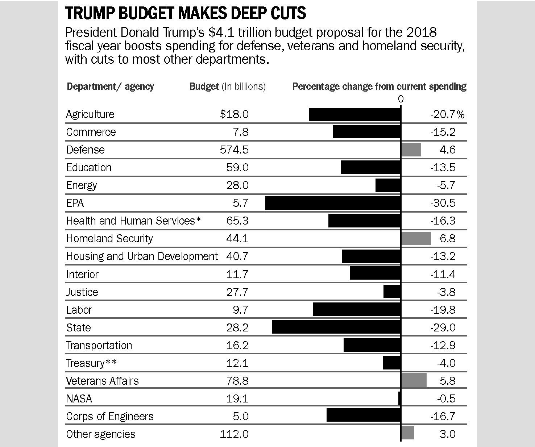
President Trump’s proposed 2018 Budget lays out a plan to achieve a balanced budget over a ten year period. I strongly endorse this goal whether or not the Trump budget is a realistic way to get this done.
The virtue of the Trump budget is to tackle waste and inefficiency across many different domestic programs (see chart below).


Its main defect is that neither healthcare reform nor tax reform has yet been implemented and the cost and/or savings of these two major initiatives are not yet known.
In the meantime the only way to think about balancing the budget is conceptually in terms of how it might be done.  Barron’s economic analyst Gene Epstein has done this recently.


Mr. Epstein proposes:

  • $8.6 trillion worth of spending cuts over ten years, of which 40% would come from programs other than Social Security and healthcare. By achieving a balanced budget in ten years it would lower our public debt (on which we pay interest) from 77% today to 58% in 2027.
  • By raising the age limit for full SS benefits to 67 (already enacted) at a faster pace, and indexing initial benefits to price inflation rather than wage inflation, $200 billion can be saved over ten years. Another $300 billion can be saved by phasing in a 25% reduction in SSDI benefits.
  • Cutting the estimated improper payment rate for Medicare of 12.1% in half would save $400 billion over ten years. Raising the premiums for Medicare Part B and Part D to 35% of costs from the current 25% of costs would save $400 billion.
  • Another $600 billion would be saved by turning Medicaid into a block grant program to the states and giving the states much more flexibility in how it is spent.
  • $950 billion could be cut from the military budget by cutting back on overly expensive new weapon systems as well as closing unnecessary military bases, both foreign and domestic.
  • Many cuts in government subsidies to individuals and businesses would save $1 trillion. Grants in aid to sates could be cut by $500 billion.

Conclusion. There are many different ways to curtail federal spending. It has to be done and the sooner we get started the less painful it will be for all concerned.

Follow me on Twitter
Follow me on Facebook


The GOP Needs to Get Healthcare Right This Time


The Affordable Care Act expands healthcare access in the U.S. but does nothing to control its costs. With its current majorities in Congress as well as holding the presidency, the GOP now owns the healthcare insurance crisis.  If the GOP doesn’t get it fixed right, it is almost inevitable that we’ll eventually end up with a single-payer system such as universal Medicare.


I have previously discussed one good way to fix the bill recently passed by the Republican House of Representatives.  But today I will take a more general approach proposed by Thomas Miller from the American Enterprise Institute.  Mr. Miller says that a replacement for the ACA should emphasize:

  • Private markets rather than a bureaucratic system.
  • Positive incentives to obtain and maintain affordable coverage instead of mandates and ever-growing regulations to buy what you don’t want.
  • Decentralized decision making by patients, their representatives and state and local officials.
  • Lower taxes, higher value choices and clearer rewards for performing better, working harder and acting more responsibly.
  • Better targeted subsidies that will ensure generous protection of our most vulnerable Americans.

General principles such as these will end both the individual and employer mandates and allow average Americans a greater choice in how they want to spend their resources to protect and enhance their health.

Conclusion. The ACA has taken us closer to the goal of universal healthcare for all Americans and there can be no retreat from this standard. But much better cost control can be achieved and this is what fixing the ACA should focus on.  A free market system for healthcare will work if it is set up in a fair and responsible manner.

Follow me on Twitter
Follow me on Facebook