Omaha: What Happens When There’s a Labor Shortage?


The unemployment rate in Nebraska is now down to 2.9% and even in Omaha, a relatively large metropolitan area of 850,000, it is only 3.2%.  As reported by the Omaha World Herald today, such a low unemployment rate creates big problems for employers at all levels.

CaptureFor example:

  • In fast foods, beginning salaries are up to $10 or more per hour, well above Nebraska’s new minimum wage of $8 per hour, and raises for responsible employees are frequent. Manager’s salaries are increasing rapidly. Benefits are being expanded into such areas as tuition reimbursement.
  • For the predominantly minority residential area of North Omaha, with a traditional unemployment rate of up to 20%, local manufacturers are beginning to provide transportation vans to pick up and drop off workers.
  • The Omaha Chamber of Commerce is running an ad campaign in Seattle to appeal to soon-to-be-laid-off Microsoft workers, because there are lots of vacant tech positions in Omaha.
  • Both the Greater Omaha Chamber of Commerce and the Lincoln Chamber of Commerce have endorsed LB 586 in the Nebraska Legislature to ban discrimination in the workplace based on sexual orientation and gender identity. The purpose, as expressed by both chambers of commerce, is to create a more attractive work environment in order to attract more workers from other states. The neighboring states of Iowa and Colorado have passed such laws.

What more can be done?  The welcoming labor market should provide a bigger incentive for both high school and college students to finish their studies and graduate.  Jobs will be waiting for them!  The labor shortage should also help create more interest in immigration reform.  This would insure that Nebraska has an adequate number of legal guest workers to meet the needs of the agricultural and meatpacking industries.

Nebraska Will Benefit From Immigration Reform


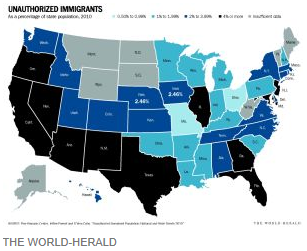
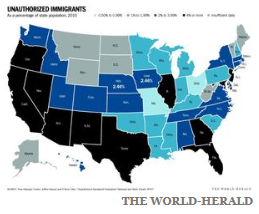
Several months ago the Omaha World Herald reported that Nebraska has approximately 45,000 illegal immigrants, or about 2.5% of the state’s population.  Nebraska’s unemployment rate has now dropped to 3.4%, the third lowest in the nation behind only North Dakota and South Dakota.  Such a low unemployment rate represents a labor shortage.  There simply aren’t enough Nebraskans to perform all of the physically demanding, low skill work needed in the agriculture, meatpacking and construction industries.  It is this labor shortage which is attracting such a large number of illegal immigrants to Nebraska.
CaptureAccording to the New York Times, the Tea Party has recently changed its focus from “curtailing the reach of the federal government, cutting the deficit and countering the Wall Street wing of the Republican Party to becoming largely an anti-immigration overhaul movement.”  This is a very unfortunate development.
Why would it be so difficult to solve our illegal immigration problem in the following manner:

  • Give all businesses a limited period of time, perhaps six months, to present a list of current employees who are illegal. Everyone on this list without a criminal record would receive a guest worker visa.
  • Going forward, businesses would be authorized to hire additional foreign workers as needed with guest worker visas issued in their home country. This would eliminate the need for illegal entry into the U.S.
  • As of a certain date in the near future, all businesses would be required to periodically demonstrate the legal status of all workers on their payroll.
  • Guest workers would be eligible to apply for citizenship after a lengthy period of time, perhaps ten years.

Once an adequate guest worker visa program has been set up and is operating efficiently, security on our southern border with Mexico would hardly be more of a problem than is security on our northern border with Canada. Illegal immigration should be considered as an economic problem, not a law-enforcement problem.
If it were handled correctly in this way, the problem would disappear in short order!

“Nebraska Is Not a Tea Party State”


So declares Jim Jenkins, an independent candidate for the U.S. Senate from Callaway in western Nebraska. Several weeks ago I endorsed Jim based on his common-sense centrist views on many important issues such as fixing the debt, tax reform, Obamacare, and immigration reform.  Check out his campaign website for the details.
CaptureNow Jim has come out with additional common-sense reform ideas:

                                      My 5-Point Bipartisan Reform Agenda

Nebraska doesn’t belong to a political party; Nebraska belongs to our people. Unless you can develop a framework in Congress by which you actually debate, discuss and negotiate, we’re not going to be able to move forward. Here’s my 5-point, bipartisan reform agenda to end gridlock in Washington.

  1. Fix the Debt. Debate recommendations from the bipartisan National Commission on Fiscal Responsibility and Reform, more commonly known as the Simpson-Bowles Commission that presented Congress and the President with a comprehensive plan to reduce the deficit.
  2. Biennial Budget. Congress should adopt a biennial budget process, an approach to budgeting utilized by many states, including Nebraska that allows for a more thorough evaluation of budget proposals in year one and a review of budget effectiveness in year two.
  3. No Budget, No Pay. Unless Congress passes a budget by the end of its fiscal year members of Congress will not receive pay. I also support legislation that suspends Congressional recesses until it has passed a budget. Failure to pass budgets undermines the greater economy and undermines the credibility of Congress with its citizens.
  4. Immigration Reform. President George W. Bush presented a bipartisan plan on immigration that had the backing of a significant number of Democrats. The passage of immigration reform will require a meeting in the messy middle. Both Democrats and Republicans are going to have to yield.
  5. Leadership Council. Congress should adopt a bipartisan leadership group each session that would identify the top legislative priorities.

We need leaders in Washington who will work together to find common-sense solutions to our very challenging national problems. Jim Jenkins is such a person and I hope you will consider voting for him on November 4!

Why I Support Jim Jenkins for the U.S. Senate from Nebraska


I have been writing this blog for almost two years because of my great concern about the direction our country is headed on fundamental fiscal and economic issues. Federal spending has been out of control for over thirty years and the situation is getting progressively worse.  Our national debt is over $17 trillion and growing at a rate of $500 billion per year.  And it will soon be growing much faster than this if we don’t make big changes.  Economic growth has been stuck at the anemic rate of 2.2% of GDP ever since the end of the Great Recession over five years ago.
Our national leaders are simply not doing the job they were elected for.  Democrats blame the Republicans and Republicans blame the Democrats but excuses are not good enough.  We need people in Washington who can figure out how to navigate within the system and actually find solutions to our very serious problems.
CaptureI believe that Jim Jenkins, a registered independent from Callaway, is the best qualified candidate to do what needs to be done.  Check out his website, Jenkins for Senate, and decide for yourself.  Here are a few of his views on important issues:

  • Fixing the Debt. Jim supports the recommendations of the Simpson-Bowles Commission which calls for dramatically cutting federal spending especially for entitlements and also raising taxes if necessary in order to drastically shrink our annual deficits.
  • Tax Reform. Jim supports lower tax rates achieved by eliminating many of the tax expenditures (credits, deductions and exclusions) embedded in the code. This is what is needed to boost economic growth.
  • Affordable Care Act. Jim believes that the ACA has many rough edges but that it is possible to fix them rather than repealing it and starting over.
  • Immigration Reform. Jim supports comprehensive immigration reform which includes securing our borders but at the same time expanding the number of guest worker visas to meet the needs of business and agriculture.
  • Veterans Administration. Jim supports setting up a plan to enable veterans to obtain medical care from health professionals within their own communities.

Compare these common sense views with the far more ideological positions of the other candidates in this race. I think that you will agree with me that Jim Jenkins is the person we want representing us in Washington!

Now Is the Time to Solve Our Illegal Immigration Problem!


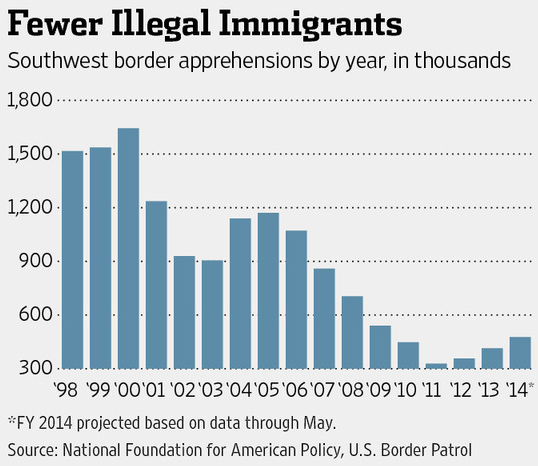
The sight of thousands of children from Central America sitting in camps at the U.S. border should knock some sense into those members of Congress who are dragging their feet on comprehensive immigration reform.  Overall, illegal border crossings are at their lowest level in many years (see chart below).  Now is the time to get things straightened out before the illegal traffic starts building up again.
CaptureWhen the New York Times, “The Border Crisis,” and the Wall Street Journal, “A Better Border Solution,” agree on an issue, I tend to agree with them.  Both newspapers say that the current crisis is the result of illegal immigrants in the U.S. trying to rescue their children from deplorable conditions back home.  If they had legal status they would go home themselves and bring their children back to the U.S. but they can’t risk doing this without a visa.
As I pointed out in a recent blog, “Immigration Reform Will Benefit Nebraska,” it shouldn’t be that hard to achieve a comprehensive solution as follows:

  • All businesses would compile a list of their current employees who are illegal. Everyone on this list, without a criminal record, would receive a guest worker visa as of a certain date. Visas would be transferable from one employer to another.
  • Companies would be authorized to hire additional foreign workers in their home countries who would then receive a guest worker visa to enter the U.S.
  • Once the system was set up and operational, all businesses would be required to periodically demonstrate the legal status of all workers.
  • Guest workers would be eligible to apply for citizenship after a relatively lengthy period of time.

America needs immigrant labor to do the hard low skilled physical work such as in agriculture, meatpacking, and construction, which most Americans don’t want to do.  An adequate guest worker system would virtually eliminate illegal immigration, thereby solving a huge current law enforcement problem.  It would also give the U.S. economy a big boost by providing all businesses with an adequate source of labor.
We have got to get beyond our hang-up about amnesty to solve this incredibly serious problem!

Immigration Reform Will Benefit Nebraska


Today’s Omaha World Herald has an excellent article, “A Window on Immigration.”  It points out that 2.46% of Nebraska residents as of the 2010 census were illegal immigrants.  This works out to about 45,000 illegal immigrants in Nebraska today compared to just 3,000 as recently as 1980.  This is really a shocking figure.  It is roughly the same as the population of Nebraska’s fourth largest city (Grand Island) or Nebraska’s fifth largest county (Buffalo).  Nebraska’s unemployment rate of 3.9% is really a labor shortage.  It needs these 45,000 illegal immigrant workers!
CaptureWhy is it so difficult for our national leaders to solve this problem?  It’s crazy to think that we are going to round up 11 million illegals throughout the country and dump them into Mexico unless they are willing to “self-deport.”  Amnesty and citizenship are bogus side issues.  Here is the outline of a simple plan which would solve the problem:

  • Give all businesses a limited time period, perhaps six months or a year, to present a list of their current employees who are illegal. Everyone on this list without a criminal record would receive a guest worker visa along with all necessary legal papers. These papers would belong to the individual worker who could use them to change employment from one business to another.
  • Going forward, businesses would be authorized to hire additional foreign workers as needed who would automatically qualify for guest worker visas. Such visas would be granted in the country of origin thereby avoiding the need for illegal entry into the U.S.
  • As of a certain date in the near future, all businesses would be required to periodically demonstrate the legal status of all workers on their payroll. Penalties for non-compliance would be severe.
  • Guest workers would be eligible to apply for citizenship after a relatively lengthy period of time, perhaps five years or ten years.

Once an adequate guest worker visa program has been set up and is operating efficiently, allowing all businesses to hire as many foreign workers as they need, security on our southern border with Mexico would be no more of a problem than is security on our northern border with Canada.
In other words, illegal immigration is an economic problem, not a law enforcement problem.  The way to solve this problem is to address it correctly!

The Looming Demographic and Generational Showdown


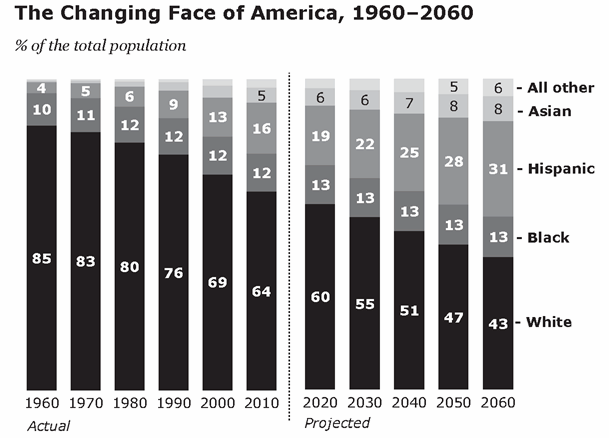
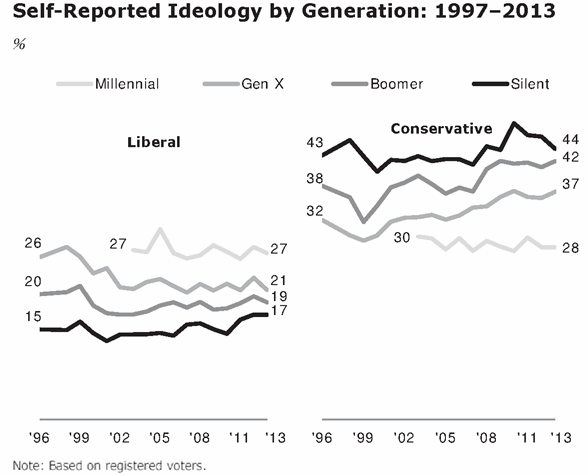
An extraordinary new book has just been published by the Pew Research Center’s Paul Taylor, “The Next Generation: Boomers, Millennials and the Looming Generational Showdown”, describing huge demographic changes which are already beginning to wash across the American political landscape. They are in brief outline:

  • The retirement explosion. Today’s 45 million aged 65+ population will increase to 70 million by 2030.
  • The color explosion. Today’s 65% Caucasian population will likely shrink to 43% by 2060.
  • The ideology gap. The four current American generations; the Silents, the Boomers, the Gen Xers, and the Millennials are increasingly less conservative and more liberal.
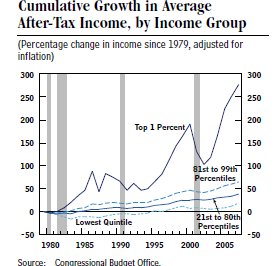
  • The inequality gap. Both income and wealth inequality are growing rapidly and this trend is likely to continue.

Each of these trends is firmly established by data as shown in the accompanying charts. There are huge political implications for these mega-trends. For starters, the biggest threat to our nation’s finances is the rapidly increasing cost of entitlements, especially Social Security and Medicare. Where will the political will to control this spending come from when there are ever more retirees who want to keep their benefit programs?
CaptureWith a surging immigrant population, primarily Hispanic and Asian, constantly gaining more political clout, it becomes more and more urgent to move our 12 million undocumented aliens out of the shadows with some kind of legal status. A broad based guest worker program would be a good way to get started.
Capture1The ideology gap is more difficult to interpret. The four groups are more conservative than liberal and people in general become more conservative as they grow older. Nevertheless, there is an overall trend towards liberalism as age decreases.
Capture2Finally, the growing inequality gap will inevitably create much resentment if ignored by our political system.
Capture4Each of these four mega-trends will create pressure for more federal spending to address the needs and interests of various segments of society. We already have huge deficits, and rapidly increasing national debt, to contend with. How do we balance the pressure for more spending with the need for fiscal restraint? Stay tuned!

A Global Perspective on Income Inequality II. Where Are the Jobs?


My last post on January 23 shows vividly what the challenges are in restoring the American middle class to the prosperity which existed up until the Great Recession hit in late 2007.  The problem, of course, is the gale strength force of globalization which is lifting up low wage workers all over the developing world and creating huge competition for the many low-skilled workers in the United States.
In today’s New York Times, the former Obama Administration car czar, Steven Rattner, writes about “The Myth of Industrial Rebound” in the United States, explaining why manufacturing jobs are coming back much more slowly than other jobs.  “Manufacturing would benefit from the same reforms that would help the broader economy: restructuring of our loophole-ridden corporate tax code, new policies to bring in skilled immigrants, added spending on infrastructure and, yes, more trade agreements to encourage foreign direct investment.”
CaptureThe above chart shows the huge decline in manufacturing jobs relative to other parts of the economy such as the education and health sector as well as the professional and business sector.  Of course, these more rapidly growing service sectors are the ones benefitting from the information technology revolution.  In manufacturing, on the other hand, the low skill jobs are going overseas while the high skill jobs, using technology such as robots, are much fewer in number.
Conclusion: in order to increase manufacturing jobs in the U.S., we better government policies, as outlined above by Mr. Rattner.  But we also need to recognize that there aren’t going to be as many high skilled manufacturing jobs in the future.  We are going to need much better K-12 and post-secondary educational outcomes to prepare the middle class for the high skilled service jobs which will predominate in the future.

Harnessing Market Forces versus Offsetting Market Forces


The economist Matthew Slaughter writes in today’s Wall Street Journal that ’High Trade’ Jobs Pay Higher Wages. He points out that the 22.9 million Americans who work for U.S. headquartered multinational companies made an average of $73,338 in 2011 compared with the overall average wage of about $55,000 that year.  “Workers in multinational firms earn more, as global engagement fosters innovation and productivity growth.”
“There is a growing concern about stagnant or falling incomes, yet most of the measures proposed to deal with the issue – raising the minimum wage and reinstating unemployment benefits – purport to help workers by offsetting market forces.  Less attention is given to harnessing market forces.”
CaptureThis can be done by “liberalizing U.S. trade, investment, immigration and tax policies.”  In other words, we need more trade agreements like NAFTA, which has been so successful in increasing trade in North America.  We need more high skilled workers, both domestic and foreign.  We need lower corporate tax rates to encourage multinational corporations to bring their trillions of dollars in overseas profits back home.
We should always strive for a more equal society with less income inequality.  But the best single way to do this is to create more opportunity by growing the economy, i.e. by harnessing market forces.

An Optimistic View of America’s Future!


In the latest issue of Barron’s, Frederick Rowe, the managing partner of Greenbrier Partners Capital Management, asks in “More Than a Sugar High?” , “Can you imagine a country that is managed in an economically rational manner, creating the wealth that’s necessary to take proper care of the citizens who get left behind? … What if our economic recovery is more than a sugar high?  What if there is more here than insanely stimulative monetary policy from the Federal Reserve?  What if the U.S. has already begun to steer an economic course to a period of unprecedented and genuine prosperity, achievement, and problem solving?”
Here are eight factors which Mr. Rowe gives to point us in the right direction:

  • North American Energy Independence (already on the horizon).
  • Sensible Immigration Reform: encouraging our most enterprising and hard-working people to become citizens rather than chasing them away.
  • Repatriation of Corporate Income: if a company domiciled in the U.S. makes money in Argentina and wants to invest it in the U.S. we double-tax the daylights out of it.  It would be hard to imagine a more counterproductive tax policy.
  • Changing Directors and Their Thinking: the once unthinkable mindset of corporate directors acting on behalf of long-term owners (rather than the CEOs with whom they play golf) is actually gaining traction.
  • Lowering Corporate Taxes: the tax-writing committees in Congress are working on this.
  • Increasing Technological Leadership: the most dynamic technology companies in the world are domiciled in the U.S. Technology, in the short run, displaces workers.  But eventually workers catch up because new technology creates new kinds of jobs that were never imagined before.
  • Americanization of the World: more than three billion people around the world will soon be able to afford to live much more like the 300 million Americans do.  So companies which make it big here have an automatic global opportunity.
  • Obamacare:  Even this bureaucratic catastrophe provides a large opportunity for economic opportunity.  Think of Jimmy Carter’s failures which led to Ronald Reagan’s successes.

“Let your imagination run and consider all the things that can be accomplished by an energy-independent, cash-generating, cash-repatriating country that is a hotbed of technological innovation.”
I can’t possibly say it any better than this!