A Fiscal Conservative with a Social Conscience


My last two blogs were “Why racism exists in America” and “Educare and the Academic Achievement Gap.”  I often describe myself as a fiscal conservative but it would be more accurate to say that I am a fiscal conservative with a social conscience.
Capture0By this I mean:

  • First and foremost I want to shrink our annual federal budget deficits enough so that our national debt begins to decline as a percentage of GDP. Right now the public debt (on which we pay interest) is at 74% of GDP which is the highest it has been since the end of WWII. This high level of debt is unsustainable and will inevitably lead to a new and much worse financial crisis if it is not put on a downward path.
  • Closely related to the first goal is the need to get our economy growing faster than the 2% average rate of growth since the end of the Great Recession in June 2009. This will have the twin benefits of producing more tax revenue which will make it easier to shrink our annual budget deficits as well as creating more and better paying jobs for everyone.
  • A third goal is to reduce income inequality. The best way to do this is not with more income redistribution from those with higher incomes to those with lower incomes but rather by achieving faster economic growth which will raise incomes for all. Yet another critical way of making American society more equal is to focus on:
  • Reducing social inequality. There are many different forms of social inequality  in our society but let’s focus on one of the most severe aspects: black-white racism.  America will be a more peaceful and prosperous country if we can reduce the glaring inequalities between the two races.

I am sufficiently optimistic to think it is possible to make progress on all of these fronts at the same time. It won’t be easy but momentum is slowly but surely building in this direction.
Social Inequality vs Income Inequality


There is today in the U.S. much concern about income inequality and I have devoted many posts to this topic recently such as “Are economics and Social Progress Related to Each Other?”,How to Expand Economic Mobility”, and “Richer and Poorer.”
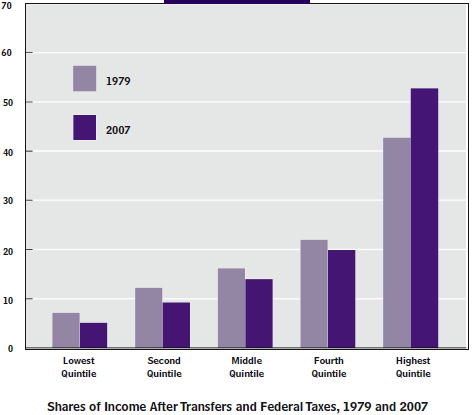
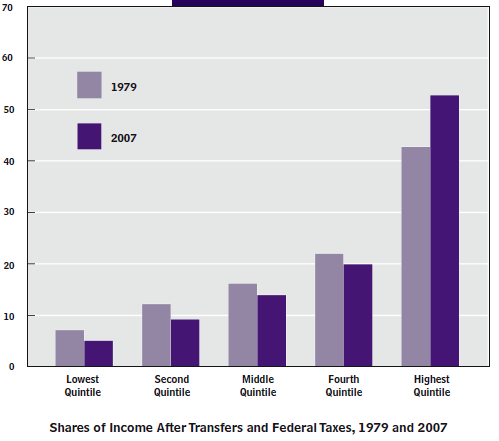
CaptureThe above CBO chart shows that income inequality has not changed much in the last 30 years once government transfers and federal taxes are taken into account. Along the same line, the Manhattan Institute’s Oren Cass makes a strong case in, “The Inequality Cycle,” that Americans should be paying at least as much attention to the social aspects of inequality as to the economic aspects.
For example:

  • As Charles Murray shows in “Coming Apart,” (http://www.amazon.com/Coming-Apart-State-America-1960-2010/dp/030745343X) the upper class has remained stable with respect to marriage rates (94% in 1960, 84% in 2010), civic involvement, and trust in society while for the lower class marriage rates (84% in 1960, 48% in 2010 and dropping), civic involvement and public trust have all declined significantly.
  • Children in the lower classes are five times more likely to face abuse, violence, addiction and the death or imprisonment of a parent.
  • By the time they reach kindergarten, 72% of middle class children know the alphabet compared with only 19% of poor children.
  • The fraction of children with a single parent is the best predictor of upward economic mobility in a particular region, whereas the level of income inequality is not a significant predictor.

Mr. Cass suggests that public policy should focus on these social problems at least as much as on income inequality. For example:

  • Education reform should be focused on both ends of the K-12 spectrum: early childhood education to ensure that all children are ready to learn when they get to school and better vocational education in high school so that graduates can find a good job if they’re not going to college.
  • Remove onerous regulations on the workplace so that employers are not pushed unnecessarily into independent contractor arrangements.
  • The federal government should be more supportive of marriage (e.g. with tax policy), and the participation of religious organizations in the delivery of public social services (to improve their quality).

Conclusion: Being poorly raised does more to cut off opportunity than being raised poor.

The Pope, the United Nations and Global Poverty


This is a big week in the U.S. Pope Francis is coming here and the UN will convene a conference in NYC to endorse international development goals for the next 15 years. As I explained in a recent post, “The Dung of the Devil,” the Pope should pay more attention to the recent accomplishments of free enterprise in decreasing the amount of poverty and economic inequality around the world.
In an article just a few days ago in the Wall Street Journal, Bjorn Lomborg, the Director of the Copenhagen Consensus Center, explains that the U.N. is likely to endorse 169 targets for global investment for the next 15 years. Mr. Lomborg demonstrates with cost-benefit analysis that focusing on just 19 of these goals would accomplish far more than adopting everything on the U.N.’s much longer list.
Capture1Here are a few of Mr. Lomborg’s items:

  • Completing the World Trade Organization’s Doha agreement would return $2000 for every dollar spent to retrain and compensate displaced workers.
  • The elimination of fossil fuel subsidies would be worth $15 for every dollar spent in direct support of the very poor who are unable to afford higher fuel prices. By contrast, trying to drastically increase the production of renewable energy would return less than a dollar for every dollar spent because renewable forms of energy remain so expensive.
  • Tripling access to preschool in sub-Saharan Africa would have benefits worth more than $30 for every dollar spent because of improved future earnings. On the other hand, efforts to improve exams and teacher accountability are much harder to achieve and the benefits would only amount to $5 for every dollar spent.
  • Other actions: boosting agricultural yields, cutting indoor air pollution with clean cook stoves, increasing access to family planning, fighting malaria and combatting malnutrition are other examples where investment would lead to big dollar returns.

Conclusion: Free enterprise economics has done much in recent years to eliminate poverty and inequality around the world. Additional public and private investment, focusing on just a relatively few major goals, can accomplish even more.

Higher Ed: Higher Costs, More Inequality. What to do?


Several months ago I discussed “How the American Education System Contributes to Inequality.” It so happens that students from high-income families graduate from college in much greater numbers and also with much less debt, compared with students from low-income families.
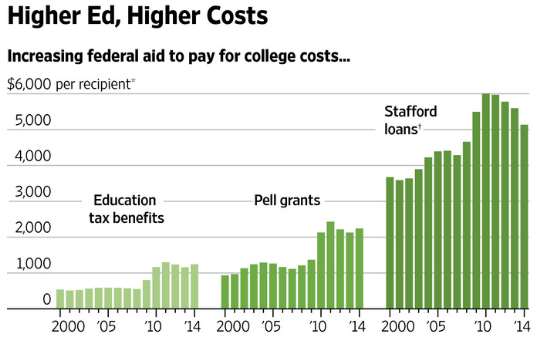
CaptureA new study from the New York Federal Reserve has found a connection between a rapid increase in student aid in recent years and the rapid increase in college costs. In particular:

  • A $1 increase in the subsidized loan cap leads to a tuition increase of 65 cents, and
  • A $1 increase in the Pell Grant limit leads to a tuition increase of 55 cents.
  • Furthermore, private schools, both nonprofit and for-profit, are bigger offenders than public schools, even though declining state subsidies for higher education primarily affect public universities.
  • At the present time undergraduates can borrow a maximum of $57,500 from the federal government.
  • Under the decade-old Grad Plus program, graduate students can borrow any amount their school charges. In the seven years before Grad Plus, undergraduate tuition was rising faster than grad school costs. In the seven years after, the reverse occurred.
    Capture1Clearly this is an untenable situation. The solution, in my opinion, is to strictly limit the total amount of federal loans for both undergraduate and graduate students and force schools to compete on price. For example:
  • Limit the total amount borrowable by an undergraduate, from the federal government, to $30,000, the average amount borrowed today, and then let it adjust it each year for inflation.
  • Limit the total amount borrowable by a graduate student to $60,000, the average amount borrowed today, adjustable each year by inflation.
  • Students who want to borrow additional funds may do so on the private market, with no subsidies or guarantees provided by the federal government.

Such a program would provide much needed financial discipline to colleges and universities and reduce and stabilize ballooning student loan costs for the federal government.

Should the National Minimum Wage Be Raised?


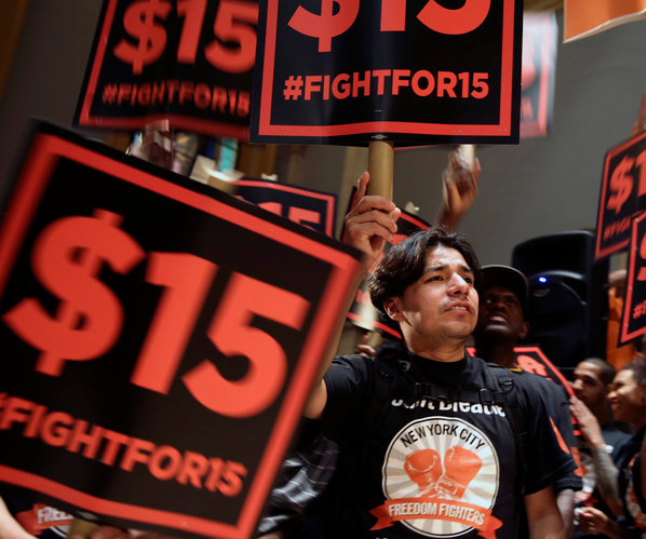
A recent column by David Brooks in the New York Times, “Minimum Wage Muddle,” is a good summary of the pros and cons of raising the minimum wage for the whole country. Mr. Brooks refers to a recent Congressional Budget Office report that a hike in the minimum wage to $10.10 per hour might lift 900,000 out of poverty but would also likely mean a loss of 500,000 jobs.
Capture5As suggested in a recent post, one of the things we could do to get beyond our political dysfunction at the national level is to:

  • Put a greater emphasis on state-centered federalism both to encourage experimentation and innovation in the American system and to remove issues from the national agenda which contribute to division, stalemate and endless controversy.
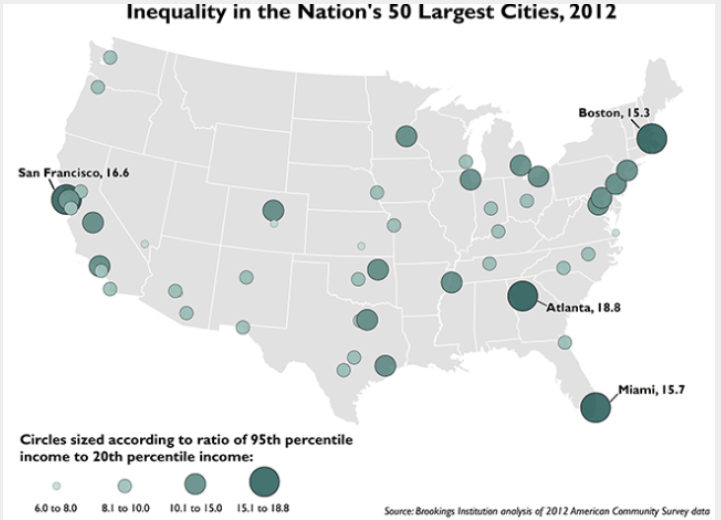
    Capture4Considering that income inequality varies so greatly from one part of the country to another, (see above), it makes a lot of sense to federalize the minimum wage issue. In other words, let cities and states set their own minimum wage levels based on their own local circumstances.
    For example, the state of Nebraska, with very little inequality and where I live, has just raised its minimum wage to $8/hour ($9/hour beginning January 2016). Nebraska’s lowest in the country unemployment rate of 2.6% means that hardly anyone will lose their job.
    As Mr. Brooks says, “Raising the minimum wage will produce winners among job holders from all backgrounds, but it will disproportionately punish those with the lowest skills, who are least likely to be able to justify higher employment costs.”
    Conclusion: raising the national minimum wage is not the best way to address the inequality and fairness issue. A better way is to create more jobs by boosting the economy overall. Then help low wage workers take home more money with a (perhaps expanded) Earned Income Tax Credit. Cities and states can establish their own individual minimum wages however they wish.

Richer and Poorer


As I often remind readers, this blog is primarily concerned with three basic fiscal and economic problems facing the U.S. They are: 1) our stagnant economy, 2) our massive debt, and 3) income inequality. Today I discuss inequality. The March 16 2015 issue of the New Yorker contains an extensive article on this topic by Jill Lapore, “Richer and Poorer.” However it suffers a common defect of only presenting one side of a complex issue.
There are facts about inequality which more people need to be aware of. For example:

  • The scope of income inequality is greatly reduced once incomes are adjusted for government transfers and federal taxes as shown in the following chart from the Congressional Budget Office.
    Capture
  • There is a strong correlation between inequality and growth as shown by the second chart just below from the World Bank.
    Capture2
  • Globalization has had a dramatic effect on incomes world-wide as low skill work has shifted from the developed world to the developing world as shown in the chart below from the Wall Street Journal. Hundreds of millions of people in the developing world have been lifted out of poverty at the cost of lost jobs to low skill workers in the U.S. and other developed countries.
    Capture3Any effective strategy for decreasing income inequality needs to be reality based. Yes, it exists but its severity is exagerated. The Americans who need help the most are the ones unlikely to either attend or graduate from college. What they need most is vocational training to prepare them for the millions of high skill jobs going begging in the U.S.
    The best thing we can do to decrease income inequality in the U.S. is to get our economy growing faster. Since the end of the Great Recession in June 2009, it has grown at the historically slow rate of 2.2% of GDP and this slow rate of growth is predicted (by the CBO) to continue indefinitely under current government policies. A return to the historical 3% growth rate would create jobs and better jobs for millions of the unemployed and under-employed as well as providing bigger raises for the middle class as employers have to compete for qualified workers.
    How can we make the economy grow faster? I have addressed this critical issue many times and will return to it soon.

Inequality and Growth


In my opinion the two most serious problems facing the U.S. at the present time are 1) stagnant growth and 2) massive debt. As discussed by William Galston in yesterday’s Wall Street Journal, the U.S. presidential campaign is now beginning to address the first of these issues.  For example:

  • Bernie Sanders rejects “growth for the sake of growth” and says that “our economic goals have to be redistributing a significant amount back from the top 1%.”
  • Hillary Clinton says that we have to build a “growth and fairness” economy. “We can’t create enough jobs and new businesses without more growth, and we can’t build strong families and support our consumer economy without more fairness.”
  • Jeb Bush argues that there is nothing wrong with household incomes that 4% growth wouldn’t solve.

The readers of this blog will have little difficulty figuring out where I stand on this continuum of economic values. My view is illustrated by the chart just below from the World Bank which shows that countries with the fastest growing economies also have the least amount of inequality.
CaptureLet’s be more specific. Mrs. Clinton would achieve more fairness by:

  • Raising the minimum wage.
  • Guaranteeing child care and other family friendly policies.
  • Encouraging profit sharing.
  • Encouraging more innovation by increasing public investment in infrastructure, broadband, energy and scientific research.

These are attractive goals but how do we achieve them? The best way to raise wages is to get the economy growing so much faster that it creates a labor shortage. Then businesses will be competing for labor and wages will go up. This is exactly what is happening in Omaha NE where I live and the unemployment rate is down to 2.9% (2.6% in Nebraska as a whole).
Furthermore, in a tight labor market, businesses will automatically try harder to keep good employees by providing extra benefits such as childcare and profit sharing.
Public investment in infrastructure, etc. will be more easily affordable with the higher tax revenue generated by a faster growing economy.
Conclusion: faster growth is the best way to create a more fair and equal society!

Life in America: Opportunity or Inequality?


How bad is income inequality in the U.S. and what should be done about it?  This is a question of great current interest with many different points of view.  The chart just below from the Congressional Budget Office shows the extent of income inequality and also shows that it has gotten somewhat worse between 1979 and 2007, just before the onset of the Great Recession.  And we know that our stagnant economy has made it worse yet between 2007 and the present.
CaptureBut now look at the chart (below) from the U.S. Census Bureau of the distribution of household income in the U.S. in 2012.  The chart shows the median income of about $51,000 and then has a very long tail to the right.  This means that there are large numbers of households making large incomes of all different sizes.  It makes no particular sense to distinguish the top 1% (who make $380,000 or more) from the bottom 99%.
Capture1The point is that there is huge opportunity in the U.S. to do very well financially whether or not one makes it into the top 1%.
In an earlier post, “Growth vs Equitable Growth,” I reported on the agenda of the Washington Center for Equitable Growth, a progressive think tank.  In order to achieve “equitable growth” they advocate:

  • Improving educational outcomes at all levels, pre-K – 12+.
  • Running a “high pressure” economy in order to tighten the labor market.
  • Expand the Earned Income Tax Credit especially for workers without children.

I couldn’t agree more.  This is an excellent plan to create more prosperity for more people.  It’s much more plausible in the U.S. to make poor people richer than to make rich people poorer.

Growth vs Equitable Growth


There is a huge debate going on in political and policy circles between the advocates of increasing economic growth and the advocates of increasing income equality.  I generally argue that the best way to increase income equality is to increase economic growth overall.
CaptureI have just come across a series of articles from the Nov/Dec 2014 issue of the American Monthly, “American Life: an investor’s guide,” which are sponsored by the Washington Center for Equitable Growth, a progressive Think Tank.  The fact that this group is focused on equitable growth, rather than the narrower goal of income equality, is of great interest to me.
Capture1They advocate a number of things that I agree with such as:

  • The incredible importance of early childhood healthcare and education.
  • Improving K-12 education, especially in low-income areas.
  • Providing much more vocational education and apprenticeship programs.
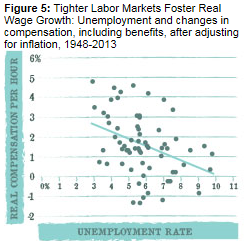
  • Running a “high pressure” economy in order to tighten the labor market. They recognize that lower unemployment leads to higher wages (see above).
  • Expand the Earned Income Tax Credit especially for workers without children.

The authors want to “pressurize” the economy with a more stimulative fiscal policy which means increased deficit spending, a very bad idea in my opinion.  Much better ways to boost the economy are with policies such as tax reform, trade expansion, immigration reform and regulatory relaxation.
Yes, there is a high degree of income inequality and yes, it’s getting worse over time.  But, as Warren Buffett says, the poor are not poor because the rich are rich.  The best way to help the poor is to make them more productive.  That is exactly the purpose of the policies enumerated above.

The Social Effects of Income Inequality


It is well understood that income inequality is increasing in the U.S. for a number of reasons: economic globalization, the rapid development of new technology and the slow recovery from the Great Recession of 2007 – 2009.
CaptureThe New York Times’ economics journalist, Eduardo Porter, discusses the social effects of this ominous trend in the article “Income Inequality Is Costing the U.S. on Social Issues.” For example:

  • The U.S. has the highest teenage birthrate in the developed world – seven times the rate in France, for example.
  • More than one out of four U.S. children lives with one parent, the largest percentage by far amongst industrialized nations.
  • More than a fifth of U.S. kids live in poverty, sixth from the bottom among the OECD.
  • Among adults, seven out of every 1000 are in prison, five times the rate for other rich democracies and three times the U.S. rate from four decades ago.
  • In 1980 the infant mortality rate in the U.S. was about the same as in Germany. Today it is almost twice the rate as for German babies.
  • American babies born to white, college educated, married women survive as often as those born to advantaged women in Europe. It is the babies born to nonwhite, non-married, non-prosperous women who die so young.

In other words, there is huge social disparity between the well-off and the poor in the U.S. and, furthermore, the resulting social breakdown is getting worse. Why has this been happening?
Conservatives say that it is the fault of a growing welfare state which has sapped Americans’ industriousness and sense of self-responsibility.  Liberals say that welfare programs arn’t extensive enough to withstand the strict demands of globalization and technological development.
Mr. Porter concludes that, “the challenge America faces is not simply a matter of equity.  The bloated incarceration rates, rock-bottom life expectancy, unraveling families and stagnant college graduation rates amount to an existential threat to the nation’s future.”
I tend to agree.  Is our democratic political process capable of responding in a satisfactory manner?  I will return to this theme often in the coming months!