Why Is American Healthcare So Expensive?


The U.S. spends almost 18% of GDP on healthcare costs, double what any other developed county spends.
CaptureThere are many reasons for our excessive healthcare spending.  For example:

  • As illustrated in the above chart, many medical procedures are far more expensive here than in other countries.
  • Profit levels in the healthcare industry are often very high, for example: 16.4% for pharmaceuticals, health-care information 9.4%, home healthcare firms 8.5%, medical labs 8.2% and generic drug makers 6.5%.
  • Health insurers, on the contrary, have a very low profit margin, (2.2% in 2009), and so can hardly be blamed for the high cost of healthcare.

The Affordable Care Act greatly expands access to healthcare but does very little to control costs.  The Manhattan Institute’s Avik Roy has outlined a plan, “Transcending Obamacare: A Patient Centered Plan for Near-Universal Coverage and Permanent Solvency” which would reform Obamacare by making it more like two very successful and low cost consumer-driven plans, those in Switzerland and Singapore.
These two countries feature government sponsored health savings accounts, backed up by insurance for catastrophic care.  What happens is that out-of-pocket spending for healthcare per individual is higher in Switzerland and Singapore than it is in the U.S., as indicated in the chart below.
Capture1In other words, the real reason for our high cost of healthcare is that Americans don’t have enough “skin in the game.”  We have very little incentive to hold down the cost of our own care because it is mostly paid for by third party insurance companies.
As the cost of healthcare continues to climb, such changes are already beginning to creep into the health insurance market place.  Private companies are raising the deductibles on the insurance plans which they subsidize.  The bronze, silver, gold and platinum plans on the ACA exchanges differ largely by the level of the insurance deductible.
Avik Roy’s plan referred to above in essence speeds up the process of converting the ACA into an efficient, consumer-driven healthcare system by making it more flexible and therefore more adaptable to market forces.

Providing Regulatory Relief for Main Street Banks

The major congressional response to the Financial Crisis was the passage of the Dodd-Frank Act in 2010, putting many restrictions on U.S. financial institutions in hopes of ending “too big to fail.”  The problem is that the new regulations often apply to the many low risk, traditional, main street banks which did not cause the financial crisis.  The new regulations hamper the ability of these smaller banks to lend money to their regular customers, thereby slowing down the economic growth we need for full recovery from the recession.
CaptureThomas Hoenig, Vice Chair of the Federal Deposit Insurance Corporation, has recently made some common sense recommendations for alleviating this problem.
He proposes to provide relief for financial institutions which meet the following criteria:

  • Banks that hold zero trading assets or liabilities.
  • Banks that hold no derivative positions other than interest rate swaps and foreign exchange derivatives.
  • Banks whose total value of all derivative exposures is less than $3 billion.
  • Banks which have a ratio of equity-to-assets of at least 10%. Most community banks meet this criteria and the number is within reach for those which do not.

Of more than 6500 commercial banks, only about 400 do not meet the first three criteria.  None of the banks with more than $100 billion in total assets meet these criteria. Banks which qualify could receive relief such as:

  • Exemptions from Basel capital standards and risk-weighted asset calculations.
  • Allowing for examiner judgment in eliminating requirements to refer “all possible or apparent fair lending violations to Justice” if judged to be de-minimis or inadvertent.
  • Exemptions from appraisal and stress test requirements.
  • Allowing an 18-month examination cycle as opposed to the current 12-month cycle.

Mr. Hoenig’s conclusion: “For the vast majority of commercial banks that stick to traditional banking activities, and conduct their activities in a safe and sound manner with sufficient capital reserves, the regulatory burden would be eased.  For the small handful of firms that have elected to expand their activities beyond commercial banking, the additional regulatory burden is theirs to bear.”

Should We Raise Taxes or Cut Spending?


Tax Day is a good time to remind ourselves about our perilous fiscal situation.  With a public debt (on which we pay interest) of $13 trillion and with annual deficits of just under $500 billion adding to the debt each year, we have a huge problem which is not being adequately addressed by Congress.  The solution is to either raise taxes or cut spending or do a combination of both.
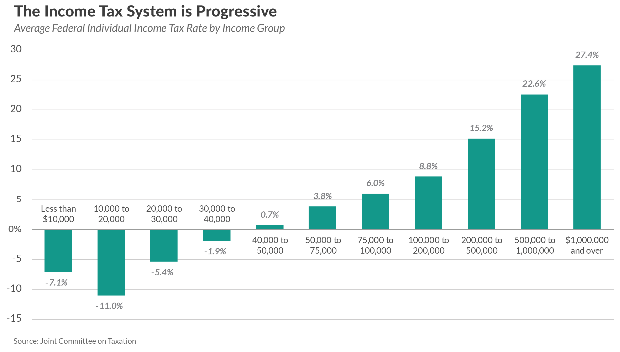
CaptureIs it feasible to raise taxes, presumably on the rich?  The problem in doing this is that our tax code is already very progressive as indicated by the above chart. The top 20% already pay 84% of all income taxes.  It’s just not feasible to expect to be able to raise their taxes by a very large amount.  In addition, Middle- and lower-income people are in a tight fiscal situation, because of the slow economy, and can hardly be expected to see their own taxes increase.
Capture1The alternative to raising taxes is to cut spending and there are many opportunities to do this.  The organization Citizens Against Government Waste has just identified a collection of government programs whose elimination would save $639 billion in the first year alone.  Taxpayers for Common Sense has a long list of potential spending cuts which would save $267 billion in the first year.
Amazingly, neither of these lists of possible cuts includes any mention of entitlement programs.  Before very long, major savings in entitlement programs must certainly be achieved in order to put the federal government on a sustainable fiscal course.
In fact, spending should be trimmed all across the board, wherever possible, in order to get our annual deficits on a steadily downward course.  It is critical for this process to get under way as soon as possible and to continue until fiscal balance is achieved by entirely eliminating deficit spending altogether.

Are We Doing Enough to Help the Poor?


Income inequality in the U.S. is getting worse and one reason is that the middle class is being “hollowed out” by a lack of sufficient job opportunities.
CaptureThe result is more people at the bottom end of the income scale.  Not surprisingly, it turns out that many of these low-wage workers are receiving public assistance, as documented by the UC Berkeley Labor Center, and the New York Times.
Capture1The authors point out that if these workers received higher wages, they would not require as much public support which, in turn, would save money for the taxpayers.  This is a true but not a practical means for helping the poor.  Employees are paid what they’re worth based on the law of supply and demand.  Companies will pay as much as they have to in order to find and retain well qualified workers.  Furthermore, a minimum wage which is too high will simply lead to a higher rate of unemployment.
There is really only one good way to raise the overall wage level, especially at the bottom end of the scale.  It is to speed up economic growth, thereby lowering the unemployment rate and creating more demand for workers.
This is exactly what has happened in Omaha NE where I live.  The official unemployment rate is 3.2% and there is a labor shortage.  A new minimum wage ($8/hour now, $9/hour next January) was approved by the voters last November.  But low-skill entry level jobs are paying $10/hour or more because of the scarcity of workers.
There are plenty of opportunities to succeed in Omaha.  Support yourself with a low-wage job and go to Metropolitan Community College to learn a high-skill, high-wage trade.  Most people are capable of following this route to a better life!

“We’ve Got to Do Something about Income Inequality”


This is what I hear over and over again from my liberal-minded friends.  Their solution is to raise taxes on the rich and give to the poor.  This might help a little but not nearly enough.
The best way to help middle- and lower-income people is to give them more opportunities for self-advancement by providing more upward mobility in society.  Right now the middle class is being “hollowed out” as shown in the chart just below.
CaptureThere are three major reasons for this:

  • Economic Globalization which provides low cost goods from around the world and thus puts pressure on low- and semi-skilled workers in the U.S.
  • Rapid technological advancement which puts a higher premium on educational attainment and advanced skill acquisition.
  • Slow economic growth averaging only 2.3% since the end of the Great Recession in June 2009.

Globalization and technological advancement are strong worldwide forces likely to continue indefinitely.  We will simply have to adapt to them with long term strategies such as improved educational outcomes at all levels (early childhood, K-12 and post-secondary).  But speeding up economic growth is under our direct control with tried and true methods which are not being fully utilized at the present time. Such as:

  • Tax Reform. We should lower tax rates for individuals across the board, paid for by shrinking deductions for the wealthy. This will give middle- and lower-income workers, as well as new entrepreneurs, more money to spend, thereby boosting both supply and demand in the economy.
  • Increasing the Earned Income Tax Credit paid for by using some of the increased revenues from shrinking deductions for the wealthy. This would encourage more people to take and hold onto entry level jobs, thus boosting the economy by increasing the size of the workforce.

In other words, much can be done to reduce income inequality.  Redistribution of tax revenue is fine as long as it is done in a way which increases economic growth, rather than just punishing the rich.

How the American Higher Education System Contributes to Inequality


Income inequality in the U.S. is a major problem, getting worse all the time.  There are many reasons why this is happening and many suggestions for how to deal with it.  On the other hand, it is well appreciated that a college degree is one of the best tickets for upward mobility into the middle class.  A new book by Suzanne Mettler, “Degrees of Inequality,” shows how American higher education is actually increasing the divide between the haves and have-nots.  She points out that:

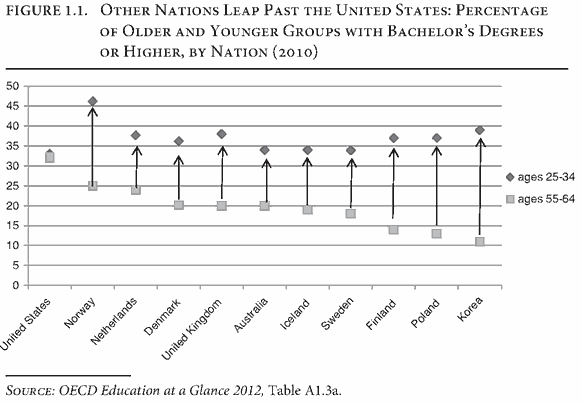
  • There are too few college graduates in the U.S.  In 2010 Americans between ages 25 and 34 had a college graduation rate of 33%. At least 10 OECD nations have higher rates (see below). American world leadership in the future will be jeopardized if we don’t continue to be an educational leader as we have been in the past.

    Capture

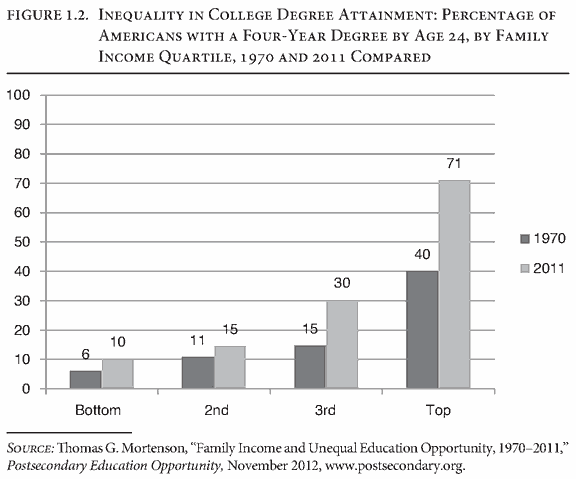
  • America is graduating inequality. College degree attainment has increased between 1970 and 2011 for all income groups. However this is happening much more quickly for higher income groups. 83% of 18 to 24 year olds now have a high school diploma and 75% of this group start college. But the completion rate by age 24 is only 47%, mostly from the higher income groups (see below).Capture1
  • Not all college degrees are created equal. Students at private, nonprofit institutions graduate at higher rates than students from public institutions who, in turn, graduate at much higher rates than students from for-profit institutions. And graduates of the for-profits have larger loan debt than for graduates from private nonprofit and public institutions.

Capture2

Students at for-profit educational institutions tend to be from lower-income families.  As noted, they have lower graduation rates and end up with higher debt levels.  Clearly the three tier system of American higher education has a harmful effect on the young adults who need the most help in moving up the economic ladder.
How should society address this major problem in an era of tight public spending?  One answer is to increase regulation of the government-run student loan program.  All educational institutions should be held at least partially responsible for the defaulted loans of their former students.
Another approach is to increase financial support for community colleges so that they can provide more programs for the low-income students who are most likely to attend them.

How Do We Boost Middle Class Jobs?


Income inequality is a serious political issue these days as it should be.  America’s future well-being depends on widely shared prosperity.  One of the very best ways to lessen inequality is to increase mobility into the middle class.
Capture  The political and economic analysis group, FiveThirtyEight, has just reported new data (see above) that “Mid-tier Jobs Are Seeing Less Growth.”  The middle class has already been hollowed out by the gale-wind forces of globalization and technological advancement.  Now the Great Recession, and the slow recovery from it, has made things that much worse.  It’s long past time to focus on middle class recovery.
The best way to do this is to make the economy grow faster as follows:

  • Tax Reform. Lowering individual rates should be the first priority, paid for by closing loopholes and shrinking deductions for the wealthy. This will give middle- and lower-income workers more money to spend and encourage startup small businesses. Lowering corporate tax rates, again offset by shrinking deductions, will incentivize multi-national corporations to bring their profits back home for distribution or reinvestment.
  • Increase the Earned Income Tax Credit, paid for with some of the increased revenues from shrinking deductions for the well-to-do. This will encourage more people to take and hold onto entry level low-wage jobs, thus increasing the size of the workforce.
  • Putting More Emphasis on Career Education in High School. Not everyone wants to or needs to go to college. There are lots of well-paying middle class jobs for high skilled workers and a shortage of workers for these jobs in many labor markets.
  • Miscellaneous. Immigration reform, trade expansion, and easing regulations on small business would also help grow the economy.


Economic growth since the end of the Great Recession in June 2009 has averaged a meager 2.3%. Speeding up growth is the best way to raise wages and lower unemployment at a much faster rate.  This is the best way to boost middle class jobs!

My Moral, Social and Political Values


About a month ago I wrote a post about a book by Dennis Prager, “Still the Best Hope: why the world needs American values to triumph.”  According to Mr. Prager, there are three ideologies competing for the allegiance of humankind.  They are: Islamism, Leftism and Americanism.  He defines American values as 1) Liberty, 2) In God We Trust and 3) E Pluribus Unum, the three expressions which appear on all American coins.  His trinity of ideologies and values helps me understand my own political framework.
CaptureI consider myself to be a cultural Christian meaning that I identify with Christian values such as practicing the Golden Rule and trying to be a Good Samaritan rather than believing in any particular theological doctrines.
My social values are based on my moral and religious values.  Americans have the good fortune to live in a very prosperous country with much personal liberty.  But along with our freedom and prosperity comes responsibility.  First of all, we are responsible for our own behavior.  If we make bad choices, we have to accept the consequences and try to learn from our mistakes.  We have greatly benefitted from the hard work of our forebears.  In return it is our responsibility to leave the world a better place than we found it.
Just as my social values are consistent with my moral values, so do my social values determine my political values.  I am a fiscal conservative and a social moderate.  I consider it highly irresponsible for my generation to leave a huge, and growing, national debt for future generations.  Either government should cut back on spending or it should raise taxes to pay for what it spends.
But I also consider it to be America’s responsibility, as well as in its own self-interest, to promote freedom and responsibility around the world.  This is demanding,  expensive and sometimes controversial but we need to be willing to do it.  Likewise, we need to provide an adequate safety net for those among us who are truly unable to cope for themselves.
This is my first public attempt to describe the underlying values around which I organize and conduct my life.  It’s a start but I’m pretty sure that I’ll be coming back to this theme again in the future!

Can We Solve All Our Fiscal and Economic Problems at the Same Time?


This website, It Does Not Add Up, is devoted to discussing our country’s most serious economic and fiscal problems.  They are:

  • Stagnant Economy. Since the end of the Great Recession in June 2009, the economy has been growing on average at the historically slow rate of about 2.3%. Slow growth means higher unemployment, stagnant wages and less tax revenue.
  • Massive Debt. U.S. public (on which we pay interest) debt is now 74% of GDP (highest since WW II) and projected by CBO to grow rapidly unless strong measures are taken to reduce it. This puts our country’s future wellbeing and prosperity at great risk.
  • Increasing Income Inequality. Incomes for the high-skilled and well-educated are increasing much faster than for the low-skilled and less-educated workers.

The new Republican majorities in Congress are stirring the waters by proposing a ten year plan to shrink the deficit down to zero, i.e. to balance the budget by 2025.  The opposition claims that this would “sharply cut the scale of domestic spending, which would mostly fall on the poor.”
Capture1But the American Enterprise Institute’s James Pethokoukis points out that social spending in the U.S., both public and private, is very generous and second only to France in the entire OECD. So here is how we could proceed to address our basic problems in a unified manner:

  • Balance the Budget by a combination of Republican spending cuts and cutting back on two major tax deductions: Employer-sponsored Health Insurance (cost: $250 billion per year) and Mortgage Interest (cost: $70 billion per year).
  • Boost Economic Growth by expanding the Earned Income Tax Credit to encourage more people to accept low paying, entry level jobs. Increase the Social Security eligibility age from 67 to 70, thereby keeping near retirees in the workforce for three additional years (this will also extend the solvency of the Social Security Trust Fund).
  • Decrease Income Inequality. Cutting back on tax deductions, in part to pay for expansion of the EITC, lessens income inequality as well as shrinking the deficit. A faster growing economy also lessens inequality by providing more opportunities for upward mobility.

In other words, addressing each of these fundamental problems in an intelligent manner contributes to solving the remaining problems as well.  This creates a virtuous circle for economic progress!

Too Much Income Inequality is Harmful to Society


It is well understood that income inequality is increasing in the U.S. and that there are lots of reasons for it.  Globalization provides low cost goods from around the world and thus puts pressure on low-wage workers in our own country.  Rapid technological advancement puts a high premium on educational attainment and skill acquisition and thus helps individuals who are highly motivated to succeed.  The Great Recession and our slow recovery from it have held back the growth of employment and wages increases for middle- and lower-income workers.
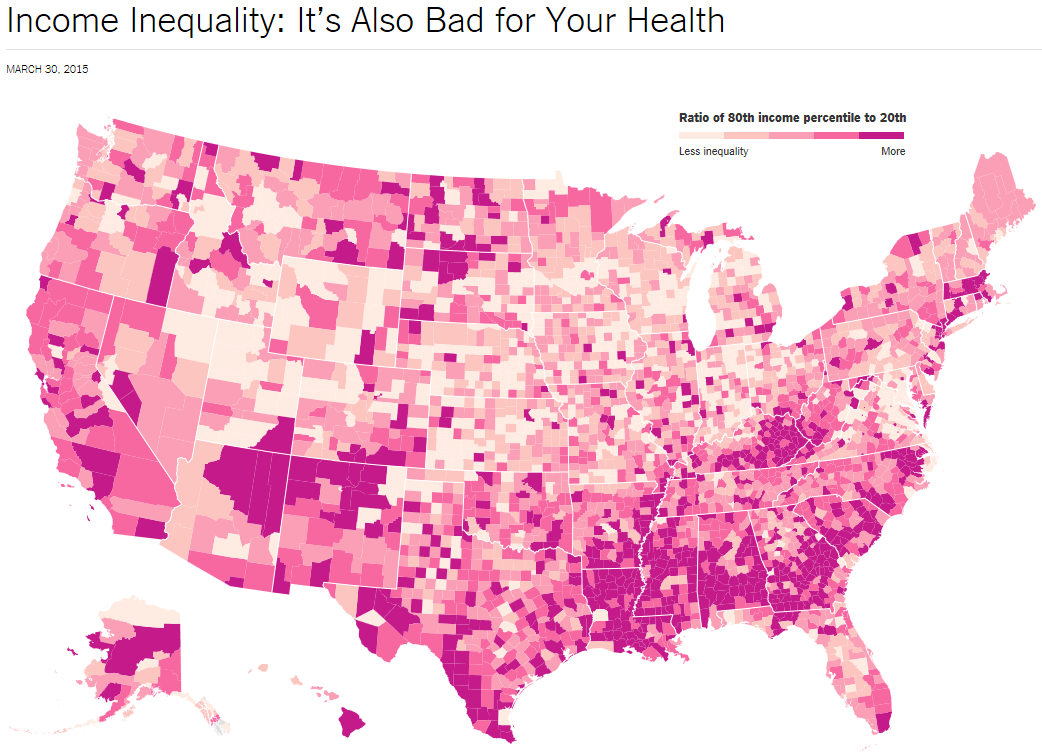
CaptureIncreasing income inequality is a pernicious social condition and has lots of unpleasant consequences.  A new study of U.S. counties has shown that there is a strong correlation between more inequality in a particular geographical area and shorter average live spans.  It is quite reasonable to expect that higher-income people will be more health conscious than lower- income people. Excessive inequality is bad for lots of reasons.
The question is what we can do about it.  Here are two good ways to address it:

  • Faster economic growth would help a lot. The American Enterprise Institute’s Michael Strain has recently proposed a fairly modest plan for increasing employment by cutting tax deductions for the wealthy, increasing the Earned Income Tax Credit for the poor and at the same time decreasing deficit spending. I have made a more substantial proposal along the same lines.
  • Boost educational performance across the board. College-ready middle class kids will take care of themselves so the emphasis should be on the 70% of young adults who will not go to a four year college. There are lots of good jobs available for the highly skilled and so we need more career education in high school. We also need more early childhood education to prepare kids from low-income families to get off to a good start in elementary school.

Increasing economic growth and expanding educational opportunities for the non-college bound will require little, if any, new federal spending.  Such policies as above are simply common sense ways to reduce income inequality and achieve a more inclusive society.