Fundamental Principles for Tax Reform


I have been criticizing the Republican Congress lately for straying from fundamentals in attempting to reform healthcare and tax policy. What are the fundamentals for tax reform?  In my opinion they are:

  • Faster economic growth. The economy has averaged only 2% annual growth since the end of the Great Recession in June 2009. The unemployment rate has slowly fallen to the current 4.4% level and a labor shortage is now developing. But wage gains for the broad middle class and especially blue collar workers have been minimal. Faster growth will put pressure on employers to raise wages faster to acquire the skilled workers they need.
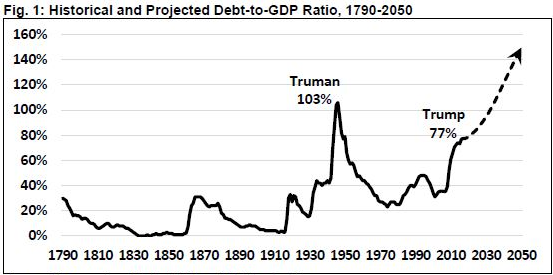
  • Revenue neutrality. With the public debt (on which we pay interest) now 77% of GDP, the highest since the end of WWII, and predicted by the Congressional Budget Office to keep getting steadily worse without major changes in policy, it would be the height of irresponsibility for Congress to approve tax changes which increase our annual deficits.

Given these two basic principles, what should be the specific changes made to tax law? Here are my priorities:

  • Lowering the corporate tax rate from its current level of 35% to a competitive level, approximately 20%, with other developed countries. This would be a huge incentive for our multinational corporations to bring their foreign profits back home.
  • Full expensing for business investment is allowed, replacing depreciation over a period of years, to speed up new investment.
  • Simplification of the rules for individuals, such as with fewer tax rates and fewer credits, so that fewer errors will be made and a greater proportion of true tax liabilities will be collected.
  • Create revenue neutrality for the above tax rate cuts by eliminating, or at least shrinking, many deductions and closing loopholes.

Conclusion. Tax reform will be highly beneficial for the economy if it is done correctly. This means ignoring many of the special interest provisions which have also been suggested for conclusion.  I will discuss these in my next post.

Follow me on Twitter 
Follow me on Facebook 

The GOP Congress Needs to Get Back to Fundamentals


Granted that it is hard to implement good policy with a populist President like Donald Trump who is most interested in stirring up his base, nevertheless the Republican Congress is making some serious policy mistakes:

  • Healthcare. The GOP should accept the fact that universal healthcare is a desirable societal goal and is here to stay. The Graham-Cassidy bill is bad policy because some states, such as debt-ridden Illinois, can’t possibly handle healthcare on their own. The fact that the ACA needs operational fixes gives the Republicans leverage for insisting on cost lowering changes in a bipartisan bill.
  • Tax Reform. The GOP should focus on the most serious problems in our tax system. The complexity of the tax code is partly responsible for the fact that taxes paid lag true tax liabilities by an estimated 16% or $406 billion per year.  As an example of waste, the IRS has paid out $132 billion in EITC benefits over the last decade to people who were ineligible.
    Our uncompetitive corporate tax rate of 35% encourages multinational companies to leave their profits overseas rather than bringing them back home for reinvestment.  Even so, corporate tax revenue as a share of GDP is less than in most other developed countries.
    Republicans claim to be the party of fiscal responsibility and should therefore be highly uncomfortable with any tax plan which reduces federal revenue and increases our already very large annual deficits.  With a low unemployment rate of 4.4%, any additional artificial (deficit financed) fiscal stimulus is likely to kick off a new round of inflation.

Conclusion. Republicans have a relatively short window of opportunity to enact policy changes beneficial for the country. They need to get serious about what is really important before time runs out.

Follow me on Twitter 
Follow me on Facebook 

Why Is Political Progress So Difficult in the United States?


With Donald Trump expanding the culture wars and the Democrats lining up with the progressive policies of Bernie Sanders, the national political scene seems to be getting more confusing all the time.


And yet there is remarkable consensus on many levels about what the country really needs:

  • Faster economic growth would help provide more jobs and better paying jobs for the blue-collar workers which both parties are trying to appeal to.
  • Tax reform meaning to reduce tax rates, shrink deductions and generally simplify the tax code has widespread bipartisan support, as one way to provide the growth which everyone wants.
  • Shrinking the debt as a percentage of GDP is widely recognized as critical to the future well-being of our country and especially for the poor who are most dependent on social welfare programs.  How to curtail spending sufficiently to get this done is inevitably a highly contentious issue.
  • Healthcare for (almost) all is now the law of the land, given that the GOP has failed to repeal the Affordable Care Act. The emphasis going forward should be to control healthcare costs for both individuals and families as well as for the federal government (the taxpayers).
  • Immigration and DACA. There appears to be strong bipartisan support in Congress for giving the Dreamers legal status in the U.S. With a very low (4.4%), and still dropping, unemployment rate, a huge labor shortage is developing in many states, including Nebraska. What the U.S. needs is an expanded guest worker visa program so that all employers are able to find the (legal) employees they need to conduct business. Perhaps DACA reform will lead to broader immigration reform as well.

Conclusion. The above issues should be largely amenable to bipartisan consensus. Both parties would benefit from putting aside petty differences and working together to solve them.

Follow me on Twitter 
Follow me on Facebook 


Achieving Permanent, Revenue Neutral, Pro-Growth Tax Reform


As Congress turns its attention to tax reform, there is a clear bipartisan consensus on the fundamental principles to employ, see here, herehere, and here.


For example:

  • Promote growth and increase wages for working families
  • Modernize our outdated business and international tax system.
  • Rely on reasonable economic assumptions
  • Make sure that any rewrite of the tax code is revenue neutral

The Tax Foundation has outlined several different approaches to tax reform which meet the above guidelines.  Their Option A is especially attractive:

  • The corporate tax is reduced to 22.5% and full expensing for business investment is allowed.
  • GDP increases by 7.1% long term which translates to a .7% increase per year for ten years, which is substantial economic growth.
  • All income groups, except for the top 1%, will see an after-tax increase in income.
  • Individual Tax brackets are consolidated into the three rates of 12%, 20.5% and 37% and the standard deduction is nearly doubled (from $6350 to $12,000).
  • All itemized deductions are eliminated except for home mortgage interest (limited to $500,000) and charitable contributions.
  • Capital gains and dividends are taxed as ordinary income with individuals being allowed to deduct 40% of qualified dividends and long-term capital gains.
  • The estate tax is eliminated.
  • This tax plan is revenue neutral on a static basis.

Conclusion. There are many attractive features in this plan. Being revenue neutral, with strong economic growth, means that the increase in tax revenue will shrink our huge current annual deficits.  Only the very wealthy top 1% of taxpayers will see their income (slightly) decreased.  The substantial decrease in the corporate tax rate will incentivize multinational corporations to bring their overseas profits back home for reinvestment.

Follow me on Twitter 
Follow me on Facebook 

Donald Trump and American Progress


I am a non-ideological (registered independent) fiscal conservative and social moderate. I was not very excited about either presidential candidate last fall but finally decided to vote for Clinton because of Trump’s sleaziness.
As it turned out Mr.Trump was elected because of his strong support from the white working class, especially in the upper Midwestern states of Wisconsin, Michigan and Pennsylvania.  Interestingly, the Democrats are responding by proposing legislation to try to appeal more strongly to blue-collar workers.
Of course I disapprove of Donald Trump’s poor handling of the Charlottesville tragedy but I try to avoid being distracted by all of the drama and rather stay focused on his policies and actions.  In this respect there are both plusses and minuses.


On the positive side:

  • North Korea. He is handling this crisis well simply by working through the UN to condemn North Korea’s provocative testing of ballistic missiles. Also his Administration has clearly stated that the goal of U.S. policy is to denuclearize the Korean peninsula, not to achieve regime change in North Korea.
  • The economy is still chugging along at 2% annual growth. On the deregulation front, the annualized pace of new regulations for 2017 is 61,000 pages, down from 97,000 in 2016. This is the lowest level since the 1970s and has the potential to speed up growth.

On the negative side:

  • NAFTA renegotiation is just getting started. Any shrinkage of U.S. exports will badly hurt the economy, especially in states like Nebraska which depend so much on agricultural exports.
  • Immigration. Mr. Trump proposes to dramatically decrease annual legal immigration quotas, especially for low-skilled workers. This is a very poor idea  which will hurt the economy, especially in states like Nebraska which have low unemployment rates.

Conclusion. President Trump’s record at this point is mixed, all the more so since the two very important issues of the 2018 budget and tax reform have yet to be resolved in Congress. Mr. Trump’s election may or may not be good for progress in America.  We simply don’t know yet.

Follow me on Twitter 
Follow me on Facebook 

How to Achieve Sensible Tax Reform


Experts across the political spectrum agree that the U.S. tax code is a huge mess and needs to be reformed as well as simplified.  It is also generally accepted that lower tax rates will lead to faster economic growth.
As Congress turns its attention to tax reform, Senate Democrats have stated the basic principles which they would like to see included in any changes which are made:

  • Increase the wages of working families. This could be accomplished by lowering tax rates for all individuals across the board, paid for by eliminating (or at least shrinking) many of the personal deductions in the tax code. The approximately two thirds of all taxpayers who do not itemize deductions would then receive a tax cut, equivalent to a wage increase.
  • Promote domestic investment and improve middle class job growth. Lower tax rates will give businesses and entrepreneurs a bigger incentive to invest in business expansion and therefore grow the economy faster and create more new jobs.

  • Modernize our outdated business and international tax system. Our corporate tax rate at 35% is the highest in the developed world and, at the same time, produces below average revenue (see chart). Another reform would be to adopt business expensing (immediate tax write-off for new investment). Again, all such changes should be paid for by eliminating loopholes and shrinking deductions.
  • Any rewrite of the tax code must be deficit neutral. As important and valuable as tax reform is, it has to take into account our country’s most fundamental problem: our huge and rapidly growing national debt and therefore end up being deficit neutral overall.

Conclusion. The above principles, stated by the Senate Democrats, represent a sound approach to reforming the U.S. tax system. I hope that the Republicans are willing to recognize the validity of these proposals and include the Democrats in developing a bipartisan tax reform plan.

Follow me on Twitter 
Follow me on Facebook 

The Democrats and the Economy II. A Path Forward


On Monday the Democratic Congressional leadership held a rally in rural Berryville, Virginia. They laid out a program designed to appeal to the middle class and blue-collar workers who voted for Donald Trump.  However many of their proposals involve expensive government programs and therefore would add significantly to the national debt.


What is needed is a greater emphasis on free-market ways of helping middle- and low-income workers such as:

  • Increasing basic economic growth which has stalled to a relatively slow 2% per year of GDP since the end of the Great Recession in June 2009. For example:
  • Revenue neutral tax reform, lowering rates for both individuals and corporations, paid for by closing loopholes and shrinking deductions, would have many benefits. It would stimulate business investment, create new demand by lowering the taxes paid by the approximately 2/3 of taxpayers who do not itemize deductions, and provide an incentive for multinational corporations to bring their foreign profits back to the U.S. for reinvestment.
  • Targeted deregulation of the financial sector by exempting main street banks from the onerous requirements of the Dodd-Frank Act would enable these smaller banks to lend more money to small businesses.
  • Fundamental healthcare reform to lower costs from the current 18% of GDP to the approximate 12% average of other developed countries. This would save the American economy $1 trillion annually which could be spent far more productively. The Democrats are on the right track here by refusing to accept Republican half measures.
  • Improve educational opportunities such as early childhood education for low-income families, expanded career education and job training in high school and community colleges, and more emphasis on income-based repayment for student college debt. There would be some cost involved here.
  • Modest increase in the national minimum wage from the current level of $7.25 per hour to perhaps $10 per hour and then index it to inflation going forward. The Democratic proposal for a national $15 per hour minimum wage would put too many people out of work.

Conclusion. This collection of proposals involves both Democratic and Republican ideas and should be implementable with a bipartisan effort.

Follow me on Twitter 
Follow me on Facebook 


The Right Way to Deregulate Wall Street


The economy has been chugging along at about 2% annual GDP growth ever since the end of the Great Recession in June 2009. Unemployment has been steadily dropping and is now a fairly low 4.4%.  Low wage earners are now even beginning to see bigger gains in pay.
Most people would like to speed up economic growth even more.  Tax reform will help in this regard but so will sensible deregulation.  Barron’s has an excellent article this week about deregulating Wall Street by William D. Cohan.


According to Mr. Cohan:

  • GDP growth is highly correlated with bank lending.
  • The Dodd-Frank Act, passed by Congress in 2010, has disproportionately burdened community banks, despite their having no role in the financial crisis.
  • More than 1700 U.S. banks have disappeared since Dodd-Frank was passed.
  • Senator John Kennedy (R, LA) has introduced a bill which would exempt community banks and credit unions with assets of less than $10 billion from the Dodd-Frank Act.
  • As a result of Dodd-Frank, big banks are now required to have more capital and less leverage. Today a bank’s assets would have to fall about 7% before a bank’s capital would be wiped out, as opposed to only 2% in 2008.  This makes them safer.
  • Prior to 1970 the Wall Street partnership structure ensured that bankers had plenty of skin in the game – essentially their full net worth was on the line every day.
  • Today bankers and traders are rewarded for taking risks with other people’s money. Mr. Cohan recommends that the top 500 traders and executives at every big bank have a significant portion of their net worth on the line.

Conclusion. Mr. Cohan’s program would not only give a big boost to the economy by enabling community banks to lend more freely but would also make our financial system safer by requiring top financiers to have skin in the game.

Follow me on Twitter 
Follow me on Facebook 


How to Achieve a Balanced U.S. Budget


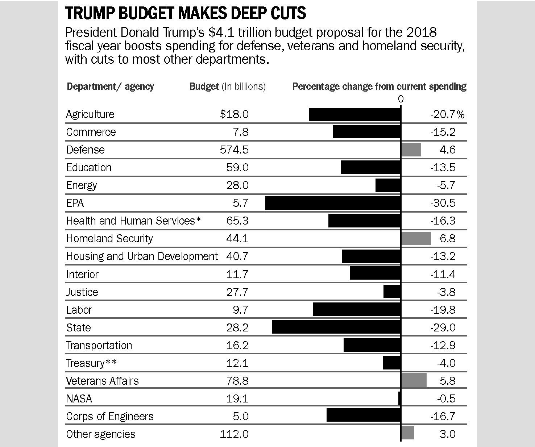
President Trump’s proposed 2018 Budget lays out a plan to achieve a balanced budget over a ten year period. I strongly endorse this goal whether or not the Trump budget is a realistic way to get this done.
The virtue of the Trump budget is to tackle waste and inefficiency across many different domestic programs (see chart below).


Its main defect is that neither healthcare reform nor tax reform has yet been implemented and the cost and/or savings of these two major initiatives are not yet known.
In the meantime the only way to think about balancing the budget is conceptually in terms of how it might be done.  Barron’s economic analyst Gene Epstein has done this recently.


Mr. Epstein proposes:

  • $8.6 trillion worth of spending cuts over ten years, of which 40% would come from programs other than Social Security and healthcare. By achieving a balanced budget in ten years it would lower our public debt (on which we pay interest) from 77% today to 58% in 2027.
  • By raising the age limit for full SS benefits to 67 (already enacted) at a faster pace, and indexing initial benefits to price inflation rather than wage inflation, $200 billion can be saved over ten years. Another $300 billion can be saved by phasing in a 25% reduction in SSDI benefits.
  • Cutting the estimated improper payment rate for Medicare of 12.1% in half would save $400 billion over ten years. Raising the premiums for Medicare Part B and Part D to 35% of costs from the current 25% of costs would save $400 billion.
  • Another $600 billion would be saved by turning Medicaid into a block grant program to the states and giving the states much more flexibility in how it is spent.
  • $950 billion could be cut from the military budget by cutting back on overly expensive new weapon systems as well as closing unnecessary military bases, both foreign and domestic.
  • Many cuts in government subsidies to individuals and businesses would save $1 trillion. Grants in aid to sates could be cut by $500 billion.

Conclusion. There are many different ways to curtail federal spending. It has to be done and the sooner we get started the less painful it will be for all concerned.

Follow me on Twitter
Follow me on Facebook


Is Trump Serious about Shrinking the Debt?

The newly released Trump budget for Fiscal Year 2018 claims that it will lead to a balanced budget in ten years.  This is a highly desirable goal.  However the projected $4.5 trillion in spending cutbacks for many popular programs, as well as the projected 3% GDP growth for the next ten years, are both unrealistically optimistic.  Nevertheless, at least the Trump Administration is moving in the right direction.


Here is a good summary by Donald Marron in National Affairs of why it is so important to keep deficits and debt under control:

  • Prolonged deficits and mounting debt will undermine economic growth by interfering with investment in the private sector.
  • Prolonged deficits risk fueling inflation as the government lowers the value of the dollar by printing more of them.
  • High levels of debt held by foreign lenders put us at the mercy of foreign countries.
  • The growing debt exposes America to greater “rollover” risk with the increasing reliance on short term debt which frequently has to be rolled over.
  • Rising debt limits flexibility for increased spending in times of recession or other emergency. For example, when the Financial Crisis occurred in 2008, the debt level was just half of its current level. This meant the government could risk higher deficit spending in order to stimulate the economy.
  • Deficits have an unfortunate tendency to feed on themselves. Our current deficit level of approximately $500 billion per year is so large that it can only be significantly reduced with great pain. The only possible way to make deficit reduction politically feasible is to spread this pain widely amongst the public as shared sacrifice. This will be very hard to do.
  • Deficits and debt are grossly unfair to future generations who are stuck with servicing the debt and/or struggling to pay it down.

Conclusion. The Trump Administration recognizes the strong need to get deficits and debt under control. Unfortunately its current budget just submitted is not a realistic plan to get this done.

Follow me on Twitter
Follow me on Facebook