The Many Things I Am Thankful For


My website, “It Does Not Add Up,” is primarily concerned with the very serious fiscal and economic problems faced by the U.S.  Occasionally I write about other critical issues such as how the U.S. should respond to the recent terrorist attacks in Paris.  Or what can be done to address the K-12 academic achievement gap between kids from low income families and those from middle class families (an issue I am personally involved in).
CaptureToday I will try to express what I think is right about our country and why I am so thankful to be an American:

  • America is the strongest, wealthiest and one of the freest countries on earth.
  • We owe a huge debt of gratitude to those who came before us and have built such a wonderful country for us to live in.
  • We can vigorously debate our differences of opinion about how to move forward.
  • There is enormous energy, enthusiasm and participation in constantly striving to make the U.S. a freer, more just and more prosperous nation.
  • We resolve our differences peacefully through a democratic political process – one person, one vote.
  • We try to give everyone an equal opportunity to get ahead.
  • We have a vast safety net to take care of the less fortunate members of society and those who fall through the cracks.
  • We try especially hard to lift up a whole class of people who have historically been discriminated against. Slowly but surely progress is being made on this difficult task.
  • On the whole we accept our responsibility, as a strong and prosperous nation, to provide leadership in maintaining peace and stability around the world.

As you can see, I am an optimist. We do have big problems but we’re also doing many things right.  America will continue to flourish in the future because we will successfully meet our many challenges.  This won’t happen automatically or necessarily easily but rather because so many capable and dedicated people are working so hard to achieve it.  The political process will ultimately respond to the true will of the people.

Does the U.S. Care About Europe?


“After Paris, Islamic State’s rise and Syria’s agony are shaking a weakened Europe – and the broader international system,” writes the Brookings Institution’s Robert Kagan in yesterday’s Wall Street Journal. “Can the U.S. summon the will to respond?”
Capture“What the U.S. now does or doesn’t do in Syria will affect the future stability of Europe, the strength of trans-Atlantic relations and therefore the well-being of the liberal world order. … Just as in the 1990s, when Europeans could address the crisis in the Balkans only with the U.S. playing the dominant military role, so again America will have to take the lead, provide the troops, supply the bulk of the air power and pull together those willing and able to join the effort.”
Such an effort would require:

  • Establishing a safe zone in Syria to avoid having more refugees flood Europe and provide a place to return for those who have already fled. This would require not only U.S. airpower but also ground forces numbering up to 30,000.
  • An additional 10,000 – 20,000 troops to uproot Islamic state from its havens in Syria and Iraq.
  • An internationally negotiated transition in Syria ushering Mr. Assad from power and establishing a new provisional government to hold nationwide elections.

As Mr. Kagan reminds us the U.S. has taken lots of police actions in the last 70 years since the end of WWII:  Korea, Vietnam, Panama, Kuwait, the Balkans, Afghanistan and Iraq being the big ones.  “Not today.  Americans remain paralyzed by Iraq, Republicans almost as much as Democrats, and Mr. Obama is both the political beneficiary and the living symbol of this paralysis.  He may be the first president since the end of WWII who simply doesn’t care what happens to Europe.”
Mr. Kagan concludes, “Perhaps there are Europeans today wishing that the U.S. will not compound its error of commission in Iraq by making an equally unfortunate error of omission in Syria.  They can certainly hope.”

Follow me on Twitter: https://twitter.com/jack_heidel
Follow me on Facebook: https://www.facebook.com/jack.heidel.3

 

How to Defeat ISIS


The lead story in yesterday’s New York Times, “Experts Explain How Global Powers Can Smash ISIS,” starts out “Much of the world agrees that the Islamic State needs to be crushed.  But how can that be accomplished?”
CaptureHere is the strategy espoused in the NYT article and also by Garry Kasparov, writing in the Wall Street Journal:

  • Assad must go. “For the U.S. and the West to ally with Iran, Russia and the Assad regime in Syria would be morally repugnant, strategically disastrous and entirely unnecessary.”
  • The importance of the Sunnis. “To beat ISIS you need the enlistment of the Sunnis and this won’t happen as long as Assad remains in power.” Removing Assad “would immediately have the support of Turkey and Saudi Arabia.” “The 2007 U.S. military surge in Iraq was so successful because it included the protection and recruitment of Sunni tribes to fight Sunni extremists.” “The hasty exit from Iraq left the Sunnis at the mercy of a hostile Shiite government.”
  • Troops on the ground. “Anything less than a major U.S. and NATO-led ground offensive against ISIS will be a guarantee of continued failure and more terror attacks in the West.”
  • Long term governance. “For the long term, eradicating the Islamic State and other violent Jihadi groups will require drastic reforms in the nature of Middle East governments. ISIS thrives on their failures.”

After the Paris attacks, the West now realizes that ISIS represents a huge threat to world peace and stability.  Hopefully the U.S. is also beginning to realize that only it can provide the leadership to organize an effective response.
I will soon return to talking about the fiscal and economic issues which I usually dwell on.  Every once in a while another major issue intervenes and takes precedence.

Follow me on Twitter: https://twitter.com/jack_heidel
Follow me on Facebook: https://www.facebook.com/jack.heidel.3

Avoiding World War III


What happened in Paris could also easily happen in London, New York City or Washington D.C. and soon will if our President does not adequately respond to the threat of terrorism.  As the Wall Street Journal declared yesterday, “For seven years Mr. Obama has used the unpopularity of the Iraq war as a shield for his retreat from anti-terror leadership and the Middle East.”
CaptureThe American Enterprise Institute’s Danielle Pletka informs us that:

  • NATO aircraft scrambled more than 500 times in 2014, with only a few exceptions, in reaction to Russian incursions into NATO member airspace.
  • In 2014, Japan scrambled aircraft almost 1000 times, with all but a few of these incidents attributed to either Russian or Chinese warplanes.
  • Russian bombers entered US airspace 10 times in 2014, double the previous average.

Ms. Pletka also suggests how we should respond to four years of carnage in the Middle East:

  • The first step is to actually have a strategy, rather than a series of reactive tactics and incremental escalations.
  • The second step is to build a coalition with sub-state and national partners that we trust and that trust us to stick with the job.
  • The good news is that there is still time to lead a decisive war against ISIS.
  • There is no need to launch broadsides against all Muslims, the Syrian people and refugees in general. It is Islam extremists who are attacking us, not mainstream Islamists.

The world is a dangerous place and we have many enemies.  On this website I am mostly focused on our own fiscal and economic problems which are very serious and need to be dealt with in a timely manner.  However the immediate safety and security of our country is the highest priority of all and, on occasion, takes precedence over everything else.  Now is a time for such heightened vigilance.


America and the World: the Need for Leadership


As we are just getting started on what so far is a confusing presidential election campaign, it would be easy to forget how incredibly lucky we are in America.  Our country is very strong and we are isolated from many of the world’s problems.  The terrorist attacks in Paris over the weekend are a grim reminder of this fact.  But we still have responsibility for much of what is happening around the world.
Capture

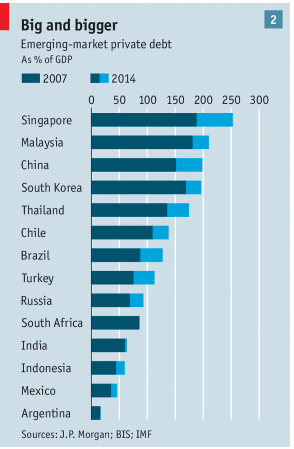
  • George W. Bush’s biggest failing is not the Iraq War, draining Medicare funds with a new drug benefit or ramping up deficits with tax cuts that lose revenue. His biggest failing is not foreseeing the financial crisis and at least mitigating it if not heading it off entirely. His financial advisors (Greenspan, Bernanke, Geithner, Paulson) were asleep at the switch. As the Economist makes clear in its latest issue, “First America, then Europe. Now the debt crisis has reached the emerging markets.”
    Capture0
  • Barack Obama’s biggest failing is not the stagnant economy or massive debt buildup which occurred on his watch, although he could have eased their burden with smarter policies. His biggest failing is his unwillingness to assert sufficient power in the Middle East to head off the chaos we observe today. The enormous European refugee crisis with all of its attendant horrors is largely the result of his inadequate intervention in Iraq, Libya and Syria.

The main concerns of this website are the internal fiscal and economic problems faced by the U.S.  We have to figure out amongst ourselves how to address these very serious issues.  But, like it or not, what we do affects the whole world.  If we fail to meet our responsibilities, the whole world, including us, will suffer with the consequences.

Follow me on Twitter:  https://twitter.com/jack_heidel
Follow me on Facebook: https://www.facebook.com/jack.heidel.3

What Defines a (Fiscal) Conservative?


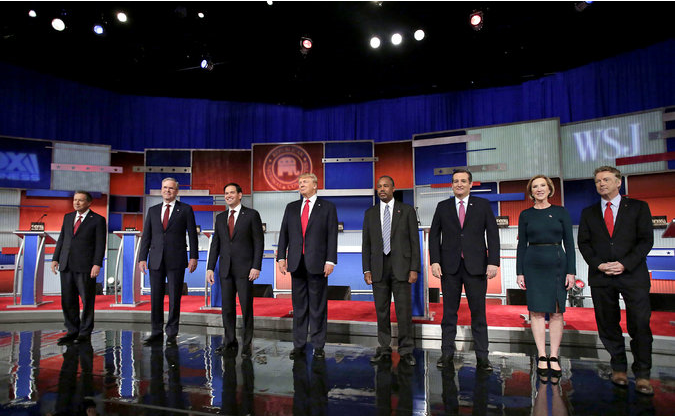
After four debates among the Republican presidential candidates, differences between them are becoming clearer.  The New York Times has an interesting article about this in today’s paper, “G.O.P. Fight Is Now a Battle Over What Defines a Conservative.”
CaptureHere are my views on the four issues discussed:

  • A Wall or a Path? We need to solve our illegal immigration problem and the key is to set up a viable guest worker program. The fact is that our economy needs foreign workers for many jobs which require hard physical labor such as in agriculture, meatpacking and construction trades. If businesses are able to bring in immigrants when sufficient domestic labor is not available, then other issues such as border security and verifying legal status can easily be resolved.
  • The U.S. Place in the World. U.S. leadership makes the world a safer place. This means we need a strong military presence all around the world as well as active alliances, trade and military, with many other countries.
  • Of Banks, Bailouts and Blame. The cause of the financial crisis was the bursting of the housing bubble, in turn caused by an unrealistic government housing policy as well as lax enforcement of existing regulations. Blaming greedy bankers is a copout. The Dodd-Frank Law is overkill which creates a drag on the economy by hampering smaller financial institutions and community banks. The best way to control large banks is to increase their capital requirements.
  • Who Should Get Tax Cuts? The main purpose of tax reform should be to boost the economy without increasing deficit spending. The way to do this is with across the board cuts in tax rates, paid for by closing loopholes and shrinking deductions. Here are some details. The 64% of taxpayers who do not itemize deductions will get an immediate tax cut and income inequality will be greatly reduced.

Getting the answers to these issues correct will have a large effect on the future wellbeing of our country.  The Republican presidential candidates should be commended for grappling with them in a productive manner.


I Am One of Paul Krugman’s “Very Serious People”


There is a stark contrast between the fiscal and economic policies being proposed by the presidential candidates from the two different parties. The Democrats want to tax the rich to reduce income inequality while the Republicans want major tax reform in order to speed up economic growth.
CaptureI favor the latter approach as long as it does not increase deficit spending.  The Keynesian economist Paul Krugman mocks deficit hawks like me as “Very Serious People.”  But in my “serious” view we have a choice between two very different paths for our economic future:

  • Slow Growth. Continue on our present path of slow 2% annual growth. The official unemployment rate has dropped to 5% but slack in the economy caused by the low labor participation rate keeps raises low and millions still unemployed or under-employed. The slow economy also keeps inflation and interest rates low. This permits Congress and the President to shrug off deficit spending and debt accumulation because it’s virtually “free money,” being borrowed at very low interest rates.   Our present course not only prolongs income inequality but also allows the debt to keep ramping up indefinitely. The longer this continues, the greater will be the disruption when inflation and interest rates do eventually return to normal historical levels.
  • Faster Economic Growth.   There are many things we can do to speed up economic growth. Tax reform is first and foremost but deregulation (relax Obamacare and Dodd-Frank), trade expansion (pass TPP) and immigration reform (with an adequate guest worker program) would also help. But, contrary to what the Republican presidential candidates say, tax reform must be revenue neutral to be sustainable. That way the economic growth it produces will lower deficit spending rather than increasing it.  This is critical because economic growth will create new jobs and raise pay for existing jobs, thereby creating inflationary pressure. Inflation will lead to higher interest rates which in turn will make our debt much more expensive than it is now.

Conclusion. We can make our economy grow faster if we simply put our mind to it. But then inflation and interest rates will go up and interest payments on the debt will become an increasing burden on society.  This is why it is so important to put our debt on a downward path as a percentage of GDP.  We can make it happen if we want to.

Austerity’s Grim Legacy?


There is a very important debate going on in the country right now as I have discussed in my last three posts:

  • The Republican presidential candidates are proposing big tax cuts to stimulate the economy but at the cost of huge increases in annual deficits and the accumulated debt.
  • The Democratic candidates want to raise taxes on the wealthy but even raising the top tax rate from 39.6% to 50% would have only a modest effect in lowering income inequality.
  • The Tax Foundation has an excellent plan to lower tax rates for all in a revenue neutral manner by closing loopholes and limiting deductions. Their plan would give the economy a big boost and actually lower deficits by bringing in more tax revenue.

Now comes Paul Krugman in Friday’s New York Times, “Austerity’s Grim Legacy”  saying that “Some of us tried in vain to point out that deficit fetishism was both wrong-headed and destructive, that there was no good evidence that government debt was a problem for major economies, … And we were vindicated by events.  More than four and a half years have passed since Alan Simpson and Erskine Bowles warned of a fiscal crisis within two years; U.S. borrowing costs remain at historic lows.”
Capture12How can such an obviously intelligent and articulate economist miss what is so very, very clear to so many lesser mortals?  Interest rates will not stay low forever!  And when they do go up, interest payments on our rapidly expanding debt will skyrocket! The Congressional Budget Office estimates that the interest payment on our debt will increase from 1.7% of GDP today to 3.6% of GDP in 2025, or $827 billion in 2025 compared with $227 billion in 2015.  Where will the money to pay this new $600 billion expense come from?
It is absolutely crazy not to take our enormous debt seriously.  We simply must put this huge debt on a downward path as a percentage of GDP.  It can be done but it will take a concerted effort by our national leaders to do it.

                                    Follow me on Twitter: https://twitter.com/jack_heidel
                         Follow me on Facebook: https://www.facebook.com/jack.heidel.3

A Much Better Way to do Tax Reform


My last two posts, here and here, have pointed out the folly of the tax plans of the presidential candidates from both parties:

  • The Republican plans would stimulate the economy but at a cost of huge increases in the national debt, even using dynamic scoring to take into account the growth effects of these plans.
  • Raising the top tax rate to 50%, a Democratic idea, would bring in $100 billion per year, but this is not enough to either make a big dent on budget deficits or lower income inequality appreciably.
    CaptureThe Tax Foundation has just published an excellent guide to income tax policy which makes several good suggestions for using tax reform to boost the economy:
  • Eliminating the deduction for state and local taxes would raise $81 billion per year. Using this revenue to reduce individual income tax rates would grow the economy by 1.77% of GDP over 10 years.
    Capture11
  • Eliminating the mortgage interest deduction would raise $75 billion per year. Reducing individual tax rates by the same amount would grow the economy by 1.61% of GDP over 10 years.
    Capture12
  • Capping itemized deductions at $25,000 would bring in $188 billion per year. Reducing individual tax rates by the same amount would grow the economy by 1.99% over ten years.
    Capture13

Sensible, i.e. revenue neural, tax reform will do wonders for the economy as this study from the Tax Foundation shows. It will bring in more tax revenue to help pay the bills.  It will raise salaries for the already employed.  It will create new jobs for the millions of unemployed and underemployed people who want them.  It will thus reduce income inequality by increasing the wages of people on the bottom. Why is this so hard for so many people to understand?

                               Follow me on Twitter: https://twitter.com/jack_heidel
                     Follow me on Facebook: https://www.facebook.com/jack.heidel.3
Are Democratic Presidents Better for the Economy than Republicans?


In his usual provocative manner, Paul Krugman reminded us yesterday that, according to a recent study by Alan Blinder and Mark Watson, ever since President Truman the economy has grown faster under Democratic presidents than under Republican presidents.  There are a lot of different explanations for this, not necessarily demonstrating better economic policies by Democratic presidents.  Nevertheless, it is a noteworthy finding which fiscally conservative, fix-the-economy types, need to be aware of.
CaptureAmong other things, Republican presidential candidates must become more credible about their economic policies than they have been so far.  They have all proposed big cuts in tax rates to stimulate the economy. But their plans lose trillions of dollars in tax revenue.  At a time of huge deficits and a rapidly growing national debt this is simply unacceptable.
In today’s Omaha World Herald, the economics journalist, Robert Samuelson, reports on a new Brookings Institute study about the effect of raising the top individual tax rate from 39.6% to 50%.  Such a tax hike would raise as much as $100 billion per year.

  • However, if used to lower deficit spending, it would cover less than ¼ of current deficit spending ($439 billion in 2015, for example).
  • If used to reduce income inequality for the poorest 1/5 of Americans, it would give such households an average of $2,650, and the overall effect on income inequality would be very modest.

The point is that neither costly tax cuts to boost economic growth nor a sizable tax increase on the wealthiest Americans represents a viable program to straighten out our economic problems. What we need to grow the economy is:

  • Revenue neutral tax reform, lowering rates across the board, paid for by closing loopholes and shrinking deductions.
  • Lightening the regulatory burden at least on small and mid-size businesses in order to speed up business growth and entrepreneurship.
  • Trade expansion and immigration reform to increase productivity.

Fiscal conservatives are badly needed to implement such policies effectively but neither party can get the job done alone. It will take both parties working together to make progress.

                                Follow me on Twitter: https://twitter.com/jack_heidel
                      Follow me on Facebook: https://www.facebook.com/jack.heidel.3