Fixing the Debt: Creating a Greater Sense of Urgency II. An Example


My last post, ”Fixing the Debt: Creating a Greater Sense of Urgency,” expresses my dismay that our huge debt problem does not receive enough serious attention from the American people.  Yes, most Americans deplore the national debt and the deficit spending that leads to it, but it only too seldom affects how they vote for candidates for federal office, thus giving a pass to the big spenders in Congress.
CaptureHere is a good example of this refusal to take the debt seriously.  The advocacy group FAIR (Fairness and Accuracy in Reporting) ridicules NPR for addressing this problem, “Look a Deficit: How NPR Distracts You From Issues That Will Actually Affect Your Life.”  Here is what FAIR is saying:

  • Interest on the national debt is projected to be only 2% of GDP in 2016 and 3% of GDP in 2024, which is tiny. (But this is because the interest rate for the debt is now abnormally low, approximately 1.7%).
  • If the Fed keeps interest rates low, then interest on the debt will continue to stay low indefinitely and so the debt will continue to be a trivial problem. And the President appoints 7 of the 12 voting members of the Fed Open Market Committee which sets interest rates.
  • The reason the Fed raises interest rates is to slow the economy and keep people from getting jobs.  (Actually the real reason is not to keep people from getting jobs but to keep inflation under control. Once inflation takes off, it is very difficult to bring it back down as we painfully discovered in the late 70s and early 80s).
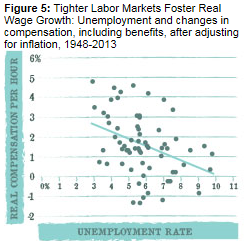
  • Anyhow, if the Fed raises interest rates to keep the labor market from tightening, as it did in the late 1990s, this would effectively be depriving workers of the 1.0 – 1.5 percentage points in real wage growth they could expect if they were getting their share of productivity growth. (A rise in interest rates need not choke off economic growth which is primarily affected by supply and demand. Fiscal policy (tax rates and spending), established by Congress, has a far greater effect on the rate of economic growth than does monetary policy).


If our debt is not soon placed on a sustainable downward path, we will soon have another financial crisis, much worse than the Great Recession of 2008.  This will affect everyone’s life in a substantial and very unpleasant way.

Fixing the Debt: Creating a Greater Sense of Urgency


As I have mentioned before, I am a volunteer for the nonpartisan Washington D.C. think tank “Fix the Debt.”  As such I give presentations to civic organizations in the Omaha area about our debt problem and what we can and should do about it.  I have now given four such talks and have another one coming up next week.
Capture
What is most difficult for me is to try to convey a sense of urgency about addressing this problem. Most people deplore deficit spending in a general sense but not nearly enough people think that dealing with it should take priority over current presumably pressing spending needs such as, for example, depletion of the highway trust fund, expanding military spending, or improving early childhood education, just to be specific.
So here is how I am going to try to create a greater sense of urgency.  Several months ago I had a post entitled, “The Slow Growth Fiscal Trap We’re Now In” in which I said (in brief summary) that our current economic condition of

  • slow growth means
  • low inflation which leads to
  • low interest rates which in turn leads to
  • massive debt which eventually leads to a new and much more severe
  • fiscal crisis.

This is the predicament we’re now in.  Do we consciously maintain a slow growth economy, with all the unemployment pain and stagnant wages which this entails, or do we speed things up, enabling more people to go back to work, and also deal with the higher inflation and interest rates which this will entail?
Faster growth may well eventually come on its own anyway and then we’ll be forced to fix our fiscal problems at a time when they’ll be much worse than they are now.
Isn’t it clear that it is much better to act now in a responsible manner rather than to wait and have to react hurridly later on when the problem is much worse?

The Great Decoupling

In the great debate over slow economic growth and falling incomes of the middle class, the usual culprits are globalization, growth of technology and income inequality.
Capture
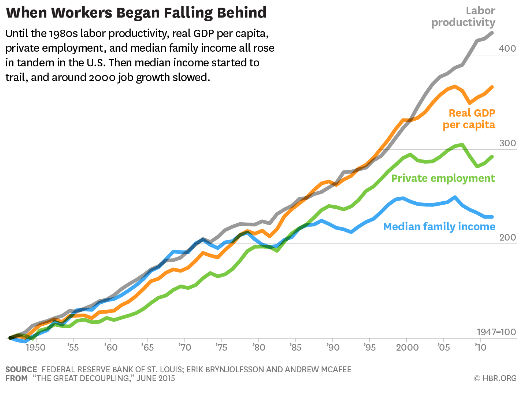
Just published in the latest issue of the Harvard Business Review, “The Great Decoupling: an interview with Erik Brynjolfsson and Andrew McAfee” is a more focused analysis of what is happening. These two technology experts note that both labor productivity and GDP are growing much faster than the growth in the number of jobs as well as median family income.  This is what they refer to as the great decoupling.  They are careful to point out that the same trends are happening in other developed countries such as Finland, Germany and Sweden.
They emphasize that the best response to this decoupling is to create an economic environment that’s conducive to innovation, new business formation, and economic growth.  In their opinion this means to focus on five things:

  • Education. Primary and secondary education systems should spend more time on things that computers are not good at such as creativity, interpersonal skills and problem solving.
  • Infrastructure. World-class roads, airports and networks are the foundations of growth.
  • More entrepreneurship. Most industries and regions are seeing fewer new companies than in recent decades.
  • Immigration reform. The U.S. needs to attract more of the world’s most talented people. Immigrant-founded companies have been great job-creation engines.
  • Basic Research. Since companies concentrate on applied research, the government needs to step up support for basic research. Both total and nondefense federal R&D spending, as percentages of GDP, have declined by more than a third since 1980.

The recommendations of Messrs. Brynjolfsson and McAfee are quite sensible.  But they will be hard to implement overall.  More federal funding for both infrastructure and basic research will be very difficult in an era of tight budgets.
This is the challenge of our time.  We must become better prepared to prosper in an era of increasing global competition and rapidly expanding technology.  And do this in a tight fiscal environment.
A very big challenge indeed!

Growth vs Equitable Growth


There is a huge debate going on in political and policy circles between the advocates of increasing economic growth and the advocates of increasing income equality.  I generally argue that the best way to increase income equality is to increase economic growth overall.
CaptureI have just come across a series of articles from the Nov/Dec 2014 issue of the American Monthly, “American Life: an investor’s guide,” which are sponsored by the Washington Center for Equitable Growth, a progressive Think Tank.  The fact that this group is focused on equitable growth, rather than the narrower goal of income equality, is of great interest to me.
Capture1They advocate a number of things that I agree with such as:

  • The incredible importance of early childhood healthcare and education.
  • Improving K-12 education, especially in low-income areas.
  • Providing much more vocational education and apprenticeship programs.
  • Running a “high pressure” economy in order to tighten the labor market. They recognize that lower unemployment leads to higher wages (see above).
  • Expand the Earned Income Tax Credit especially for workers without children.

The authors want to “pressurize” the economy with a more stimulative fiscal policy which means increased deficit spending, a very bad idea in my opinion.  Much better ways to boost the economy are with policies such as tax reform, trade expansion, immigration reform and regulatory relaxation.
Yes, there is a high degree of income inequality and yes, it’s getting worse over time.  But, as Warren Buffett says, the poor are not poor because the rich are rich.  The best way to help the poor is to make them more productive.  That is exactly the purpose of the policies enumerated above.

Economics Is a National Security Issue


“Speak softly and carry a big stick”                          President Theodore Roosevelt, 1900

There are many foreign policy issues facing the U.S. at the present time:

  • Russia is stirring up unrest in Eastern Europe by threatening the independence of Moldova and the Ukraine as well as several NATO countries.
  • The Middle East is in turmoil stirred up by ISIS and the effort to prevent Iran from acquiring nuclear weapons.
  • China is working hard to assert dominance in East Asia.

The world is more stable when there is a single dominant power such as the U.S..  If the U.S. retreats from this role, it is inevitable that regional powers such as Russia, China and Iran will assert themselves to take up the slack.  We don’t need to act as the world’s policeman every time a problem flares up around the world.  But democracies are  better actors on the world stage than are autocracies.  Therefore the whole world benefits when the U.S. projects power and interest.
CaptureA column in today’s Wall Street Journal by Michele Flournoy and Richard Fontaine makes a very important point, namely that “Economic Growth Is a National Security Issue.” In other words, the stronger is our economy, the more influence and respect we will enjoy in our relations with other countries.  Especially they recommend emphasizing:

  • Trade and Investment. It looks like Congress will give the President trade-promotion authority for negotiating a Trans-Pacific Partnership free-trade agreement. Indian, African and European trade agreements could then follow.
  • Energy. The ban on the export of crude oil and natural gas should be lifted.
  • International Institutions. A Chinese-led Asian Infrastructure Investment Bank will be much less of a threat to the U.S. one a TPP trade agreement goes into effect.

Ms. Flournoy and Mr. Fontaine are focused here on international economic growth.  But all economic growth, domestic as well as international, will make the U.S. stronger and therefore better able to project power.
Conclusion: we need to focus more strongly on economic growth in all of its guises!


Are Economics and Social Progress Related to Each Other?


“Your (last post) is one of the most active and positive that I have read of yours. You do put your time to where your values are. Those of us who see you as too economically focused and ourselves as more humanely concerned need to act as well. Thanks for your focus and attention.”
from a reader of my blog

I am a fiscal conservative and a social moderate. The primary reason I write this blog is because I am so concerned about the fiscal recklessness of our national leaders. Our national debt is much too large and still growing too fast. We need to either cut spending or raise taxes (or do both).
But I am also a social progressive. I voted in favor of Nebraska raising its minimum wage last fall. I support gay marriage as a civil right. I support having Nebraska expand Medicaid in order to cover more low-income people (where Medicaid needs to be fixed is at the federal level).
CaptureThere is in fact a very close connection between having a sound economy and social progress. As the above chart shows, the U.S. ranks very high in both GDP per person and social progress. All of the countries which are most socially progressive also have sound economies. This is not a coincidence.
My last post talks about what society can do to help blacks improve their socio-economic status. This includes improving educational opportunity in the inner city. But improved educational opportunity needs to be closely directed toward improved economic opportunity. This means, for example, having good jobs available for new high school and community college graduates. But this, in turn, means having strong economic growth with intelligent tax and regulatory policies to encourage entrepreneurship and business expansion.
In short, a sound economy is essential for social progress.

Can We Do More to Help Blacks Improve Their Lot?


Nebraska is a progressive state in many respects.  Last fall we raised our state minimum wage.   The Nebraska Legislature is now on the verge of eliminating the death penalty.  Seven years ago the Legislature established the Learning Community in metro Omaha, whose purpose is to eliminate the academic achievement gap between children from the middle class and those living in low-income families.
CaptureI am an elected member of the Learning Community Coordinating Council which oversees the work of the LC.  As such I give a lot of thought to the plight of the low-income black community in north Omaha.  My own answer to the question in the title is yes, of course, there is more we can do but it needs to be carefully directed.  I have written several previous posts on this topic. Here and here.
For example, the Hamilton Project has an excellent program, ”Policies to Address Poverty in America,”  which calls for a highly focused effort along the lines of:

  • Promoting Early Childhood Development
  • Supporting Disadvantaged Youth
  • Building Skills
  • Improving the Safety Net and Work Support

Mr. Robert Balfanz, the Director of the Everyone Graduates Center at John Hopkins University in Baltimore, suggests focusing on the toughest 660 out of 12,600 high schools in the U.S. which fully one-half of non-graduating students attend.  More specifically:

  • Refocus these high poverty high schools in order to identify by the middle of the ninth grade the students most likely to drop out.
  • Set up early warning systems so that adults can step in at the first sign that a student is in trouble.
  • Employ additional adults to support students who need daily nagging to succeed, especially during the key transitional years in the sixth and ninth grades.

These two programs have lots of similarities and are focused on at-risk inner-city youth.  Massive black underachievement is a huge social problem, and ultimately a huge drain on our entire economy as well.  More than just good intentions are necessary for effective intervention.  An intelligent and focused approach as described here would be a good way to proceed.

How to Tame the Regulatory State


I have just been reading a fascinating new book by Charles Murray, “By the People: rebuilding liberty without permission,” describing how the U.S. regulatory agencies were created and the many abuses they impose upon us.
Capture  As Mr. Murray explains, a Regulatory Agency first promulgates substantive rules of conduct.  A complaint that an Agency rule has been violated is then prosecuted by the Agency and adjudicated by the Agency.  If the Agency ultimately finds a violation, then and only then, the affected private party can appeal to an independent judicial court.  But an Agency decision, even before the court, possesses a very strong presumption of correctness on matters both of fact and law.
“If the enabling legislation is silent or ambiguous, Congress has in effect left a gap in the statute for the Agency to fill.  If the Agency in filling that gap has interpreted the statute in a ‘reasonable’ manner, the court will give effect to that judgment, deferring to the Agency.”
Mr. Murray proposes a new standard that “All regulations that are arbitrary, capricious or an abuse of discretion are automatically eligible for civil disobedience.” To this end a private legal-aid foundation should be set up to provide legal assistance to ordinary Americans who are being victimized by the regulatory state.  It would be funded by what Mr. Murray refers to as the Madison Fund.  A $100 million endowment from a wealthy individual would be sufficient to get it started.
Its purpose would be:

  • To defend people who are innocent of the regulatory charges against them.
  • To defend people who are technically guilty of violating regulations that should not exist, by drawing out the litigation as long as possible, making enforcement of the regulations more expensive to the regulatory agency than they’re worth and reimbursing fines that are levied.
  • To generate as much publicity as possible, both to raise public awareness of the government’s harassment of ordinary people and to bring the pressure of public opinion to bear on the problem.

The goal is to achieve a “No Harm, No Foul” regulatory regime.  A good analogy is to force regulators to use the same strategy as used by state troopers on interstate highways.  A majority of drivers are engaged in civil disobedience just about all the time.  But normal practice is to stop only those people who are driving significantly faster than the flow of traffic or are driving erratically.
As Mr. Murray concludes, “We’re all biased, but only people within government have the power to impose their biases on their fellow citizens with the force of law.”

Why Is U.S. Productivity Growth Declining?


The economist Alan Blinder has just reported, “The Mystery of Declining Productivity Growth” that U.S. productivity growth has fallen dramatically in the last few years.  “The healthy 2.6% a year from 1995-2010 has since been an anemic 0.4%.  What’s scary is that we don’t know why.”
CaptureThe economists Edward Prescott and Lee Ohanian believe the productivity slowdown is caused by a corresponding slowdown in new startups (as illustrated by the above chart).  They point out, for example, that:

  • The creation rate of new businesses in 2011 was 30% lower than the average rate of the 1980s.
  • New startups are critical for growth since many of today’s heavyweights will decline as new businesses take their place. For example, only half of the Fortune 500 firms in 1995 remained on that list in 2010.
  • Startups in high technology have also declined since 2000 even though there is no slowdown in the development of new technology.

Consistent with the recommendations of James Bessen in a recent post of mine, “Learning by Doing,” Messrs. Prescott and Ohanian recommend policy changes such as:

  • Better training, plus immigration reform, to produce more skilled workers.
  • Streamlining regulations that raise cost, especially for small businesses.
  • Tax reform to reduce marginal tax rates.
  • Reforming Dodd-Frank to make it easier for small businesses to obtain loans from main street banks.

In today’s New York Times, the economist Tyler Cowen wonders whether our economy is in the midst of a “Great Reset.”  “Perhaps the most crucial issue is whether economies will return to normal conditions of steady growth, or whether we are witnessing a fundamental transformation” to a less productive economy.
Here’s another way to put it: shall we attempt to adopt better pro-growth policies or shall we just give in to the status quo and accept that we can’t do any better?  Are we optimists or are we pessimists?

Learning By Doing III. Limiting the Influence of Lobbyists


The eclectic entrepreneur/economist/law professor, James Bessen, suggests how to boost our stagnant economy in a new book, “Learning by Doing: the real connection between innovation, wages and wealth.” The idea is to make fuller use of new technology by putting more emphasis on practical vocational training, ending government favoritism for established businesses, and by removing regulatory roadblocks to job mobility and entrepreneurship.  He also thinks that the greatest hindrance to progress on these fronts is the influence of lobbyists and, more generally, “the growing role of money in politics.”
CaptureHow do we limit the ability of lobbyists, with their huge financial resources, to slow down the opening up of new technology to the broadest possible group of participants?  Some people would say this can only be done by curtailing the use of money in politics.  But this is virtually impossible.  Spending money to get your message out is really just a form of speech and the First Amendment to the Constitution says that “Congress shall make no law abridging the freedom of speech.”
Rather than trying to restrict the ways in which lobbyists can spend their money, we could alternatively try to immunize our elected representatives from its effect, in one or both of these two different ways:

  • Pass a Balanced Budget Amendment to the Constitution. Such an amendment would likely create the discipline needed for Congress to be able to set priorities and decide what is more or less important with regard to the overall economy. Spending programs, tax revenue, and the effects of regulation would all have to be considered together to maximize economic efficiency. Lobbyists would have far less power to push one particular program independently of how it relates to everything else.
  • Term Limits for national office. Knowing that one’s time in office is limited would help provide the strength to make the difficult tradeoffs necessary for good legislation and make officeholders more immune to special interest influence.

Conclusion:  Rather than making a likely futile attempt to reduce the amount of money in the political process, change the process sufficiently so that money doesn’t have as much influence!