
Fundamental Tax Reform Is the Key to Solving Our Economic and Fiscal Problems II. The Graetz Plan

The Yale Tax Law Professor, Michael Graetz, has proposed a new tax system “100 Million Unnecessary Returns: A Simple, Fair, and Competitive Tax Plan for the United States” which would do wonders towards straightening out the huge fiscal and economic problems now facing our country.
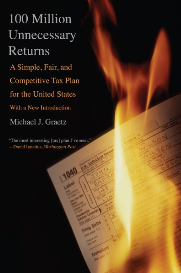
CaptureHow do we rev up the national economy in order to put more people back to work and, at the same time, raise the revenue needed to operate the government in the 21st century without mountains of debt?  Mr. Graetz’s basic idea is to tax consumption rather than relying totally on an income tax.  Under his plan both savings and investments will be taxed at a lower rate which will encourage more of both.  The Plan has these features:

  • A broad based Value Added Tax of about 14% is enacted on goods and services.  The U.S. is the only advanced economy without a VAT.
  • Families earning less than $100,000 are exempted from the income tax.  For incomes between $100,000 and $250,000, the tax rate would be 15%.  For income over $250,000, the rate would be 25%.
  • The corporate income tax rate is lowered to 15%.
  • The Earned Income Tax Credit (EITC) is used to provide relief from the VAT burden to low-income families by using payroll tax offsets.
  • The plan is designed to be revenue neutral as verified by the Tax Policy Center.

This plan has many advantages including:

  • Taxing consumption and lowering the corporate tax rate to 15% from its current level of 35% would dramatically encourage investment in the U.S. thereby stimulating the economy and creating both new jobs and higher wages for American workers.
  • It would eliminate more than 100 million of the 140 million U.S. tax returns.
  • With many fewer Americans paying income taxes there would be far less temptation for Congress to use income tax exclusions, deductions and credits to try to address social and economic problems.
  • The plan retains all of the progressive features of our current tax system whereby higher income earners pay higher tax rates.

The point of describing the Graetz Plan in some detail is not to suggest that it is the best way to implement tax reform but rather that here, at least, is one attractive way to do it.  The purpose is to move the discussion forward.  We badly need to make changes along these lines!

Fundamental Tax Reform Is the Key to Solving Our Economic and Fiscal Problems I. Why Change Is Needed

I have been writing this blog for just over a year.  It addresses what I consider to be the two biggest problems faced by our country at the present time.  First is our enormous national debt, now over $17 trillion, and the huge annual budget deficits which are continuing to make it worse.  The second problem, of equal magnitude, is our slow rate of economic growth, about 2% of GDP annually, ever since the Great Recession ended in June 2009.
CaptureThese two problems are closely related.  If the economy grew faster, federal tax revenue would grow faster and the annual deficit would shrink faster.  Not to mention that a faster growing economy would create more jobs and lower the unemployment rate, which is still a high 7%.
The impediments to solving these problems are huge.  Our public debt, on which we pay interest, is now over $12 trillion or 73% of GDP.  Although it may stabilize at this level for a few years, it will soon begin climbing much higher, without major changes in current policy.  This is primarily because of exploding entitlement spending for retirees (Social Security and Medicare) who will increase in number from about 50 million today to over 70 million in just 20 years.  As interest rates return to normal higher levels, just paying interest on the national debt will become, all by itself, a larger and larger drain on the economy.
The impediments to faster economic growth are increasing global competition, such as inexpensive foreign labor, as well as rapid advances in technology, such as electronics and robotics.  Both of these trends reduce the need for unskilled workers in America which in turn holds down wages and slows down economic growth.
At the same time we have an antiquated tax code to raise the huge sums of money necessary to pay for a large and complex national government.  It worked fine through the post-World War II period, as long as the U.S. had the dominant world economy with little significant competition from others.  But this situation no longer exists.  We now have a tax system which doesn’t raise enough money to pay our bills and at the same time is so progressive that the highest rates (39.6% on individuals and 35% for corporations) are not sufficiently competitive with other countries.  This discourages the entrepreneurship and business investment we need to grow the economy faster and create more jobs.
We have an enormous problem on our hands!  Is it possible to fundamentally change our tax system to turn things around?  My next post will answer this question in the affirmative!

Is a Bad Deal Better Than No Deal At All?


Beltway insiders are praising the just announced budget deal between the Democrats and the Republicans.  For example, a news analysis in today’s Wall Street Journal, “Accord Is Departure for Capitol”, suggests that budget politics may be changing, getting any deal is very hard, that perhaps bipartisanship isn’t dead in Washington but that there is still unfinished business.  This is a purely euphemistic assessment.   All this deal really does is to let the big spenders off the hook.
What it does is to relax the sequester by $63 billion for the next two years for very little in return.  The $84 billion in new fees over ten years “officially” reduces the deficit by $21 billion but two year’s worth of new fees is just $16.8 billion.  This means that the deficit will actually increase by $46 billion over the next two years.
But the real problem is that the leverage represented by the sequester is being thrown away for the next two years and this sets a bad precedent for the future.  For example, we can now assume that the debt limit will also be raised for two more years in February 2014 because there will no longer be any leverage for bargaining for any other changes.
This in turn means that entitlement reform is for all practical purposes dead for the next two years.  This is the really hard problem to solve.  Big spenders will do anything to avoid dealing with it.  Responsible fiscal conservatives know it must be addressed and need all the help they can muster to get something done.
What happens if the budget deal is not passed by Congress?  It simply means that the sequester remains in effect and that discretionary spending will be $43 billion lower this current budget year than otherwise.  The value of the sequester is to force action on the really thorny issue of reducing entitlement spending.  Let’s preserve it for this purpose and not throw it away for nothing significant in return.
Leaders are supposed to address issues, not walk away from them!

Is Expanding The Social Safety Net Compatible With Fiscal Restraint?

Yesterday’s New York Times addresses this issue with an article “Ohio Governor Defies G.O.P. With Defense of Social Safety Net”.  It describes how Republican Governor John Kasich has maneuvered to expand Medicaid coverage in Ohio to 275,000 low income Ohioans under the new healthcare law, over the objections of his own Republican dominated state legislature.
Mr. Kasich is a former congressional deficit hawk and there is little doubt about his fiscal conservatism.  He recently balanced his state budget by cutting revenues to local government by $720 million.  But he has also expanded state aid for the mentally ill and supported efforts to raise local taxes for improving education.  He says “for those who live in the shadows of life, for those who are the least among us, I will not accept the fact that the most vulnerable in our state should be ignored.”
Especially after the disastrous debt ceiling debate, with Tea Party Republicans willing to default on our national debt in order to defund Obama Care, it is critical for fiscal conservatives to publicly demonstrate that they are not opposed to helping the poor in a reasonable manner, as long as it is cost effective.
To be in favor of controlling entitlement spending is not the same thing as wanting to abolish entitlement programs.  In fact, it is just the opposite.  We must control their costs so that the government will have the means to continue to support them.  It is just plain ordinary common sense.  If our national debt continues to grow unchecked, we risk not only entitlement programs but our entire way of life.
Take Medicaid as a concrete example.  Right now the federal government pays a percentage of the costs incurred by state governments in running the program.  The more a state spends for Medicaid, the greater the reimbursement from the federal government. This increases spending for both the states and the federal government.  A more cost effective approach is to give each state a block grant from the federal government and enough leeway to operate its own program as efficiently as it can.  Exactly this approach is being used in Rhode Island and is working very well at a much lower overall cost.
Being a fiscal conservative is not the same thing as being mean spirited!  The future of our country depends on getting this crucial message out far and wide!

Who Won and Who Lost in the Fiscal Stalemate?

The mainstream media are uniformly agreed that the Democrats and President Obama “won” the latest debt ceiling and shutdown standoff and that the Republicans “lost”.  For example, New York Times, reporter Jeremy Peters gives the GOP a rebuke in “Losing a Lot to Get Little”. “For the Republicans who despise President Obama’s health care law, the last few weeks should have been a singular moment to turn its botched rollout into an argument against it.  Instead, in a futile campaign to strip the law of federal money, the party focused harsh scrutiny on its own divisions, hurt its national standing, and undermined its ability to win concessions from Democrats.”
This is all true and, in addition, the twenty or twenty-five Tea Party stalwarts made fools of themselves by being so intransigent.  And 145 House Republicans ran away by voting against the final deal.
But look at the broader picture.  The federal government has been reopened for just three months, until January 15, 2014, and at current funding levels which include the 2013 sequester spending cuts.  On January 1, the more stringent 2014 sequester cuts take effect.  In other words the pressure is growing on the big spenders in Congress to deal seriously with our ongoing debt and deficit crises.
The big spenders have two options.  They can continue to kick the can down the road (i.e. refuse to bargain and force additional continuing resolutions to keep the government open) as discretionary spending continues to shrink more each year.  Or they can agree to make significant adjustments to entitlements to slow down their rate of growth, in return for easing the sequester cuts.
In a more rational world, the big spenders would understand that cutbacks must be made and the two sides would bargain in good faith and reach agreement.  But fiscal conservatives continue to have the necessary leverage to force compromise, and are unlikely to give it up.
Conclusion: the Tea Party “lost” and fiscal conservatives broke even.  The big spenders didn’t “win” but they got a temporary pass because the Tea Party overreacted and was shot down.

What Should the Republicans Do Now?


An editorial in yesterday’s Wall Street Journal, “A GOP Shutdown Strategy”, offers good advice to the House Republicans for how to proceed in the shutdown stalemate.  “ …the best chance to move Democrats is Louisiana Senator David Vitter’s amendment that would annul the exemption from Obama-Care that the White House carved out for Congressmen and their staff.  These professionals will receive special subsidies unavailable to everybody else on the insurance exchanges, and preserving this deeply unpopular privilege would be a brutal vote for Democrats.”
The House Republican Caucus should attempt to line up 218 votes to attach this provision to a continuing resolution to fund the government for all or part of the new fiscal year at the current level.  If 218 votes to support this approach cannot be found, then the House should pass a clean funding resolution.  Nothing else has a chance of succeeding (the idea of trying to defund Obama-Care for even one year is absurd) and the American people will grow increasingly impatient. 
The bigger issue by far is the need to raise the debt limit by October 17th at the latest.  Here the Republicans have major leverage, namely the sequester, which takes a bigger bite out of discretionary spending each year for nine more years.  The Republican House can give the Democratic Senate a choice:  either agree to a sensible long range plan for spending restraint (including entitlements), or else we’ll agree to raise the debt limit for six months or so, into early 2014, and then revisit the debt limit issue after the 2014 tighter sequester limits take effect. 
This is what I suggest.  Now we’ll wait and see what happens!