Donald Trump’s Popularity is Steadily Increasing


Like many things about Donald Trump, his approval ratings are contradictory and misleading. The Wall Street Journal reports that:

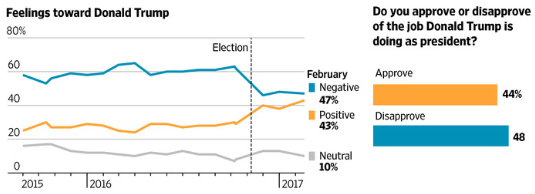
  • Only 44% of Americans currently approve of President Trump’s job performance (while 48% disapprove) which is historically low for a new President.capture107
  • On the other hand, the percentage of Americans who have positive feelings about him has been steadily increasing ever since he declared his candidacy in June of 2015, and has now reached a high of 43% (see chart). Since his State of the Union speech was generally well received, this rating is likely to go even higher.

Here is my own perspective. As I have said many times on this blog, I believe our country’s two biggest and most urgent problems are:

  • Slow economic growth, averaging just 2% per year since the end of the Great Recession in June 2009. This means fewer jobs, smaller raises for workers and less tax revenue to spend on important national initiatives.
  • Massive Debt, now standing at 77% of GDP (for the $14 trillion public debt on which we pay interest), the highest since right after WWII. The Congressional Budget Office predicts that this debt level will keep on steadily getting worse, without big changes in current policy. It is therefore a huge threat to our national security and prosperity.

I have great confidence that the Trump administration and Congressional allies will put a high priority on faster growth and are likely to be able to achieve it. I can’t yet tell if Trump understands the seriousness of our massive debt.  But the Tea Party and Freedom Caucus members in the House of Representatives do very strongly understand this problem and will insist on addressing it.  I believe that they will be able to persuade the President to support them in doing this.

Conclusion. At this point I am a supporter of President Trump because I think that our national government is moving in the right direction.

Follow me on Twitter
Follow me on Facebook

Nebraska Senator Deb Fischer Is a Big Spender


Senator Fischer is up for re-election in 2018 and she starts out a recent fund raising letter (see below) as follows: “My goals are clear: stronger national defense, safer roads and bridges, healthcare that is accessible and affordable, protection of our fundamental liberties, less government, and a fairer, simpler tax code.” Here’s the breakdown:

  • First, and most important: national security.
  • Second, our roads and bridges must be repaired and rebuilt.
  • Third, Obamacare must be repealed and replaced.
  • Fourth, our fundamental liberties must be protected.
  • Fifth, government must shrink and the tax code must be simpler and fairer.

I don’t disagree with the specifics of any of these five goals but rather where the emphasis is placed. Her first two goals are to greatly increase spending for both the military and for infrastructure projects.  Her last goal is to shrink the federal government which is a good idea but very hard to accomplish in practice.

capture99
Here is the basic problem our national debt (the public part on which we pay interest) is now at 77% of GDP, the highest it has been since right after WWII, and steadily getting worse.  Right now this approximately $14 trillion debt is essentially “free” money because interest rates are so low.  But when interest rates inevitably rise to more normal levels, interest payments on the debt will soar by hundreds of billions of dollars per year and eat much more deeply into tax revenue.
It should be a very high priority for Congress to establish a plan to bring government spending more closely in line with tax revenue.  I have previously described how this could be accomplished over a ten year period without cutting hardly anything but simply using restraint for spending increases.

Conclusion. If Senator Fisher feels that it is necessary to make big spending increases in areas such as national defense and infrastructure repair, then she should be equally adamant about the need to hold down the growth of government spending overall.

Follow me on Twitter
Follow me on Facebook

capture100

capture101


What Donald Trump Is Doing Right


Amid the steady and intense criticism of President Trump, he is actually doing a lot of things right, as pointed out by the Hudson Institute’s Christopher DeMuth:

  • He has picked highly qualified and independent-minded assistants such as Jim Mattis for Defense (who considers Russia to be a threat), Rex Tillerson for State (who has urged action on climate change) and Mike Mulvaney for Budget Director (who wants entitlement reform). Mr. Trump has tweeted that “I want them to be themselves and express their own thoughts, not mine.”

    capture99

  • For a president to have strong willed assistants is in the best American tradition: Washington (with Jefferson, Madison and Hamilton), Lincoln (with Chase, Seward and Stanton), Roosevelt (with Acheson, Marshall and Stimson), and Reagan ( with Baker, Shultz and Weinberger) all wanted their cabinet members to engage in vigorous discussion about fundamental policy.
  • Trump forgoes ideology for simple cross-partisan principles such as America First, safety from terrorism and violent crime and better jobs and schools for the poor and working class, and defiance of self-serving elites.
  • He is comfortable with controversy and dissent and often incites it to advantage. His tweets and pronouncements can be outrageous and overstated but they demonstrate a healthy skepticism toward ossified orthodoxy and are designed to stimulate debate rather than to close it down.
  • His biggest mistake so far, the ill-advised travel ban for immigrants put on hold by a judicial Temporary Restraining Order, has been taken in stride by his administration while they reconsider how to proceed.

Conclusion. Ever since Mr. Trump’s election to the presidency, I have been saying  that his ultimate success in office depends on whether or not he can address our country’s two biggest problems: 1) slow growth and 2) massive debt.  At this point I am optimistic that he will succeed in doing these things.

Follow me on Twitter:
Follow me on Facebook:

Why I Am Optimistic about President Trump


I voted for Hillary Clinton last November. Not because I liked her program.  I was voting against Donald Trump.  He is crude, sleazy and a terrible narcissist.  I preferred John Kasich, Governor of Ohio, in the Republican Primary.  But he didn’t make it.  I voted for Mitt Romney in 2012 but he didn’t make it either.
The question now is whether or not the Trump Administration will effectively address our country’s two biggest problems, both of which are very serious and need urgent attention:

  • Slow economic growth, averaging just 2% per year since the end of the Great Recession in June 2009. Faster growth means a tighter labor market which in turn means more workers and higher wages. This in turn means less inequality. Furthermore, it is the United States’ dominant economic strength which assures world peace and stability. The Chinese economy, now half the size of ours, will catch us eventually. But stronger U.S. growth will delay this and enable us to cope with it better when it happens.
  • Massive Debt. The public debt of $14 trillion (on which we pay interest) is now 77% of GDP, (https://itdoesnotaddup.com/2017/01/31/trump-needs-a-wall-of-fiscal-discipline/) the highest since the end of WWII and steadily getting worse. With current low interest rates the debt is now essentially “free” money. But what will happen when interest rates return to normal historical levels? At this point interest payments on the debt will rise precipitously and become a huge drain on the budget. We can’t prevent this from happening but we can lessen the impact by acting now.

Will the Trump Administration take these two problems seriously?

  • For sure on economic growth. His re-election chances in four years depend largely on the fortunes of his base of blue-collar workers. His appointments at Treasury (Mnuchin), HHS (Price), and EPA (Pruitt) all support the tax reform and deregulation needed to get this done. I am confident that Trump will avoid a disastrous trade war.capture99
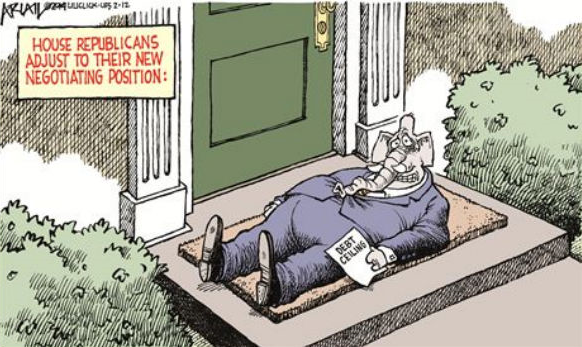
  • The debt. This is trickier because Trump has said he won’t touch Social Security or Medicare. My optimism is based on the fact that the Debt Ceiling will be re-imposed on March 16 at its level on that date. This will give Congress just a few months to raise the ceiling to a higher level. It is likely that the many fiscal conservatives in the House will insist, in return, for some sort of spending restraint such as a ten-year plan to balance the budget.

Conclusion. We’re not out of the woods yet. But there is a clear path showing the way forward.

Follow me on Twitter
Follow me on Facebook


What, if Anything, Will Restrain Donald Trump?


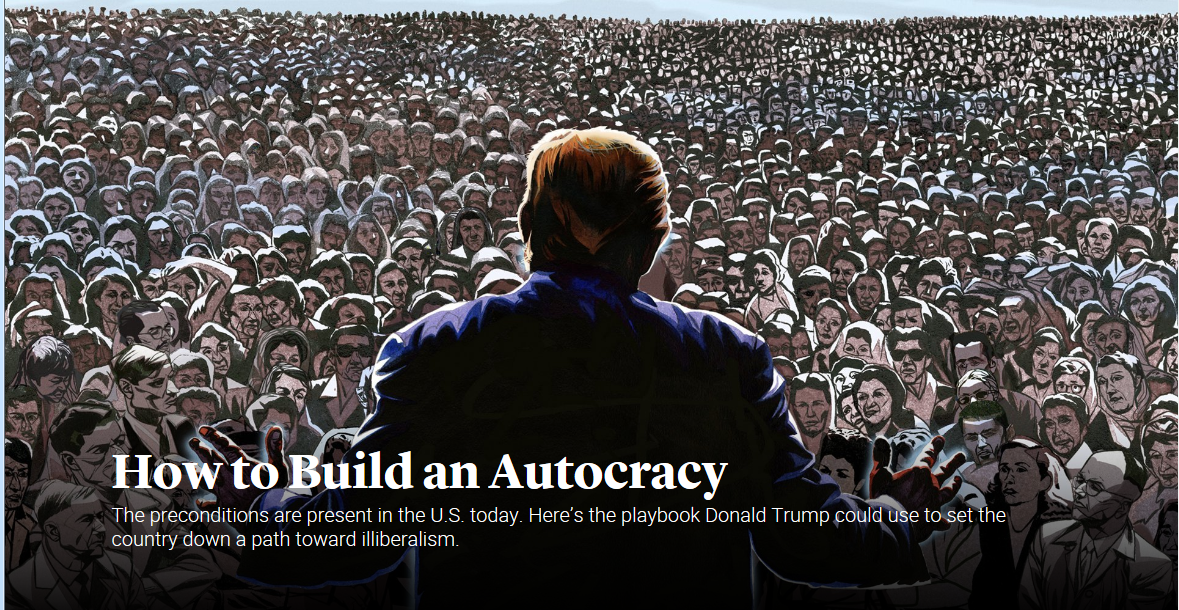
The Atlantic magazine has just released a remarkable essay written by the political commentator, David Frum, entitled, “How to Build an Autocracy.”  Says Mr. Frum, “Donald Trump will not set out to build an authoritarian state.  His immediate priority seems likely to be to use the presidency to enrich himself.  But as he does so, he will need to protect himself from legal risk.  Being Trump, he will also inevitably wish to inflict payback on his critics.  Construction of an apparatus of impunity and revenge will begin haphazardly and opportunistically.  But it will accelerate.  It will have to.”

capture99
Let’s assume that Mr. Frum is correct that Trump’s top priority is to enrich himself.  What will stop him from doing this?  A recent column in the New York Times points out that:

  •  54% of registered voters in congressional districts represented by Republicans view Mr. Trump favorably compared with only 42% who view him unfavorably.
    In these same districts, 87% of registered Republicans view Mr. Trump favorably.
  • In other words, the Republican dominated Congress is unlikely to strongly oppose his sleazy and self-enriching behavior.

But there are other constraints on what he does in office:

  • As I said in a recent post in order for Mr. Trump to be reelected in 2020, he will need to substantially speed up economic growth in order to increase the wages of his key blue-collar supporters. He clearly wants to accomplish this.
  • On the other hand, the conservative Republican base, including its representatives in the House such as the Freedom Caucus, will simply not support huge increases in deficit spending for anything (except an emergency) including infrastructure, the military or unfunded tax cuts.
  • In fact, Rep Mick Mulvaney (R, SC), a deficit hawk, has been nominated to become the Trump Administration’s Budget Director. In March the debt ceiling will have to be raised. I expect the many fiscal conservatives in Congress to insist on significant fiscal restraint (e.g. a ten year plan to balance the budget) as a tradeoff for raising the debt ceiling.

Conclusion. Just because Republicans are tolerant of Mr. Trump’s personal behavior does not mean he can successfully ignore the strong Republican desire for fiscal restraint.

Follow me on Twitter
Follow me on Facebook


The Divided States of America: Who’s at Fault?


Frontline’s two part series, “The Divided States of America” makes the case that the divisive and hyper-partisan political atmosphere of the past eight years was caused primarily by the racially tinged reaction of the extremist Tea Party to the progressive policies of a forward looking, if inexperienced, black president.

capture97
I think that Frontline has missed the most fundamental reasons for our current malaise, namely that:

  • Slow economic growth since the end of the Great Recession in June 2009 has caused great angst and resentment amongst middle-income, and especially blue-collar, workers who have stagnant incomes when they observe all around them the elite professional, managerial and financial classes who are doing so well.
  • Self-righteous attitude of progressives who refuse to accept that conservatives have legitimate, and maybe even superior, points of view on various issues.

For example:

  • National Debt. The public debt (on which we pay interest) is now 76% of GDP, the highest since the end of WWII, and is projected by the Congressional Budget Office to keep steadily getting worse without a change in policy. Right now, with ultra-low interest rates, our $14 trillion debt is essentially “free” money. But what is going to happen when interest rates go back up to more normal levels? It could easily be a new fiscal crisis, much worse than the financial crisis of 2008.
  • Inequality. Inequality has risen somewhat in recent years but slow growth is the real problem. What is especially lacking is new business investment to increase labor productivity. The best way to fix this is with tax reform (lower tax rates paid for by shrinking deductions) and a reduction in government regulation. But this would mean more “trickle down” economics. Horrors!
  • Improving Obamacare. The Affordable Care Act has increased access to healthcare but has done nothing to control costs. Most developed countries control the cost of healthcare with a “single payer,” government run monopoly. But this is anathema to many Americans who neither want to give up personal choice nor want to forgo the innovation which a free-market consumer-driven healthcare system provides.

Conclusion. The driver of our currently divisive political climate is a deep chasm between the fundamental beliefs of the two different sides. How can this deep division be overcome short of a new crisis which pulls both sides together?  A very difficult question.

Follow me on Twitter
Follow me on Facebook


What Will Trump Do?


I did not vote for Donald Trump because of his often crude remarks and sleazy behavior. But I am now cautiously optimistic about the prospects for his presidency based on the quality of his nominees for important government posts.  Like many of his voters, I “take him seriously but not literally.”

capture97
Here is what I think he will do:

  • Economic Policy. He will try to speed up economic growth, well above the average 2.1% annual GDP growth of the past 7½ years. This can be accomplished with tax reform (lowering tax rates paid for by shrinking deductions), regulatory reform (including paring back Dodd-Frank and the ACA), immigration reform and tougher trade policies. Faster growth benefits the whole country and especially the blue-collar workers who voted for him.
  • Improving life in the inner cities. K-12 education is a disaster in many inner cities and Betsy DeVos will be a reformer in the Education Department. Ben Carson grew up in public housing and is an excellent choice for HUD.
  • Foreign Policy. Mr. Trump wants changes from China on currency and trade practices. He also wants more cooperation from Russia in fighting terrorism. He wants our NATO partners to bear a bigger share of their own defense. His Secretary of State designee, Rex Tillerson, supports arming Ukraine against Russia and also supports the TPP trade agreement with Asia. This all sounds good to me.
  • Fiscal Policy. My biggest concern at this point is our national debt, now 76% of GDP (for the public part on which we pay interest) which is historically high and steadily getting worse. The House Republicans are serious about shrinking deficit spending and hopefully Mr. Trump will support their efforts.

Conclusion. Donald Trump has a highly unconventional (but very effective) style of communication. If it leads to progress in addressing our biggest problems as above, then he’ll have a very successful presidency.

Follow me on Twitter
Follow me on Facebook

What to look for in President Trump’s First Budget


As a new administration prepares to take office in January, one of the key indicators of President Trump’s approach to government will be his first budget. This is especially true since the Republican controlled Congress is likely to take a Republican President’s budget seriously.

capture79
One of our nation’s chief fiscal watchdogs, the Concord Coalition, has summarized the most important things to look for:

  • What is the overall fiscal target? President Obama’s recent budgets have aimed at stabilizing the debt as a share of the economy. House Republicans have aimed for a more ambitious goal of balancing the budget within ten years, gradually reducing the debt as a share of the economy. What path will Mr. Trump recommend?
  • What specific tax cuts will be proposed and what are the likely revenue effects? During the campaign Mr. Trump proposed tax cuts amounting to $5.9 trillion in revenue loss over ten years. Even with dynamic scoring, taking the stimulatory effects of his tax cuts into effect, the revenue loss is still $3.9 trillion over ten years. Such huge revenue losses will make our debt much worse than it is already and won’t be approved by Congress.
  • What will the budget recommend for the federal debt limit? Currently the debt limit is suspended until March 16, 2017 when it will return at whatever level it is on that date. Congress will then have several months to reset it. Whatever the President recommends will send a strong signal, positive or negative, to the financial markets.
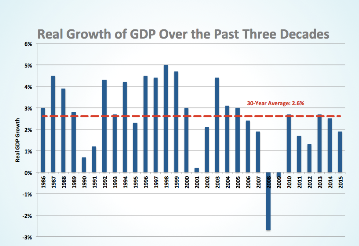
  • What economic growth rates will the budget assume?   GDP growth has averaged 2.6% for the past 30 years. Any predicted long term growth rate higher than this will lack credibility without strong justification.

Conclusion. Mr. Trump has the opportunity to institute the change in course which so many Americans would like to see. His first budget will set the tone and provide an important clue as to whether or not he is serious about doing this.

Follow me on Twitter
Follow me on Facebook


The Importance of Shrinking Our Debt and How to Do It


President-elect Donald Trump is on record as favoring tax and regulatory reform in order to speed up economic growth and I have made it clear that this can be accomplished without increasing our debt.
But what is really needed is to grow our economy faster and actually shrink our debt at the same time.  It will be very difficult, essentially impossible, to accomplish this with growth alone or even by raising taxes because the magnitude of our debt, 76% of GDP and rising, is so great.

capture70
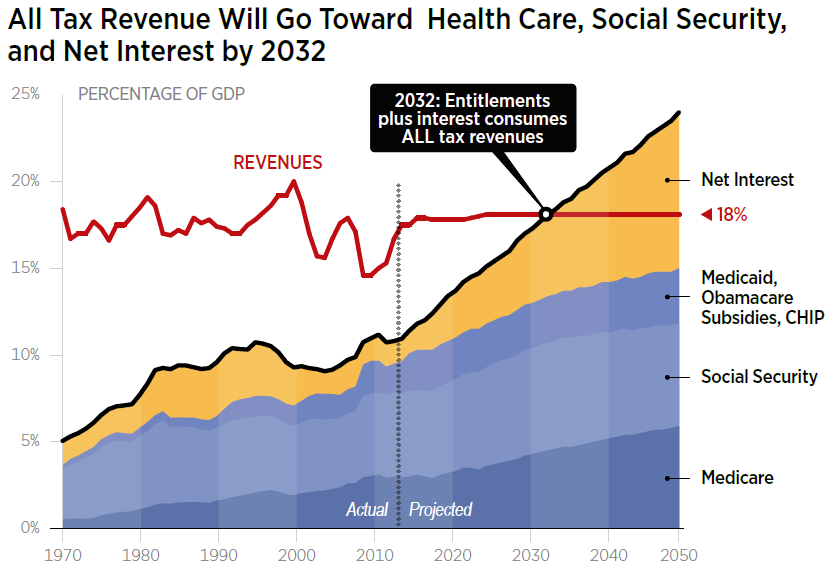
There is really only one way to begin to shrink the debt and this is to get entitlement spending under control.  The above chart shows that, without major changes, by 2032 all tax revenue will go towards healthcare, Social Security and net interest. Here is what needs to be done:

  • Social Security is already paying out $100 billion per year more than it collects in payroll taxes. Its Trust Fund will run dry in 15 years unless major changes are made and all benefits will drop by about 25% when this happens. We need to either increase the eligibility age for full benefits and/or raise the income cap on payroll taxes. These changes can be phased in but the sooner we get started the less painful it will be.
  • Medicare is an even bigger problem than Social Security. Either we have government rationing, i.e. “death panels,” or else rationing by price meaning some form of premium support. This simply means that we will all have more “skin in the game,” in the sense that we will all have a financial incentive to minimize our own healthcare expenses.
  • Medicaid should be block granted to the states so that the federal government is not obligated to a fixed match for all state Medicaid expenses. Again, cost control is the object of such a change.

Conclusion. It needs to be emphasized as strongly as possible that the reason for stringent cost control of entitlement programs is to preserve them for posterity, not destroy them.  Our prosperous way of life is severely threatened by our unwillingness to recognize this problem.

Follow me on Twitter
Follow me on Facebook


Trumponomics II. Debt


As I discussed in my last post, Donald Trump’s primary mandate from the presidential election is to get the economy growing faster in order to help out his base of blue-collar workers who have suffered wage stagnation for many years and especially since the end of the Great Recession in June 2009.  The tax and regulatory reform needed to accomplish this urgent task will undoubtedly turn out to be the first plank of Trumponomics.

capture2
But there is another equally urgent task which must not be overlooked by the incoming Trump Administration.  Our national debt, the public part on which we pay interest, is now 75% of GDP, the highest level since the end of WWII, and projected by the nonpartisan Congressional Budget Office to keep growing rapidly in the years just ahead (see chart above).
As Barron’s has pointed out, “Saving America, Part 1”, in its current issue:

  • Today’s public debt of $14 trillion will grow to $45 trillion in just 20 years’ time on the basis of current entitlement programs like Medicare and Medicaid, without any new spending programs or tax cuts.
  • The annual interest on a $45 trillion debt load would be about $750 billion at today’s super low interest rates. If interest rates rise to more typical levels, the interest payment on this level of debt would be about $1.5 trillion a year. This represents almost half of all federal spending during the current 2016-2017 budget year.

Conclusion. Such a high level of interest payment on our debt is unthinkable. This means that either we make fundamental reforms in government entitlement programs in the next few years or else we will have a severe fiscal crisis on our hands in less than twenty years’ time. We have some stark choices to make and hopefully the incoming Trump Administration will not shy away from what needs to be done.

Follow me on Twitter
Follow me on Facebook