Responsible Tax Reform III. Avoid Complacency about Debt


The Trump Administration has proposed a tax reform plan, with both good and bad features, and it is not yet known how Congress will respond to it.  In the meantime we should focus on what tax reform can accomplish if does right:

  • Lower tax rates. Most observers agree that lower tax rates will increase economic growth by encouraging more business investment. Since the end of the Great Recession in June 2009, GDP has grown at the historically slow rate of 2% per year. Any additional growth will be beneficial by tightening the job market, thereby creating more jobs as well as higher wages for the already employed.
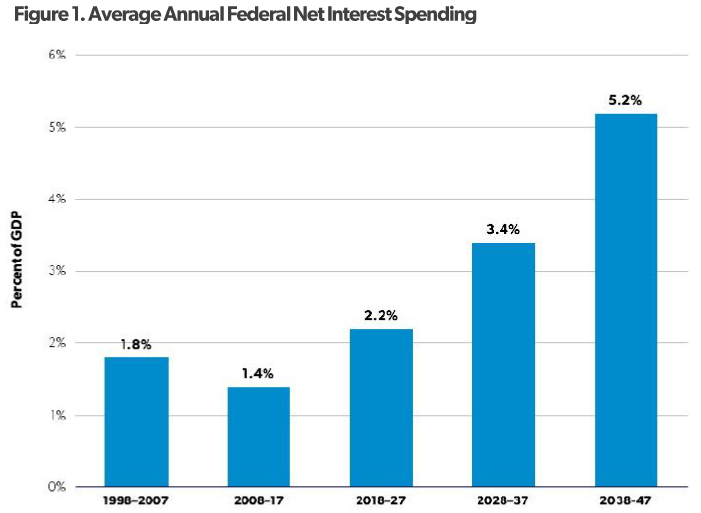
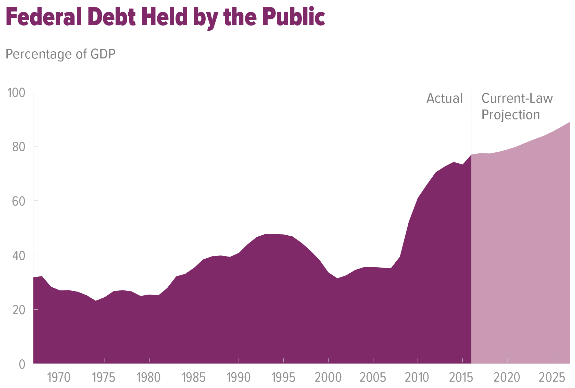
  • Revenue neutrality. Our public debt (on which we pay interest) is now 77% of GDP, the highest it has been since right after WWII. At the present time interest rates are so low that the debt is almost “free” money. But interest rates will inevitably rise back to more normal levels in the future. When this does happen, whether it be sooner or later, interest payments on our ever increasing debt will skyrocket, and eat up as much as a third of federal tax revenue.  A huge fiscal crisis will then occur, far worse than the Financial Crisis of 2008.
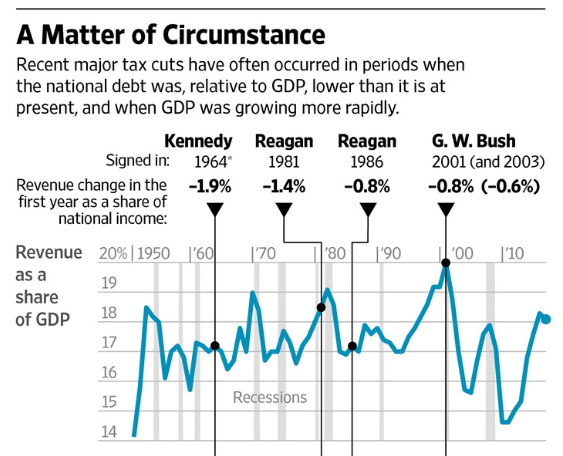
  • Observing historical precedent. There have been five tax rate cuts in the last half century: (Kennedy (1964), Reagan (1981, 1986) and Bush (2001, 2003)).  Note that public debt was 40% or less of GDP at the time of each of these tax cuts (see chart). The revenue losses associated with each was temporary and the first three at least strongly stimulated new growth.

Conclusion. Our national debt is much too high at the present time to adopt a tax reform plan with an extravagant disregard for revenue loss. The current debt level is so high (and projected to keep getting steadily worse) that modest tax rate cuts, coupled with significant spending restraint, is clearly called for.

Follow me on Twitter
Follow me on Facebook

Responsible Tax Reform II. The Trump Plan


Responsible tax reform will be highly beneficial for the U.S. economy because:

  • Economic growth will be speeded up by lowering tax rates on businesses, thereby encouraging more investment.
  • National debt will shrink because faster growth will produce more tax revenue. But this only works if the revised tax plan is revenue neutral to begin with.

The Trump tax plan, described here and here, has the following features:

  • three tax brackets, reduced from seven. Simplification like this is a good idea.
  • double the standard deduction. This puts more money in the pockets of the average tax payer who does not itemize deductions and is therefore a good idea.
  • repeal of the alternative minimum tax. This only affects wealthy people and should be retained, if necessary, to make sure that overall reform does not increase the deficit.
  • lower capital gains tax. This will encourage more investment but should not be included unless the overall plan is revenue neutral.
  • repeal of inheritance tax. This tax feature should be retained until our annual budget deficits are eliminated, i.e. until we achieve balanced budgets on an annual basis.
  • preserving deductions for mortgage interest and charitable contributions. The mortgage interest deduction should be greatly reduced from its current level of $1 million per residence. Wealthy taxpayers don’t need that much help. Raising the standard deduction will already help middle income taxpayers.
  • cutting the corporate tax rate. This is an excellent idea as long as its revenue loss is made up elsewhere. It will encourage multinational corporations to bring their overseas profits back home for reinvestment in the U.S.

Conclusion. The Trump tax plan has some good features as well as some poor ones. Reducing tax rates is a good idea.  But adding to annual deficits is a very bad idea.  With some effort it is possible to reduce tax rates in a revenue neutral way.

Follow me on Twitter
Follow me on Facebook

Principles for Responsible Tax Reform

President Trump has just unveiled the outline of his tax reform proposal. Tax reform done right can give our economy a needed shot in the arm.  The big question is, of course, what is the right way to do it?
The Committee for a Responsible Federal Budget has proposed some sensible guidelines:

  • Promote Economic Growth and Dedicate the Gains to Deficit Reduction. The Joint Committee on Taxation and the Treasury Department have estimated that comprehensive tax reform can increase the growth rate of GDP over the next decade by .05 to .25% per year. For example, a .2% increase would reduce our debt by $550 billion over ten years (see chart). This does not fix our fiscal problems but it helps.

  • Maintain or Reduce Current Deficits. Make sure that any tax rate cuts are offset by revenue increases (i.e. shrinking tax deductions) so that the annual deficit is not increased. Ultimately, our fiscal challenges are unlikely to be solved without reducing spending, reforming entitlements and increasing revenue.
  • Set Permanent Tax Policy. The reconciliation process in the Senate, whereby a simple majority can approve legislation, disallows any increase in the debt beyond ten years. In other words, permanent tax reform will require a sixty vote majority to override a filibuster. This is the only way to achieve sound policy.
  • Avoid Unjustified Timing Shifts and Other Gimmicks. A timing shift is a gimmick if it doesn’t make economic sense. For example, gradually reducing tax rates, rather than cutting them immediately, would only delay revenue losses by shifting them to the future, and is therefore a gimmick.
  • Rely on Reasonable Economic Assumptions. A good example of a faulty economic assumption is to arbitrarily assume that a tax rate reduction will create 3% annual GDP growth and therefore pay for itself over a sufficiently long time period. Such a proposal was made by the economist Stephen Moore in yesterday’s Wall Street Journal.

Conclusion. Slow economic growth and massive debt are our country’s two biggest problems. Tax reform done right will speed up growth without worsening the debt.  I will be paying close attention to the forthcoming debate on this issue.

Follow me on Twitter
Follow me on Facebook

The Magnitude of our Debt Problem


I began writing this blog in November 2012, right after the 2012 national election when Barack Obama was reelected to a second term as President. Under Obama our biggest problems were: 1) slow economic growth (2% annually since June 2009) and 2) massive and rapidly increasing debt, now 77% of GDP.
After the surprise victory of Donald Trump last fall, my perspective has changed a little bit.  Slow growth is still a huge problem.  My last several posts have, in fact, focused on the despair of many blue-collar workers who have been harmed by our stagnant economy in recent years.
Mr. Trump was strongly supported by blue-collar workers last fall and clearly wants to help them out.  Faster economic growth will accomplish this and President Trump is working with the Republican Congress to get this done through tax and regulatory reform.  I’m optimistic that progress will be made along these lines.
But our debt problem has not really been addressed so far by the Trump Administration.  James Capretta from the American Enterprise Institute gives a good summary of where we are:

  • Entitlement Spending is the Problem. In 1972 the federal government spent a combined 4.2% of GDP on Social Security, Medicare and Medicaid. In 2016 spending on these programs was 10.4% of GDP. The Congressional Budget Office predicts that this figure will jump to 13.5% of GDP in 2030 and 15.6% of GDP in 2047 unless current policy is changed.

  • The Fiscal Consequences of Interest Rate Normalcy. In 2008 when federal debt was at 39% of GDP, federal spending on net interest payments was 1.7% of GDP. For 2017 net interest payments will be just 1.3% of GDP even though the federal has doubled since 2008. This is due to the abnormally low interest rate of 2.3% at the present time. CBO projects that the interest rate on 10-year Treasury notes will rise to 3% in 2019-2020 and 3.6% for the period 2021-2027.

Conclusion. Right now our huge and rapidly increasing debt is almost “free money” because interest rates are so low. This can’t and won’t last.  As interest rates inevitably climb to more normal levels, interest payments on the debt will rise precipitously.  This will cause much pain by further squeezing spending on many popular programs.  The only sane way to mitigate this highly unpleasant prospect is to shrink deficit spending down to zero as quickly as possible.

Follow me on Twitter
Follow me on Facebook

The Fading American Dream and Donald Trump


It is now generally accepted that Donald Trump was elected President because of his strong support amongst white blue-collar workers, especially in the battle ground states of Wisconsin, Michigan and Pennsylvania. Mr. Trump was able to persuade these voters that he would be able to raise their stagnant incomes and even bring back the millions of manufacturing jobs which have been lost to automation and globalization.


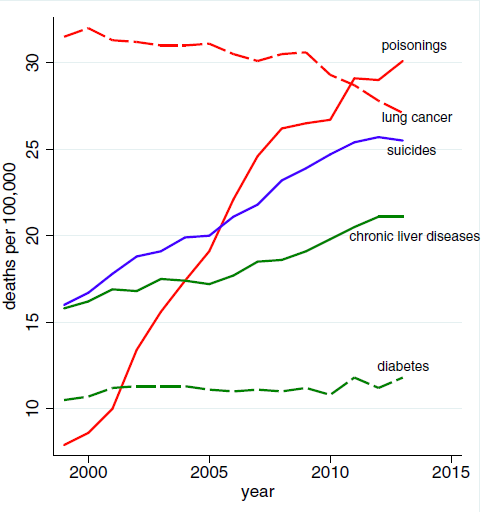
Now the two economists, Anne Case and Angus Deaton, have shown that mortality rates for white, U.S. non-Hispanics, aged 45 – 54, with a high school degree or less, have doubled since 1990.
Here is the general situation:

  • Overall, U.S. life expectancy at birth has increased from 63 years in 1940 to 79 years in 2010.
  • Life expectancy is still increasing for the college educated as well for U.S. Blacks and U.S. Hispanics. It is also still rising in many other developed countries.
  • The main cause for the rising death rates of the vulnerable group is “deaths of despair” – suicides, drug overdoses and the consequences of heavy drinking.

The authors point out that:

  • It is precisely working class whites whose economic prospects have deteriorated the most in recent years, especially since the financial crisis.
  • The U.S. has moved largely to defined-contribution pension plans with stock market risk in recent years whereas in Europe defined-benefit pensions are still the norm.
  • The current mortality crisis bears a resemblance to the AIDS epidemic which took the lives of 650,000 Americans from 1981 – 2015. However, public awareness of the AIDS crisis was far greater than for the current mortality epidemic.

Conclusion. The basic American dream of home ownership, modest financial and job security and a bright outlook for one’s children has faded for a large class of middle-aged workers. The crisis is manifested in an increase in mortality rates for this vulnerable class.  Donald Trump’s election mandate is to fix this problem but it is a tall order indeed.

Follow me on Twitter
Follow me on Facebook

Trump’s Bark Is Worse than His Bite


The anti-Trump fervor seems to be slowly dying down as his appointees take hold of their agencies and begin to promulgate new policies. I have expected this to happen because of the excellent quality of many of the people he has appointed.
Here are a few recent developments:

  • Interior Secretary Ryan Zinke has said that “the border is complicated as far as building a physical wall” and there are all sorts of problems to be resolved before it can be done.
  • Reality is setting in with regard to Russia policy “given Russia’s continued provocations in terms of weapon’s deployments, overtures to Iran, cyber intrusions and intervention in Ukraine.”
  • The Brookings Institution has just issued a new report showing that school choice options are increasing in the country’s largest school districts. This indicates that Education Secretary Betsy DeVos is in the mainstream by supporting more choice.
  • Coal jobs Trump vows to save no longer exist.  In other words, cancelation of the Obama Clean Power Plan will have little effect on the huge drop in coal use because coal has become so much more expensive than natural gas.
  • Of course, the Trump 2018 Budget Proposal will be heavily modified by Congress but it does contain some good ideas. Agriculture, Foreign Aid and Community Development Block Grants are all ripe for big cuts.
  • The biggest unknown with respect to administrative action concerns trade policy. The question here is what concessions he can get from China and Mexico without starting a disastrous trade war.

What is mainly lacking at this point is any significant action by Congress on the Trump agenda. What will happen with healthcare reform, tax reform and deficit reduction, for example?

Conclusion. Trump is doing fine so far but it is on relatively straightforward issues under his control. Hopefully he will be able to make progress on the bigger issues as well which require working with Congress.

Follow me on Twitter
Follow me on Facebook


America’s Biggest Problem is Almost under the Radar


I’ve had several posts recently elaborating on the theme of Tyler Cowen’s new book, “The Complacent Class,” that too many Americans have become complacent about the comfortable life which they now enjoy.


Let’s take a different approach today and consider some of the problems which large numbers of Americans really are concerned about:

  • The election of Donald Trump as President. Granted, he just barely squeaked through in the Electoral College with 46% of the popular vote. He makes outlandish statements which have little, if any, basis in fact. But he has appointed many capable cabinet secretaries and other assistants and he listens to them. He adjusts his policies when struck down by the courts. In my opinion he has suffered no major mistakes so far.
  • Increasing income inequality in American society. This is a problem but, as Nicholas Eberstadt has pointed out, the real problem is income insecurity for millions of blue-collar workers. The best solution here is faster economic growth which the Trump Administration and the Republican Congress hope to achieve through tax reform and deregulation.
  • Global Warming. More and more Americans understand the increasing severity of this problem. There is a fair chance that a revenue neutral carbon tax will be implemented in the near future. This would be a big boost toward controlling carbon emissions in the U.S. and would provide more clout in establishing worldwide emission standards as well.
  • A chaotic world. Terrorism will not go away but at least ISIS will soon be defeated as an independent state. Other worldwide threats such as China, Russia and Iran can be managed with a strong U.S. military force undergirded by a strong U.S. economy.

Conclusion. The above problems are considered by large numbers of people to be serious and are therefore being addressed in one way or another. But our biggest problem of all, massive debtis off the radar for much of the political class, including President Trump. It needs to be taken far more seriously than it is before we have another, and much more severe, financial crisis.

Follow me on Twitter
Follow me on Facebook

Donald Trump’s Popularity is Steadily Increasing


Like many things about Donald Trump, his approval ratings are contradictory and misleading. The Wall Street Journal reports that:

  • Only 44% of Americans currently approve of President Trump’s job performance (while 48% disapprove) which is historically low for a new President.capture107
  • On the other hand, the percentage of Americans who have positive feelings about him has been steadily increasing ever since he declared his candidacy in June of 2015, and has now reached a high of 43% (see chart). Since his State of the Union speech was generally well received, this rating is likely to go even higher.

Here is my own perspective. As I have said many times on this blog, I believe our country’s two biggest and most urgent problems are:

  • Slow economic growth, averaging just 2% per year since the end of the Great Recession in June 2009. This means fewer jobs, smaller raises for workers and less tax revenue to spend on important national initiatives.
  • Massive Debt, now standing at 77% of GDP (for the $14 trillion public debt on which we pay interest), the highest since right after WWII. The Congressional Budget Office predicts that this debt level will keep on steadily getting worse, without big changes in current policy. It is therefore a huge threat to our national security and prosperity.

I have great confidence that the Trump administration and Congressional allies will put a high priority on faster growth and are likely to be able to achieve it. I can’t yet tell if Trump understands the seriousness of our massive debt.  But the Tea Party and Freedom Caucus members in the House of Representatives do very strongly understand this problem and will insist on addressing it.  I believe that they will be able to persuade the President to support them in doing this.

Conclusion. At this point I am a supporter of President Trump because I think that our national government is moving in the right direction.

Follow me on Twitter
Follow me on Facebook

Is 3% Economic Growth Possible?


Donald Trump was elected President because of strong support from blue-collar workers in the battleground states such as Wisconsin, Michigan, Pennsylvania and Ohio. The American Enterprise Institute scholar, Nicholas Eberstadt, has explained clearly why this happened.  It is largely a result of a slowdown in economic growth in recent years which has hit blue-collar workers especially hard.

capture104
Can this recent slow growth trend be reversed?  The economist, Edward Lazear, has a positive answer to this question in today’s Wall Street Journal.  According to Mr. Lazear:

  • 3% growth is the long term norm. The annual growth rate in the 30 years preceding the 2007 recession was 3.1%. It has averaged just 2% annually since the end of the recession in June 2009.
  • GDP growth is the sum of two components: growth in productivity and in labor hours. Historically productivity has grown at a rate of about 2% per year and labor at about 1%.
  • Nonfarm labor productivity rose by a total of 7% between 2009 and 2016 which amounts to only 1% per year. It rose 18% between 2001 and 2008 or 2.3% per year.
  • Both President Trump and the House Republicans advocate business expensing (immediate tax write-offs for new investment) as an important part of tax reform. It has been estimated that just this one change in policy will induce an increase in GDP of from 5% to 9% over ten years. This would raise GDP from the current 2% annual growth to between 2.5% and 2.9% annually.
  • The Social Security Administration predicts no increase in the U.S. population age 20 to age 64 between 2020 and 2030.
  • But note that the labor participation rate fell during the recession by 2% among Americans between ages 25 and 54, the prime working age. Two drivers of this loss of workers are: 1) a large increase of the disability rolls and 2) the fact that the ACA will likely reduce the number of hours worked by about 2% between 2017 and 2024.
  • Eliminating burdensome business regulations will also help significantly.

Conclusion. There is clearly much that can be done to speed up both labor productivity and the number of hours worked by Americans. President Trump and the Republican Congress have a good shot at increasing economic growth to 3% annually.

Follow me on Twitter
Follow me on Facebook


The Origins of Trumpism II. A National Crisis for Working Men


The American Enterprise Institute’s Nicholas Eberstadt has performed a valuable national service with two recent publications: “Men without Work” and “Our Miserable 21st Century”  These works lay out in great detail what has gone wrong in our country in the past 16 years:

  • Overall household wealth has doubled as a result of a surging stock market fed by the Federal Reserve policy of quantitative easing.
  • The recovery from the crash of 2008 has been singularly slow and weak compared to the 1947 – 2007 trend line.
  • The work rate for Americans aged 20 and older has declined by 4% from 66% to 62%.
  • Half of all prime working age male labor-force dropouts take opioid medication on a daily basis paid for by Medicaid. 57% of this population class is collecting disability benefits.
  • 17 million male ex-prisoners and convicted felons are now in our midst and largely unable to find the employment which would lead to productive lives.

Here is Mr. Eberstadt’s initial prescription for addressing this very serious social problem:

  • Revitalize American business and its job-generating capacities. According to the Brooking Institution’s Ian Hathaway and Robert Litan, “business deaths now exceed business births for the first time in the thirty-plus-year history of our data.”capture63
  • Reducing the immense and perverse disincentives against male work embedded in our social welfare programs. For example, U.S. disability programs are subject to widespread abuse and gaming. Social welfare programs should emphasize a “work first” principle emphasizing training and education, job placement, and tax credits, etc.
  • Drawing men with a criminal record back into productive work life. Note that the huge increase in America’s ex-prisoner and ex-felon population in recent years coincides with a dramatic drop in rates for both violent crime and property crime. This suggests that former criminals do not pose a continuing danger to society.

Conclusion. For the future prosperity and social cohesion of our country addressing this problem should be a very high priority. Let’s hope that President Trump gets the message.

Follow me on Twitter
Follow me on Facebook