Why Economic Growth is Slowing Down


The two main themes on this website, “It Does Not Add Up,” are that the U.S. national debt is too high and that our economy is growing too slowly.  How can we shrink the debt (as a percentage of GDP) and how can we make the economy grow faster?  I make use of all sources of information which shed light on these two fundamental issues.
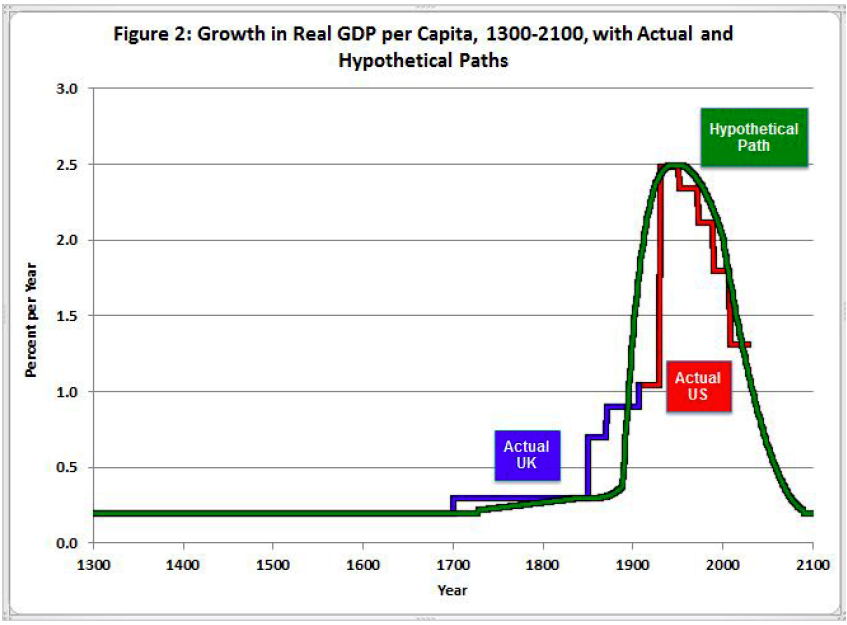
CaptureToday I briefly discuss the work of the Northwestern University Economist Robert Gordon, summarized in his new book, “The Rise and Fall of American Growth.”  His basic thesis, see the above chart, is that human civilization experienced essentially no economic growth up until about 1700, then slow growth occurred mainly in the UK and US up until about 1870 followed by explosive growth mainly in the US up until about 1970.  Since 1970 growth has slowed way down except for a brief spurt from 1994 – 2004.
According to Mr. Gordon, these growth periods were caused by Industrial Revolution #1 (steam, railroads), IR #2 (electricity, internal combustion, modern plumbing, communications, petroleum), and IR #3 (computers, internet, mobile phones), all of which led to productivity growth spurts which have by now largely run their course. Not only are we out of industrial revolutions but there are, in addition, stiff headwinds working against economic growth.  For example:

  • The First Headwind: Rising Inequality. Downward pressure on the wages of the bottom 90%. Increased inequality at the top. Educational outcomes strongly correlated with socio-economic status.
  • The Second Headwind: Education. Stagnation in high school graduation rates and poor performance on international tests measuring achievement. High debt levels for college graduates.
  • The Third Headwind: Demography. The labor participation rate has dropped form 66.0% in 2007 to 62.6% today, only half caused by baby boomer retirements.
  • The Fourth Headwind: Repaying debt. The public debt, on which interest is paid, is now 74% of GDP and is predicted by the CBO to steadily increase. This will inevitably lead to either higher taxes or slower growth in future transfer payments.
  • The Fifth Headwind: Social deterioration at the bottom of the income distribution. Increasing number of children are born out of wedlock for high school graduates and dropouts, much higher for blacks than for whites. For mothers aged 40, the percentage of children living with both biological parents declined from 94% in 1960 to 34% in 2010.
  • Other Headwinds. Globalization and Global warming.

Mr. Gordon makes a voluminous case for the slowing down of economic growth, the basic reasons why this is happening, and the social forces which are making it worse. Next: How should public policy respond to this huge challenge?

Follow me on Twitter: https://twitter.com/jack_heidel
Follow me on Facebook: https://www.facebook.com/jack.heidel.3
 

Annual Deficits are Starting to Go Back Up!


As regular readers of It Does not Add Up know well, I am highly alarmed about the large budget deficits and slow economic growth in the U.S. in recent years.  Some people respond that deficits are falling and that we have entered a new era of slow-growth secular stagnation which is unavoidable.
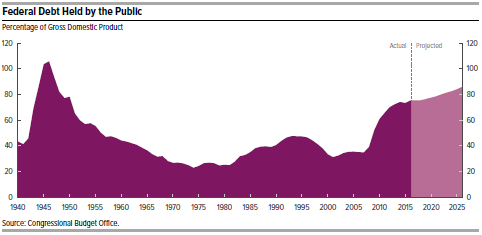
CaptureA new report from the Congressional Budget Office, our most reliable source for objective fiscal and economic information, now predicts that the deficit for 2016 will be $544 billion, a large increase over the $439 billion deficit for 2015.  Furthermore, CBO predicts that for future years deficits will continue to grow, exceeding $1 trillion by 2022. Here is a summary of the CBO predictions:

  • Federal outlays are projected to rise by 6% this year, to $3.9 trillion, or 21.2% of GDP. This represents a 7% rise in mandatory (entitlement) spending, a 3% increase in discretionary spending, and a 14% increase in net interest on the national debt.
  • Under entitlements, Social Security payments will increase by 3% and healthcare (Medicare, Medicaid, CHIP (children’s health) and Obamacare) payments will increase by 11%.
  • Revenues will increase by 4% in 2016, to $3.4 trillion, or 18.3% of GDP.
  • Deficits are projected to increase from 74% of GDP in 2015 to 86% of GDP by 2026.
  • Spending for mandatory programs will increase from 13.1% of GDP in 2016 to 15% of GDP in 2026.

First Conclusion: The spending increases from 2015 to 2016, outlined above, illustrate a clear and alarming trend which is evident in the full ten-year set of CBO data. Discretionary spending will rise but at a sustainable rate of about 3% a year or less.  Mandatory (entitlement) spending will rise at a much faster and unsustainable rate.  It is healthcare spending, i.e. for Medicare, Medicaid, CHIP and Obamacare, and not Social Security, which is driving the rapid increase in mandatory spending.
Second Conclusion:  Although it is government healthcare spending which is driving our rapidly worsening deficit and debt problem, this is just part of the larger problem of the rapidly increasing cost of overall (including private) healthcare spending in the U.S.  This is the basic problem we need to focus on to get both fiscal and economic policy back on the right track.

Follow me on Twitter: https://twitter.com/jack_heidel
Follow me on Facebook: https://www.facebook.com/jack.heidel.3

Republican Congress Approves Irresponsible Budget


Congress has adjourned for Christmas having passed a final budget for the 2016 Fiscal Year extending through next September. It puts into place for this year the two year spending agreement reached between Congress and the President in October.  However Congress started out the year by passing a ten year budget plan resolution leading to a balanced budget by 2025.  The budget just passed leads instead to a deficit of $1.1 trillion in 2025.
CaptureHere are the details as described by the nonpartisan Committee for a Responsible Federal Budget:

  • Revenue: decreased under new budget by a $650 billion (over ten years) by making various temporary tax deductions permanent.
  • Discretionary Spending: increased by $50 billion for the current budget year (by breaking the sequester cap).
  • Medicare: instead of saving $430 billion over ten years, Medicare spending is increased by $95 billion over ten years.
  • 2025 Deficit: instead of shrinking to zero in ten years, it is now projected to be more than $1 trillion in 2025.
  • 2025 Debt: currently the (public, on which we pay interest) debt is 74% of GDP. The ten year balanced budget plan would reduce the debt to 56% of GDP. Instead, the debt is now on track to reach 80% of GDP by 2025.

Granted the Republican Congress hopes to develop a tax reform plan in 2016 which would lower tax rates for everyone, paid for by closing many of the loopholes and deductions just approved last week. One very good way to do this has recently been proposed by the Tax Foundation. The TF plan would boost economic growth and thereby increase tax revenue substantially over ten years.
The problem is that real tax reform is unlikely to happen without a Republican president in office.  If a Democratic president is elected in 2016, then the dire predictions made by the CRFB (above) are likely to remain valid for the foreseeable future. Our fiscal and economic future remains quite precarious at the present time!

Follow me on Twitter: https://twitter.com/jack_heidel
Follow me on Facebook: https://www.facebook.com/jack.heidel.3

Stopping Donald Trump II. Less Inequality or More Growth?


In my last post I presented the argument that voters are often more reasonable than the populist leaders who are trying to appeal to them.  They would rather hear something more optimistic than rage against a dangerous world.
Capture0But there is a difference of opinion on how to reach these voters:

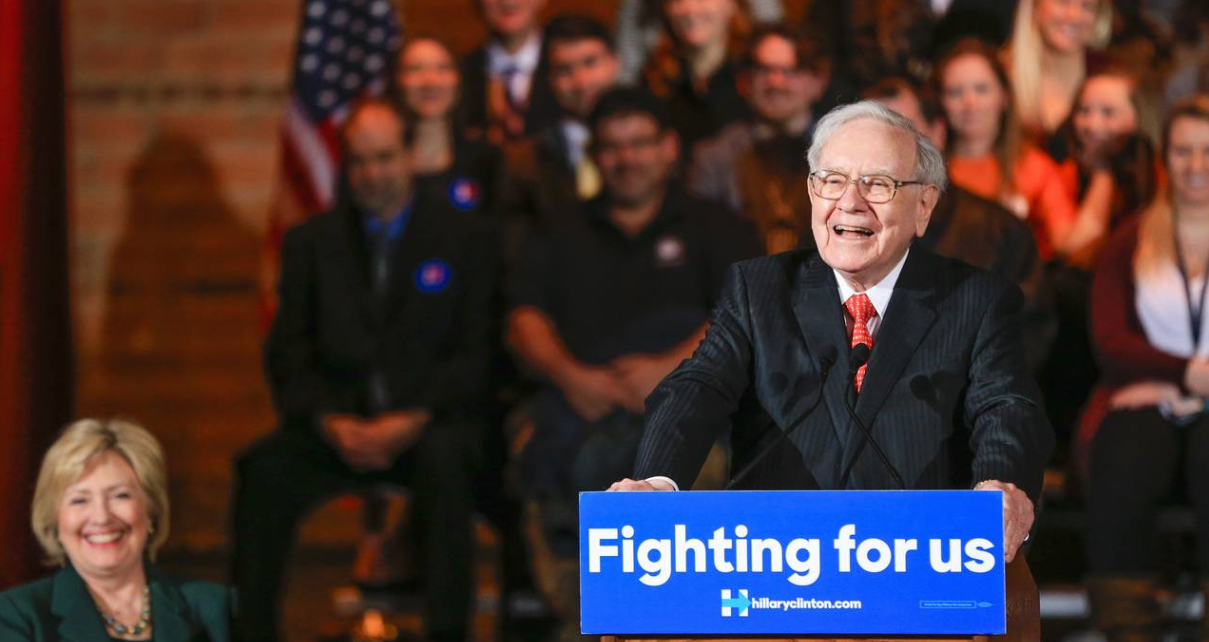
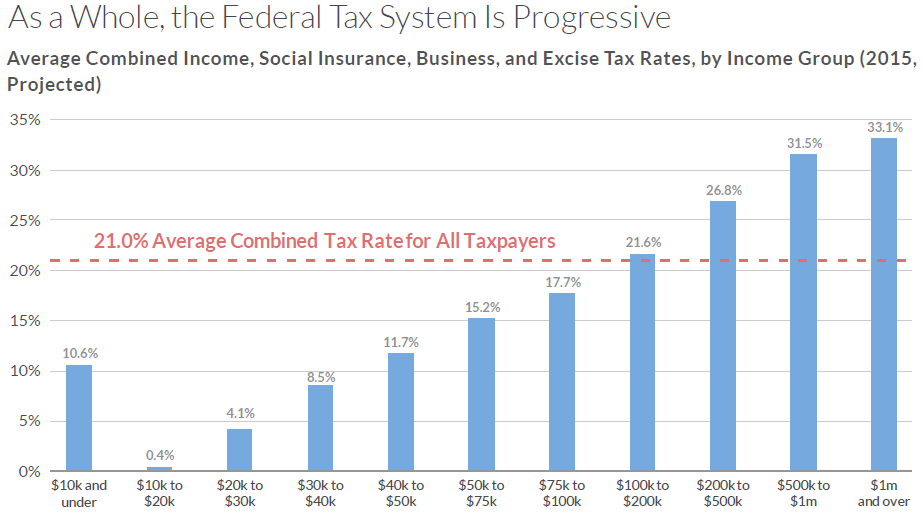
  • Leading Democratic presidential candidate Hillary Clinton endorses the Buffett Rule which calls for millionaires to pay a minimum tax of 30% on their income. Says Clinton, “I want to go even further because Warren is right. I want to be the president for the struggling, for the striving and the successful.”
  • All of the Republican presidential candidates, including Donald Trump, have tax reform plans which will grow the economy but none of which are revenue neutral. In other words, they will all add to annual deficits and therefore make our debt problem much worse than it already is.
  • The nonpartisan Tax Foundation has issued a new report, “Options for Broadening the U.S. Tax Base,” which proposes capping itemized deductions at $25,000 per individual combined with
    i)   cutting the corporate tax rate to 27%
    ii) cutting the top three ordinary income brackets by 5%, and
    iii) implementing a top capital gains tax rate of 20%.
    Such a plan would be revenue neutral and would lead to a long term GDP gain of 2.7%, a long term wage gain of 2.2% and a ten year dynamic revenue gain of $759 billion.

The Clinton plan would bring in up to $50 billion per year in new tax revenue but would do little to boost the economy. The Republican presidential tax plans are fiscally irresponsible. The Tax Foundation plan would boost the economy and reduce deficits rather than increase them.  Other specific reforms would boost the economy even more.
In other words there are clear cut ways to create more jobs and raise wages.  This is a message which should appeal to the angry and disaffected voters who are attracted to Donald Trump.

Follow me on Twitter: https://twitter.com/jack_heidel
Follow me on Facebook: https://www.facebook.com/jack.heidel.3


The Best Way to Stop Donald Trump


The main sources of background information for my posts are The New York Times and the Wall Street Journal. I read the Economist but most of the time it is either too esoteric or else too far  removed from the specifics of U.S. fiscal and economic policy which I am interested in.  But this week they have hit the nail on the head regarding Donald Trump and his fellow right-wing populists around the world.
Capture0
Says the Economist:

  • Populists differ but the bedrock for them all is economic and cultural insecurity. Stagnant wages hurt a cohort of older working-class white men whose jobs are threatened by globalization and technology. Jihadist terrorism pours petrol on this resentment and extends populism’s appeal.
  • Nobody should underestimate how hard it is to take the populists on. It is a huge mistake to dismiss their arguments by calling them fascist or extremist. Such disdain risks suggesting that political leaders are uninterested in the real grievances the populists play on.
  • The best way to overcome resentment is economic growth – not putting up walls. The best way to defeat Islamist terrorism is to enlist the help of Muslims – not to treat them as hostile.
  • Voters are often more reasonable than the populist leaders who are trying to appeal to them. Most of them would sooner hear something more optimistic than rage against a dangerous world.
  • Politicians also need to deal with the populists’ complaint that government often fails them. Reluctance to deploy more troops against the ISIS caliphate in Syria and Iraq does not appear to be a serious strategy to defeat it.

Conclusion: There is a clear path forward for candidates with a positive message of openness and tolerance and realistic plans to make the economy grow faster. Who is best situated to deliver such a message?  Stay tuned!

Follow me on Twitter: https://twitter.com/jack_heidel
Follow me on Facebook: https://www.facebook.com/jack.heidel.3

Tax Reform and Economic Growth


In a recent post I pointed out that both Republican and Democratic presidential candidates are being unrealistic with their tax reform proposals:

  • The Republican plans would stimulate the economy but at the cost of huge increases in the national debt, even taking into account the growth effects of these plans.
  • Raising the top tax rate to 50%, a Democratic idea, would bring in an additional $100 billion per year in tax revenue, but this is neither enough to make a big dent on budget deficits or appreciably lower income inequality by redistribution.
    Capture

The nonpartisan Tax Foundation has just released a new report, “Options for Broadening the U.S. Tax Base,” describing three different ways to do this:

  • Ending the exclusion of employer-sponsored health insurance
  • Removing the cap on the social security payroll tax
  • Capping itemized deductions at a fixed dollar level

Combined with marginal tax rate cuts, each of these options would lead to substantial economic growth.  However, the first option, ending the exclusion of employer-sponsored health insurance, is unlikely but rather this exclusion could be turned into tax credits as part of further healthcare reform.  Likewise, removing the cap on the social security payroll tax is more likely to be used to raise additional revenue to make social security financially sound for the long run.
However, the single measure of capping itemized deductions at $25,000 per individual could be combined with

  • Lowering the corporate tax rate to 27%
  • Cutting the top three ordinary income brackets by 5%
  • Implementing a top capital gains tax rate of 20%

Such changes would be revenue neutral and would lead to a long term GDP gain of 2.7%, a long term wage rate gain of 2.2% and a ten year dynamic revenue gain of $759 billion.
Conclusion:  it is possible to cut tax rates, broaden the tax base and grow the economy all at the same time and without increasing the deficit.  This is what we should be doing!

Follow me on Twitter: https://twitter.com/jack_heidel
Follow me on Facebook: https://www.facebook.com/jack.heidel.3

I Am One of Paul Krugman’s “Very Serious People”


There is a stark contrast between the fiscal and economic policies being proposed by the presidential candidates from the two different parties. The Democrats want to tax the rich to reduce income inequality while the Republicans want major tax reform in order to speed up economic growth.
CaptureI favor the latter approach as long as it does not increase deficit spending.  The Keynesian economist Paul Krugman mocks deficit hawks like me as “Very Serious People.”  But in my “serious” view we have a choice between two very different paths for our economic future:

  • Slow Growth. Continue on our present path of slow 2% annual growth. The official unemployment rate has dropped to 5% but slack in the economy caused by the low labor participation rate keeps raises low and millions still unemployed or under-employed. The slow economy also keeps inflation and interest rates low. This permits Congress and the President to shrug off deficit spending and debt accumulation because it’s virtually “free money,” being borrowed at very low interest rates.   Our present course not only prolongs income inequality but also allows the debt to keep ramping up indefinitely. The longer this continues, the greater will be the disruption when inflation and interest rates do eventually return to normal historical levels.
  • Faster Economic Growth.   There are many things we can do to speed up economic growth. Tax reform is first and foremost but deregulation (relax Obamacare and Dodd-Frank), trade expansion (pass TPP) and immigration reform (with an adequate guest worker program) would also help. But, contrary to what the Republican presidential candidates say, tax reform must be revenue neutral to be sustainable. That way the economic growth it produces will lower deficit spending rather than increasing it.  This is critical because economic growth will create new jobs and raise pay for existing jobs, thereby creating inflationary pressure. Inflation will lead to higher interest rates which in turn will make our debt much more expensive than it is now.

Conclusion. We can make our economy grow faster if we simply put our mind to it. But then inflation and interest rates will go up and interest payments on the debt will become an increasing burden on society.  This is why it is so important to put our debt on a downward path as a percentage of GDP.  We can make it happen if we want to.

A Much Better Way to do Tax Reform


My last two posts, here and here, have pointed out the folly of the tax plans of the presidential candidates from both parties:

  • The Republican plans would stimulate the economy but at a cost of huge increases in the national debt, even using dynamic scoring to take into account the growth effects of these plans.
  • Raising the top tax rate to 50%, a Democratic idea, would bring in $100 billion per year, but this is not enough to either make a big dent on budget deficits or lower income inequality appreciably.
    CaptureThe Tax Foundation has just published an excellent guide to income tax policy which makes several good suggestions for using tax reform to boost the economy:
  • Eliminating the deduction for state and local taxes would raise $81 billion per year. Using this revenue to reduce individual income tax rates would grow the economy by 1.77% of GDP over 10 years.
    Capture11
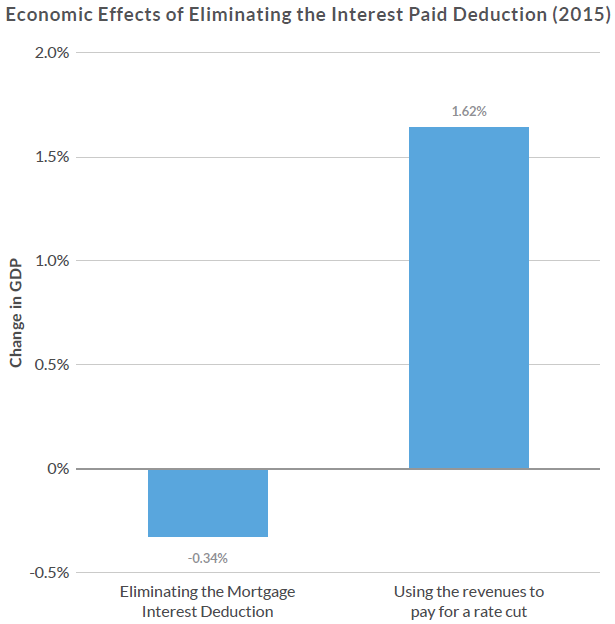
  • Eliminating the mortgage interest deduction would raise $75 billion per year. Reducing individual tax rates by the same amount would grow the economy by 1.61% of GDP over 10 years.
    Capture12
  • Capping itemized deductions at $25,000 would bring in $188 billion per year. Reducing individual tax rates by the same amount would grow the economy by 1.99% over ten years.
    Capture13

Sensible, i.e. revenue neural, tax reform will do wonders for the economy as this study from the Tax Foundation shows. It will bring in more tax revenue to help pay the bills.  It will raise salaries for the already employed.  It will create new jobs for the millions of unemployed and underemployed people who want them.  It will thus reduce income inequality by increasing the wages of people on the bottom. Why is this so hard for so many people to understand?

                               Follow me on Twitter: https://twitter.com/jack_heidel
                     Follow me on Facebook: https://www.facebook.com/jack.heidel.3

Are Democratic Presidents Better for the Economy than Republicans?


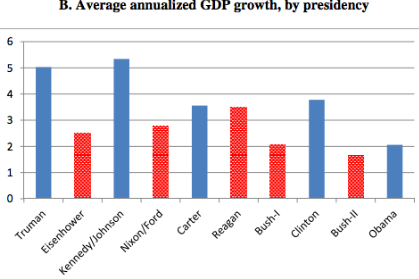
In his usual provocative manner, Paul Krugman reminded us yesterday that, according to a recent study by Alan Blinder and Mark Watson, ever since President Truman the economy has grown faster under Democratic presidents than under Republican presidents.  There are a lot of different explanations for this, not necessarily demonstrating better economic policies by Democratic presidents.  Nevertheless, it is a noteworthy finding which fiscally conservative, fix-the-economy types, need to be aware of.
CaptureAmong other things, Republican presidential candidates must become more credible about their economic policies than they have been so far.  They have all proposed big cuts in tax rates to stimulate the economy. But their plans lose trillions of dollars in tax revenue.  At a time of huge deficits and a rapidly growing national debt this is simply unacceptable.
In today’s Omaha World Herald, the economics journalist, Robert Samuelson, reports on a new Brookings Institute study about the effect of raising the top individual tax rate from 39.6% to 50%.  Such a tax hike would raise as much as $100 billion per year.

  • However, if used to lower deficit spending, it would cover less than ¼ of current deficit spending ($439 billion in 2015, for example).
  • If used to reduce income inequality for the poorest 1/5 of Americans, it would give such households an average of $2,650, and the overall effect on income inequality would be very modest.

The point is that neither costly tax cuts to boost economic growth nor a sizable tax increase on the wealthiest Americans represents a viable program to straighten out our economic problems. What we need to grow the economy is:

  • Revenue neutral tax reform, lowering rates across the board, paid for by closing loopholes and shrinking deductions.
  • Lightening the regulatory burden at least on small and mid-size businesses in order to speed up business growth and entrepreneurship.
  • Trade expansion and immigration reform to increase productivity.

Fiscal conservatives are badly needed to implement such policies effectively but neither party can get the job done alone. It will take both parties working together to make progress.

                                Follow me on Twitter: https://twitter.com/jack_heidel
                      Follow me on Facebook: https://www.facebook.com/jack.heidel.3

The Republicans Need to Get Real about Tax Reform


The Republican presidential candidates have been releasing tax plans and they have been analyzed by the nonpartisan Tax Foundation. It turns out that most of these plans lose revenue over a ten-year period even on a so-called dynamic scoring basis where the stimulatory effects of the plan are taken into effect.  Such callous disregard for the huge annual deficits we are now running, and our huge accumulated national debt, is totally unacceptable especially from the political party which bills itself as being fiscally responsible.
CaptureThe left-leaning New York Times points this out yesterday in its lead editorial, “Why the Republican Tax Plans Won’t Work.”  According to the NYT:

  • Tax Revenues will need to increase by 40% over the next 10 years just to keep federal spending even with inflation and population growth.
  • Further additional revenues will be needed to pay for health care for the elderly, transportation systems, climate change and likely increased interest payments on the national debt.
  • Thus taxes will have to go up and can only be imposed realistically on the wealthy who have had the biggest income gains in recent years.
  • Democratic presidential candidates do propose tax cuts but only for low- and middle-income Americans.
  • Democrats are calling for new taxes on financial transactions.
  • Democrats also propose to raise wages, support higher minimum wages, support unions and expand profit-sharing and employee ownership.

This is the program the Democrats will be pushing if they win the presidency next year. It has some attractive features but the likely overall outcome will be increased deficit spending, a rapidly increasing debt and a continued stagnant economy.
Meaningful tax and regulatory reform will both be needed to get the economy growing faster than the 2% average of the past six years.  Any credible tax reform program simply must be at least revenue neutral so that, combined with spending restraint, it will put our national debt on a downward path.

Follow me on Twitter: https://twitter.com/jack_heidel
                   Follow me on Facebook: https://www.facebook.com/jack.heidel.3