Is 3% Economic Growth Possible?


Donald Trump was elected President because of strong support from blue-collar workers in the battleground states such as Wisconsin, Michigan, Pennsylvania and Ohio. The American Enterprise Institute scholar, Nicholas Eberstadt, has explained clearly why this happened.  It is largely a result of a slowdown in economic growth in recent years which has hit blue-collar workers especially hard.

capture104
Can this recent slow growth trend be reversed?  The economist, Edward Lazear, has a positive answer to this question in today’s Wall Street Journal.  According to Mr. Lazear:

  • 3% growth is the long term norm. The annual growth rate in the 30 years preceding the 2007 recession was 3.1%. It has averaged just 2% annually since the end of the recession in June 2009.
  • GDP growth is the sum of two components: growth in productivity and in labor hours. Historically productivity has grown at a rate of about 2% per year and labor at about 1%.
  • Nonfarm labor productivity rose by a total of 7% between 2009 and 2016 which amounts to only 1% per year. It rose 18% between 2001 and 2008 or 2.3% per year.
  • Both President Trump and the House Republicans advocate business expensing (immediate tax write-offs for new investment) as an important part of tax reform. It has been estimated that just this one change in policy will induce an increase in GDP of from 5% to 9% over ten years. This would raise GDP from the current 2% annual growth to between 2.5% and 2.9% annually.
  • The Social Security Administration predicts no increase in the U.S. population age 20 to age 64 between 2020 and 2030.
  • But note that the labor participation rate fell during the recession by 2% among Americans between ages 25 and 54, the prime working age. Two drivers of this loss of workers are: 1) a large increase of the disability rolls and 2) the fact that the ACA will likely reduce the number of hours worked by about 2% between 2017 and 2024.
  • Eliminating burdensome business regulations will also help significantly.

Conclusion. There is clearly much that can be done to speed up both labor productivity and the number of hours worked by Americans. President Trump and the Republican Congress have a good shot at increasing economic growth to 3% annually.

Follow me on Twitter
Follow me on Facebook


The Origins of Trumpism II. A National Crisis for Working Men


The American Enterprise Institute’s Nicholas Eberstadt has performed a valuable national service with two recent publications: “Men without Work” and “Our Miserable 21st Century”  These works lay out in great detail what has gone wrong in our country in the past 16 years:

  • Overall household wealth has doubled as a result of a surging stock market fed by the Federal Reserve policy of quantitative easing.
  • The recovery from the crash of 2008 has been singularly slow and weak compared to the 1947 – 2007 trend line.
  • The work rate for Americans aged 20 and older has declined by 4% from 66% to 62%.
  • Half of all prime working age male labor-force dropouts take opioid medication on a daily basis paid for by Medicaid. 57% of this population class is collecting disability benefits.
  • 17 million male ex-prisoners and convicted felons are now in our midst and largely unable to find the employment which would lead to productive lives.

Here is Mr. Eberstadt’s initial prescription for addressing this very serious social problem:

  • Revitalize American business and its job-generating capacities. According to the Brooking Institution’s Ian Hathaway and Robert Litan, “business deaths now exceed business births for the first time in the thirty-plus-year history of our data.”capture63
  • Reducing the immense and perverse disincentives against male work embedded in our social welfare programs. For example, U.S. disability programs are subject to widespread abuse and gaming. Social welfare programs should emphasize a “work first” principle emphasizing training and education, job placement, and tax credits, etc.
  • Drawing men with a criminal record back into productive work life. Note that the huge increase in America’s ex-prisoner and ex-felon population in recent years coincides with a dramatic drop in rates for both violent crime and property crime. This suggests that former criminals do not pose a continuing danger to society.

Conclusion. For the future prosperity and social cohesion of our country addressing this problem should be a very high priority. Let’s hope that President Trump gets the message.

Follow me on Twitter
Follow me on Facebook


What Donald Trump Is Doing Right


Amid the steady and intense criticism of President Trump, he is actually doing a lot of things right, as pointed out by the Hudson Institute’s Christopher DeMuth:

  • He has picked highly qualified and independent-minded assistants such as Jim Mattis for Defense (who considers Russia to be a threat), Rex Tillerson for State (who has urged action on climate change) and Mike Mulvaney for Budget Director (who wants entitlement reform). Mr. Trump has tweeted that “I want them to be themselves and express their own thoughts, not mine.”

    capture99

  • For a president to have strong willed assistants is in the best American tradition: Washington (with Jefferson, Madison and Hamilton), Lincoln (with Chase, Seward and Stanton), Roosevelt (with Acheson, Marshall and Stimson), and Reagan ( with Baker, Shultz and Weinberger) all wanted their cabinet members to engage in vigorous discussion about fundamental policy.
  • Trump forgoes ideology for simple cross-partisan principles such as America First, safety from terrorism and violent crime and better jobs and schools for the poor and working class, and defiance of self-serving elites.
  • He is comfortable with controversy and dissent and often incites it to advantage. His tweets and pronouncements can be outrageous and overstated but they demonstrate a healthy skepticism toward ossified orthodoxy and are designed to stimulate debate rather than to close it down.
  • His biggest mistake so far, the ill-advised travel ban for immigrants put on hold by a judicial Temporary Restraining Order, has been taken in stride by his administration while they reconsider how to proceed.

Conclusion. Ever since Mr. Trump’s election to the presidency, I have been saying  that his ultimate success in office depends on whether or not he can address our country’s two biggest problems: 1) slow growth and 2) massive debt.  At this point I am optimistic that he will succeed in doing these things.

Follow me on Twitter:
Follow me on Facebook:

Why I Am Optimistic about President Trump


I voted for Hillary Clinton last November. Not because I liked her program.  I was voting against Donald Trump.  He is crude, sleazy and a terrible narcissist.  I preferred John Kasich, Governor of Ohio, in the Republican Primary.  But he didn’t make it.  I voted for Mitt Romney in 2012 but he didn’t make it either.
The question now is whether or not the Trump Administration will effectively address our country’s two biggest problems, both of which are very serious and need urgent attention:

  • Slow economic growth, averaging just 2% per year since the end of the Great Recession in June 2009. Faster growth means a tighter labor market which in turn means more workers and higher wages. This in turn means less inequality. Furthermore, it is the United States’ dominant economic strength which assures world peace and stability. The Chinese economy, now half the size of ours, will catch us eventually. But stronger U.S. growth will delay this and enable us to cope with it better when it happens.
  • Massive Debt. The public debt of $14 trillion (on which we pay interest) is now 77% of GDP, (https://itdoesnotaddup.com/2017/01/31/trump-needs-a-wall-of-fiscal-discipline/) the highest since the end of WWII and steadily getting worse. With current low interest rates the debt is now essentially “free” money. But what will happen when interest rates return to normal historical levels? At this point interest payments on the debt will rise precipitously and become a huge drain on the budget. We can’t prevent this from happening but we can lessen the impact by acting now.

Will the Trump Administration take these two problems seriously?

  • For sure on economic growth. His re-election chances in four years depend largely on the fortunes of his base of blue-collar workers. His appointments at Treasury (Mnuchin), HHS (Price), and EPA (Pruitt) all support the tax reform and deregulation needed to get this done. I am confident that Trump will avoid a disastrous trade war.capture99
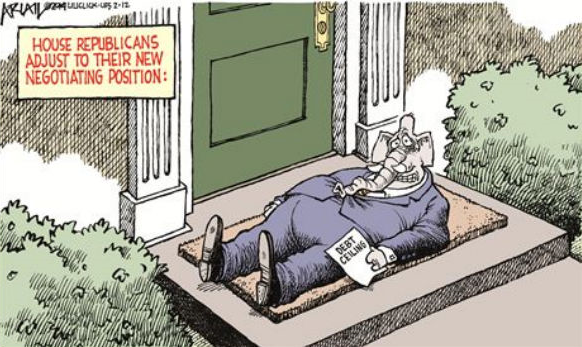
  • The debt. This is trickier because Trump has said he won’t touch Social Security or Medicare. My optimism is based on the fact that the Debt Ceiling will be re-imposed on March 16 at its level on that date. This will give Congress just a few months to raise the ceiling to a higher level. It is likely that the many fiscal conservatives in the House will insist, in return, for some sort of spending restraint such as a ten-year plan to balance the budget.

Conclusion. We’re not out of the woods yet. But there is a clear path showing the way forward.

Follow me on Twitter
Follow me on Facebook
 

What, if Anything, Will Restrain Donald Trump?


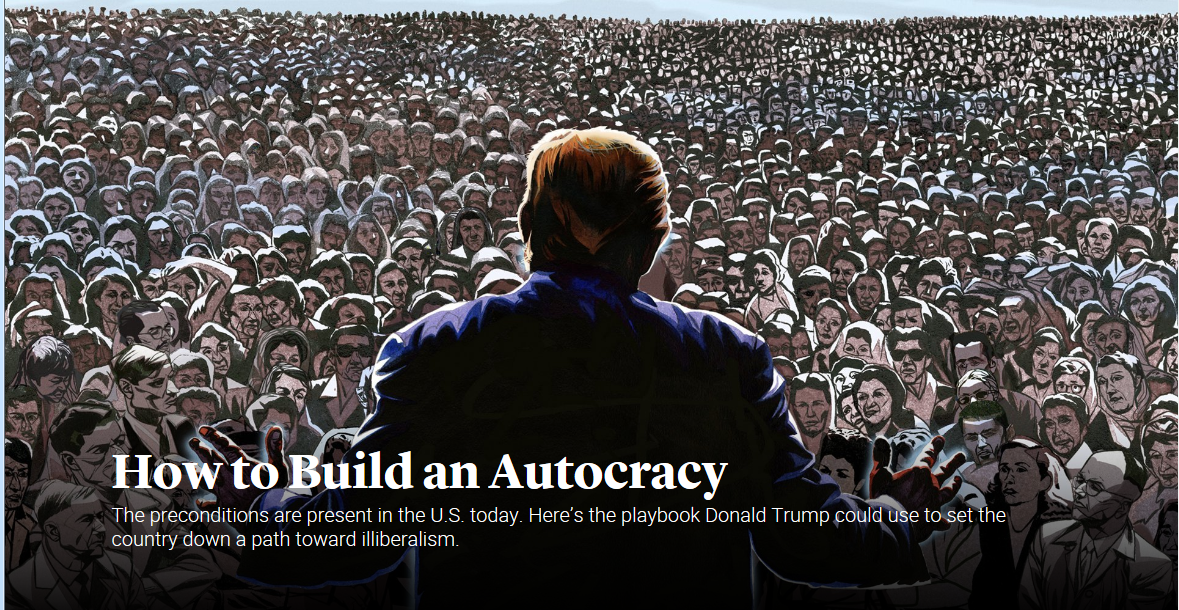
The Atlantic magazine has just released a remarkable essay written by the political commentator, David Frum, entitled, “How to Build an Autocracy.”  Says Mr. Frum, “Donald Trump will not set out to build an authoritarian state.  His immediate priority seems likely to be to use the presidency to enrich himself.  But as he does so, he will need to protect himself from legal risk.  Being Trump, he will also inevitably wish to inflict payback on his critics.  Construction of an apparatus of impunity and revenge will begin haphazardly and opportunistically.  But it will accelerate.  It will have to.”

capture99
Let’s assume that Mr. Frum is correct that Trump’s top priority is to enrich himself.  What will stop him from doing this?  A recent column in the New York Times points out that:

  •  54% of registered voters in congressional districts represented by Republicans view Mr. Trump favorably compared with only 42% who view him unfavorably.
    In these same districts, 87% of registered Republicans view Mr. Trump favorably.
  • In other words, the Republican dominated Congress is unlikely to strongly oppose his sleazy and self-enriching behavior.

But there are other constraints on what he does in office:

  • As I said in a recent post in order for Mr. Trump to be reelected in 2020, he will need to substantially speed up economic growth in order to increase the wages of his key blue-collar supporters. He clearly wants to accomplish this.
  • On the other hand, the conservative Republican base, including its representatives in the House such as the Freedom Caucus, will simply not support huge increases in deficit spending for anything (except an emergency) including infrastructure, the military or unfunded tax cuts.
  • In fact, Rep Mick Mulvaney (R, SC), a deficit hawk, has been nominated to become the Trump Administration’s Budget Director. In March the debt ceiling will have to be raised. I expect the many fiscal conservatives in Congress to insist on significant fiscal restraint (e.g. a ten year plan to balance the budget) as a tradeoff for raising the debt ceiling.

Conclusion. Just because Republicans are tolerant of Mr. Trump’s personal behavior does not mean he can successfully ignore the strong Republican desire for fiscal restraint.

Follow me on Twitter
Follow me on Facebook
 

Can We Trust Donald Trump to Do What’s Best for America?


From a reader of my blog:

You are an eternal optimist. Have you factored in these possibilities:

1. Paul Ryan and others will support the Wall and what it costs.
2.
Immigration control will limit much needed manpower.
3.
Trade wars with Mexico and other countries might severely reduce the output of
the USA.
4.
Tax reform will favor the ultra-wealthy, thus not do much to stimulate the
economy, causing a dramatic increase in the debt.
5.
Defense spending will be massive, thus up with the debt.
6.
Charter schools will lack sufficient oversight, thus poor results will follow.

You seem to convey that Trump will execute a strategy much as you think it should be done. I doubt it.

The above outcomes are unlikely for the following reasons:

  • Trump obviously likes being President, will continue to do so, and will hope to be re-elected in 2020. His re-election prospects will depend almost entirely on his boosting economic growth in order to increase the wages of his key blue-collar supporters.capture97
  • The quickest way to speed up growth is through corporate and business tax reform and deregulation. Trump’s entire team of advisors and cabinet secretaries, as well as congressional majorities, agree on this strategy. These things are likely to get done, sooner rather than later.
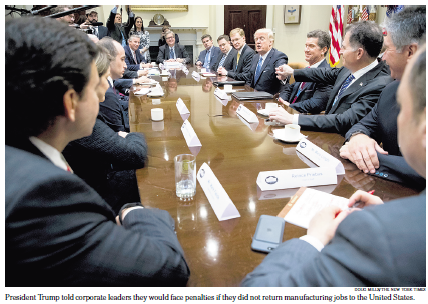
  • A trade war with Mexico or any other major trading partner (China, Canada, etc.) will badly hurt the economy. Trump knows this as well as anyone and won’t let it happen. A 20% tariff on Mexican imports to pay for a wall will just transfer the cost to American consumers and will be very unpopular. Trump’s people can figure this out.
  • Having 11½ million illegal immigrants in the U.S. is a significant problem and Trump has a mandate to fix it. His plan is to 1) build a wall, 2) deport the 800,000 or so lawbreakers amongst these illegals, and then 3) figure out what to do with the rest. This sounds to me like a reasonable plan and has a good chance of being successfully implemented.Conclusion. I admit to being an optimist. It keeps me going! I’ll respond to the other specifics (debt, charter schools, etc.) in the near future.

    Follow me on Twitter
    Follow me on Facebook

On Evaluating President Trump: Put Substance over Style


In Sunday’s New York Times, the Ethics and Public Policy Center’s Peter Wehner wrote: “Donald Trump is a transgressive personality.  He thrives on creating disorder, in violating rules, in provoking outrage.  He is a shock jock.  . . . For Mr. Trump, nothing is sacred.  The truth is malleable, instrumental, subjective.  It is all about him.  It is always about him.”

capture97
I understand that he is a narcissist but I am paying as much attention to what he does as to what he says.  For example:

  • Economic Policy. A major focus of his campaign was to get the economy growing faster. His appointments so far will help in this regard. Mnuchin at Treasury is for tax reform and financial deregulation. Price at HHS is for healthcare deregulation. Pruitt at EPA is for loosening environmental rules. He may try to negotiate modifications to NAFTA but he is too smart to start a trade war which would be devastating to the overall economy. His best hope for being re-elected in 2020 is to create more jobs and better paying jobs for his fervent blue-collar supporters.
  • Education Policy. K-12 public education for minorities in many big inner cities is a disaster. Betsy DeVos is an education reform activist in Michigan. Shaking up the education establishment is a good idea.
  • Fiscal Policy. Our public debt is much too large and must be reduced, sooner rather than later, before we have a new fiscal crisis. This will be very difficult to do because it means modifying entitlements such as Social Security and Medicare which Mr. Trump has said he won’t do. The Republican House is adamant about shrinking the debt and it is hard to imagine Mr. Trump standing in the way. It will be fascinating to see how he finesses this critical issue.

Conclusion. Far from being a detriment to performing his presidential duties, Mr. Trump’s rhetorical skills could come in very handy in moving our nation forward.

Follow me on Twitter
Follow me on Facebook
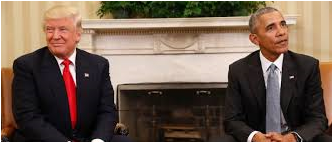
Trump as the Anti-Obama


Donald Trump assumes office with perhaps the lowest favorability ratings of any modern president. According to the New York Times,

  • Mr. Trump’s approval rating is only 40% among all adults and just 46% among likely voters.
  • But a recent CNN poll reports that 48% of adults think he’ll do a good job as president and 61% think he’ll bring back well-paying jobs to economically depressed areas.capture97

Contrast this with Barack Obama’s latest poll ratings:

  • According to Gallup Mr. Obama leaves office with an approval rating of 57%.
  • But Rasmussen reports that only 35% of likely voters think the country is heading in the right direction (with 55% saying that we’re headed in the wrong direction).

I interpret this to mean that the country is largely turned off by Mr. Trump’s crude speech and sleazy behavior, while still liking his economic program.  On the other hand, voters like Mr. Obama personally while disapproving of many of his policies and accomplishments.

All of this leaves Mr. Trump in an amazingly good political position:

  • With unemployment currently at a relatively low 4.7% and the economy fully recovered from the Great Recession, even modest reform in tax policy coupled with energy, healthcare and financial deregulation could provide a significant boost to long stalled economic growth.
  • He is criticized for having no clear cut political philosophy but this means he is free to do whatever makes good sense regardless of ideology. This will be a huge advantage in working with both parties to get things done.
  • He has nowhere to go but up in the polls. Such an increase in personal popularity will create the semblance of forward momentum.

Conclusion. The prospects are indeed propitious for Donald Trump to become a transformational president.

Follow me on Twitter
Follow me on Facebook
 

The Divided States of America: Who’s at Fault?


Frontline’s two part series, “The Divided States of America” makes the case that the divisive and hyper-partisan political atmosphere of the past eight years was caused primarily by the racially tinged reaction of the extremist Tea Party to the progressive policies of a forward looking, if inexperienced, black president.

capture97
I think that Frontline has missed the most fundamental reasons for our current malaise, namely that:

  • Slow economic growth since the end of the Great Recession in June 2009 has caused great angst and resentment amongst middle-income, and especially blue-collar, workers who have stagnant incomes when they observe all around them the elite professional, managerial and financial classes who are doing so well.
  • Self-righteous attitude of progressives who refuse to accept that conservatives have legitimate, and maybe even superior, points of view on various issues.

For example:

  • National Debt. The public debt (on which we pay interest) is now 76% of GDP, the highest since the end of WWII, and is projected by the Congressional Budget Office to keep steadily getting worse without a change in policy. Right now, with ultra-low interest rates, our $14 trillion debt is essentially “free” money. But what is going to happen when interest rates go back up to more normal levels? It could easily be a new fiscal crisis, much worse than the financial crisis of 2008.
  • Inequality. Inequality has risen somewhat in recent years but slow growth is the real problem. What is especially lacking is new business investment to increase labor productivity. The best way to fix this is with tax reform (lower tax rates paid for by shrinking deductions) and a reduction in government regulation. But this would mean more “trickle down” economics. Horrors!
  • Improving Obamacare. The Affordable Care Act has increased access to healthcare but has done nothing to control costs. Most developed countries control the cost of healthcare with a “single payer,” government run monopoly. But this is anathema to many Americans who neither want to give up personal choice nor want to forgo the innovation which a free-market consumer-driven healthcare system provides.

Conclusion. The driver of our currently divisive political climate is a deep chasm between the fundamental beliefs of the two different sides. How can this deep division be overcome short of a new crisis which pulls both sides together?  A very difficult question.

Follow me on Twitter
Follow me on Facebook


What Is Slowing Down Today’s Economy? II. Three Culprits


My last post, “What Is Slowing Down the U.S. Economy,” reports on an interesting analysis by the Gallup economist, Jonathan Rothwell, making an excellent case that three of the biggest drags on the U.S. economy are the costs of:

capture93

  • Healthcare. By far the biggest drag, healthcare costs have increased from 9% of GDP in 1980 to 18% in 2015. Mr. Rothwell notes that the average U.S. physician spends $83,000 per year to process claims and interact with insurance companies compared to $22,000 in Canada which has a single payer system. The solution, in my opinion, is to change the tax treatment of employer provided health insurance (to cover catastrophic coverage only) in order to give individuals more “skin in the game.”
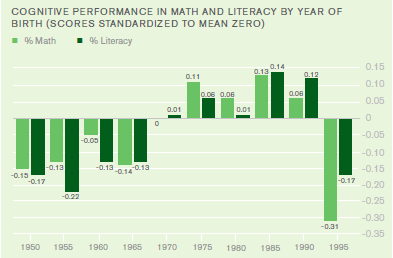
  • Education. Although education costs have risen only from 6% to 7% of GDP over the past 35 years, education overall is 8.9% more expensive in 2015 than in 1980 and higher education is 11.1 times more expensive. Considering the ever increasing need for highly trained workers in today’s high-tech and globally competitive economy, such rapidly increasing cost presents a huge impediment to progress. Foundational K-12 education is also failing to close the achievement gap between low-income minority students and middle-class students. Such disparity in educational outcomes bodes ill for future social harmony. Even overall cognitive performance in math and literacy is now declining (see chart). These are tough problems to solve.

    capture95

  • Housing. Again, only a 1% increase (from 11% to 12%) in GDP from 1980 to 2015 but this translates into a rental cost increase of 19% of GDP in 1980 to 28% of GDP in 2015. Also mortgage payment costs increased from 12% of GDP in 1980 to 16% of GDP today. Mr. Rothwell attributes these increases to a tightening of local zoning restrictions. There does not appear to be any general policy solution to such a problem.

Conclusion. The costs of healthcare, education and housing are eating up greater and greater amounts of family income and therefore are retarding economic growth and social progress. What can be done about these problems?  Stay tuned!

Follow me on Twitter
Follow me on Facebook