Do Programs for the Poor Become Poor Programs?


Most Americans agree that achieving better educational outcomes is one of the key ingredients to providing better opportunities for moving up the economic ladder.  As one way to accomplish this, more and more attention is being given to early childhood education.  The preeminent early childhood program in the U.S. is Head Start, which was begun in the 1960s as part of LBJ’s war on poverty.  But a 2012 federal evaluation of Head Start showed that children who have participated in Head Start have been no more successful in elementary school than those who haven’t.
In today’s New York Times, UC Berkeley Professor David Kirp addresses this problem, “The Benefits of Mixing Rich and Poor”.  Mr. Kirp reminds us that only low-income children are eligible to participate in Head Start.  He then goes on to describe several pre-K programs around the country which serve kids from both low-income and middle class families together.  These programs achieve much better success for low-income kids without sacrificing the interests of the well-off kids.
CaptureA similar phenomenon has been observed in the Learning Community of Omaha Nebraska.  The LC is a six year old experiment created by the State to close the achievement gap between children from low income and middle class families.  The Open Enrollment facet of the LC enables low income kids to receive free transportation to transfer to other schools within the 11 individual school districts which comprise the LC.  The above chart shows that resident FRL (free and reduced price lunch) students in low poverty schools perform substantially better than resident FRL students in high poverty schools.  In other words, low-income students benefit academically from associating with middle class students.
The question is how to design efficient public policy around this widely noted and common sense observation.  It would be too expensive, in today’s tight budget climate, to provide universal pre-K education for all three and four year olds in the U.S.  But the Rosemount Center, in Washington D.C., one of the pre-K programs described by Mr. Kirp., admits children from middle class families on a paying basis.
This could become an affordable and effective national model for providing pre-K education for rich and poor together!

An Inequality Culprit: Single-Parent Families


It is generally agreed that income inequality in the U.S. is bad and getting worse.  Before we can address it effectively, we have to understand what is causing it.  In this regard the Wall Street Journal had an article recently, “Ignoring an Inequality Culprit: Single-Parent Families”, by two scholars, Robert Maranto and Michael Crouch, from the Department of Education Reform at the University of Arkansas.
CaptureMr. Maranto and Mr. Crouch call attention to what they call “the strongest statistical correlate of inequality in the United States: the rise of single parent families during the past half century. … In 1960, more than 76% of African-Americans and nearly 97% of whites were born to married couples.  Today the percentage is 30% for blacks and 70% for whites. … This trend, coupled with high divorce rates, means that roughly 25% of American children now live in single-parent homes, twice the percentage in Europe (12%).  Roughly a third of American children live apart from their fathers.” In addition, “more than 20% of children in single-parent families live in poverty long-term, compared with 2% of those raised in two parent families.”  It is estimated “that 41% of the economic inequality created between 1976-2000 was the result of changed family structure.”
The authors wonder why there is not more public attention given to this depressing state of affairs and conclude that

  • Intellectual and cultural elites lean to the left and it is primarily social conservatives who promote traditional family structure.
  • Family breakup has hit minority communities the hardest. Therefore public discussion can be characterized as being racist.
  • This is a very hard problem to solve. Marriage and childrearing involve highly personal choices which cannot be dictated by society.

In this regard, my March 11, 2014 post “A balanced and Sensible Antipoverty Program”, emphasizes the need to at least remove marriage penalties from government welfare policy.
As the authors conclude, “The first step is to acknowledge the problem.”

Do We Need a New School of Economics?


“Consider the following scenario. You are an airline pilot charged with flying a planeload of passengers across the Atlantic. You are offered the choice of two different aircraft. The first aircraft has been prepared by chief engineer Keynes and the second by chief engineer Hayek.
You have to choose which plane to use, so naturally you ask the advice of the two engineers. Keynes urges you to use his aircraft, offering a convincing explanation of why Hayek’s plane will crash on take-off. Hayek urges you to use his aircraft, offering an equally convincing explanation of why Keynes’s plane will crash on landing.

At loss as to which plane to choose, you seek the advice of two leading independent experts – Karl Marx and Adam Smith. Marx assures you that it does not matter which aircraft you choose as both will inevitably suffer catastrophic failure. Similarly, Smith also reassures you that it does not matter which aircraft you choose, as long as you allow your chosen craft to fly itself.”
Thus begins a fascinating new book, “Money, Blood and Revolution: How Darwin and the doctor of King Charles I could turn economics into a true science,” by the fund manager and economist, George Cooper.
CaptureMr. Cooper sets up a circulatory model of democratic capitalism whereby rent, interest payments and profits flow from low income people at the bottom of the pyramid to the wealthy at the top. And then tax revenue (collected mostly from the wealthy) is redistributed downward in the form of government programs.
According to Mr. Cooper, the financial crisis was caused by a combination of lax regulation and excessive credit and monetary stimulus. The question is what to do about it. Mr. Cooper says:

  • Stop adding to the problem. High student debt and high mortgage debt are still being supported by government programs.
  • Change the course of the monetary river. Quantitative easing does not work because it just puts money into the hands of the wealthy and they have no incentive to spend it.
  • Change the course of the fiscal river. Instead put money into the hands of the people at the bottom of the pyramid with expanded government spending on infrastructure (paid for by taxing the wealthy).

Without endorsing all of Mr. Cooper’s suggestions, he nevertheless has many good ones and expresses them in a highly entertaining style!

Invested in America


The Business Roundtable, an association of chief executive officers of leading U.S. companies, has just issued a new report, “Invested in America: A Growth Agenda for the U.S. Economy”, describing four actions which policymakers can take to rejuvenate the U.S. economy.
CaptureThey are:

  • Restore Fiscal Stability: constrain federal spending in a manner that reduces long-term spending growth, making both Medicare and Social Security more progressive and less expensive.
  • Enact Comprehensive Tax Reform: adopt a competitive, pro-growth tax framework that levels the playing field for U.S. companies competing in global markets.  Several studies estimate that cutting the U.S. corporate tax rate by 10 % (e.g. from 35% to 25%) would boost GDP by 1% or more.
  • Expand U.S. Trade and Investment Opportunities: pass updated Trade Promotion Authority legislation and use TPA to complete many new trade agreements which are already pending.
  • Repair America’s Broken Immigration System: increase the number of visas for higher skilled workers and provide legal status for the millions of undocumented immigrants currently living in the U.S.

These are the same “big four” policy changes which many progressive business leaders as well as evenhanded think tank experts often recommend.  They are really just common sense ideas which reasonable people should be able to come together on.
Isn’t it obvious that we’ll soon be in big trouble if we don’t get our enormous budget deficits under control?  And that controlling entitlement spending is key to getting this done?
Isn’t it just as obviously commonsensical that even U.S. based multinational corporations will try to avoid locating business operations in countries like the United States with very high corporate tax rates?
Isn’t it likewise obvious that foreign trade is just an extension of domestic trade and that the world is better off with as much trade as possible?
Finally, the secret of a vibrant, growing economy is to encourage as much initiative and innovation as possible.  Who take more initiative than the immigrants who figure out how to get here in the first place?
We don’t have to accept a sluggish economy, high unemployment and massive debt!  But we do need to take intelligent action to extricate ourselves from the predicament we are in!

Who Are the Enemies of the Poor?


In his usual provocative fashion, New York Times columnist Paul Krugman says that Republicans are “Enemies of the Poor” because “they’re deeply committed to the view that efforts to aid the poor are actually perpetuating poverty, by reducing incentives to work.”
CaptureBut the Heritage Foundation’s Robert Rector has recently pointed out in the Wall Street Journal, “How the War on Poverty Was Lost”, that “the typical American living below the poverty line in 2013 lives in a house or apartment that is in good repair, equipped with air conditioning and cable TV.  He has a car, multiple color TVs and a DVD player.  The overwhelming majority of poor Americans are not undernourished and did not suffer from hunger for even one day of the previous year.”  In fact we are now spending $600 billion a year of our $3.4 trillion federal budget and another $230 billion by the states to fight poverty.  The poverty rate was 19% in 1964 and is 16% today (when government benefits are included).
Mr. Rector reminds us that “LBJ’s original aim (in initiating his antipoverty program) was to give poor Americans ‘opportunities, not doles’.  It would attack not just the symptoms of poverty but, more important, remove the causes.  By that standard, the war on poverty has been a catastrophe.  The root ‘causes’ of poverty have not shrunk but expanded as family structure disintegrated and labor force participation among men dropped.”
So what should our poverty agenda look like going forward?  We are already providing the basic necessities of life.  Our future efforts should therefore be focused on improving the quality of life for the poor.  This means more effective education and job training.  It means more effort to keep families together by reducing marriage penalties.  But most of all it means providing more opportunities for employment and job advancement.  This requires faster economic growth.  There are many ways to accomplish this.  Back to square one!
The true enemies of the poor are those who refuse to accept the progress which has been made in the War on Poverty and the need to change our approach in order to make further progress.

How Do We Increase Economic Mobility?


As the Wall Street Journal reported several days ago, “Economic Mobility Is the New Flashpoint”.  “Both parties agree the opportunity gap is widening, but the proposed solutions are starkly different.”  The Democrats want to increase the minimum wage, extend unemployment benefits, and expand access to college.  The Republicans suggest a whole potpourri of approaches such as reforming welfare (including food stamps), extending school choice, cutting taxes, and relaxing regulations on new businesses.
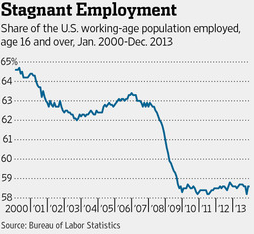
A look at the latest jobs report from the Labor Department should provide the focus which Congress needs to figure out how to increase economic opportunity.  Although the unemployment rate dropped substantially to 6.7% from 7.0% at the beginning of December, only 74,000 new jobs were created in December.  The explanation is that 347,000 left the labor force last month.  The labor force participation rate, the share of the U.S. working-age population employed, age 16 and over, has dropped from 64.5% in 2000, to just under 63% at the beginning of 2008 to near a post-recession low of 58.6% last month (see chart below).
CaptureIn other words, Congress should be totally focused on speeding up economic growth in order to create more jobs.  Since new businesses create the most new jobs, we should indeed relax as many regulations as possible which impede entrepreneurship.  We should lower the corporate tax rate from its very high current value of 35% to get American multinational companies to bring their trillions of overseas profits back home for reinvestment in the U.S.  Moving to a national consumption tax (see the Graetz Plan discussion in my January 7 post), could mean dropping the corporate tax rate to as low as 15%.
Isn’t is obvious that the best thing we can do to give low income people an opportunity to rise up the economic ladder is to just give them a job in the first place?  If they’re ambitious they’ll take any opportunity they can get and run with it!