Do Charter Schools Improve K-12 Education?


President-elect Donald Trump has nominated a charter school advocate from Michigan, Betsy DeVos, to be his Secretary of Education. This raises the obvious question, do charter schools improve K-12 education? A recent study by Stanford University’s Center for Research on Education Outcomes (CREDO) suggests that they do in general, although very unevenly.

capture86
As summarized and elaborated upon by the Economist, here are the results:

  • Charter schools work well for low-income children in cities. In 41 urban areas (see map), students learned 40 more days of math and 28 more days of reading every year on average. Black and Hispanic children performed especially well. Where they have worked well such as in Boston, New York City and Washington D.C., students make gains up to 100 days per year.
  • One lesson learned is that autonomy needs to be coupled with accountability. When charter schools expand with little oversight, as in Arizona, results can be worse than in regular schools.
  • A second lesson is that leadership matters. Business practices such as performance tracking and incentives achieve better test scores. A successful charter organization such as KIPP (Knowledge is Power Program) opens new school only when it spots a leader capable of running it.
  • A third lesson is how to scale up the type of education provided by the best charters. These have five qualities: frequent feedback for teachers, tutoring, longer school days and terms, effective use of data to track student progress, and a relentless focus on academic achievement.

Conclusion. Charter schools are a valuable state and local educational option. Many charters are succeeding very well and the factors which lead to success are increasingly well understood. At the very least the competition created by charter schools leads to better performance by public schools. The answer to the question in the title is yes!

Follow me on Twitter
Follow me on Facebook

Trumponomics II. Debt


As I discussed in my last post, Donald Trump’s primary mandate from the presidential election is to get the economy growing faster in order to help out his base of blue-collar workers who have suffered wage stagnation for many years and especially since the end of the Great Recession in June 2009.  The tax and regulatory reform needed to accomplish this urgent task will undoubtedly turn out to be the first plank of Trumponomics.

capture2
But there is another equally urgent task which must not be overlooked by the incoming Trump Administration.  Our national debt, the public part on which we pay interest, is now 75% of GDP, the highest level since the end of WWII, and projected by the nonpartisan Congressional Budget Office to keep growing rapidly in the years just ahead (see chart above).
As Barron’s has pointed out, “Saving America, Part 1”, in its current issue:

  • Today’s public debt of $14 trillion will grow to $45 trillion in just 20 years’ time on the basis of current entitlement programs like Medicare and Medicaid, without any new spending programs or tax cuts.
  • The annual interest on a $45 trillion debt load would be about $750 billion at today’s super low interest rates. If interest rates rise to more typical levels, the interest payment on this level of debt would be about $1.5 trillion a year. This represents almost half of all federal spending during the current 2016-2017 budget year.

Conclusion. Such a high level of interest payment on our debt is unthinkable. This means that either we make fundamental reforms in government entitlement programs in the next few years or else we will have a severe fiscal crisis on our hands in less than twenty years’ time. We have some stark choices to make and hopefully the incoming Trump Administration will not shy away from what needs to be done.

Follow me on Twitter
Follow me on Facebook

Disruption Involves Taking Chances


I am a fiscal conservative (I want to balance the budget) and a social moderate. I voted for Hillary Clinton for president because Donald Trump is a sleazy person and has such a volatile temperament.  But I’m also in favor of making big changes and Mr. Trump will certainly do this.

capture79As the Economist points out, “his voters took Mr. Trump seriously but not literally, even as his critics took him literally but not seriously.”  The Economist goes on to point out some of the risks involved in making the kinds of changes Mr. Trump is talking about:

    • If Obamacare is repealed, 20 million Americans will lose their health insurance. Yes, but it’s not going to happen this way. Obamacare will end up being modified and improved, not abolished.
  • His tax cuts would chiefly benefit the rich and would greatly increase our national debt. Yes, but the House of Representatives has a much better plan to do this and it is Congress, not Mr. Trump, which will develop a detailed plan.
  • Even if he does not actually deport illegal immigrants, he will foment the divisive politics of race. The illegal immigration problem needs to be solved and Mr. Trump is likely to get this done, with or without a wall.
  • Mr. Trump has demanded trade concessions from China and NAFTA. If he causes a trade war, the fragile world economy could tip into a recession. Blue collar workers, his strongest base of support, have had stagnant incomes for years and deserve some help. If he can increase our exports, blue collar workers will benefit.
  • He wants to reverse the Paris agreement on climate change which would harm the planet and undermine America as a negotiating partner. Global warming is real but the Paris accord does essentially nothing to slow it down. Increased coal use in China and India will more than negate what the U.S. and Western Europe are doing to cut back on fossil fuels.
  • Mr. Trump has demanded that other countries pay more towards their security or he will walk away. NATO members should be doing more on their own and if he can prod them to do this, then NATO will be stronger as a result.


Conclusion. Mr. Trump’s expressed views should be interpreted as initial bargaining positions. They are likely to have the effect of leading to progress on many serious problems which need to be addressed.  The risks involved in the negotiation process are worth taking

Follow me on Twitter
Follow me on Facebook

The Obama Economic Record


The readers of this blog know that I focus on what I consider to be the two biggest problems affecting our economy: 1) slow growth averaging just 2% per year since the end of the Great Recession and 2) our massive debt now equal to 75% of GDP (for the public part on which we pay interest) and predicted to keep growing steadily under current policy.
I have also made it clear that I am not pleased with the economic policies of either of the two main candidates for president, Hillary Clinton or Donald Trump.  Whichever one of them is elected, our best hope for the future is that she or he will have to work with the Republican House of Representatives which has an excellent plan, “A Better Way,”  for renewal.
capture71But, of course, the next president will take up where Barack Obama has left off.  The current issue of the Economist has an essay, “The Way Ahead,” in which Mr. Obama identifies several challenges:

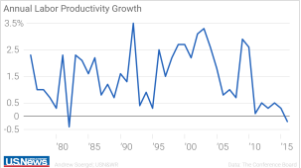
  • Boosting productivity growth. The above chart from his essay shows how much productivity growth has declined in the last ten years. He claims that the corresponding lack of investment is caused by an anti-tax ideology which rejects new funding for public projects, which in turn can be blamed on a fixation on deficits in spite of our skyrocketing debt problem. The House plan correctly identifies tax and regulatory reform as what are needed for progress.
  • Combatting rising inequality. An expanded Earned Income Tax Credit will definitely help here but mainly what is needed is overall faster economic growth.
  • Insuring that everyone who wants a job can get one. Wage insurance and better retraining programs for laid off workers are good ideas. But again, faster economic growth is what is really needed.
  • Building a resilient economy which is primed for future growth. Mr. Obama says that “America should also do more to prepare for future shocks before they occur.” This is exactly why we urgently need to start shrinking our debt now before the shock of higher interest rates leads to huge increases in interest payments on our rapidly growing debt.

Conclusion. Let’s give Mr. Obama credit for avoiding another depression after the Financial Crisis. But his poor policies are to blame for the very slow rate of recovery ever since.

Follow me on Twitter
Follow me on Facebook


What Is Right and Wrong With the U.S. Economy


My last several posts have discussed the poor economic proposals of both major presidential candidates. Today’s New York Times has an excellent article by Neil Irwin, “Here’s What’s Going Right and Wrong in the U.S. Economy.”  According to Mr. Irwin and the NYT:

  • GDP Growth Disappointing. GDP growth was only 1.2% in the second quarter of 2016 and in fact has now averaged only 1.2% for the past year, much lower than the 2.1% average growth since the end of the Great Recession in June 2009.Capture30
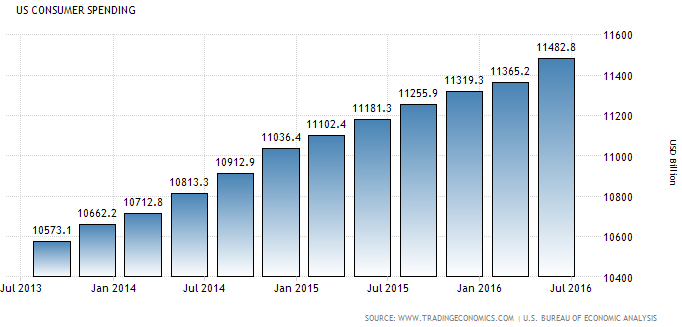
  • Consumers Spending Money. Consumer spending was up 4.2% in the second quarter continuing a long term trend. This means that there is plenty of demand for new products in the economy.Capture26
  • Wages Rising More Quickly. Total compensation is not only rising but the wage and salary component, not counting benefits, is up 2.5% over one year ago. This means that consumers have more money to spend.Capture27
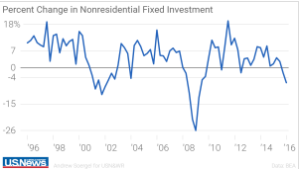
  • Investment Shrinking. Investment in new business structures, equipment and intellectual property has now fallen for the third consecutive quarter.  Eventually, if not turned around, this decrease in new investment will lead to fewer jobs and less consumer spending.Capture28
  • Poor Productivity Growth. Labor productivity fell .6% in the first quarter of 2016, a continuing slide. Weak productivity growth is a grave threat to long term prosperity in the U.S.Capture29

Conclusion. Wages are going up and consumers have money to spend. But worker productivity can only increase when business makes new investment.  This is not happening nearly fast enough. The House Republicans have an excellent plan to encourage business investment.
Is either presidential candidate paying attention to this opportunity to speed up economic growth?
I, for one, am waiting to find out!

Follow me on Twitter
Follow me on Facebook


Why Is the U.S. Economy Growing So Slowly?


The U.S. economy has only been growing at the rate of 2.1% since the end of the Great Recession in June 2009, almost seven years ago. Such a slow rate of growth means millions of unemployed and underemployed workers and only small salary raises for tens of millions of others.
Capture5The New York Times economic journalist, Eduardo Porter, observes that we have “A Growth Rate Weighted Down by Inaction.”  He points out that:

  • Our economy is adversely affected by the gradual shrinkage of the work force as a share of population as baby boomers retire and the one time surge of women into the workforce in the 20th century has ended.
  • A second factor is a persistent decline in productivity growth over the last dozen years.
  • A pessimistic forecast by the Economic Cycle Research Institute foresees growth of only 1% per year for the next five years. The Congressional Budget Office projects more optimistic productivity growth at 1.5% per year, which added to workforce growth of .5% per year, would amount to total growth of 2% per year for the next ten years.

Mr. Porter goes on to say that there are concrete reasons why productivity growth is so slow:

  • Hiring is growing faster than capital investment. This is because most job growth in the last decade has been in (low productivity) services instead of (high productivity) manufacturing.
  • Too many restrictions on educated immigrants. Relaxing these restrictions would increase entrepreneurship.
  • Too many onerous regulations.
  • Under training of skilled workers. We need more vocational and career education.

Many people, including myself, have pointed out ways to alleviate these problems and speed up economic growth, for example see here. It is most unfortunate that our dysfunctional national leadership cannot figure out how to work together to get this done.

Follow me on Twitter
Follow me on Facebook

Can She Fix It?


As I have recently pointed out, Hillary Clinton is now likely to be our next president.  In my last post I provided vivid evidence that middle class income grew dramatically between 1971 and 2001 and has been either stagnant or declining since then.  The fact is that the years from 1971 – 2001 were a time of rapid economic growth, about 3.5% per year.
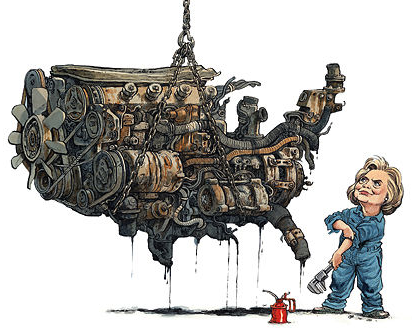
Capture2So it is obvious what needs to be done to fix America’s economic woes: grow the economy faster!  In its latest issue, the Economist asks, “Can she fix it?” The tentative answer suggested by the Economist is no, based on Mrs. Clinton’s tepid policy proposals to date:

  • She wants to make college more affordable, grant paid leave to parents, raise the national minimum wage to $12 per hour, and increase infrastructure spending. These are nice sounding proposals but will have only minor effects on growth or add greatly to the national debt (infrastructure spending).
  • She proposes a tax-credit for companies to encourage profit-sharing schemes. This would just make the tax code more complicated.
  • She wants an extra tax on the debt of big banks but simply increasing capital requirements on big banks would be more effective.
  • She wants to raise the top tax individual tax rate to 45% but shrinking deductions and closing loopholes would be a more efficient way to make the tax code more progressive.
  • She wants to abandon the Trans Pacific Trade Partnership rather than figuring out how to help those workers who lose from expanded trade with such measures as wage insurance or better job retraining.

As the Economist concludes, “A bigger plan to help American workers would start by boosting competition, both by slashing unnecessary regulations for small businesses, and by ensuring that big firms no longer operate in protected markets.”
If we are going to end up with another Clinton presidency, we certainly don’t want four more years of Obama-type economic stagnation!

Follow me on Twitter: https://twitter.com/jack_heidel
Follow me on Facebook: https://www.facebook.com/jack.heidel.3

The Obama Legacy


I have no antagonism for Barack Obama. He was elected because of the unpopularity of the Iraq War and George Bush who started it.  He inherited the Financial Crisis and pulled us out of it without another depression.  He has put us on the road to universal healthcare even though the structure of the Affordable Care Act does little to control costs.
Capture  But overall, the negatives of his presidency outweigh the positives.  Consider the situation we are currently in:

  • Stagnant Economy. The annual rate of growth of GDP since the end of the Great Recession in June 2009 has been an anemic 2% compared to our historical growth rate of 3% since the end of WWII. Although the official unemployment rate is down to a respectable 5%, there are millions of unemployed and underemployed people who have stopped looking for work. Obama and the Democrats in Congress have little interest in the tax reform and deregulatory measures which would boost economic growth.
  • Massive Debt. Our public debt (on which we pay interest) has doubled to over $13 trillion on Obama’s watch. As the Federal Reserve begins to raise interest rates to ward off inflation, interest payments on this debt will increase enormously. It is absolutely imperative to begin to substantially shrink our annual budget deficits. The Democratic Party, under his leadership, has expressed no willingness to do this.
  • Chaotic Middle East. The rise of ISIS in Syria, Iraq and North Africa, and the resulting refugee crisis in Europe is the result of weak U.S. leadership in the Middle East. Peace and stability depends on a strong U.S. presence in all trouble spots around the world. We neglect this responsibility at our peril.
  • Hyper-partisan Political Atmosphere. Stalemate in addressing these and other serious problems has led to the rise of extremist presidential candidates like Bernie Sanders and Donald Trump. Moderate candidates with successful experience in elected office are unable to gain political traction.

Our country is in a big mess. We are being guided by ideology rather than common sense.  I am optimistic by nature.  But it’s awfully easy to be pessimistic about our future.

Follow me on Twitter: https://twitter.com/jack_heidel
Follow me on Facebook: https://www.facebook.com/jack.heidel.3


The Best Way to Stop Donald Trump


The main sources of background information for my posts are The New York Times and the Wall Street Journal. I read the Economist but most of the time it is either too esoteric or else too far  removed from the specifics of U.S. fiscal and economic policy which I am interested in.  But this week they have hit the nail on the head regarding Donald Trump and his fellow right-wing populists around the world.
Capture0
Says the Economist:

  • Populists differ but the bedrock for them all is economic and cultural insecurity. Stagnant wages hurt a cohort of older working-class white men whose jobs are threatened by globalization and technology. Jihadist terrorism pours petrol on this resentment and extends populism’s appeal.
  • Nobody should underestimate how hard it is to take the populists on. It is a huge mistake to dismiss their arguments by calling them fascist or extremist. Such disdain risks suggesting that political leaders are uninterested in the real grievances the populists play on.
  • The best way to overcome resentment is economic growth – not putting up walls. The best way to defeat Islamist terrorism is to enlist the help of Muslims – not to treat them as hostile.
  • Voters are often more reasonable than the populist leaders who are trying to appeal to them. Most of them would sooner hear something more optimistic than rage against a dangerous world.
  • Politicians also need to deal with the populists’ complaint that government often fails them. Reluctance to deploy more troops against the ISIS caliphate in Syria and Iraq does not appear to be a serious strategy to defeat it.

Conclusion: There is a clear path forward for candidates with a positive message of openness and tolerance and realistic plans to make the economy grow faster. Who is best situated to deliver such a message?  Stay tuned!

Follow me on Twitter: https://twitter.com/jack_heidel
Follow me on Facebook: https://www.facebook.com/jack.heidel.3

America and the World: the Need for Leadership


As we are just getting started on what so far is a confusing presidential election campaign, it would be easy to forget how incredibly lucky we are in America.  Our country is very strong and we are isolated from many of the world’s problems.  The terrorist attacks in Paris over the weekend are a grim reminder of this fact.  But we still have responsibility for much of what is happening around the world.
Capture

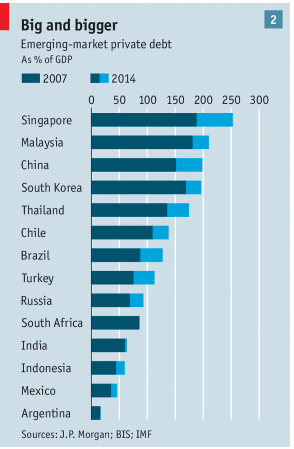
  • George W. Bush’s biggest failing is not the Iraq War, draining Medicare funds with a new drug benefit or ramping up deficits with tax cuts that lose revenue. His biggest failing is not foreseeing the financial crisis and at least mitigating it if not heading it off entirely. His financial advisors (Greenspan, Bernanke, Geithner, Paulson) were asleep at the switch. As the Economist makes clear in its latest issue, “First America, then Europe. Now the debt crisis has reached the emerging markets.”
    Capture0
  • Barack Obama’s biggest failing is not the stagnant economy or massive debt buildup which occurred on his watch, although he could have eased their burden with smarter policies. His biggest failing is his unwillingness to assert sufficient power in the Middle East to head off the chaos we observe today. The enormous European refugee crisis with all of its attendant horrors is largely the result of his inadequate intervention in Iraq, Libya and Syria.

The main concerns of this website are the internal fiscal and economic problems faced by the U.S.  We have to figure out amongst ourselves how to address these very serious issues.  But, like it or not, what we do affects the whole world.  If we fail to meet our responsibilities, the whole world, including us, will suffer with the consequences.

Follow me on Twitter:  https://twitter.com/jack_heidel
Follow me on Facebook: https://www.facebook.com/jack.heidel.3