How Likely Is Financial Collapse?


The financial crisis of 2008 was the biggest shock to our financial system since the Great Depression of the 1930s.  It caused a deep recession from which we are still recovering.  To aid the recovery the Federal Reserve launched an unprecedented expansion of the money supply, referred to as quantitative easing, as well as keeping short term interest rates near zero. As explained by James Rickards, a portfolio manager at West Shore Group, in his new book, “The Death of Money, the coming collapse of the international monetary system,” such a severe recession would normally have caused a corrective period of deflation.  Quantitative easing has warded off deflation and, so far, without igniting inflation.
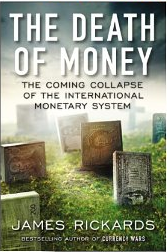
CaptureWe are now in a catch-22 situation.  Congress could and should adopt several policy changes to speed up the recovery as I described several days ago in “The Federal Reserve Cannot Revive the Economy by Itself.”  But, if and when the economy does start growing faster, it will require great skill by the Fed to exit from its current policies without harm.  If it contracts the money supply too quickly, it risks a sharp rise in interest rates.  If it contracts the money supply too slowly, it risks a sharp rise in inflation. Mr. Rickards doubts that the Fed will be able to accomplish this fine tuning without another major crisis.  Here are his Seven Signs of what to look for:

  • The price of gold ($1300 per ounce today). A rapid rise to $2500 will anticipate inflation. A rapid decrease to $800 signals severe deflation.
  • Gold’s continued acquisition by Central Banks. Large purchases by China, for example, will announce inflation.
  • IMF governance reforms, e.g. towards more voting power for China, will be an inflation warning.
  • The failure of regulatory reform, i.e. reinstatement of Glass-Steagall in addition to the Volcker Rule, will increase the chances of systemic failure.
  • System crashes, resulting from high-speed, highly automated, high volume trading. An increasing tempo of such events will cause disequilibrium which could close markets.
  • The end of QE, could give deflation a second wind and lead to a new round of QE.
  • A Chinese collapse (predicted by Rickards), will lead first to deflation and then inflation.

We all hope that the Federal Reserve can steer clear of a new, and much deeper, financial crisis.  But it doesn’t hurt to have guideposts and Mr. Rickards knows what he’s talking about.

The Federal Reserve Cannot Revive the Economy by Itself


The Great Recession caused by the financial crisis ended in June 2009.  In the intervening five years the U.S. economy has grown at the anemic annual rate of 2.2%.  In an attempt to speed up growth the Fed has injected $4 trillion into the economy and kept short term interest rates near zero during this time period.  Fed Chair Janet Yellen recently gave her semiannual report to Congress and, according to the American Enterprise Institute’s John Makin, “Fed Chair Yellen puts on a brave face.”  She said that “If economy performance is disappointing, then the future path of interest rates likely would be more accommodative than currently anticipated.”
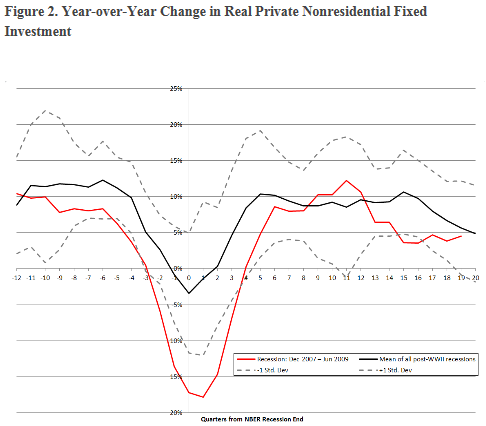
CaptureCapture1Mr. Makin adds that “Eventually the realization will dawn that the only way to get the economy moving again is to work on the supply side.  Specifically, that means undertaking measures to boost investment and produce a rising capital stock which will boost labor productivity, hiring, and GDP growth without inflation.” He suggests that three measures to boost capital spending are:

  • Enactment of accelerated depreciation provisions and investment tax credits.
  • A sharp reduction in the corporate tax rate from 35 to 15 percent to induce corporations to repatriate the $1.59 trillion in accumulated profits being held abroad.
  • A concerted White House-led effort to set a clear, less burdensome path for healthcare and other regulatory measures as a means to reduce investment dampening uncertainty.

I would add a fourth measure:

  • An across the board lowering of individual tax rates (offset by closing loopholes and deductions which primarily benefit the wealthy) in order to boost personal consumption which has been highly depressed due to stagnant wage growth and high unemployment.

In other words there are clear and straightforward measures which our national leaders can take to speed up the economy.  ‘If there is a will, there’s a way’ and incumbents should be held responsible for inaction come the elections in November!

Trickle-Down Monetary Policy and What to Do About It


“There is no means of avoiding the final collapse of a boom brought about by credit expansion.  The alternative is only whether the crisis should come sooner as the result of a voluntary abandonment of further credit expansion, or later as a final and total catastrophe.”
Ludwig von Mises, Austrian economist, 1881 – 1973

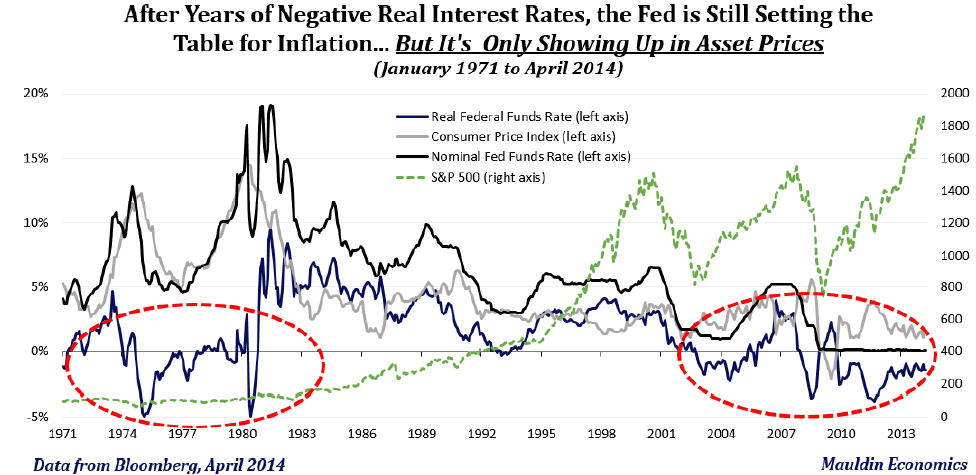
The economist/investor John Mauldin writes a weekly newsletter, “Thoughts from the Front Line” (http://d21uq3hx4esec9.cloudfront.net/uploads/pdf/140426_TFTF2.pdf) which offers good general insight.  In the latest issue Mr. Mauldin writes “For all intents and purposes we have adopted a trickle-down monetary policy, one which manifestly does not work and has served only to enrich financial institutions and the already wealthy.  Now I admit that I benefit from that, but it’s a false type of enrichment, since it has come at the expense of the general economy, which is where true wealth is created.”
CaptureMr. Mauldin also quotes the economist William White, “When you talk about crisis resolution, it’s about attacking the fundamental problems that got you into trouble in the first place.  And the fundamental problem we are still facing is excessive debt.  Not excessive public debt, mind you, but excessive debt in the private and public sectors. … With ultra-loose monetary policy, governments have no incentive to act.  But if we don’t deal with this now, we will be in worse shape than before.”
What then should government do?  The best single thing is to develop a concentrated focus on boosting the economy.  This would put millions of people back to work and raise salaries for the entire workforce.  Tax revenue would rise and both public and private debt would be paid down more quickly.
The way to do this is with fundamental, broad-based tax reform.  This means lowering tax rates for both individuals and corporations, paid for by closing loopholes and shrinking deductions.  This would have the effect of taking from the rich and giving to the poor, i.e. putting more money in the hands of those who are most likely to spend it, thereby creating more demand leading to faster economic growth.
It’s not that hard to figure out!

Inequality III: Is the Game Rigged?


The economist Joseph Stiglitz has an Op Ed column in today’s New York Times, “In No One We Trust”, blaming the financial crisis on the banking industry.  “In the years leading up to the crisis our traditional bankers changed drastically, aggressively branching out into other activities, including those historically associated with investment banking.  Trust went out the window. … When 1 percent of the population takes home more than 22 percent of the country’s income – and 95 percent of the increase in income in the post-crisis recovery – some pretty basic things are at stake. … Reasonable people can look at this absurd distribution and be pretty certain that the game is rigged. … I suspect that there is only one way to really get trust back.  We need to pass strong regulations, embodying norms of good behavior, and appoint bold regulators to enforce them.”  
CaptureMr. Stiglitz is partially correct.  Although the housing bubble, caused by poor government policy – loose money, subprime mortgages, and lax regulation – was the primary cause of the financial crisis, nevertheless, poorly regulated banking practices made the crisis much worse.  But this is all being fixed with Dodd-Frank, a just recently implemented Volker Rule, and a soon coming wind-down of Fannie Mae and Freddie Mac. 
Mr. Stiglitz concludes, “Without trust, there can be no harmony, nor can there be a strong economy.  Inequality is degrading our trust.  For our own sake, and for the sake of future generations, it is time to start rebuilding it. 
But how do we reduce the inequality in order to restore the trust which is necessary for a strong economy?  Mr. Stiglitz doesn’t say!
What we need is faster economic growth in order to create more new jobs.  The last four years have demonstrated that the Federal Reserve can’t accomplish this with quantitative easing.  It needs to be done by private business and entrepreneurship.  Tax reform and the easing of regulations on new businesses is what we need.  It’s too bad that ideological blinders prevent so many people from understanding this basic truth!    
    

How to Get the Economy Back on Track


Harvard Economist, Martin Feldstein, has an Op Ed column in yesterday’s New York Times, “Saving The Fed From Itself”, which gets our current economic situation half right.  First of all, Mr. Feldstein says that the Fed’s quantitative easing policy is inadequate because “the magnitude of the effect has been too small to raise economic growth to a healthy rate.  … The net result is that the economy has been growing at an annual rate of less than 2 percent.  … Weak growth has also meant weak employment gains.  … Total private sector employment is actually less than it was six years ago.  … While doing little to stimulate the economy, the Fed’s policy of low long-term interest rates has caused individuals and institutions to take excessive risks that could destabilize the economy just as it did before the 2007-2009 recession.”  So far he’s right on the button!
But then he goes on to say, “To get the economy back on track,” Congress should enact a five year plan to spend a trillion dollars or more on infrastructure improvement and that this would “move the growth of gross domestic product to above three percent a year.”  An artificial stimulus like this might work temporarily but then it ends and we’re back where we started.  We need a self-generating stimulus that will keep going indefinitely on its own.  How do we accomplish this?
The answer should be obvious.  We do it by stimulating the private sector to take more risk in order to generate more profits. In the process they will hire more employees and boost the economy.
How do we motivate the private sector?  By lowering tax rates and loosening the regulations which stifle growth.  Closing tax loopholes and lowering deductions (which will raise revenue to offset the lower tax rates) has the added benefit of attacking the corporate cronyism which everyone deplores.
We really do need to put first things first.  If we can jump start the economy by motivating the private sector to invest and grow, we will have more tax revenue to spend on new and expanded government programs as well as shrinking the federal deficit.
Why is this so hard for so many people to understand?

The Mess in Detroit: A Stern Warning for the Whole Country


An article in yesterday’s New York Times, “Detroit Ruling Lifts a Shield on Pensions”, reports a ruling by bankruptcy judge Steven W. Rhodes that Detroit “could formally enter bankruptcy and that Detroit’s obligations to pay pensions in full is not inviolable.”
The article goes on to say “that most here agree that the city’s situation is dire:  annual operating deficits since 2008, a pattern of new borrowing to pay for old borrowing, miserably diminished city services, and the earmarking of about 38 percent of tax revenues for debt service.  A city that was once the nation’s fourth largest has dropped to 18th, losing more than half of its population since 1950.  The city was once home to 1.8 million people but now has closer to 700,000.”
The parallels and analogies between what has happened in Detroit and what is now happening in the U.S. are striking.  The U.S. has had huge annual deficits for five years in a row and the accumulated debt is enormous, the Federal Reserve is holding interest rates down to make borrowing cheaper, and our country’s infrastructure is deteriorating much faster than it is being repaired.
Right now interest on the national debt is small ($223 billion in 2013, or 8% of federal revenues).  But interest rates will inevitably return before long to their average historical rate of about 5%.  Right now the public debt (on which we pay interest) is just over $12 trillion.  This means that in the near future interest on the national debt will be at least $600 billion per year and probably much larger because the debt is still growing so rapidly.  This will take a huge bite out of revenue and leave far less of it for other purposes.
This problem will continue to exist even if the budget were to be miraculously balanced from now on but it would at least lessen over time as the economy continues to grow.  Without budget restraint the problem will never go away and will be a perpetual drag on our national welfare.
This is, of course, exactly the condition in which Detroit finds itself at the present time.  Detroit has the option to declare bankruptcy and make its creditors and pensioners take big losses.  Once it does this it can make a fresh start and perhaps recover its former status.
But are we prepared to let the whole country suffer a similar fate?  The consequences would be enormous.  If the U.S. goes down, the whole western world could come down with it.  Democracy and human progress would be severely threatened.  This is really too terrible a tragedy to even contemplate.  Let’s turn things around before they get any worse!