Surprise! It Is Progressives Who Drive Income Inequality


The economist Lawrence Lindsey has an Op Ed in yesterday’s Wall Street Journal  analyzing Census Bureau data here, and here showing that income inequality rose more under Bill Clinton than under Ronald Reagan.  It also has risen much more under Barack Obama than under George W. Bush.
Capture6Here is the explanation for this:

  • Cheap money is a boon to those who have access to it.
  • Bill Clinton, George W. Bush and Barack Obama all presided over bubble economies fueled by easy monetary policy. But the effects of the Bush housing bubble were more evenly distributed than for the Clinton stock market bubble or the Obama credit bubble.
  • In 1968 government transfer payments totaled $53 billion or roughly 7% of personal income. By 2014, these had climbed to $2.5 trillion or 17% of personal income. Despite the redistribution of a sixth of all income, inequality is far higher today than in 1968.
  • Two earner households have become the backbone of the American middle class.
  • When families with children making between $20,000 and $50,000 attempt to have a second earner go back to work, the effective tax rate on the extra earnings, including lost government benefits, is between 50% and 80%. This “working class trap” is increasing income inequality and keeping the income of these households lower than they would otherwise be.
  • During the first six years of the Obama presidency, the number of two-earner households declined, while the number of single-earner households rose by 2.6 million and the number of no-earner households rose by 5 million. In other words, two-thirds of the increase in the number of households under Obama is accounted for by households with no one working. This is the reason the middle class has shrunk and that inequality is increasing.
  • A recent Brookings Institution study shows that boosting the top tax rate from 39.6% today to 50%, and redistributing the additional $95 billion in tax revenue to the bottom 20% of wage earners would reverse only 20% of the increase in income inequality under Obama.

As Mr. Lindsey concludes, “Attacking the rich and running against inequality may be a sensible political strategy. But in the end the programs to implement this strategy make the problem worse.”

Follow me on Twitter: https://twitter.com/jack_heidel
Follow me on Facebook: https://www.facebook.com/jack.heidel.3
What Defines a (Fiscal) Conservative?


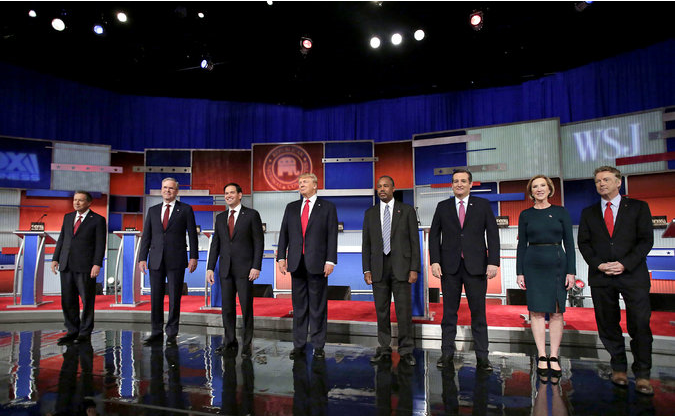
After four debates among the Republican presidential candidates, differences between them are becoming clearer.  The New York Times has an interesting article about this in today’s paper, “G.O.P. Fight Is Now a Battle Over What Defines a Conservative.”
CaptureHere are my views on the four issues discussed:

  • A Wall or a Path? We need to solve our illegal immigration problem and the key is to set up a viable guest worker program. The fact is that our economy needs foreign workers for many jobs which require hard physical labor such as in agriculture, meatpacking and construction trades. If businesses are able to bring in immigrants when sufficient domestic labor is not available, then other issues such as border security and verifying legal status can easily be resolved.
  • The U.S. Place in the World. U.S. leadership makes the world a safer place. This means we need a strong military presence all around the world as well as active alliances, trade and military, with many other countries.
  • Of Banks, Bailouts and Blame. The cause of the financial crisis was the bursting of the housing bubble, in turn caused by an unrealistic government housing policy as well as lax enforcement of existing regulations. Blaming greedy bankers is a copout. The Dodd-Frank Law is overkill which creates a drag on the economy by hampering smaller financial institutions and community banks. The best way to control large banks is to increase their capital requirements.
  • Who Should Get Tax Cuts? The main purpose of tax reform should be to boost the economy without increasing deficit spending. The way to do this is with across the board cuts in tax rates, paid for by closing loopholes and shrinking deductions. Here are some details. The 64% of taxpayers who do not itemize deductions will get an immediate tax cut and income inequality will be greatly reduced.

Getting the answers to these issues correct will have a large effect on the future wellbeing of our country.  The Republican presidential candidates should be commended for grappling with them in a productive manner.


I Am One of Paul Krugman’s “Very Serious People”


There is a stark contrast between the fiscal and economic policies being proposed by the presidential candidates from the two different parties. The Democrats want to tax the rich to reduce income inequality while the Republicans want major tax reform in order to speed up economic growth.
CaptureI favor the latter approach as long as it does not increase deficit spending.  The Keynesian economist Paul Krugman mocks deficit hawks like me as “Very Serious People.”  But in my “serious” view we have a choice between two very different paths for our economic future:

  • Slow Growth. Continue on our present path of slow 2% annual growth. The official unemployment rate has dropped to 5% but slack in the economy caused by the low labor participation rate keeps raises low and millions still unemployed or under-employed. The slow economy also keeps inflation and interest rates low. This permits Congress and the President to shrug off deficit spending and debt accumulation because it’s virtually “free money,” being borrowed at very low interest rates.   Our present course not only prolongs income inequality but also allows the debt to keep ramping up indefinitely. The longer this continues, the greater will be the disruption when inflation and interest rates do eventually return to normal historical levels.
  • Faster Economic Growth.   There are many things we can do to speed up economic growth. Tax reform is first and foremost but deregulation (relax Obamacare and Dodd-Frank), trade expansion (pass TPP) and immigration reform (with an adequate guest worker program) would also help. But, contrary to what the Republican presidential candidates say, tax reform must be revenue neutral to be sustainable. That way the economic growth it produces will lower deficit spending rather than increasing it.  This is critical because economic growth will create new jobs and raise pay for existing jobs, thereby creating inflationary pressure. Inflation will lead to higher interest rates which in turn will make our debt much more expensive than it is now.

Conclusion. We can make our economy grow faster if we simply put our mind to it. But then inflation and interest rates will go up and interest payments on the debt will become an increasing burden on society.  This is why it is so important to put our debt on a downward path as a percentage of GDP.  We can make it happen if we want to.

Social Inequality vs Income Inequality


There is today in the U.S. much concern about income inequality and I have devoted many posts to this topic recently such as “Are economics and Social Progress Related to Each Other?”,How to Expand Economic Mobility”, and “Richer and Poorer.”
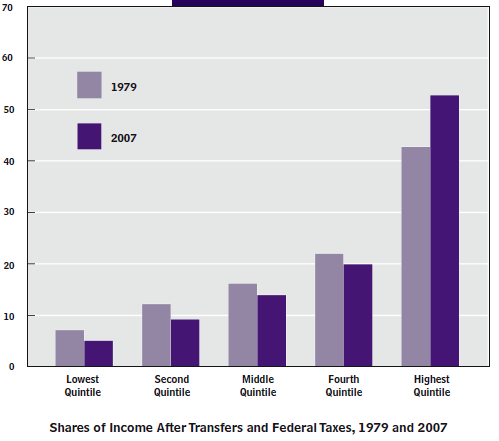
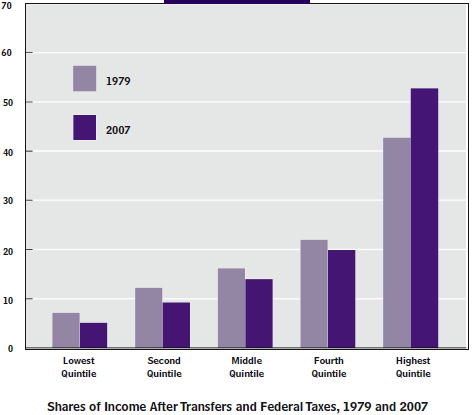
CaptureThe above CBO chart shows that income inequality has not changed much in the last 30 years once government transfers and federal taxes are taken into account. Along the same line, the Manhattan Institute’s Oren Cass makes a strong case in, “The Inequality Cycle,” that Americans should be paying at least as much attention to the social aspects of inequality as to the economic aspects.
For example:

  • As Charles Murray shows in “Coming Apart,” (http://www.amazon.com/Coming-Apart-State-America-1960-2010/dp/030745343X) the upper class has remained stable with respect to marriage rates (94% in 1960, 84% in 2010), civic involvement, and trust in society while for the lower class marriage rates (84% in 1960, 48% in 2010 and dropping), civic involvement and public trust have all declined significantly.
  • Children in the lower classes are five times more likely to face abuse, violence, addiction and the death or imprisonment of a parent.
  • By the time they reach kindergarten, 72% of middle class children know the alphabet compared with only 19% of poor children.
  • The fraction of children with a single parent is the best predictor of upward economic mobility in a particular region, whereas the level of income inequality is not a significant predictor.

Mr. Cass suggests that public policy should focus on these social problems at least as much as on income inequality. For example:

  • Education reform should be focused on both ends of the K-12 spectrum: early childhood education to ensure that all children are ready to learn when they get to school and better vocational education in high school so that graduates can find a good job if they’re not going to college.
  • Remove onerous regulations on the workplace so that employers are not pushed unnecessarily into independent contractor arrangements.
  • The federal government should be more supportive of marriage (e.g. with tax policy), and the participation of religious organizations in the delivery of public social services (to improve their quality).

Conclusion: Being poorly raised does more to cut off opportunity than being raised poor.

Should the National Minimum Wage Be Raised?


A recent column by David Brooks in the New York Times, “Minimum Wage Muddle,” is a good summary of the pros and cons of raising the minimum wage for the whole country. Mr. Brooks refers to a recent Congressional Budget Office report that a hike in the minimum wage to $10.10 per hour might lift 900,000 out of poverty but would also likely mean a loss of 500,000 jobs.
Capture5As suggested in a recent post, one of the things we could do to get beyond our political dysfunction at the national level is to:

  • Put a greater emphasis on state-centered federalism both to encourage experimentation and innovation in the American system and to remove issues from the national agenda which contribute to division, stalemate and endless controversy.
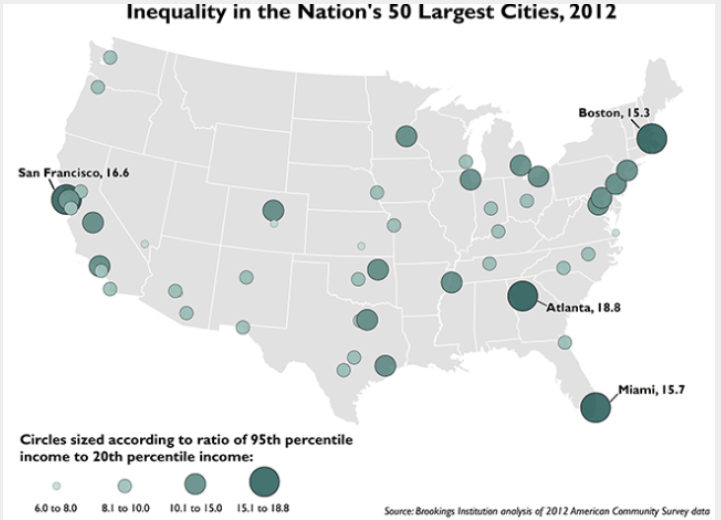
    Capture4Considering that income inequality varies so greatly from one part of the country to another, (see above), it makes a lot of sense to federalize the minimum wage issue. In other words, let cities and states set their own minimum wage levels based on their own local circumstances.
    For example, the state of Nebraska, with very little inequality and where I live, has just raised its minimum wage to $8/hour ($9/hour beginning January 2016). Nebraska’s lowest in the country unemployment rate of 2.6% means that hardly anyone will lose their job.
    As Mr. Brooks says, “Raising the minimum wage will produce winners among job holders from all backgrounds, but it will disproportionately punish those with the lowest skills, who are least likely to be able to justify higher employment costs.”
    Conclusion: raising the national minimum wage is not the best way to address the inequality and fairness issue. A better way is to create more jobs by boosting the economy overall. Then help low wage workers take home more money with a (perhaps expanded) Earned Income Tax Credit. Cities and states can establish their own individual minimum wages however they wish.

Richer and Poorer


As I often remind readers, this blog is primarily concerned with three basic fiscal and economic problems facing the U.S. They are: 1) our stagnant economy, 2) our massive debt, and 3) income inequality. Today I discuss inequality. The March 16 2015 issue of the New Yorker contains an extensive article on this topic by Jill Lapore, “Richer and Poorer.” However it suffers a common defect of only presenting one side of a complex issue.
There are facts about inequality which more people need to be aware of. For example:

  • The scope of income inequality is greatly reduced once incomes are adjusted for government transfers and federal taxes as shown in the following chart from the Congressional Budget Office.
    Capture
  • There is a strong correlation between inequality and growth as shown by the second chart just below from the World Bank.
    Capture2
  • Globalization has had a dramatic effect on incomes world-wide as low skill work has shifted from the developed world to the developing world as shown in the chart below from the Wall Street Journal. Hundreds of millions of people in the developing world have been lifted out of poverty at the cost of lost jobs to low skill workers in the U.S. and other developed countries.
    Capture3Any effective strategy for decreasing income inequality needs to be reality based. Yes, it exists but its severity is exagerated. The Americans who need help the most are the ones unlikely to either attend or graduate from college. What they need most is vocational training to prepare them for the millions of high skill jobs going begging in the U.S.
    The best thing we can do to decrease income inequality in the U.S. is to get our economy growing faster. Since the end of the Great Recession in June 2009, it has grown at the historically slow rate of 2.2% of GDP and this slow rate of growth is predicted (by the CBO) to continue indefinitely under current government policies. A return to the historical 3% growth rate would create jobs and better jobs for millions of the unemployed and under-employed as well as providing bigger raises for the middle class as employers have to compete for qualified workers.
    How can we make the economy grow faster? I have addressed this critical issue many times and will return to it soon.

Inequality and Growth


In my opinion the two most serious problems facing the U.S. at the present time are 1) stagnant growth and 2) massive debt. As discussed by William Galston in yesterday’s Wall Street Journal, the U.S. presidential campaign is now beginning to address the first of these issues.  For example:

  • Bernie Sanders rejects “growth for the sake of growth” and says that “our economic goals have to be redistributing a significant amount back from the top 1%.”
  • Hillary Clinton says that we have to build a “growth and fairness” economy. “We can’t create enough jobs and new businesses without more growth, and we can’t build strong families and support our consumer economy without more fairness.”
  • Jeb Bush argues that there is nothing wrong with household incomes that 4% growth wouldn’t solve.

The readers of this blog will have little difficulty figuring out where I stand on this continuum of economic values. My view is illustrated by the chart just below from the World Bank which shows that countries with the fastest growing economies also have the least amount of inequality.
CaptureLet’s be more specific. Mrs. Clinton would achieve more fairness by:

  • Raising the minimum wage.
  • Guaranteeing child care and other family friendly policies.
  • Encouraging profit sharing.
  • Encouraging more innovation by increasing public investment in infrastructure, broadband, energy and scientific research.

These are attractive goals but how do we achieve them? The best way to raise wages is to get the economy growing so much faster that it creates a labor shortage. Then businesses will be competing for labor and wages will go up. This is exactly what is happening in Omaha NE where I live and the unemployment rate is down to 2.9% (2.6% in Nebraska as a whole).
Furthermore, in a tight labor market, businesses will automatically try harder to keep good employees by providing extra benefits such as childcare and profit sharing.
Public investment in infrastructure, etc. will be more easily affordable with the higher tax revenue generated by a faster growing economy.
Conclusion: faster growth is the best way to create a more fair and equal society!

Life in America: Opportunity or Inequality?


How bad is income inequality in the U.S. and what should be done about it?  This is a question of great current interest with many different points of view.  The chart just below from the Congressional Budget Office shows the extent of income inequality and also shows that it has gotten somewhat worse between 1979 and 2007, just before the onset of the Great Recession.  And we know that our stagnant economy has made it worse yet between 2007 and the present.
CaptureBut now look at the chart (below) from the U.S. Census Bureau of the distribution of household income in the U.S. in 2012.  The chart shows the median income of about $51,000 and then has a very long tail to the right.  This means that there are large numbers of households making large incomes of all different sizes.  It makes no particular sense to distinguish the top 1% (who make $380,000 or more) from the bottom 99%.
Capture1The point is that there is huge opportunity in the U.S. to do very well financially whether or not one makes it into the top 1%.
In an earlier post, “Growth vs Equitable Growth,” I reported on the agenda of the Washington Center for Equitable Growth, a progressive think tank.  In order to achieve “equitable growth” they advocate:

  • Improving educational outcomes at all levels, pre-K – 12+.
  • Running a “high pressure” economy in order to tighten the labor market.
  • Expand the Earned Income Tax Credit especially for workers without children.

I couldn’t agree more.  This is an excellent plan to create more prosperity for more people.  It’s much more plausible in the U.S. to make poor people richer than to make rich people poorer.

Growth vs Equitable Growth


There is a huge debate going on in political and policy circles between the advocates of increasing economic growth and the advocates of increasing income equality.  I generally argue that the best way to increase income equality is to increase economic growth overall.
CaptureI have just come across a series of articles from the Nov/Dec 2014 issue of the American Monthly, “American Life: an investor’s guide,” which are sponsored by the Washington Center for Equitable Growth, a progressive Think Tank.  The fact that this group is focused on equitable growth, rather than the narrower goal of income equality, is of great interest to me.
Capture1They advocate a number of things that I agree with such as:

  • The incredible importance of early childhood healthcare and education.
  • Improving K-12 education, especially in low-income areas.
  • Providing much more vocational education and apprenticeship programs.
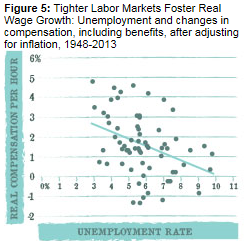
  • Running a “high pressure” economy in order to tighten the labor market. They recognize that lower unemployment leads to higher wages (see above).
  • Expand the Earned Income Tax Credit especially for workers without children.

The authors want to “pressurize” the economy with a more stimulative fiscal policy which means increased deficit spending, a very bad idea in my opinion.  Much better ways to boost the economy are with policies such as tax reform, trade expansion, immigration reform and regulatory relaxation.
Yes, there is a high degree of income inequality and yes, it’s getting worse over time.  But, as Warren Buffett says, the poor are not poor because the rich are rich.  The best way to help the poor is to make them more productive.  That is exactly the purpose of the policies enumerated above.

Globalization Is a Messy Process


Globalization is having a dramatic effect on income distribution around the world as I discussed in a previous post. Middle incomes in the developed world are stagnating while at the same time they are growing rapidly throughout much of the rest of the world.
At the same time as western world economies are stagnating, turmoil and instability are breaking out elsewhere, especially in eastern Europe, the Middle East and northern Africa.  Fortunately the U.S. and its allies are stepping in with military force to help maintain local order in many parts of the world where it is breaking down.
In short, at the same time, whether connected or not, the postwar geopolitical system is breaking down and the economic stability of the Great Moderation has given way to the Great Recession and its aftermath of macroeconomic volatility.
An interesting article by Chrystia Freeland in the latest issue of The Atlantic, “Globalization Bites Back” addresses both of these issues together.  She says “I believe that capitalist democracy has proved itself to be the only compelling, universalist vision of how to live the good life.  But the stable world order many of us assumed this thesis foretold has not come to pass.”
CaptureAs the above chart shows, one very positive result of this messy process is likely to occur.  The middle class worldwide is predicted to grow from 1.8 billion in 2009 to 4.9 billion in 2030.  All of this enormous growth in the size of the middle class will occur outside of North America and Europe.
The implications for the continued prosperity and world leadership of the U.S. are clear.  We need to get our own economy back on track, growing at a faster rate.  We also need to get our fiscal house in order so that the dollar will continue to be the international currency of choice.
Our dominant role in world affairs is beneficial to all but it is by no means assured without much effort on our part.