The Land of the Free and the Home of the Brave


As we celebrate the 239th anniversary of the signing of the Declaration of Independence in 1776, Americans have much to be thankful for.  It is often said that the United States is the strongest, wealthiest and freest country the world has ever known.  Although this may be somewhat of an exaggeration (see below), it is still indicative of how fortunate we are compared to the rest of the world.
CaptureAs we celebrate our good fortune, we need to be acutely aware that our continued success as a great nation is not automatically assured.  In fact we face a number of troubling and persistent problems which are not likely to disappear unless we take strong action to address them.  For example we have:

  • A stagnant economy with only 2.2% annual growth since the end of the Great Recession. And the Congressional Budget Office predicts no speed up over at least the next ten years, based on current policy. Such slow growth condemns 20 million unemployed and underemployed citizens to unfulfilling lives, as well as lackluster pay raises for many more tens of millions.
  • Massive debt. Our public debt (on which we pay interest) is now at 74% of GDP, highest since the end of WWII, and predicted by the CBO to grow rapidly under current policies. When interest rates return to the normal 5% level, interest payments on the debt will skyrocket, making it much more difficult to fund all of the federal programs we depend on for our quality of life.
  • Increasing Income Inequality is real even if overhyped in the media. America is still a land of great opportunity but basic fairness demands that all citizens be able to share in our national abundance.
  • Threats from abroad. ISIS now controls much of Iraq, Syria and northern Africa and must be defeated. NATO needs our very strong support, all the more so with the Eurozone and European Common Market under increasing pressure from within.


As the strongest nation in the world we have much responsibility for continued world peace and prosperity.  We can’t fulfill this role adequately unless our own internal fiscal and economic policies are in fundamentally sound shape.
Let’s be thankful for what we have and bear down hard to insure that we keep it!
Life in America: Opportunity or Inequality?


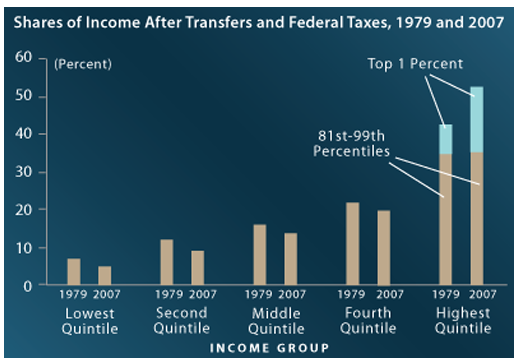
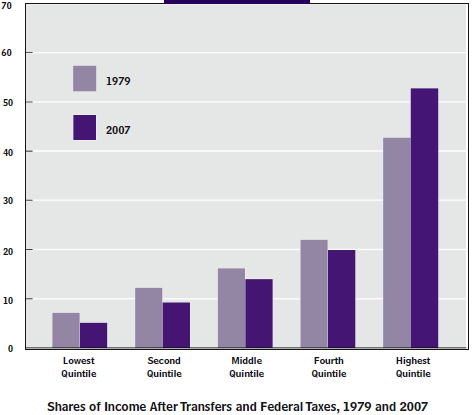
How bad is income inequality in the U.S. and what should be done about it?  This is a question of great current interest with many different points of view.  The chart just below from the Congressional Budget Office shows the extent of income inequality and also shows that it has gotten somewhat worse between 1979 and 2007, just before the onset of the Great Recession.  And we know that our stagnant economy has made it worse yet between 2007 and the present.
CaptureBut now look at the chart (below) from the U.S. Census Bureau of the distribution of household income in the U.S. in 2012.  The chart shows the median income of about $51,000 and then has a very long tail to the right.  This means that there are large numbers of households making large incomes of all different sizes.  It makes no particular sense to distinguish the top 1% (who make $380,000 or more) from the bottom 99%.
Capture1The point is that there is huge opportunity in the U.S. to do very well financially whether or not one makes it into the top 1%.
In an earlier post, “Growth vs Equitable Growth,” I reported on the agenda of the Washington Center for Equitable Growth, a progressive think tank.  In order to achieve “equitable growth” they advocate:

  • Improving educational outcomes at all levels, pre-K – 12+.
  • Running a “high pressure” economy in order to tighten the labor market.
  • Expand the Earned Income Tax Credit especially for workers without children.

I couldn’t agree more.  This is an excellent plan to create more prosperity for more people.  It’s much more plausible in the U.S. to make poor people richer than to make rich people poorer.

How to Expand Economic Mobility


My blog addresses the three main economic and fiscal issues facing the U.S. today: slow growth, economic inequality and massive debt. Today I focus on inequality by referring to a recent article by the Manhattan Institute’s Scott Winship, “Up: Expanding Opportunity in America.” Mr. Winship observes that there has been little change in upward mobility over the past three generations.  Furthermore the U.S. has upward earnings mobility rates quite comparable to Canada and the Scandinavian countries, which are generally regarded as having strong economies.
CaptureNevertheless he makes several suggestions for attempting to boost upward mobility in the U.S. as follows:

  • Proposal 1: Wage War on Immobility through an Opportunity, Evidence and Innovation Office and an Opportunity Advisory Commission. OEIO would fund and evaluate an array of demonstration projects at the state and local levels. It would consolidate many already existing programs and have a budget of $20 billion per year.
  • Proposal 2: Experiment with Promising and Innovative Approaches to Mobility Promotion. Examples are: text-messaging strategies such as READY4KLanguage ENvironment Analysis, and Converting Large Schools with High Drop-out Rates into Small Personalized Schools.
  • Proposal 3. Block-Grant Means Tested Programs and Send Them Out to the States. Such a proposal has recently been made by the House Budget Committee.
  • Proposal 4. Encourage Employment through Work Subsidies. This is already being done with the Earned Income Tax Credit.
  • Proposal 5. Encourage Delayed and Planned Childbearing through Tax Incentives. The idea is to promote marriage by expanding the current Child Tax Credit of $1000 per child for single parents to perhaps $4000 per child for married parents, but for low-income families only.
  • Proposal 6. Reform the Social Security Disability Insurance Program. The share of adults age 25 to 64 receiving SSDI benefits has tripled from 1.6% in 1970 to 5% in 2010. Reform of this program would put many able-bodied men and women back to work and save lots of money, some of which could be used to fund the above programs.

Conclusion:  Increasing upward mobility is one very good way to combat economic inequality.  Mr Winship provides an excellent discussion of several new as well as already established ways of accomplishing this goal.

The Social Effects of Income Inequality


It is well understood that income inequality is increasing in the U.S. for a number of reasons: economic globalization, the rapid development of new technology and the slow recovery from the Great Recession of 2007 – 2009.
CaptureThe New York Times’ economics journalist, Eduardo Porter, discusses the social effects of this ominous trend in the article “Income Inequality Is Costing the U.S. on Social Issues.” For example:

  • The U.S. has the highest teenage birthrate in the developed world – seven times the rate in France, for example.
  • More than one out of four U.S. children lives with one parent, the largest percentage by far amongst industrialized nations.
  • More than a fifth of U.S. kids live in poverty, sixth from the bottom among the OECD.
  • Among adults, seven out of every 1000 are in prison, five times the rate for other rich democracies and three times the U.S. rate from four decades ago.
  • In 1980 the infant mortality rate in the U.S. was about the same as in Germany. Today it is almost twice the rate as for German babies.
  • American babies born to white, college educated, married women survive as often as those born to advantaged women in Europe. It is the babies born to nonwhite, non-married, non-prosperous women who die so young.

In other words, there is huge social disparity between the well-off and the poor in the U.S. and, furthermore, the resulting social breakdown is getting worse. Why has this been happening?
Conservatives say that it is the fault of a growing welfare state which has sapped Americans’ industriousness and sense of self-responsibility.  Liberals say that welfare programs arn’t extensive enough to withstand the strict demands of globalization and technological development.
Mr. Porter concludes that, “the challenge America faces is not simply a matter of equity.  The bloated incarceration rates, rock-bottom life expectancy, unraveling families and stagnant college graduation rates amount to an existential threat to the nation’s future.”
I tend to agree.  Is our democratic political process capable of responding in a satisfactory manner?  I will return to this theme often in the coming months!

How the American Higher Education System Contributes to Inequality


Income inequality in the U.S. is a major problem, getting worse all the time.  There are many reasons why this is happening and many suggestions for how to deal with it.  On the other hand, it is well appreciated that a college degree is one of the best tickets for upward mobility into the middle class.  A new book by Suzanne Mettler, “Degrees of Inequality,” shows how American higher education is actually increasing the divide between the haves and have-nots.  She points out that:

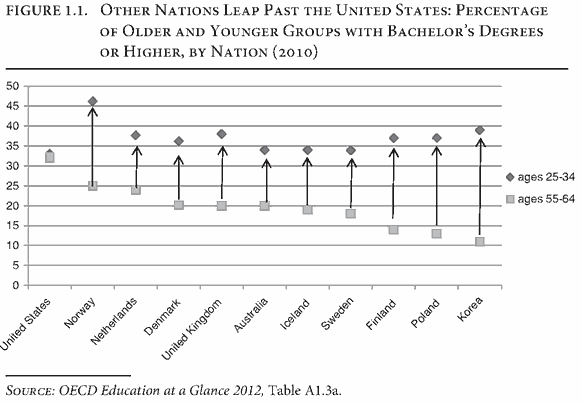
  • There are too few college graduates in the U.S.  In 2010 Americans between ages 25 and 34 had a college graduation rate of 33%. At least 10 OECD nations have higher rates (see below). American world leadership in the future will be jeopardized if we don’t continue to be an educational leader as we have been in the past.

    Capture

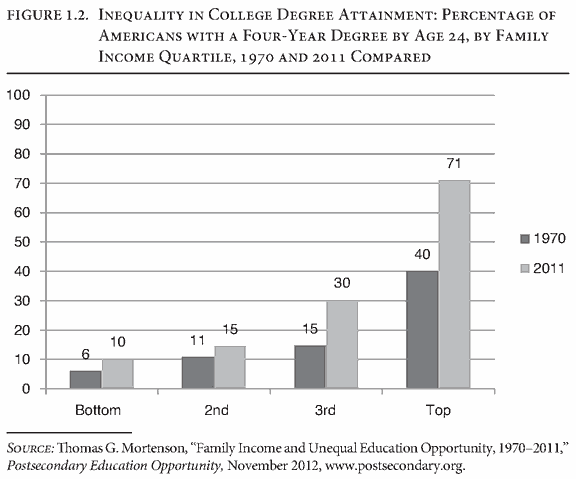
  • America is graduating inequality. College degree attainment has increased between 1970 and 2011 for all income groups. However this is happening much more quickly for higher income groups. 83% of 18 to 24 year olds now have a high school diploma and 75% of this group start college. But the completion rate by age 24 is only 47%, mostly from the higher income groups (see below).Capture1
  • Not all college degrees are created equal. Students at private, nonprofit institutions graduate at higher rates than students from public institutions who, in turn, graduate at much higher rates than students from for-profit institutions. And graduates of the for-profits have larger loan debt than for graduates from private nonprofit and public institutions.

Capture2

Students at for-profit educational institutions tend to be from lower-income families.  As noted, they have lower graduation rates and end up with higher debt levels.  Clearly the three tier system of American higher education has a harmful effect on the young adults who need the most help in moving up the economic ladder.
How should society address this major problem in an era of tight public spending?  One answer is to increase regulation of the government-run student loan program.  All educational institutions should be held at least partially responsible for the defaulted loans of their former students.
Another approach is to increase financial support for community colleges so that they can provide more programs for the low-income students who are most likely to attend them.

Too Much Income Inequality is Harmful to Society


It is well understood that income inequality is increasing in the U.S. and that there are lots of reasons for it.  Globalization provides low cost goods from around the world and thus puts pressure on low-wage workers in our own country.  Rapid technological advancement puts a high premium on educational attainment and skill acquisition and thus helps individuals who are highly motivated to succeed.  The Great Recession and our slow recovery from it have held back the growth of employment and wages increases for middle- and lower-income workers.
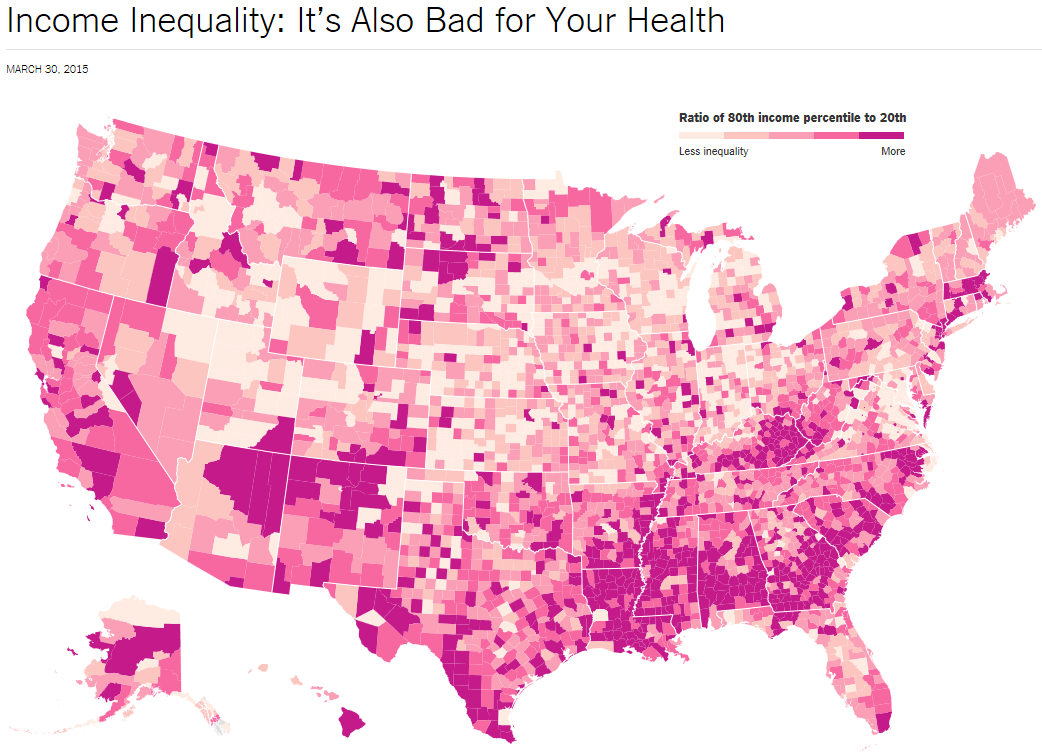
CaptureIncreasing income inequality is a pernicious social condition and has lots of unpleasant consequences.  A new study of U.S. counties has shown that there is a strong correlation between more inequality in a particular geographical area and shorter average live spans.  It is quite reasonable to expect that higher-income people will be more health conscious than lower- income people. Excessive inequality is bad for lots of reasons.
The question is what we can do about it.  Here are two good ways to address it:

  • Faster economic growth would help a lot. The American Enterprise Institute’s Michael Strain has recently proposed a fairly modest plan for increasing employment by cutting tax deductions for the wealthy, increasing the Earned Income Tax Credit for the poor and at the same time decreasing deficit spending. I have made a more substantial proposal along the same lines.
  • Boost educational performance across the board. College-ready middle class kids will take care of themselves so the emphasis should be on the 70% of young adults who will not go to a four year college. There are lots of good jobs available for the highly skilled and so we need more career education in high school. We also need more early childhood education to prepare kids from low-income families to get off to a good start in elementary school.

Increasing economic growth and expanding educational opportunities for the non-college bound will require little, if any, new federal spending.  Such policies as above are simply common sense ways to reduce income inequality and achieve a more inclusive society.

Inequality Does Not Reduce Prosperity


In the national elections this year four states: Alaska, Arkansas, Nebraska and South Dakota raised their state minimum wage rates above the national rate of $7.25 per hour and, at the same time, elected Republicans to the U.S. Senate, in three cases replacing Democratic incumbents.  Does this represent contradictory behavior by the voters?
CaptureThe American Enterprise Institute’s James Pethokoukis recently reported (see above) that the U.S. has the third highest rate of billionaire entrepreneurs behind only Hong Kong and Israel, as well as by far the most billionaires over all.  These are the high-impact innovators like Bill Gates, Steve Jobs and Mark Zuckerberg and the Google Guys.
These observations are put in context by the Manhattan Institute’s Scott Winship who recently reported that “Inequality Does Not Reduce Prosperity.” Here is a summary of his findings:

  • Across the developed world, countries with more inequality tend to have higher living standards.
  • Larger increases in inequality correspond with sharper rises in living standards for the middle class and poor alike.
  • In developed nations, greater inequality tends to accompany stronger economic growth.
  • American income inequality below the top 1 percent is of the same magnitude as that of our rich-country peers in continental Europe and the Anglosphere.
  • In the English-speaking world, income concentration at the top is higher than in most of continental Europe; in the U.S., income concentration is higher than in the rest of the Anglosphere.
  • With the exception of a few small countries with special situations, America’s middle class enjoys living standards as high as, or higher than, any other nation.
  • America’s poor have higher living standards than their counterparts across much of Europe and the Anglosphere.

Conclusion: Americans are fair-minded and would like to help the working poor do better.   But Americans also appreciate the value of innovation and entrepreneurship.  When there is a tradeoff between increasing prosperity and reducing inequality, greater prosperity comes first.

How Bad Is Income Inequality and How Do We Fix It?


The latest news on the American economy is mixed. The unemployment rate fell to 5.9% in September but the labor force also fell by 97,000 last month.  The labor participation is now down to 62.7%, a level last seen in 1978.  On the plus side 248,000 new jobs were created but the share of the population employed stayed at 59%, less than its 59.4% level at the end of the recession in June 2009.  In other words, job growth is definitely picking up but not fast enough.
CaptureHow about income inequality?  One simple way of describing and understanding the degree of income inequality in the U.S. is to look at median household income and how it changes over time.  The above chart from the WSJ shows how the median U.S. household income fell from an all-time high of $56,895 in 1999 to $51,939 in 2013.  However it also climbed back up to $56,436 in 2007 before dropping precipitously until 2012.
Capture1The Global Strategy Group discovered in a recent survey that registered voters overwhelmingly rate economic growth as a higher priority than economic fairness.  This means that any policy designed to speed up economic growth is likely to receive favorable support by the electorate.
In a recent post I describe a plan for broad-based tax reform specifically designed to speed up economic growth.  It would involve an across-the-board cut in tax rates totaling about $500 billion per year, but completely paid for by closing loopholes and deductions which primarily benefit the wealthy.  The 64% of taxpayers who do not itemize deductions would receive a tax cut.  And they would likely spend this extra money in their pockets because they are precisely the middle- and lower-income wage earners with falling incomes.
An income tax redistribution like this would greatly reduce inequality but in a way which is designed to give the economy a big boost!

Redistribution, Inequality and Growth


Most people agree that income inequality and wealth inequality are increasing in the U.S. Likewise anyone who’s paying attention is aware of our slow rate of GDP growth, averaging 2.2% per year, since the end of the recession five years ago.  Is there a connection between inequality and slow growth?  Maybe!
CaptureFirst of all, it is important to note that income inequality in the past 30 years has been greatly offset by federal taxes and transfer programs as shown in the October 2011 chart (above) from the Congressional Budget Office.
Capture1Secondly, the Economist discusses this situation in the article “Inequality v growth”.  The economists Jonathan Ostry, Andrew Berg and Charalambos Tasangarides have shown (see above chart) that a large amount of redistribution affects growth more negatively than a smaller amount of redistribution.
Economists generally agree that the recovery has been slowed down by a lack of demand by consumers for more goods.  So the recovery should speed up as less affluent consumers feel secure enough to spend more money.  Two things, to start with, can make this happen.  One is a restoration of the housing market so that homeowners have more equity (which can be borrowed and spent).  Another way to accomplish this is with government redistribution programs, such as food stamps and Medicaid, for low income people.
But there is an even better way to put money in the hands of people who will spend it, and at no cost to the government.  I am talking about broad based tax reform, whereby tax rates are lowered for everyone, offset by closing tax loopholes and shrinking deductions, which primarily benefit the wealthy.  For the two-thirds of taxpayers who do not itemize deductions, and who tend to be the less affluent, such a tax rate cut will put money in their pockets, most of which they will spend.
Such a tax program as this would be a direct shift of resources from the wealthy to everyone else, thereby lessening inequality.  It would stimulate the economy, creating millions of new and higher paying jobs, and thereby increasing tax revenue and lowering the deficit.  Win, win, win, win!

An Inequality Culprit: Single-Parent Families


It is generally agreed that income inequality in the U.S. is bad and getting worse.  Before we can address it effectively, we have to understand what is causing it.  In this regard the Wall Street Journal had an article recently, “Ignoring an Inequality Culprit: Single-Parent Families”, by two scholars, Robert Maranto and Michael Crouch, from the Department of Education Reform at the University of Arkansas.
CaptureMr. Maranto and Mr. Crouch call attention to what they call “the strongest statistical correlate of inequality in the United States: the rise of single parent families during the past half century. … In 1960, more than 76% of African-Americans and nearly 97% of whites were born to married couples.  Today the percentage is 30% for blacks and 70% for whites. … This trend, coupled with high divorce rates, means that roughly 25% of American children now live in single-parent homes, twice the percentage in Europe (12%).  Roughly a third of American children live apart from their fathers.” In addition, “more than 20% of children in single-parent families live in poverty long-term, compared with 2% of those raised in two parent families.”  It is estimated “that 41% of the economic inequality created between 1976-2000 was the result of changed family structure.”
The authors wonder why there is not more public attention given to this depressing state of affairs and conclude that

  • Intellectual and cultural elites lean to the left and it is primarily social conservatives who promote traditional family structure.
  • Family breakup has hit minority communities the hardest. Therefore public discussion can be characterized as being racist.
  • This is a very hard problem to solve. Marriage and childrearing involve highly personal choices which cannot be dictated by society.

In this regard, my March 11, 2014 post “A balanced and Sensible Antipoverty Program”, emphasizes the need to at least remove marriage penalties from government welfare policy.
As the authors conclude, “The first step is to acknowledge the problem.”