Disruption Involves Taking Chances


I am a fiscal conservative (I want to balance the budget) and a social moderate. I voted for Hillary Clinton for president because Donald Trump is a sleazy person and has such a volatile temperament.  But I’m also in favor of making big changes and Mr. Trump will certainly do this.

capture79As the Economist points out, “his voters took Mr. Trump seriously but not literally, even as his critics took him literally but not seriously.”  The Economist goes on to point out some of the risks involved in making the kinds of changes Mr. Trump is talking about:

    • If Obamacare is repealed, 20 million Americans will lose their health insurance. Yes, but it’s not going to happen this way. Obamacare will end up being modified and improved, not abolished.
  • His tax cuts would chiefly benefit the rich and would greatly increase our national debt. Yes, but the House of Representatives has a much better plan to do this and it is Congress, not Mr. Trump, which will develop a detailed plan.
  • Even if he does not actually deport illegal immigrants, he will foment the divisive politics of race. The illegal immigration problem needs to be solved and Mr. Trump is likely to get this done, with or without a wall.
  • Mr. Trump has demanded trade concessions from China and NAFTA. If he causes a trade war, the fragile world economy could tip into a recession. Blue collar workers, his strongest base of support, have had stagnant incomes for years and deserve some help. If he can increase our exports, blue collar workers will benefit.
  • He wants to reverse the Paris agreement on climate change which would harm the planet and undermine America as a negotiating partner. Global warming is real but the Paris accord does essentially nothing to slow it down. Increased coal use in China and India will more than negate what the U.S. and Western Europe are doing to cut back on fossil fuels.
  • Mr. Trump has demanded that other countries pay more towards their security or he will walk away. NATO members should be doing more on their own and if he can prod them to do this, then NATO will be stronger as a result.


Conclusion. Mr. Trump’s expressed views should be interpreted as initial bargaining positions. They are likely to have the effect of leading to progress on many serious problems which need to be addressed.  The risks involved in the negotiation process are worth taking

Follow me on Twitter
Follow me on Facebook

We Need Fundamental Change and Now We’re going to Get It!


I want to emphasize that I voted for Hillary Clinton on Tuesday because Donald Trump has such a sleazy and mercurial personality. But Mr. Trump was clearly the change candidate and we need change big time.  His strongest base of support is the white working class which has not really recovered from the Great Recession of 2008-2009 and he will surely try to help out these people.

capture79
Here are the changes we need in order of importance:

  • Grow the economy faster. Tax reform, individual and corporate, and regulatory reform are what are most needed. Mr. Trump and the House Republicans are in rough agreement on both of these major initiatives and hopefully the new Republican led Senate will go along. The best kind of tax reform means to lower tax rates and shrink deductions enough to avoid losing tax revenue. This can be accomplished if a real effort is made to do it this way.
  • Begin to shrink our massive debt. This can only be done by major entitlement reform, meaning to control the costs of Social Security, Medicare and Medicaid. Medicare should be transitioned over from a single payer system to a premium support system, consistent with a reformed Affordable Care Act. Healthcare costs can only be contained by giving consumers more skin in the game, meaning higher deductibles supplemented with health savings accounts.
  • More assertive foreign policy. Worldwide peace and stability depend on our own economic and military strength. Right now China, Russia and Iran think they can push us around. President Trump will not let this happen.
  • Trade and immigration policy. Most knowledgeable people agree that international trade is generally beneficial. We simply have to do a better job of retraining American workers who lose their jobs to foreign competition. The key to immigration reform is tougher border security plus an effective guest worker visa program.

Conclusion. The Republican House of Representatives has an excellent plan, “A Better Way,” for American economic, fiscal and social renewal and Mr. Trump is largely supportive of it. This augers well for fundamental progress in the next four years.

Follow me on Twitter
Follow me on Facebook

Election Day 2016: The Fourth Anniversary of this Blog


I have now been writing this blog for four years, beginning right after the presidential election of 2012. I was a candidate in the May 2012 Republican Primary for the 2nd Congressional District of Nebraska.  I campaigned on the platform to “eliminate the deficit.”  I lost to the incumbent Lee Terry who was in turn replaced in office by the Democrat Brad Ashford in 2014.

capture79
The overriding theme of my blog is “how to restore fiscal responsibility to our national government.”   I discuss two fundamental and related issues:

  • Massive Debt now 75% of GDP, the highest level since right after WWII, and predicted by the Congressional Budget Office to keep rising steadily under current policies.
  • Slow Economic Growth averaging just barely 2% per year since the end of the Great Recession in June 2009. Although the unemployment rate is down to a respectable 4.9%, the labor participation rate is also lower than usual. Faster growth would mean more jobs and better paying jobs. It would also mean more tax revenue to shrink our annual deficits.

How should these problems be addressed?  In briefest outline:

  • Balanced Budget Amendment to the Constitution. This is a drastic measure but I see no other way to get the job done. The pressure on Congress is always to create new programs and spend more money, not less. A BBA could be designed in a flexible manner to allow emergency overrides. It could also be phased in by, for example, having an effective date three years after ratification. It so happens that 28 states (out of 34 needed) have now called for a Constitutional Convention to propose such an amendment. (http://bba4usa.org/)
  • Tax Reform, lowering rates for individuals and corporations, paid for by shrinking deductions, would do wonders for encouraging business investment and entrepreneurship, as well as encouraging American multinational companies to bring their foreign earnings back home for reinvestment.

Conclusion. Much more can be done but this would be a very good start.

Follow me on Twitter
Follow me on Facebook

Clinton Is Not As Bad As Trump


I’ve been saying for several months that I would endorse one of the two main presidential candidates before the election and that “Donald Trump Should Withdraw from the Presidential Race” because of his personal sleaziness and that, in any case, I could not vote for him.
But it is worse than this.  As the Wall Street Journal stated recently, “Mr. Trump would start out with more than half of the country disliking him, and most of his advisors lack governmental experience.  Too many blunders or an early recession (especially one caused by trade restrictions) could cause voters to sweep out the GOP Congress in 2018, setting up a return to an all-progressive government in 2020.” In other words the disaster of 2009-2010, when President Obama had a filibuster-proof Congress, could easily happen all over again.

capture79
Mrs. Clinton has said that she wants, ”higher taxes, more spending on entitlements, more subsidies and price controls in ObamaCare, more regulations on business, more limits on political speech, and more enforcement of liberal cultural values on schools and churches.”  The likely result of such an agenda would be more lost years of slow economic growth.  And “the costs of slow growth are corrosive.  Flat incomes lead to more social tension and political enmity.  The fight to divide a smaller pie would get uglier in a country that once was accustomed to rising possibilities.”  This is a highly conceivable result of four years of a Clinton presidency.
Conclusion. I am not exactly enthusiastic about Mrs. Clinton.  But she is predictable and much less risky than Mr. Trump.  As long as the House of Representatives remains under Republican control, which is very likely, Mrs. Clinton will have to negotiate with it to implement much of her agenda.  This could conceivably lead to bipartisan progress on such major issues as tax reform and entitlement cost control.

Follow me on Twitter
Follow me on Facebook


Fiscal Policy after the Election


As the presidential election tightens and the likely margin of victory for either candidate continues to shrink, it becomes ever more apparent that we need a bipartisan approach to solving our most basic problems.  My last post discusses the need for fundamental tax reform to get our economy growing faster to create more and better paying jobs.  Today I remind my readers of the need for better fiscal policies as well to address our massive and steadily deteriorating debt problem.
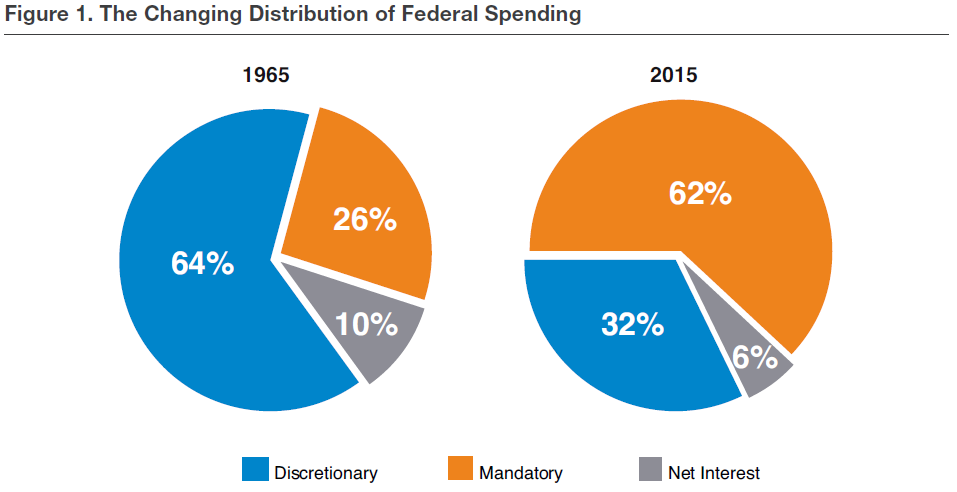
As the American Enterprise Institute,  among many other think tanks, makes abundantly clear, we are spending more and more of our federal budget on entitlements  as opposed to all of the many other federal responsibilities which are lumped together as discretionary spending.  In other words, the only way to fix our deficit and debt problems is to achieve better control over entitlement spending.

capture78
AEI has some excellent ideas on how to do this:

  • Social Security should move towards providing a universal flat benefit, set at the federal poverty level, for all U.S. residents aged 65 and older. Social Security would then become a guarantee against poverty in old age rather than a scheme for partially replacing pre-retirement earnings for middle and higher earning households.
  • Health Care. The Affordable Care Act should be replaced with a less regulated system (i.e. no mandates). The federal tax preference on employer plans could be limited to the cost of catastrophic (high deductible) insurance plus a contribution to health savings accounts. Households without employer coverage would receive a comparable tax credit.
  • Medicare would be converted into a premium support system with a fixed level of support comparable to that provided by employers.
  • Medicaid would be converted into a block grant program for the states based on the fixed, per capita costs for enrolled populations.
  • Other Safety-Net Programs should emphasize work as the key to improved economic prospects plus greater state control over resources in order to encourage innovation.

Conclusion. It should be emphasized as strongly as possible that the purpose of entitlement reform is to preserve and strengthen entitlements, not to weaken or destroy them.  Without such action we are headed for a much worse financial crisis than the one we had in 2008-2009 which will put all government social programs at risk.

Follow me on Twitter
Follow me on Facebook


How to Get Our Economy Back on Track III. Tax Reform


Both political parties, both presidential candidates, most prominent economists and economics journalists, in other words, most opinion makers, favor faster economic growth. I have had several recent posts on this topic, here and here, pointing out especially the need to increase the rate of growth of worker productivity which in turn is heavily influenced by the rate of new business investment.
One of the most valuable policy changes in this respect is tax reform, with lower marginal rates paid for by closing loopholes and shrinking deductions. The Republican House of Representatives has developed an excellent plan, “A Better Way,” which includes such extensive tax reform.

capture77
The American Enterprise Institute has recently analyzed the House plan and describes the positive impact it would have on our economy:

  • Simplification. The seven current individual tax rates would be reduced to just three: 12%, 25% and 33%. All deductions would be eliminated except for mortgage interest and charitable contributions. The standard deduction would be almost doubled. A 50% exclusion for capital gains, dividends and interest income would lower those tax rates in half.
  • Business taxes. The corporate tax rate would be cut from 35% to 20%, again by eliminating most deductions, and a territorial system adopted whereby taxes are only paid in the country where business is conducted. Immediate expensing for new investment would replace multiyear depreciation.
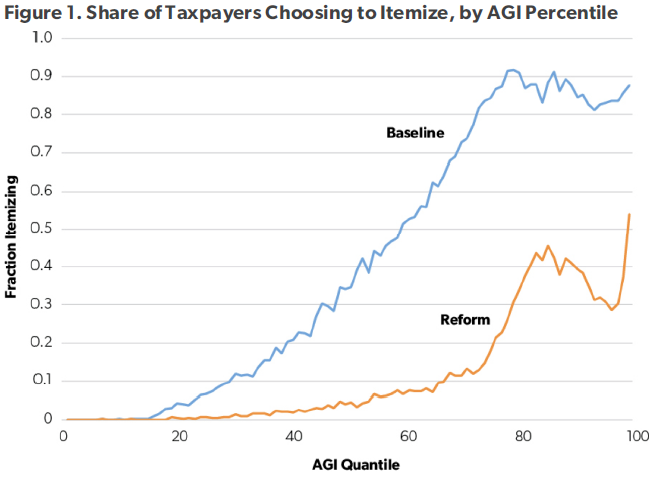
  • Effects. Base broadening by eliminating deductions will add 6.5 million new taxpayers. The number of taxpayers taking the standard deduction will increase by 37 million (from 70% to 95%). Total tax revenue will decrease by $227 billion over ten years. The effective marginal tax rate is slightly lower for most income groups.

Conclusion. The overall lower tax rates will boost economic growth. The ten year loss of tax revenue, while relatively small, is still a detriment and should be eliminated by shrinking the remaining mortgage interest deduction (which primarily benefits the wealthy).

Follow me on Twitter
Follow me on Facebook

The Political Predicament We Are In


I am an optimist by nature. I am used to having things go well.  If they’re not quite right, I try to imagine how they can get straightened out.  I’m also a realist.  As long as things are moving in the right direction, I am satisfied with the status quo.
Although my optimism is natural and intuitive, I find an intellectual justification for it in, for example, the work of Matt Ridley: “The Rational Optimist: how prosperity evolves.”  He makes a persuasive argument that not only has the humane race made huge strides in recent times but that this progress is intrinsic to evolved human nature and is likely to continue indefinitely.
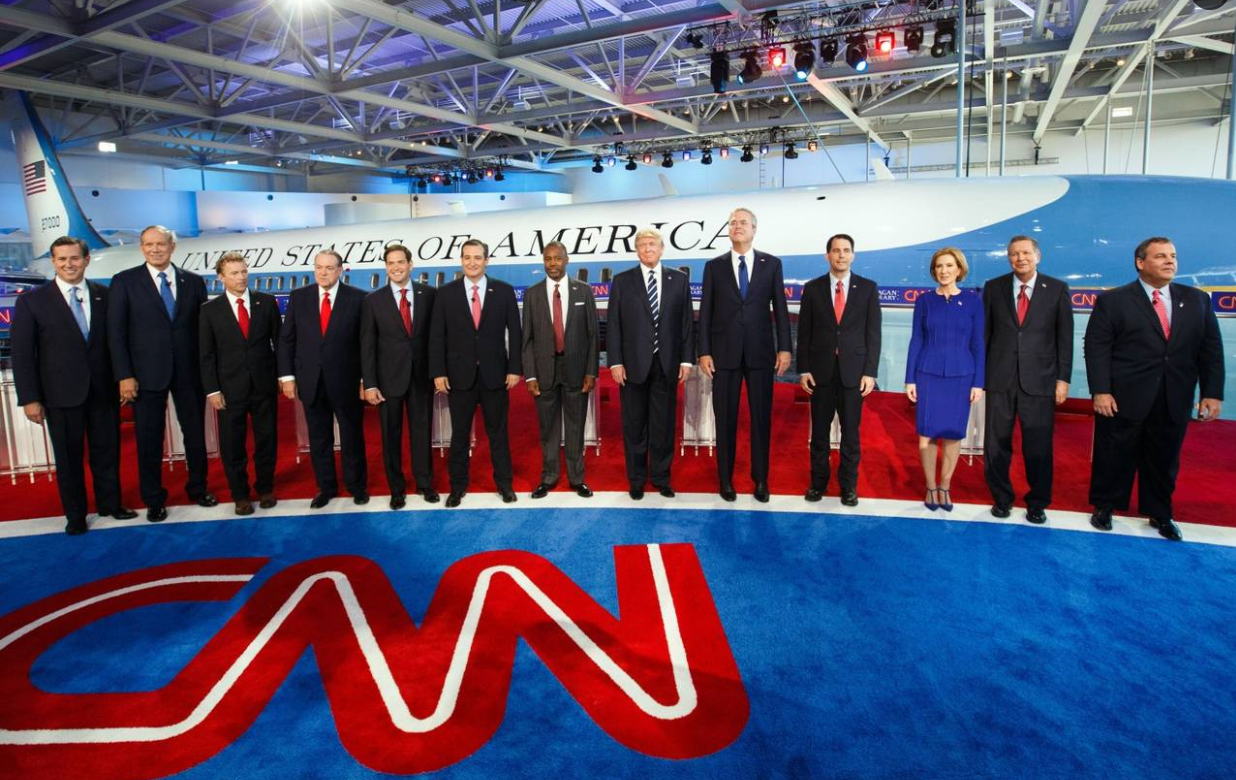
The British historian, Andrew Roberts, has a cogent essay in yesterday’s Wall Street Journal, “1776: Would You Like to Reconsider?”, expressing consternation about the horrible choice we have for president this year between vulgarity and corruption.

capture77
Mr. Roberts admonishes Republicans to:

  • Somehow find party leaders and candidates who confront people like Mr. Trump seriously from the start and do not coddle him in the vain hope that he’ll collapse.
  • Avoid having debates controlled by TV channels who want the GOP to split and the Democrats to win.
  • Avoid talking down America, even in an election year, which is likely to be misinterpreted abroad.
  • Drastically raise the percentages of support that guarantee a candidate a place in the debate in order to avoid too many candidates and moronically low standards of debate.
  • Figure out how to exclude candidates who have neither held public office nor held any previous significant (appointed) public position.
  • The Republican Party machine should have the last say on who is or is not a Republican and who can therefore stand under the Republican banner.

Of course, Mr. Robert’s suggestions are impractical because they are not sufficiently democratic! But he is pointing to a huge problem which must be addressed:  Right now democracy, as a political system, is on trial and is “losing out to the ideas of totalitarian state directed corporatism that seems to be delivering much higher growth and much better leaders.”
Question. Can democracy be saved with democratic methods?

Follow me on Twitter
Follow me on Facebook


The Grand New Party


With the presidential election tightening and Hillary Clinton still the favorite to win, more and more attention is being devoted to trying to figure out what will happen to the GOP after Donald Trump. William Galston from the Brookings Institute sees a three-headed Republican party:

  • Wall Street i.e. establishment (fiscal) conservatives.
  • Main Street i.e. small government conservatives who think that government is the main obstacle to growth.
  • Populists i.e. non-ideological working class people who feel left behind by the modern world.

The Wall Street Journal is analyzing the Trump phenomenon with a series of articles, “The Great Unraveling” based on an underperforming U.S. economy:

  • Technology has not led to broadly shared prosperity.
  • The Federal Reserve did not foresee the financial crisis and hasn’t delivered adequate growth.
  • Trade with China has put millions of Americans out of work.

Today’s WSJ, “Republicans Rode Waves of Populism until They Crashed the Party,”  describes the transformation of the Republican party all the way from Richard Nixon’s southern strategy, Pat Buchanan’s anti-immigration appeal in 1992, the Tea Party uprising in 2009 and 2010 until today’s populist rebellion against the establishment.

capture76The map above shows the huge political realignment which has taken shape between 1996 and 2012 and is undoubtedly even more pronounced in 2016. The main question for me is whether and to what extent the three main Republican factions can come together on important policy issues such as immigration and trade:

  • Immigration. In the last debate Mr. Trump said that after the border is secured, and the “bad guys” are deported, then we’ll figure out what to do with the rest of the undocumented immigrants. This suggests a workable approach to the illegal immigration problem.
  • Trade. The challenge is to figure out how to make the proposed Trans Pacific Partnership trade agreement compatible with the interests of working Americans.

Conclusion. Regardless of the outcome of the November 8th election, Donald Trump has had a huge effect on American politics.  Whichever party is most successful in appealing to the core working-class Trump voters will have a huge advantage in the 2020 elections.

Follow me on Twitter
Follow me on Facebook


How to Get Our Economy Back On Track II. Entrepreneurship!


As many commentators, including myself, have pointed out, we need faster economic growth in order to create more and better paying jobs and also to bring in more tax revenue to shrink our huge budget deficits.
The rate of economic growth equals the growth of labor productivity plus the growth of employment.  The problem is that both productivity growth and the labor force participation rate have dropped steeply in recent years.

capture63
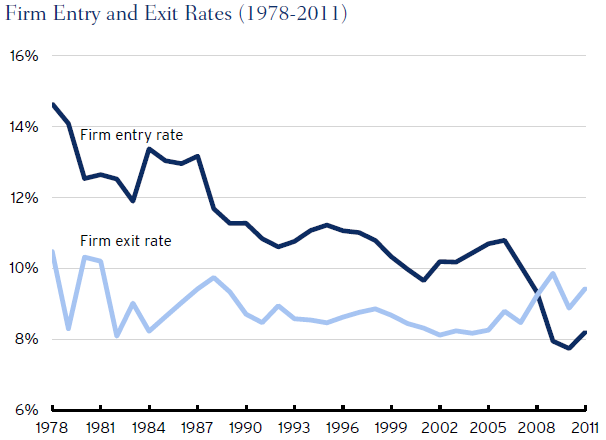
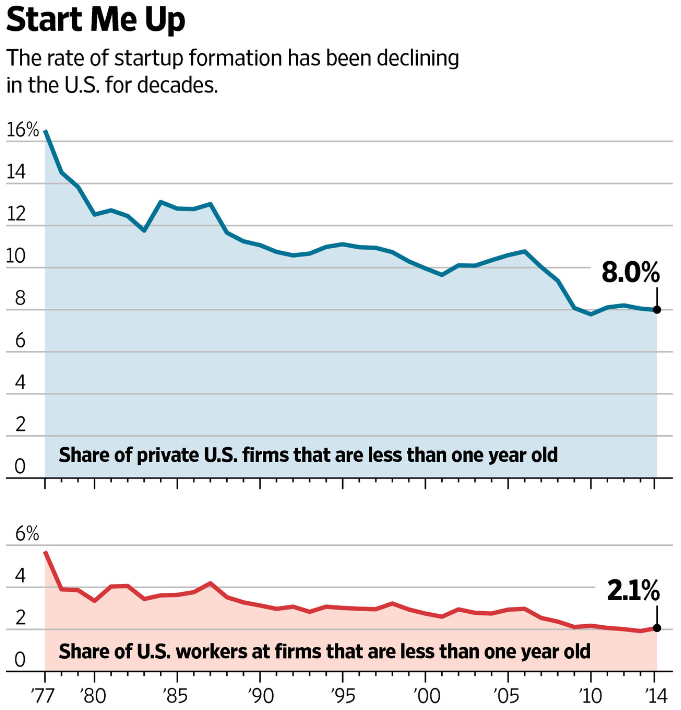
As I have pointed out in previous posts, the U.S. economy has become less entrepreneurial in recent years in the sense that there are now more firms going out of business than new firms going into business.
An article in yesterday’s Wall Street Journal has another way of looking at this.  The rate of startup formation has been declining in the U.S. for decades (as shown just below). It is obvious that figuring out how to boost entrepreneurship would do a lot to spur economic growth.

capture75
This can be accomplished with:

  • General growth measuresTax reform (lower marginal rates paid for by shrinking deductions), regulatory reform and simplification, maximum free trade to open markets, immigration reform to bring in more skilled workers, entitlement reforms to prevent a debt explosion.
  • Business tax incentives. Immediate write-off (i.e. expensing) of business investment. This encourages more investment by eliminating the need for depreciation over an arbitrary number of years. It is paid for by eliminating the deduction for interest expense to finance such investment.

Conclusion. Lots of voices are saying that technological innovation is slowing down and that only fiscal stimulus by the government can speed up growth.  Such pessimistic views will predominate unless the private sector is given the tools it needs to achieve growth in the most productive way.

Follow me on Twitter
Follow me on Facebook


The Three-Headed Republican Party


One of my favorite political and economic writers is the Brookings Institute’s William Galston who writes a regular weekly column in the Wall Street Journal.   Most recently his article, “The Three-Headed GOP After Trump, “ is particularly lucid.

capture75
Mr. Galston sees three factions in today’s Republican party:

  • Establishment conservatives who favor free trade, immigration reform, are broadly internationalist, believe in climate change, want corporate and individual tax reform, and also support entitlement reform. They would accept tax increases as part of a “grand bargain” to address our debt problem.
  • Small government conservatives ala House Speaker Paul Ryan and his “A Better Way” plan for American renewal. They believe that government is the principal obstacle to growth, especially with excessive regulation. They want major tax cuts and reductions in domestic spending as well as structural changes in Medicare and Medicaid. They are more nationalist than internationalist in outlook and oppose corporate welfare such as the Export-Import Bank.
  • Populist conservatives ala Donald Trump, many of them working class. They distrust all large institutions but do not have an ideological preference for small government. They strongly support Social Security, Medicare and Disability Insurance. They view the world outside the U.S. as more of a threat than an opportunity, and therefore oppose trade agreements and large scale immigration. “America First” is their demand.

Can these three groups coalesce into a single working majority? As I see it, Mr. Trump might have been able to accomplish this but has fallen short because he is such a sleazy individual.  Mr. Galston thinks that, after Trump, the second and third groups will be able to come together but only without the first group. I see the challenge as the traditional Republican Party, consisting of the first two groups, figuring out how to join forces with the third group.
Conclusion. A prosperous and secure future for our country depends on having a strong and viable (fiscally) conservative party.  How will this be achieved?

Follow me on Twitter
Follow me on Facebook