The High Cost of U.S. Health Care


As I indicated in my last post, ”Entitlement Spending and the National Debt,” our national debt is much too high and steadily getting worse.  Furthermore, it is entitlement spending, especially Medicare, which is the fundamental driver of our increasing debt.  If we don’t solve this problem relatively soon, we will have another financial crisis on our hands, much worse than the last one in 2008.  When interest rates go up, as they will sooner or later, then interest payments on our accumulated debt will rise precipitously and threaten to bankrupt the nation.
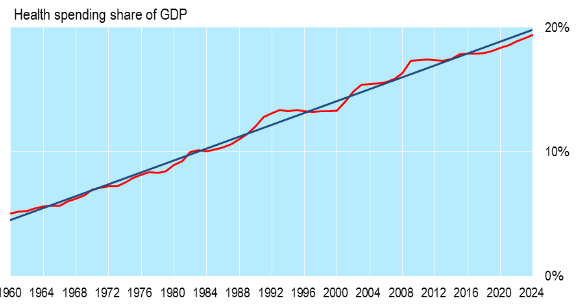
CaptureThe only effective way to control Medicare costs, however, is to control the overall cost of healthcare in the U.S., i.e. for private healthcare.  The above chart shows the nature of this problem.  Right now we are spending 17.4% of GDP on healthcare, public and private, and this is predicted to reach 19.6% of GDP by 2024.  This is almost twice as much as for any other developed country.
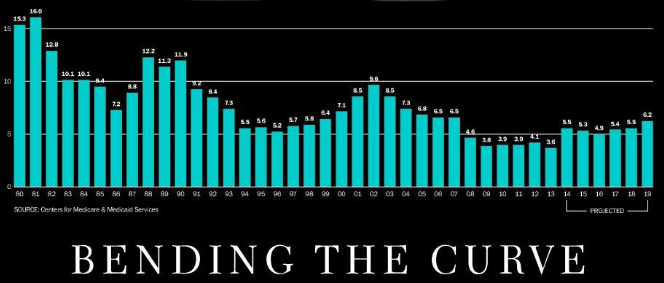
Capture6The Omaha World Herald had an article on Sunday, “Bending the Curve,” purporting to show that cost increases for total national healthcare spending are dropping (see just above).  The problem is that these supposedly low price increases in recent years are still twice the rate of inflation which is now averaging under 2% per year.  This means that even 4% – 5% price increases per year are much too high and need to be curtailed even further.
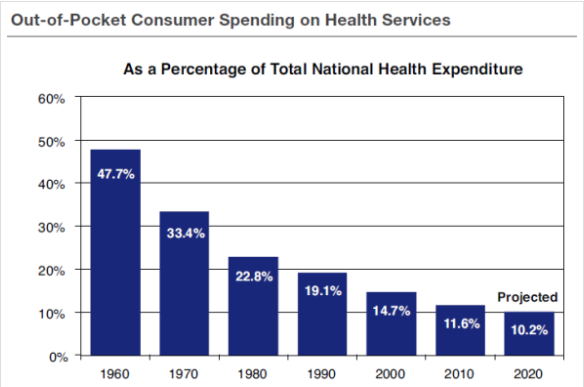
Capture10The fundamental reason why U.S. healthcare is so expensive is that Americans do not have enough “skin in the game.”  The above chart shows that our direct out-of-pocket costs for healthcare have been steadily dropping for the last fifty years as the role of health insurance has expanded.  This means that we simply don’t have enough personal incentive to hold down healthcare spending on our own.
Conclusion: We have to control entitlement spending, especially for Medicare, to get our national debt under control.  But this can only be done by limiting the steep spending increases in overall healthcare, public and private.  How will we be able to do this?  Be patient, we’re getting there!

Follow me on Twitter
Follow me on Facebook

Entitlement Spending and the National Debt


I discuss two fundamental economic and fiscal problems on this website:

  • The slow growth of our economy, only 2.1% per year since the end of the Great Recession in June 2009. This is largely responsible for stagnant wages for middle- and low-income workers, which is in turn responsible for the rise of the populist presidential candidates Bernie Sanders and Donald Trump.
  • Our massive national debt, now 74% of GDP for the so-called public part, on which we pay interest. This is the highest it has been since right after WWII.
    Capture2

Slow economic growth gets more public attention because of its direct and negative effect on so many people. However massive debt is more of an existential problem.  Right now our debt is almost “free” money because interest rates are so low.  But with debt predicted (by the Congressional Budget Office, for example) to keep climbing steadily under current policy (see the first chart) and with the inevitability of increased interest rates in the future, interest payments on the public debt are bound to rise precipitously.
Capture4The second chart just above (from the Concord Coalition) shows that interest payments on the debt will likely soon become the leading source of growth in federal spending.  But perhaps surprising is that the three non-interest sources of spending growth are the entitlement programs, Medicare, Social Security and the combined Medicaid, CHIP and ACA exchange subsidies.  All other government spending will decrease in relative terms.
Capture3Is it not readily apparent from this data that the only way to curtail a huge fiscal crisis in the not so distant future is to get entitlement spending under much better control?  The last chart, just above, (from the Trustees of SS and Medicare) shows the growth in general fund revenue required for Medicare and SS going forward.  In 2016 the discrepancy is 2.1% of GDP which amounts to $401 billion.  The discrepancy will double by 2040.  Of course, OASDI (SS) and HI (Medicare Part A) have trust funds paid into by payroll taxes.  But these trust funds are already paying out more than they take in and will be exhausted in a few years.

Conclusion. Spending on entitlement programs must be brought under much better control. How to do this will be the topic of my next post.

Follow me on Twitter
Follow me on Facebook

Evaluating the 2016 House Tax Reform Plan


The American economy is in a slow growth rut and needs to be revved up. Last week I surveyed a proposal for tax reform from the House Ways and Means Committee designed to do exactly this.
Capture11Its main features are:

  • Consolidate the seven current individual tax rate brackets into just three: 12%, 25% and 33%.
  • Dividends and capital gains are taxed at ½ of the above wage rates, depending on total income. This will encourage investment.
  • The standard deduction of $12,600 (for joint returns) is raised to $24,000 and the $4,050 personal exemption is eliminated. This means that fewer filers will itemize.
  • In fact, all itemized deductions for individuals are eliminated except for mortgage interest and charitable contributions.
  • The pass through tax rate for small businesses is capped at 25%. Full and immediate expensing for investments in new equipment and technology is allowed.
  • The corporate tax rate will drop from 35% to 20%, paid for by eliminating dozens of exemptions, including interest expensing. A territorial system will be established so that multinational firms will no longer be taxed on earnings both abroad and at home.

The non-partisan Tax Foundation has analyzed the House tax plan and concludes that:

  • The plan would significantly reduce marginal tax rates and the cost of capital which would lead over the long term to 9.1% higher GDP growth, 7.7% higher wages and an additional 1.7 million fulltime equivalent jobs.
  • The plan would reduce federal revenue over a decade by $2.4 trillion on a static basis and $191 billion on a dynamic basis.
  • On a dynamic basis, incomes for all income quintiles would increase by at least 8.4% over the long term.

Conclusion: TF’s analysis shows that the proposal is highly pro-growth.  But it should also be made revenue neutral by, for example, limiting the mortgage interest deduction as much as necessary to accomplish this. We need to make the economy grow faster but we also need to shrink our annual deficits.

Follow me on Twitter
Follow me on Facebook


How Progress Has Led to Discord


We were reminded by Robert Samuelson in yesterday’s Washington Post that America has made amazing progress in the last half century.
Consider that in 1960:

  • Men and Women held rigid gender roles.
  • African-Americans were restricted by legal segregation in the South and informal segregation almost everywhere else.
  • Homosexuality was virtually under the radar.
  • There was little environmental regulation.
  • Immigration was not an issue.
  • Defense made up 52% of government spending.

    Capture17

Think about all the (mostly) positive changes which have taken place in the meantime:

  • Women have taken paying jobs by the millions.
  • Racial segregation has been outlawed.
  • Gay rights have been established.
  • Environmental regulation has exploded.
  • Immigration, both legal and illegal, has increased.
  • Social spending has soared.
  • Defense is down to 16% of the federal budget in 2015.

Consider how our national politics is now stalemated:

  • The political system favors extremes.
  • Minorities live largely in big cities where they produce Democratic super-majorities.
  • Rural areas produce Republican super-majorities.
  • Incumbents are insulated from general election challenges which might pull them towards the center but are perpetually vulnerable to primary challenges from extremists who pull them towards the fringes.
  • Ideological purity trumps pragmatism. In the internet and cable-news era, politicians are constantly reassuring their constituents that they haven’t sold out.
  • The center sags and paralysis prevails.

Meanwhile serious national problems are getting much worse and not being addressed. Our public debt (on which we pay interest) is 74% of GDP, the highest since WWII.  The U.S. economy is growing only slowly at the rate of 2.1% per year ever since the end of the Great Recession seven years ago.  Neither presidential candidate has a credible plan to deal with these two most aggravating problems.
As a country we are in a huge mess.  How do we break out of it?  I wish I knew!

Follow me on Twitter
Follow me on Facebook


“A Republic if You Can Keep It”


Such was the response of Benjamin Franklin to an inquiry from a citizen outside of Independence Hall in Philadelphia in 1787.  Today our national government is highly dysfunctional and Congress has an especially low approval rating of 11%. U.S. Senator Mike Lee (R, Utah) believes that Congress is rightly to blame for the dysfunction.
Capture8Says Mr. Lee in an article, “The Incredibly Shrinking Congress,” in the July 11, 2016 issue of the National Review:

  • The powers vested in Congress in Article I of the Constitution are orders of magnitude stronger than the powers given to the President (Article II) or the Supreme Court (Article III). This is because legislators are closer and more accountable to the people. Here is what Congress is doing wrong:
  • Too much power is delegated to the executive branch by allowing federal agencies to write the vast majority of the laws in the form of rules, regulations and legal interpretations.
  • Congress surrenders too much authority over federal spending to the President by letting the budget process come down to a single yes or no vote up against a crisis deadline.
  • Congress delegates too much of its constitutional oversight powers to the judicial branch. The answer is to make agency rules subject to Congressional veto.
  • Unfortunately too many members have a vested interest in a weak Congress because it relieves them of the hard job of legislating conscientiously. Only a strong Congress can fix a weak Congress. For example, Congress could:
  • Require legislative approval of major new rules and reauthorizations of existing ones.
  • Modernize its budget process to make sure that all agency budgets get proper individual consideration.
  • Rein in executive discretion by, for example, directing federal judges to conduct traditional judicial reviews in challenges against the administrative state, instead of simply deferring to the agencies own interpretations.

As Mr. Lee concludes, “Putting Congress back in charge of federal policy, would put American people back in charge of Washington, regardless of who sits in the oval office.” In today’s divisive and destructive political environment, this is a very good idea indeed.

Follow me on Twitter
Follow me on Facebook

What Should Brexit Mean for the U.S.?


My two main sources of information for this blog are the New York Times and the Wall Street Journal. In particular I am always eager to read Eduardo Porter’s weekly column, Economic Scene, in the NYT.  He frames the issues very well, even though I often disagree with him on the details.
Capture17Yesterday’s column, “In Brexit and Trump, a Populist Farewell to Laissez-Faire Capitalism,” points out the similarities in the white working class support for both Brexit and for Donald Trump.  It then goes on to advocate for what the economist Larry Summers refers to vaguely as “responsible nationalism.”
I couldn’t agree more with Mr. Porter and Mr. Summers that we need policies to boost the fortunes of blue collar workers, and here are some good ways to do it:

  • Tax reform to put more disposable income in the pockets of middle- and lower-income workers, to support job creators, and to provide a big incentive for American multinational companies to bring their earnings back home for reinvestment.
  • Immigration Reform. The key here is a rigorous Guest Worker Visa program to provide immigrant employees for businesses who are unable to hire enough qualified domestic workers. At the same time, a strict eVerify enforcement system would also be established to catch illegal immigrants and deport them.
  • Free and Fair Trade. Free trade among nations has lifted hundreds of millions of people out of poverty worldwide, as well as benefitting all Americans with lower prices. What we have failed to do is to adequately help displaced workers retrain for the millions of high skilled jobs available in the U.S. which go unfilled for lack of qualified applicants.

Conclusion. Our country faces severe problems. If we don’t get deficit spending under greater control, we risk a new and more severe financial crisis.  If we can’t create more and better paying jobs for the modestly educated, we will be faced with Trump-like demagogic candidates for president every four years. It will be a huge challenge for us to extricate ourselves from this mess in a peaceful manner.

Follow me on Twitter
Follow me on Facebook

Why Free Trade Is So Important


My blog “It Does Not Add Up” addresses our country’s two major problems:

  • Slow Economic Growth, only 2.1% annually for the past seven years and
  • Massive Debt, now 74% of GDP, the highest it has been since the end of WWII.

These two problems are, of course, closely related.  Faster growth would bring in more tax revenue and reduce our annual deficits.  Shrinking the debt, as a percentage of GDP, will demonstrate that the world’s strongest economy will not falter when interest rates inevitably return to more normal (and higher) levels.
Capture5There is a strong correlation between trade and world-wide economic growth as shown in the above chart.  A recent Gallop poll found that 58% of Americans consider foreign trade an opportunity for economic growth and only 34% view it as a threat.  Not surprisingly, the opponents are lower-income, blue-collar workers who are the most vulnerable to economic change.  Consider:

  • It is technology, not trade, which is behind the loss of manufacturing jobs. Between 2000 and 2010, employment in manufacturing fell by 5.6 million. But productivity growth accounted for 85% of the job loss. Only 13% resulted from trade.
  • Since trade is not the underlying cause of job loss, protectionism is not the solution. If, for example, the U.S. imposes 45% tariffs on imports from China, production would merely shift to other low-wage developing countries in Asia. Pretty soon we’d have a massive trade war.
  • Trade Adjustment Assistance consists of extended unemployment compensation as well as retraining programs. This program misses the millions more who are unemployed due to technological change. Furthermore, extended unemployment compensation leads to deterioration of work skills. A better way to help displaced workers is to expand the Earned Income Tax Credit which supplements all low-income work.
  • NAFTA is a huge economic and foreign policy success. Trade between the U.S. and Mexico has greatly increased sine 1994 and 40% of the value of imports from Mexico consists of content originally made in the U.S. Furthermore NAFTA has promoted the growth of a large middle class in Mexico.
  • Starting in 2001 when China became a WTO member, U.S. companies became more interested in foreign investment in China and other countries and offshoring has proliferated since then. Substantially reducing the corporate tax rate would bring many of these foreign operations back to the U.S.

Trade is win-win for everyone except the production workers who lose their jobs to foreign competition. We can clearly do much more to help them maintain their standard of living.

Follow me on Twitter
Follow me on Facebook


Tax Reform for Faster Economic Growth


Several of my recent posts have been devoted to the topic of faster economic growth, see, for example, here. One way to do this is by making it easier to start and grow a small business.  Another way is with broad-based tax reform.
Capture11House Republicans have just released the outline of a plan for fundamental tax reform, “A Better Way: A Pro-Growth Tax Code for All Americans.”  It has the following main features:

  • The current seven tax brackets for individuals are condensed to just three: 12%, 25% and 33%.
  • The standard deduction of $12,600 (for joint returns) is raised to $24,000 and the $4,050 personal exemption is eliminated. This feature means that fewer filers will need to itemize deductions.
  • In fact, all itemized deductions for individuals are eliminated except for mortgage interest and charitable contributions.
  • To encourage business creation and expansion, the pass through tax rate for small business will be 25%. Full and immediate expensing for investments in new equipment and technology will be allowed.
  • The corporate tax rate will drop from 35% to 20%, paid for by eliminating dozens of tax carve-outs and deductions, including net interest expensing. A territorial system will be established whereby multinational firms will no longer be taxed both abroad and at home for the same dollar of income. This will encourage the multinationals to keep production facilities in the U.S. and to bring home foreign profits for reinvestment here.

The purpose of this plan, according to Kevin Brady, Chair of the House Ways and Means Committee, is “to rev up the economy, cut taxes on business, simplify the code and let American families file on a postcard.” The authors of the report claim that this tax proposal is revenue neutral, i.e. will not lower tax revenue, on a dynamic scoring basis, taking resulting economic growth into account.  If this assertion holds up under nonpartisan analysis, then this is an excellent proposal which deserves broad support.

Follow me on Twitter
Follow me on Facebook


The U.S. Middle Class Is Growing, Not Shrinking


One of the topics I discuss on this blog is income inequality (here, here, and here).  An interesting article in yesterday’s Wall Street Journal, “Upper Middle Class Sees Big Gains, Research Finds,” is highly pertinent to the inequality issue.
Capture1As can be seen in the above chart, the percentage of people in the middle class or above has greatly expanded between 1979 and 2014.  Furthermore, the basic research on this issue,by Stephen Rose at the Urban Institute, shows very clearly (in the chart below) what is happening: the higher is a family income, the faster it is increasing.
Capture3The best policy response to this phenomenon should be clear.  Rather than trying to decrease inequality with higher taxes on the wealthy, we should be trying to boost the less wealthy into higher income classes. The way to accomplish this is to:

  • Grow the economy faster with broad-based tax reform (lower tax rates paid for by shrinking deductions), immigration (guest worker) reform, (fair) trade expansion, and regulation reform (to help more small businesses get started). This will create more jobs and better paying jobs.
  • Improve education with early childhood education (to get minorities off to a better start in school), boosting high school graduation rates above the current 80% average (with better career and vocational education) and making college more affordable by putting more resources into community colleges and scholarships for low-income students.
  • Combat social inequality. The fraction of children with a single parent is the best predictor of upward economic mobility. The lower-income class marriage rate has dropped from 84% in 1960 to 48% in 2010. Policy should therefore focus on removing the marriage penalty in all government programs.

The basic forces of globalization and growing technology use are driving this societal change. The best way to respond is to enable more people to benefit from these basic trends.

Follow me on Twitter
Follow me on Facebook

Can the U.S. Economy Do Better VI. Does the President Matter?


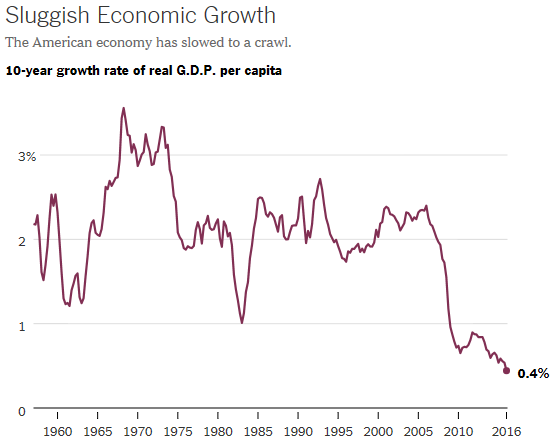
My last five posts have discussed several different aspects of the question, “Can the U.S. Economy Do Better?”  Our economy has been doing especially poorly since the end of the Great Recession seven years ago (see the chart below).  Many people claim that the President doesn’t really have all that much control over the economy.
Capture6 Here is what the2016 presidential candidates are saying on economic policy so far:

  • Hillary Clinton. She wants national paid family leave, a national minimum wage increase and more government spending on infrastructure projects. She would raise taxes by about $100 billion per year to pay for these initiatives. She is opposed to the Trans Pacific Partnership to expand trade with 11 other Pacific Rim countries.
  • Donald Trump. His top priorities are trade and immigration policy. Would he be able to successfully address China’s currency manipulation without starting a trade war? How would he be able to round up and deport millions of illegal immigrants without destroying millions of jobs and thereby crippling many businesses? His plan to slash tax rates would boost the economy but also add trillions of dollars to the debt.

As I have discussed over and over again on this blog, see, for example, here and here,  there are several fundamental policy changes needed to make our economy grow faster and create more and better paying jobs.  We need to:

  • Make it easier to start a small business by simplifying regulations at all levels.
  • Lower tax rates and simplify the tax code, paid for by shrinking deductions and closing loopholes.
  • Respond to globalization and new technology by helping its victims rather than blocking progress.

Our two presidential candidates are appealing to the fears of the voters rather than to their hopes and aspirations. Neither of them is espousing policies which will help the economy really grow in a healthy way.

Follow me on Twitter
Follow me on Facebook