How to Restore Manufacturing in America

The former CEO of Nucor Steel Company, Dan DiMicco, has written a book, “American Made: why making things will return us to greatness” describing why and how U.S. manufacturing dominance has shrunk in the past 50 years and how it can be restored.  Nucor is the largest American steel company and has never laid off an employee in its 42 years in existence, even during the recent recession.
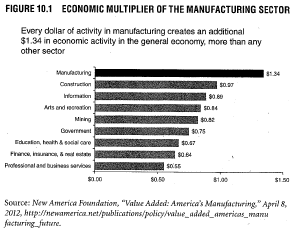
CaptureHere is Mr. DiMicco’s prescription for a return to industrial greatness:

  • Build public-private partnerships to restore the manufacturing base. For example, only $60 billion out of the $765 billion stimulus bill in 2009 was devoted to infrastructure spending.  As another example, the corporate income tax rate should be significantly lowered.
  • Level the playing field in international trade. When Germany and Japan built up huge trade surpluses in the 1970s and 1980s, the Reagan Administration responded with the Plaza Accord in 1985 outlawing foreign currency manipulation. Since then China especially has adopted a strongly mercantilist trading policy, subsidizing key industries, exporting as much as possible and importing as little as possible. No president since Reagan has insisted on equitable rule-based trade agreements where the rules are enforced.  This would help immensely.
  • Rebuild the nation’s infrastructure. Mr. DiMicco would be willing to increase deficit spending for such needs as highways, bridges, fiber-optic lines, mobile networks, and urban wastewater systems.
  • Develop our energy resources. Go all out on natural gas production by fracking. This will lower our carbon footprint and has the potential to make us completely energy independent, thereby greatly reducing our trade deficit.
  • The skills gap myth. It would help if the U.S. had better career education for high school students unlikely to go to college. But Nucor sponsors cooperative training programs at all of its locations and has no trouble finding workers.

A strong revival of U.S. manufacturing has the potential to create 30 million new jobs and thereby revitalize the American middle class.  Mr. DiMicco’s prescription makes a lot of sense.

When Liberals Blew It


“It is important and right that all privileges of the law be ours, but it is vastly more important that we be prepared for the exercise of these privileges.”
                                                                       Booker T. Washington, 1856 – 1915

My last two posts have discussed the theme of a new book by Dennis Prager, “Still the Best Hope: why the world needs American values to triumph.” Mr. Prager’s thesis is that there are three competing ideologies for the allegiance of humankind, namely Islamism, Leftism and Americanism and, furthermore, that these three ideologies are incompatible.  Any one of them succeeds at the expense of the other two.
As I said on March 8, Mr. Prager’s broad framework helps me place my own ideological views into perspective.  Here is one example of this. As everyone knows, 2015 is the 50th anniversary of the March from Selma to Montgomery.  But it is also the 50th anniversary of Daniel Patrick Moynihan’s report “The Negro Family: The Case for National Action.”  Nicholas Kristof’s Op-Ed in today’s New York Times, “When Liberals Blew It” reminds us how prescient Moynihan was about a breakdown in family structure and how reviled he was by liberals when he issued his report.  Mr. Kristof points out that:

  • In 2013, 71% of black children were born to an unwed mother (compared to 53% of Hispanic children and 36% of white children), far more than in 1965.
  • Growing up with just one biological parent reduces the chance that a child will graduate from high school by 40%.
  • A father’s absence from the home increases antisocial behavior especially for boys.

CaptureA column by the black author, Jason Riley, in yesterday’s Wall Street Journal, “Drawing the Wrong Lessons from Selma about America today,” points out that the main problem for blacks today is not racial discrimination but rather:

  • A lack of preparation for many jobs which are now available.
  • A black subculture which rejects attitudes and behaviors conducive to upward mobility.
  • That too few blacks are taking advantage of the opportunities now available to them.

In other words, more and more spending on welfare and public services is not what blacks need for further advancement.  Rather it is to stop thinking of themselves as victims and to develop a greater sense of personal responsibility.  This is the American way to get ahead!

What Are American Values?


Americans have the chance tobegin the world all over again”                                                                                          Thomas Paine, 1737 – 1809, Common Sense

As I reported in my last blog, I have been reading the relatively new book, “Still the Best Hope: why the world needs American Values to triumph” by Dennis Prager.  His thesis is that there are three competing ideologies for the allegiance of humankind: Islamist, Leftist and American and, furthermore, that these three ideologies are incompatible.  Any one of them succeeds at the expense of the other two. He identifies the American Trinity of Values as Liberty, In God We Trust, and E Pluribus Unum.
These three expressions appear on all American coins.
Capture

  • Liberty

  • Liberty is the essence of the American idea
  • Liberty necessitates small government
  • The bigger the government, the smaller the citizen
    i)           Moral character begins with taking responsibility for oneself
    ii)         Reliance on the state creates a sense of entitlement
    iii)       The smaller the government, the more the individual is needed
  • In God We Trust
  • We are “endowed by our Creator with certain unalienable rights …”
  • Judeo-Christian Values, not Judeo-Christian Theology
    i)           People are not basically good
    ii)         God-based morality
    iii)         Holiness – we are not like other animals
    iv)         Hate evil
    v)         Material well-being is one of many values
  • E Pluribus Unum – From Many One
  • Nationalism – the opposite of multiculturalism
  • American Exceptionalism – the U.S. is qualitatively different from other nations
  • America is Good – not perfect but good in comparison with other nations

The above values are selected and abbreviated from Mr. Prager’s complete list, to most accurately reflect my own views.  I strongly identify with these values which characterize America and its unique role in the world.  We are the strongest, freest and wealthiest nation the world has ever known.  For everyone’s sake let’s keep it that way!

A Provocative, Controversial and Illuminating New Book


I am currently registered as an independent.  Ideologically I am a fiscal conservative and a social moderate.  For most of my life I have been a registered Republican and have almost always voted Republican in national elections.  But most of my friends are Democrats and I often agree with them on specific issues.  So why do I identify more closely with the Republican point of view overall?  I may have finally figured it out!
CaptureI have just come across and read the provocative book, “Still the Best Hope.  Why the world needs American values to triumph” by the public intellectual, Dennis Prager.  Here is his message:

  • There are three ideologies competing for the allegiance of humankind. They are Islamist, Leftist and American. “Islamist” refers not to Muslims in general but those within the Muslim world who want to see the world governed by Sharia, or Islamic law. “Left” refers to the values associated with the western welfare state, secularism, and to contemporary socialist democratic parties. Americanism refers to the American Trinity of values: ‘Liberty,’ ‘In God We Trust,’ and ‘E Pluribus Unum’ which appear on all American coins.
  • The three ideologies are incompatible. Any one of them succeeds at the expense of the other two. All Islamists know this, many Leftists know this, but most Americanists do not know this.
  • Of the three, only Americanists do not proselytize.
  • One of the three is being promoted violently.
  • Leftism is a religion.
  • Americanism is the major impediment to Leftist success.
  • The impediments to the spreading of American ideals. Islamism and Leftism each dominate many countries. Americanism only dominates one country: America. Neither religious values, individual liberty nor market values are secure in America. Few are teaching the next generation of Americans what constitutes the American value system. The most important battle for American values is the ideological one within America.
  • Is there a fourth – Chinese – alternative? Either China will become a freer society or it will fail. It will have to affirm values beyond material success in order to succeed, as America has.


Such a stark framework as this hasn’t occurred to me before.  But it makes sense and I totally identify with Americanism as opposed to Islamism or Leftism.  This is not going to change the way I do things but it helps me understand why I am the way I am!   

We Need Fundamental Tax Reform!


Most Americans would agree that our tax code is a mess and needs major reform.  The last reform was in 1986 when the top rate was reduced from 50% to 28% and many deductions were eliminated.  However this reform effort turned out to be short lived in the sense that many of these deductions have now been added back in.  The Romney plan of 2012, cutting all tax rates by 20% in a revenue neutral way, would have been an improvement over our current system.  But, it’s gains would likely also have been only short-lived.
CaptureConsumption taxes are now being used in many parts of the world and, in recent years, the idea of a national sales tax has gained popularity in the U.S.  The so-called Fair Tax would impose a single 30% tax on all sales at the retail level.  The proponents claim that this would raise enough income to replace all federal taxes: the individual income tax, the corporate income tax, the payroll tax and the estate tax.
The tax attorney, Michael Graetz, has evidence that a 34% tax rate would be necessary to replace just the individual and corporate income taxes alone.  This is a large discrepancy.  Regardless, a major argument against the Fair Tax is that such a high single tax of 30% or higher would create a compliance problem because of the incentive for people to try to avoid paying it.
Mr. Graetz has proposed a hybrid consumption and income tax, which he calls the Competitive Tax Plan, as a more reasonable but still fundamental change to our current tax system.  Although I have discussed this proposal previously, I will summarize it again here:

  • A broad-based Value Added Tax of about 14% is enacted on goods and services.
  • Families earning less than $100,000 per year are exempted from the income tax. The tax rate would be 15% for incomes between $100,000 and $250,000, and 25% above this level.
  • The corporate income tax rate is lowered to 15%.
  • The Earned Income Tax Credit is retained and used to provide relief from the Payroll Tax for low-income families.
  • The plan is designed to be revenue neutral as verified by the Tax Policy Center.

There are many advantages of the Graetz Plan over our current system.  100 million returns, for all those with incomes under $100,000, would be eliminated.  This would, in turn, make it less politically expedient for Congress to constantly add new exemptions and preferences into the code.  Lower income tax rates for both individuals and corporations would give the economy a big boost.
The Competitive Tax Plan is an example of the type of bold, fundamental reform that we need to make to our federal tax system.

The Slow Growth Fiscal Trap We’re Now In.


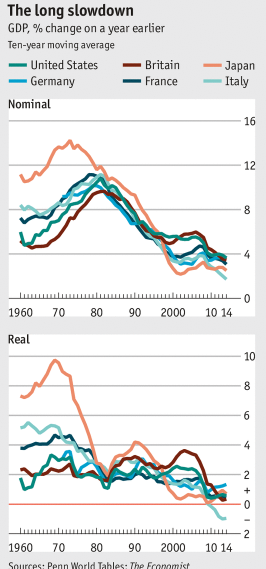
Our economy has been growing very slowly, about 2.2% per year on average, since the end of the Great Recession in June 2009.  The Congressional Budget Office predicts that this slow growth will continue indefinitely, although with a brief respite of 2.9%  growth in 2015 and 2016.  The American Enterprise Institute predicts an even lower, less than 2% growth rate, going forward.
CaptureHere’s the essence of the overall problem:

  • Slow growth keeps the unemployment level high and also means minimal raises for employed workers  The resulting economic slack leads to
  • Low Inflation. But low inflation in turn means that the Federal Reserve can try to increase growth with quantitative easing and at the same time maintain
  • Low Interest Rates to encourage borrowing. But an unfortunate side effect of low interest rates is that Congress can borrow at will and run up huge deficits without having to worry about paying interest on this “free” money. This leads to:
  • Massive Debt. But what is going to happen when inflation does take off which is bound to happen eventually? Then the Fed will be forced to raise interest rates quickly and we will be stuck with huge interest payments on our accumulated debt. When this happens, interest payments plus ever growing entitlement spending will eat up most, if not all, of the federal budget. This will almost inevitably lead to a severe
  • Fiscal Crisis.

                                                    FLOW CHART

  Slow Growth->Low Inflation->Low Interest Rates->Massive Debt->Fiscal Crisis

Of course, there are alternative scenarios.  Congress might become more responsible and cut spending and/or raise taxes.  We might luck out, so to speak, with such prolonged slow growth that inflation stays low indefinitely and interest rates never increase.  But slow growth is not pain free.  There are 20 million unemployed or under-employed Americans who want to work and whose lives are much less satisfying as a result of being idle.
Isn’t it obvious that the best response to this slow growth fiscal trap is to adopt policies to make the economy grow faster?  There are lots of things that could be done, many of which I addressed in my last post (https://itdoesnotaddup.com/2015/03/01/will-middle-class-economics-lift-us-out-of-secular-stagnation/) so I won’t repeat them here.  But I’ll be coming back to them again and again in the future!

Will ‘Middle Class Economics’ Lift Us Out of ‘Secular Stagnation’?


‘Secular Stagnation’ is the expression, made popular by the economist Larry Summers,  to refer to the present time period, since the end of the Great Recession, with slow economic growth, high unemployment, stagnant middle-class wages and increasing inequality.  It is to be contrasted with ‘The Great Moderation,’ from 1982 – 2007, with a rapidly growing economy, rising wages and stable prices.
CaptureMy last post, “Does ‘Middle Class Economics’ Really Work,” discusses President Obama’s attempt to appeal to middle-class families with policies such as:

  • Tax and regulatory provisions such as tax credits for childcare, college tuition, and second earners in two parent households; also requiring paid sick leave and a higher minimum wage.
  • Expanding access to community colleges to make workers more productive.
  • Increased infrastructure spending to boost employment.

The problem with this strategy is that it is much too weak to combat the huge headwinds opposing it.  In addition to the well-known effects of globalization and technological advance, consider the demographical challenge described below:

OECD old age support ratio:  the number of workers aged 20-64 relative to those aged over 65
Capture1
As is very clear from this chart, the demographics are just going to keep getting worse and worse and will be very bad indeed by 2050.
Here is a surprising quote from Mr. Summers: “To achieve growth of even 2 percent over the next decade, active support for demand will be necessary but not sufficient.  Structural reform is essential to increase the productivity of both workers and capital, and to increase growth in the number of people able and willing to work productively.  Infrastructure reform, policies to promote family-friendly work, support for exploitation of energy resources, and business tax reform become ever more important policy imperatives.”
I would add several additional policy changes which would speed up change in this direction:

  • Reform (but not repeal!) the Affordable Care Act by eliminating all mandates. This would incentivize businesses to move part-time employees to full time. Tax credits and subsidies provide enough incentive for individuals to become insured.
  • Regulatory reform to make it easier to start a new business.
  • Raise the age limits for both Social Security and Medicare to encourage people to work longer.
  • Reform disability insurance to make it more difficult to be declared disabled.
  • Tighten up welfare requirements to require all able-bodied adult recipients without dependents to work.
  • Reform immigration with guest-worker visas for needed foreign workers.

We need to get serious about boosting our labor participation rate in order to grow the economy faster.  Happy talk about ‘middle class economics’ will simply not do the trick!

Does ‘Middle Class Economics’ Really Work?


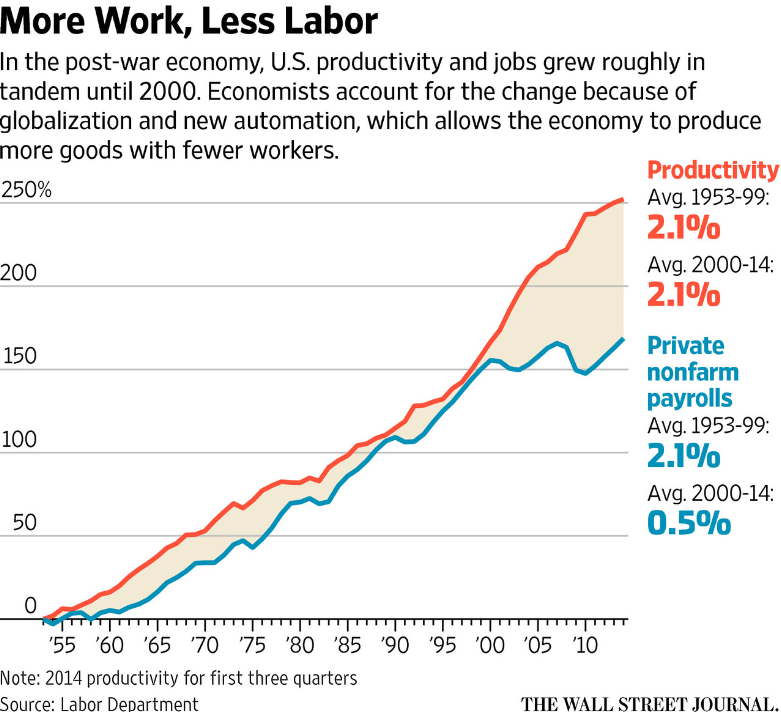
An article in yesterday’s Wall Street Journal, “What Clever Robots Mean for Jobs,”  illustrates the stark fact that “automation is commandeering much middle-class work such as clerk and bookkeeper, while creating jobs at the high- and low-end of the market.  This is one reason the labor market has polarized and wages have stagnated over the past 15 years.”
CaptureThe above chart shows the divergence between productivity growth and payrolls beginning in the year 2000.  It is a vivid portrayal of the “hollowing out” of the middle class which is causing so much grief.
Now let’s turn to a column in today’s New York Times, “What Is Middle-Class Economics,” by the journalist, Josh Barro.  The term, of course, refers to the policies by which President Obama hopes to appeal to the millions of middle-class families with stagnant incomes. According to Mr. Barro, the President’s policy proposals have three facets:

  • Tax and regulatory provisions such as tax credits for childcare, college tuition and a second earner in households where both parents work. Employers would be required to provide paid sick leave and the minimum wage would be raised.
  • Make workers more productive by expanding access to community college.
  • Increase overall economic growth with increased infrastructure spending and new trade agreements.

The problem, as Mr. Barro points out, is that such policies would have only a small effect on the taxes of a middle-income family, amounting to a cut of no more than $150 per year on average.  This is much less than the average family will save from falling gasoline prices.
On the other hand, it is generally understood that stagnant middle-class wages will not rise very much until the labor market becomes tighter as a result of falling unemployment.  Mr. Barro suggests that the government can help this process along in two ways:

  • By the Federal Reserve holding down interest rates, or at least letting them increase only very slowly.
  • With policies to make it easier to work less. The Affordable Care Act does this by decoupling health insurance from full time work. The surge in disability insurance recipients takes people out of the labor market. The rapid retirement of baby-boomers does the same thing.

Unfortunately there are many negative effects from both the Federal Reserve’s easy money policy as well as a shrinking labor participation rate.  I will return to this issue soon!

How Do We Speed Up Economic Growth?


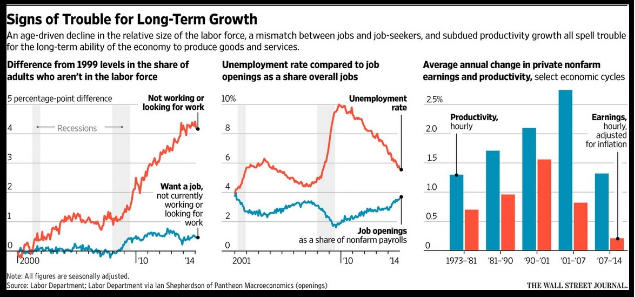
The 2015 Economic Report of the President has just been released.  It shows that the slow growth of productivity is playing a bigger role in squeezing middle class incomes than the rise of economic inequality.
CaptureThe above chart makes some dire predictions:

  • The labor force, which has averaged 1.5% growth since 1950, is likely to grow just .5% a year in coming decades, because any increase in new workers is likely to be swamped out by baby-boomer retirements.
  • Productivity has grown just 1.3% a year since the end of the last expansion in 2007.
  • These two figures together predict an anemic, less than 2% growth, economy going forward.

The President proposes several policies to address this slow growth:

    • Immigration Reform would provide more highly skilled workers for the economy as well as a more efficient guest worker system for low-income labor.
    • Increased Foreign Trade would expand our export economy.
    • An Expanded Workforce could be achieved with a higher Earned Income Tax Credit to boost dual-income households.
    • An increase of Infrastructure spending of 1% of GDP is estimated to boost output by 2.8% after 10 years.
    • Corporate Tax Reform would encourage U.S. multinationals to bring their foreign profits home for reinvestment.

These are good ideas but much more could be done as well:

  • Individual Income Tax Reform, exchanging lower tax rates for all by closing loopholes and deductions would boost spending by middle- and lower-income tax payers.
  • Reforming Social Security and Medicare by setting higher retirement ages would encourage longer work lives.
  • Reforming the Affordable Care Act by removing the employer mandate would boost productivity by making the labor market more efficient.

Faster economic growth will not only reduce unemployment, it will also make it much easier to shrink the deficit as more tax revenue is raised.  This should be one of the very highest priorities for our elected representatives in Washington!

The Financial Crisis IV. Where Do We Go From Here?


“It was a great mistake to push lower-income people into housing they couldn’t afford and couldn’t really handle once they had it.                                                                    former Congressman Barney Frank, 2010

“Only by understanding the factors that led to and amplified the crisis can we hope to guard against a repetition.”
                                                   former Federal Reserve Chair, Ben Bernanke, 2010

As I explained in my last post, my views on the financial crisis are most heavily influenced by John Allison, President of the CATO Institute; Sheila Bair, former Chair of the FDIC; and Peter Wallison, a financial policy analyst at the AEI, as follows:

  • The primary cause of the crisis was the affordable housing policy, created by Congress and administered by HUD, under which higher and higher percentages of mortgages acquired by the GSEs Fannie Mae and Freddie Mac had to be made to low and moderate income borrowers. This policy, aided by the very low interest rates maintained by the FED from 2002-2004, created the housing bubble which burst in 2007 leading to an unprecedented number of delinquencies and defaults.
  • Subprime lending abuses could have been avoided if the FED had used the authority it had under the Home Ownership Equity Protection Act of 1994 to require appropriate mortgage lending standards. In other words, lax regulation, but not deregulation, was a major contributor to the crisis.
  • Investment Banks, such as Bear Stearns and Lehman Brothers, magnified the misallocation of credit to the housing market with financial products such as CDOs and derivatives.

Clearly congressional action was needed to address the financial abuses leading up to the crisis.  But the Dodd-Frank Act is an overreaction.  It requires 398 new regulations which are taking a big toll on the economy as shown by the chart below from the American Action Forum.
CaptureDodd-Frank should be scaled back so that its provisions apply only to the very largest financial institutions where the abuses were the greatest.  This can be accomplished with capital requirements which increase proportionally with the size of the institution so that smaller banks are better able to compete with the giants.
Faster economic growth is critical for our future.  It will not only create more jobs and higher paying jobs but will also alleviate our deficit problem by bringing in more tax revenue.  Paring back and streamlining Dodd-Frank would be a big step in the right direction.