Should the National Minimum Wage Be Raised?


A recent column by David Brooks in the New York Times, “Minimum Wage Muddle,” is a good summary of the pros and cons of raising the minimum wage for the whole country. Mr. Brooks refers to a recent Congressional Budget Office report that a hike in the minimum wage to $10.10 per hour might lift 900,000 out of poverty but would also likely mean a loss of 500,000 jobs.

Capture5As suggested in a recent post, one of the things we could do to get beyond our political dysfunction at the national level is to:

  • Put a greater emphasis on state-centered federalism both to encourage experimentation and innovation in the American system and to remove issues from the national agenda which contribute to division, stalemate and endless controversy.
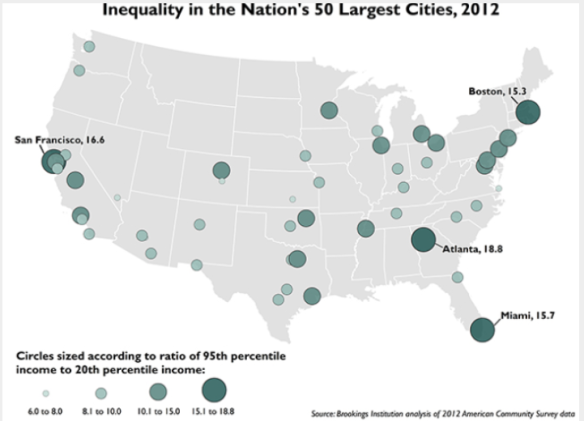
    Capture4Considering that income inequality varies so greatly from one part of the country to another, (see above), it makes a lot of sense to federalize the minimum wage issue. In other words, let cities and states set their own minimum wage levels based on their own local circumstances.
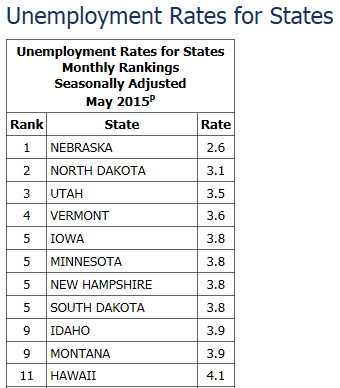
    For example, the state of Nebraska, with very little inequality and where I live, has just raised its minimum wage to $8/hour ($9/hour beginning January 2016). Nebraska’s lowest in the country unemployment rate of 2.6% means that hardly anyone will lose their job.
    As Mr. Brooks says, “Raising the minimum wage will produce winners among job holders from all backgrounds, but it will disproportionately punish those with the lowest skills, who are least likely to be able to justify higher employment costs.”
    Conclusion: raising the national minimum wage is not the best way to address the inequality and fairness issue. A better way is to create more jobs by boosting the economy overall. Then help low wage workers take home more money with a (perhaps expanded) Earned Income Tax Credit. Cities and states can establish their own individual minimum wages however they wish.
The Moral Case for Free Enterprise


Capitalism is under attack around the world as Greek socialists complain about their hard- hearted EU creditors, American liberals such as Bernie Sanders and Elizabeth Warren push the Democratic Party to the left, and Pope Francis compares the excesses of global capitalism to the “dung of the devil.”
CaptureOne of my favorite economic commentators is Arthur Brooks, President of the American Enterprise Institute.  One of his books is “The Road to Freedom: How to Win the Fight for Free Enterprise,” which examines the most important economic issues facing the United States from a moral point of view.  For example:

  • Getting the U.S. Economy Growing Again. Weak economic growth means the end of opportunity in America. Furthermore, weak growth disproportionately hurts those who most need new economic opportunities: the poor. One strategy says that the key to restarting economic growth is the state: more stimulus, more taxes, more borrowing. A second strategy says the source of economic growth is free enterprise: tax reform, less government regulation, policies that make it easier for entrepreneurs to succeed, and a smarter immigration policy.
  • Putting America Back to Work. Jobs are not just a source of money for Americans; they are a ticket to earned success. High unemployment is unfair because it robs people of their potential fulfillment. It is especially harmful to the poor and the young. The key to job creation is to get the economy growing faster.
  • Getting the United States Out of Debt. Unless the U.S. reduces deficits, it will have just three choices: steal from future generations, inflate the currency to lower the value of the debt or refuse to pay those to whom it owes the money. All of these options are immoral because they are unfair: they harm others who have done no harm to America. Three points here: 1) we have out-of-control entitlement spending, 2) debt crises are more successfully dealt with through spending reductions than with tax increases and 3) there are no quick fixes.

Considering basic economic and fiscal issues from a moral perspective adds an important new dimension to the discussion.  We might disagree on the details of how to proceed but it is imperative to take effective action of some kind!

The High Cost of Less Austerity


All eyes are focused on the drama playing out in Greece.  The Greeks have just voted not to accept Europe’s latest offer to keep the credit flowing, amounting to a 5% of Greek GDP income transfer from their European neighbors, in return for additional economic reforms to put the country on a path to self-sufficiency.
Capture1The New York Times declares, “For Europe’s Sake, Keep Greece in the Eurozone,”  that the European Union should “offer some path forward for the Greek economy, starting by writing down its huge and unpayable debts.”  More than likely EU leaders will work out a new agreement with Greece to enable it to remain in the EU and the Eurozone.  Greece is lucky to be in such a position.
In a recent post, “Could the U.S. End up Like Greece? II. How Long Will It Take?”, I pointed out that the U.S. is likely to have a public debt of 175% of GDP by 2040, the same level as the Greek debt today.  Furthermore interest rates are likely to be higher than their unusually low level today which means that we will be making proportionally higher interest payments at that time.  In other words, we are likely relatively soon, within 25 years, to have a painfully high level of debt.
Who is going to bail us out when our own debt becomes “unpayable”?  Obviously, no one!  Right now the austerity and pain caused by the Greek debt is confined to the 11 million people in Greece.
Which is better?  For us to bite the bullet now and get our fiscal house in order by, for example, moving towards annual balanced budgets Or to wait until our debt becomes unbearable and there is no one to bail us out?
We are so big that if this ever happens and drastic measures have to be taken, much of the world will be drawn into the suffering along with us.  It won’t be a pretty sight!

Letting Young People Drift and the Liberal Disconnect


The New York Times had an excellent lead editorial on Sunday, “The Cost of Letting Young People Drift,” describing how 5.5 million young Americans, ages 16 – 24, are neither working nor in school.  “At a time when the economy is requiring workers to have higher levels of skills, one in seven of America’s young adults can’t even get started.”
CaptureThe NYT editorial is based on new research, “Zeroing In on Place and Race: youth disconnection in America’s cities” performed by Measure of America.  The report points out that the problem has gotten much worse since the Great Recession in 2008, as shown in the chart below.
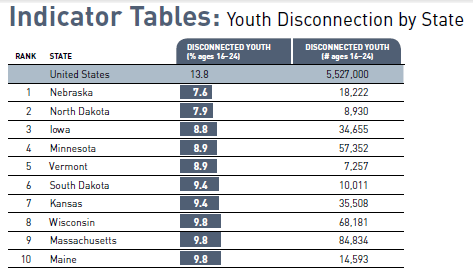
Capture1It also breaks down the youth disconnection rate by state.  For example, Nebraska (7.6%), North Dakota (7.9%) and Iowa (8.8%) have the lowest percentages, while Mississippi (18.5%), West Virginia (19.6%) and Louisiana (19.8%) have the highest percentages (as shown below).
Capture2Capture3But also look at the latest “Unemployment Rates for States” published by the Bureau of Labor Statistics.  There is a very close connection between a state’s unemployment rate and its youth disconnection rate, as shown below. In other words, one of the best ways to keep young people connected is to give them a better chance of finding a job.
Capture4Capture6But it requires faster economic growth to provide more jobs.  Just yesterday the NYT had an editorial, “Obstacles to Economic Growth,” lamenting our very slow rate of economic growth of about 2.2% for the past six years.  According to the NYT, “What’s needed most is public and private investment in the economy sufficient to support strong growth and rising productivity.”  The editorial then goes on to berate Congress for being more interested in budget cuts than in new spending programs to stimulate the economy.  According to the NYT, “the pathway to prosperity is clear for leaders who will dare to take it.”
The NYT thus recognizes the need for more private investment to stimulate the economy but has no apparent interest in policy measures to encourage it.  How can a news organization as sophisticated as the NYT be so passionate about wanting to improve society and so clueless about the best way to do it?

Why Is U.S. Productivity Growth Declining?


The economist Alan Blinder has just reported, “The Mystery of Declining Productivity Growth” that U.S. productivity growth has fallen dramatically in the last few years.  “The healthy 2.6% a year from 1995-2010 has since been an anemic 0.4%.  What’s scary is that we don’t know why.”
CaptureThe economists Edward Prescott and Lee Ohanian believe the productivity slowdown is caused by a corresponding slowdown in new startups (as illustrated by the above chart).  They point out, for example, that:

  • The creation rate of new businesses in 2011 was 30% lower than the average rate of the 1980s.
  • New startups are critical for growth since many of today’s heavyweights will decline as new businesses take their place. For example, only half of the Fortune 500 firms in 1995 remained on that list in 2010.
  • Startups in high technology have also declined since 2000 even though there is no slowdown in the development of new technology.

Consistent with the recommendations of James Bessen in a recent post of mine, “Learning by Doing,” Messrs. Prescott and Ohanian recommend policy changes such as:

  • Better training, plus immigration reform, to produce more skilled workers.
  • Streamlining regulations that raise cost, especially for small businesses.
  • Tax reform to reduce marginal tax rates.
  • Reforming Dodd-Frank to make it easier for small businesses to obtain loans from main street banks.

In today’s New York Times, the economist Tyler Cowen wonders whether our economy is in the midst of a “Great Reset.”  “Perhaps the most crucial issue is whether economies will return to normal conditions of steady growth, or whether we are witnessing a fundamental transformation” to a less productive economy.
Here’s another way to put it: shall we attempt to adopt better pro-growth policies or shall we just give in to the status quo and accept that we can’t do any better?  Are we optimists or are we pessimists?

Baltimore Is About Economics, Not Racism


The death of another black man at the hands of the police, this time Freddie Gray of Baltimore, has again set off a national debate about poverty, inequality and racial injustice.
CaptureThe Washington Post journalist Marc Thiessen wrote about this several days ago in, “The Baltimore Democrats Built,” saying that:

  • Although 63% of Baltimore residents are black, so are 40% of police officers.
  • City officials injected $130 million into the Sandtown-Winchester community (where the riots took place) in a failed effort to transform it.
  • The poverty rate in Baltimore is 24% compared with 14.5% nationally.
  • The unemployment rate for black men in Baltimore between the ages of 20 – 24 is 37%.
  • Among the nation’s 100 largest counties, the one where children face the worst odds of escaping poverty is the city of Baltimore.
  • In 2014, Baltimore public schools ranked third in the country in per-pupil spending, yet 55% of Baltimore fourth graders scored below basic in reading.
  • In the Sandtown-Winchester community, nearly half of all high school students missed at least 20 days of school in 2011.
  • This community’s murder rate is double the average for Baltimore, which in turn had the fifth highest murder rate last year among major U.S. cities.

In other words, Baltimore’s problems cannot be blamed on racial prejudice or on a lack of resources to combat poverty and low educational performance.  Clearly needed are better schools and more employment opportunities.  Better state and local leadership would help in this respect. But what is most needed is faster economic growth for the whole country.  There are many things which could be done to accomplish this.  It’s a shame that our current political system is too fractured to allow this to happen.

The Social Effects of Income Inequality


It is well understood that income inequality is increasing in the U.S. for a number of reasons: economic globalization, the rapid development of new technology and the slow recovery from the Great Recession of 2007 – 2009.
CaptureThe New York Times’ economics journalist, Eduardo Porter, discusses the social effects of this ominous trend in the article “Income Inequality Is Costing the U.S. on Social Issues.” For example:

  • The U.S. has the highest teenage birthrate in the developed world – seven times the rate in France, for example.
  • More than one out of four U.S. children lives with one parent, the largest percentage by far amongst industrialized nations.
  • More than a fifth of U.S. kids live in poverty, sixth from the bottom among the OECD.
  • Among adults, seven out of every 1000 are in prison, five times the rate for other rich democracies and three times the U.S. rate from four decades ago.
  • In 1980 the infant mortality rate in the U.S. was about the same as in Germany. Today it is almost twice the rate as for German babies.
  • American babies born to white, college educated, married women survive as often as those born to advantaged women in Europe. It is the babies born to nonwhite, non-married, non-prosperous women who die so young.

In other words, there is huge social disparity between the well-off and the poor in the U.S. and, furthermore, the resulting social breakdown is getting worse. Why has this been happening?
Conservatives say that it is the fault of a growing welfare state which has sapped Americans’ industriousness and sense of self-responsibility.  Liberals say that welfare programs arn’t extensive enough to withstand the strict demands of globalization and technological development.
Mr. Porter concludes that, “the challenge America faces is not simply a matter of equity.  The bloated incarceration rates, rock-bottom life expectancy, unraveling families and stagnant college graduation rates amount to an existential threat to the nation’s future.”
I tend to agree.  Is our democratic political process capable of responding in a satisfactory manner?  I will return to this theme often in the coming months!

Providing Regulatory Relief for Main Street Banks

The major congressional response to the Financial Crisis was the passage of the Dodd-Frank Act in 2010, putting many restrictions on U.S. financial institutions in hopes of ending “too big to fail.”  The problem is that the new regulations often apply to the many low risk, traditional, main street banks which did not cause the financial crisis.  The new regulations hamper the ability of these smaller banks to lend money to their regular customers, thereby slowing down the economic growth we need for full recovery from the recession.
CaptureThomas Hoenig, Vice Chair of the Federal Deposit Insurance Corporation, has recently made some common sense recommendations for alleviating this problem.
He proposes to provide relief for financial institutions which meet the following criteria:

  • Banks that hold zero trading assets or liabilities.
  • Banks that hold no derivative positions other than interest rate swaps and foreign exchange derivatives.
  • Banks whose total value of all derivative exposures is less than $3 billion.
  • Banks which have a ratio of equity-to-assets of at least 10%. Most community banks meet this criteria and the number is within reach for those which do not.

Of more than 6500 commercial banks, only about 400 do not meet the first three criteria.  None of the banks with more than $100 billion in total assets meet these criteria. Banks which qualify could receive relief such as:

  • Exemptions from Basel capital standards and risk-weighted asset calculations.
  • Allowing for examiner judgment in eliminating requirements to refer “all possible or apparent fair lending violations to Justice” if judged to be de-minimis or inadvertent.
  • Exemptions from appraisal and stress test requirements.
  • Allowing an 18-month examination cycle as opposed to the current 12-month cycle.

Mr. Hoenig’s conclusion: “For the vast majority of commercial banks that stick to traditional banking activities, and conduct their activities in a safe and sound manner with sufficient capital reserves, the regulatory burden would be eased.  For the small handful of firms that have elected to expand their activities beyond commercial banking, the additional regulatory burden is theirs to bear.”

Are We Doing Enough to Help the Poor?


Income inequality in the U.S. is getting worse and one reason is that the middle class is being “hollowed out” by a lack of sufficient job opportunities.
CaptureThe result is more people at the bottom end of the income scale.  Not surprisingly, it turns out that many of these low-wage workers are receiving public assistance, as documented by the UC Berkeley Labor Center, and the New York Times.
Capture1The authors point out that if these workers received higher wages, they would not require as much public support which, in turn, would save money for the taxpayers.  This is a true but not a practical means for helping the poor.  Employees are paid what they’re worth based on the law of supply and demand.  Companies will pay as much as they have to in order to find and retain well qualified workers.  Furthermore, a minimum wage which is too high will simply lead to a higher rate of unemployment.
There is really only one good way to raise the overall wage level, especially at the bottom end of the scale.  It is to speed up economic growth, thereby lowering the unemployment rate and creating more demand for workers.
This is exactly what has happened in Omaha NE where I live.  The official unemployment rate is 3.2% and there is a labor shortage.  A new minimum wage ($8/hour now, $9/hour next January) was approved by the voters last November.  But low-skill entry level jobs are paying $10/hour or more because of the scarcity of workers.
There are plenty of opportunities to succeed in Omaha.  Support yourself with a low-wage job and go to Metropolitan Community College to learn a high-skill, high-wage trade.  Most people are capable of following this route to a better life!

Can We Solve All Our Fiscal and Economic Problems at the Same Time?


This website, It Does Not Add Up, is devoted to discussing our country’s most serious economic and fiscal problems.  They are:

  • Stagnant Economy. Since the end of the Great Recession in June 2009, the economy has been growing on average at the historically slow rate of about 2.3%. Slow growth means higher unemployment, stagnant wages and less tax revenue.
  • Massive Debt. U.S. public (on which we pay interest) debt is now 74% of GDP (highest since WW II) and projected by CBO to grow rapidly unless strong measures are taken to reduce it. This puts our country’s future wellbeing and prosperity at great risk.
  • Increasing Income Inequality. Incomes for the high-skilled and well-educated are increasing much faster than for the low-skilled and less-educated workers.

The new Republican majorities in Congress are stirring the waters by proposing a ten year plan to shrink the deficit down to zero, i.e. to balance the budget by 2025.  The opposition claims that this would “sharply cut the scale of domestic spending, which would mostly fall on the poor.”
Capture1But the American Enterprise Institute’s James Pethokoukis points out that social spending in the U.S., both public and private, is very generous and second only to France in the entire OECD. So here is how we could proceed to address our basic problems in a unified manner:

  • Balance the Budget by a combination of Republican spending cuts and cutting back on two major tax deductions: Employer-sponsored Health Insurance (cost: $250 billion per year) and Mortgage Interest (cost: $70 billion per year).
  • Boost Economic Growth by expanding the Earned Income Tax Credit to encourage more people to accept low paying, entry level jobs. Increase the Social Security eligibility age from 67 to 70, thereby keeping near retirees in the workforce for three additional years (this will also extend the solvency of the Social Security Trust Fund).
  • Decrease Income Inequality. Cutting back on tax deductions, in part to pay for expansion of the EITC, lessens income inequality as well as shrinking the deficit. A faster growing economy also lessens inequality by providing more opportunities for upward mobility.

In other words, addressing each of these fundamental problems in an intelligent manner contributes to solving the remaining problems as well.  This creates a virtuous circle for economic progress!