The Federal Reserve Cannot Revive the Economy by Itself


The Great Recession caused by the financial crisis ended in June 2009.  In the intervening five years the U.S. economy has grown at the anemic annual rate of 2.2%.  In an attempt to speed up growth the Fed has injected $4 trillion into the economy and kept short term interest rates near zero during this time period.  Fed Chair Janet Yellen recently gave her semiannual report to Congress and, according to the American Enterprise Institute’s John Makin, “Fed Chair Yellen puts on a brave face.”  She said that “If economy performance is disappointing, then the future path of interest rates likely would be more accommodative than currently anticipated.”
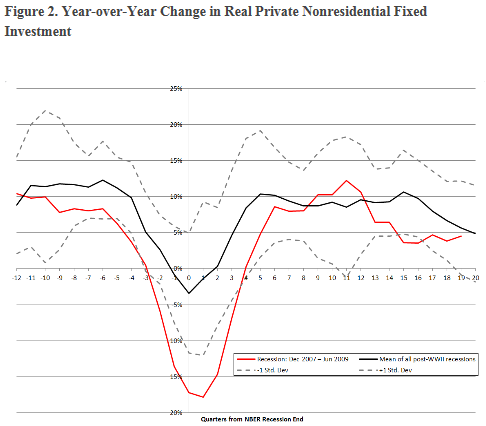
CaptureCapture1Mr. Makin adds that “Eventually the realization will dawn that the only way to get the economy moving again is to work on the supply side.  Specifically, that means undertaking measures to boost investment and produce a rising capital stock which will boost labor productivity, hiring, and GDP growth without inflation.” He suggests that three measures to boost capital spending are:

  • Enactment of accelerated depreciation provisions and investment tax credits.
  • A sharp reduction in the corporate tax rate from 35 to 15 percent to induce corporations to repatriate the $1.59 trillion in accumulated profits being held abroad.
  • A concerted White House-led effort to set a clear, less burdensome path for healthcare and other regulatory measures as a means to reduce investment dampening uncertainty.

I would add a fourth measure:

  • An across the board lowering of individual tax rates (offset by closing loopholes and deductions which primarily benefit the wealthy) in order to boost personal consumption which has been highly depressed due to stagnant wage growth and high unemployment.

In other words there are clear and straightforward measures which our national leaders can take to speed up the economy.  ‘If there is a will, there’s a way’ and incumbents should be held responsible for inaction come the elections in November!

The Truth behind the Latest Job Figures


Mortimer Zuckerman, writing a few days ago in the Wall Street Journal, “The Full-Time Scandal of Part-Time America,” points out that the latest employment figure of 288,000 net jobs created in June is highly misleading.  “Full-time jobs last month plunged by 523,000, according to the Bureau of Labor Statistics.  What has increased are part-time jobs.  They soared by about 800,000 to more than 28 million.” Mr. Zuckerman goes on to say, “Since 2007 the U.S. population has grown by 17.2 million, according to the Census Bureau, but we have 374,000 fewer jobs since a November 2007 peak and are 10 million jobs shy of where we should be.”
CaptureInterestingly, the New York Times discusses the same problem from a different point of view, ”A Push to Give Steadier Shifts To Part-Timers”.   The NYT does recognize that there are now about 7.5 million part-time workers who would prefer full time employment but are unable to find it.  But the emphasis is on giving them more advance notice for changes in work schedules.
The only way that we’ll get what we really need, more jobs, more good jobs and more fulltime jobs, is by faster economic growth beyond the anemic 2.2 average growth rate since the recession ended five years ago.  Here are several ways to accomplish this:

  • The most obvious and immediate thing we should do is to lower the corporate tax rate from its currently highest in the world level of 35%. This will stop the hemorrhaging of U.S. companies moving overseas and encourage multinational corporations to bring their profits home and reinvest them in the U.S.
  • Broad-based individual tax reform, with lower tax rates for all, offset by closing loopholes and shrinking deductions which primarily benefit the wealthy. This will put more money in the hands of the two thirds of Americans who do not itemize their tax deductions. Since these are the middle and lower income wage earners with stagnant incomes, they will spend their extra income thereby giving the economy a big boost.
  • The employer mandate in Obamacare is responsible for some of the shift from fulltime to part-time employment, and should be repealed (it has already been suspended for two years by the Obama Administration).

These are just common sense reforms which should be doable by Congress without a huge ideological fight.  We badly need leadership capable enough to do this!

A Recovery Stymied by Government?


Why has the recovery from the Great Recession of 2007 – 2009 been so slow?  Many mainstream economists blame structural problems in the economy such as more global competition for business and technological progress which replaces people by machines.  Other economists blame greatly increased government regulation since 2009 such as the Affordable Care Act in healthcare, The Dodd-Frank Act for finance and many new regulations from the Environmental Protection Agency.
CaptureThe economist Casey Mulligan, writing in yesterday’s Wall Street Journal, “A Recovery Stymied by Redistribution”, makes a case that government programs designed to alleviate the effects of the recession have made it deeper and more prolonged.  Such actions include:

  • Long-term unemployment insurance
  • Looser restrictions on food stamps which do not require recipients to seek work
  • Mortgage assistance programs which set mortgage payments at “affordable” levels
  • New rules for consumer bankruptcy with special emphasis on current earnings

Mr. Mulligan’s point is that all of these new programs, like taxes, reduce incentives to work and earn.
But, by definition, structural effects are endemic and can’t be overturned.  Also, some government reaction to the financial crisis, in order to prevent recurrence, was inevitable.  And it is natural for the government to be responsive to the human misery caused by the recession.  All of these points of view help us understand what has happened but don’t provide much guidance for boosting economic growth going forward.
The Great Recession was fundamentally caused by the bursting of the housing bubble which destroyed trillions of dollars of wealth for tens of millions of Americans.  The recovery won’t speed up until many more millions of consumers feel comfortable in spending more money. We need to put more money in their pockets.
A very good way to accomplish this, as I have been saying over and over again, is through fundamental tax reform.  The idea would be to lower individual income tax rates for everyone, and pay for this by closing the loopholes and deductions which primarily benefit the wealthy.  This will put big bucks in the hands of the two-thirds of Americans who do not itemize their deductions. Since these are the middle and lower income wage earners whose wages have been stagnant for many years, they will spend this new income in their pockets thereby giving the economy a big boost.
Let’s do it!

Does Economic Growth Depend on Healthcare Expansion?


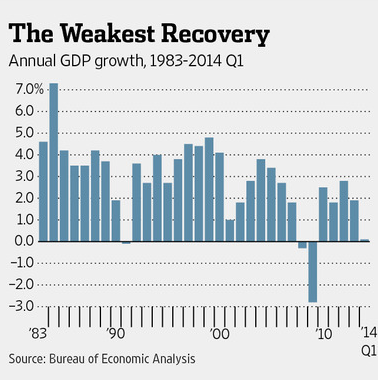
Even though economic growth is much too slow, it has been steadily increasing since the end of the Great Recession at a rate of about 2.2% per year.  But our economy actually shrunk at a 2.9% rate in the first quarter of 2014.  Healthcare spending decreased by 6.9% in the first quarter and therefore contributed to this overall drop in GNP.
CaptureThe New York Times’ economic reporter, Neil Irwin, discusses the connection, ”Our Economic Growth Is a Mystery.  Obamacare is the Reason.” in yesterday’s paper.  Since healthcare makes up one-sixth of the economy, and the implementation of Obamacare is expanding the healthcare sector, it is not surprising that the economy stumbles if Obamacare stumbles.
But he continues “The United States also has the most expensive healthcare system in the world, without producing better health outcomes.  If the nation succeeds in reducing health care costs while also getting coverage for more people, it would be a huge win for the country’s long term competitiveness.  Overtime the dollars that aren’t being spent on overpriced or unneeded health services can go to other stuff which makes life better: houses, college education, restaurant meals and the like.”
Conclusion:  we need to try all the harder to figure out how to grow the economy faster.  The best single thing we can do about this is to implement fundamental tax reform whereby individual tax rates are cut across the board, paid for by closing many of the loopholes and deductions which primarily benefit the rich.  The two thirds of taxpayers who do not itemize deductions will automatically receive a tax reduction in this way.  Since they are middle and lower income wage earners, with largely stagnant incomes, they will tend to spend their tax savings, thereby boosting the economy.
The loopholes enjoyed by the wealthy are example of crony capitalism which both liberals and conservatives complain about.  Closing these loopholes and other deductions is a very good way to lessen income inequality.  Our leaders should be able to work together in this direction!

The President Plays Small Ball


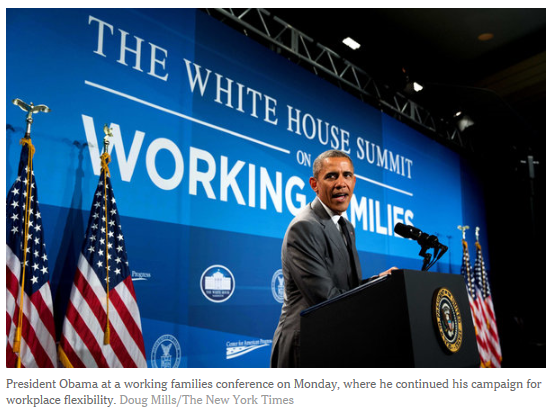
As reported in today’s New York Times, ”Personal Tack by Obama in an Effort to Aid Parents”, the President held an all-day conference yesterday for working families, saying that

  • “Family leave, child care, workplace flexibility, a decent wage – these are not frills – they are basic needs.”
  • “There is only one developed country in the world that does not offer paid maternity leave. And that is us. And that is not the list you want to be on by your lonesome.”
  • “We need you to tell Congress, don’t talk about how you support families: actually support families.”

Capture

The economic journalist, Robert Samuelson, pointed out in the Washington Post a few days ago, ”The Jobs Mystery”, that even though our unemployment rate has now dropped to 6.3%, there are still 9.8 million officially unemployed people, plus an additional 7 million who would like a job but are not looking.  There are also 7.3 million part-time workers who would like longer hours.  This gives a really quite shocking total of 24.1 million unemployed or underemployed workers.
Granted we had a bad recession which was not the President’s fault, but it ended in June 2009, a full five years ago.  In the meantime his administration has done much to retard economic growth (passing ObamaCare and the Dodd-Frank Act) and little, besides huge deficit spending, to boost it.  He and the Democratic Party should be held responsible for this neglect and they probably will be.
One thing which would do a lot to boost economic growth is apparently contrary to liberal ideology and therefore off the discussion table.  I am referring to fundamental, broad-based tax reform whereby individual tax rates would be lowered across the board, but in a revenue neutral manner, by closing or greatly shrinking the loopholes and deductions which primarily benefit the wealthy.  The two-thirds of Americans who do not itemize their tax deductions would get a big boost in take home pay.  Since they are primarily middle and lower income workers whose wages have been stagnant since the recession began, they will tend to spend this extra income, thereby giving the economy a big boost.
If the President were to sincerely ask the House Republican leadership to work with the Democratic Party to boost economic growth, something along this line could be acted upon.  This is the way to really aid families.  Why doesn’t he do it?

Crony Capitalism and Economic Growth


“If there is one thing that populists on the left and right can agree upon, it is disdain for crony capitalism.  It is a distaste for the cesspool of Washington influence in which big-business lobbyists canoodle with lawmakers to get their way.  It is anger at corporate welfare enriching America’s biggest companies at the expense of the little guy.”  So says the economics journalist Neil Irwin in today’s New York Times, “Why we’re All Crony Capitalists, Like It or Not”.
Specifically he is talking about the current debate in Congress over whether or not the Export-Import Bank of the United States should be continued.  It mostly helps big corporations like Boeing and General Electric finance sales to other countries.  But there’s a trade off.  If it shuts down, then American corporations will be at a disadvantage compared with international competitors who get help from their own governments.
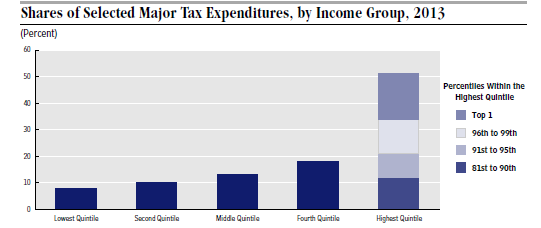
CaptureIn fact, crony capitalism has a much wider scope than this.  Each year deductions and loopholes in the U.S. tax code, referred to euphemistically as tax expenditures, total $1.2 trillion in lost tax revenue.  As the above chart from the Congressional Budget Office shows,  50% of these tax reductions are enjoyed by the highest earning 20% of all U.S. households, with 30% of the benefits going to just the top 5%.
Many experts say that our stagnant economy is caused by a lack of consumer demand, in turn caused by the huge loss of wealth during the Great Recession.  If lower and middle income people had more money, they would surely spend it and our economy would grow faster.  This line of reasoning suggests a way forward!
We should enact fundamental, broad-based tax reform, whereby individual tax rates are lowered across the board, in a revenue neutral way, paid for by greatly shrinking the deductions and loopholes enjoyed by the top 5% of wage earners.  The two-thirds of taxpayers who do not itemize their deductions will receive a correspondingly significant increase in income which they are most likely to spend.
A plan like this would not only boost the economy but also boost public morale by lessening inequality.  A win, win plan!

A Scarred U.S. Economy


Today’s New York Times has an article “U.S. Economic Recovery Looks Distant as Growth Stalls”, summarizing the predominant view of economic experts that annual growth of the U.S. economy in the future is now expected to be only 2.1%, about two-thirds of the historical rate of 3%.
CaptureThis is, of course, disappointing since it means continued stagnation of household incomes as well as high unemployment.  Much of the projected decline in GDP growth is attributed to structural factors such as:

  • The number of Americans receiving disability benefits has increased significantly in recent years. Few of these people will ever return to work.
  • Fewer immigrants are arriving. There are now two million fewer people over the age of 16 than had been projected in 2007.
  • The birth rate has declined each year from 2007.
  • Government spending on public investment has fallen by 8% since the recession started. Corporate investment has been lackluster.
  • Fewer businesses are being created and existing businesses are spending less on research and development.
  • Rising income inequality results in “secular stagnation” whereby there is insufficient consumer spending to stimulate economic growth.

There are lots of head winds slowing down the economy.  As the NYT article says, “for more than a century the pace of growth was reliably resilient, bouncing back after recessions like a car returning to its cruising speed after a roadblock.”  Treasury Secretary Jacob Lew says that the government now expects annual growth to be permanently slower.
Should we resign ourselves to this pessimistic attitude or should we consider whether or not there is any practical and feasible alternative?
There is, in fact, an easy way to speed up growth.  Broad-based tax reform would do it.  By this I mean lowering tax rates across the board paid for by closing loopholes and shrinking the deductions which primarily benefit the wealthy.  This would place more income in the hands of the two-thirds of taxpayers who do not itemize deductions.  These are typically middle and lower income folks with stagnant incomes.  They would spend their tax savings, thereby giving the economy a big boost.
This would also amount to redistribution from the rich to the poor, making us a more equal society in the process.  It’s a win-win for our economy and for social harmony.  What’s holding us back?

Raising America’s Pay II. How Can We Do It?


My last post “Raising America’s Pay” addresses a new report from the Economic Policy Institute, “Raising America’s Pay: Why It’s Our Central Economic Policy Challenge”.  Its starting point is the now generally accepted view that wages for the typical American worker have been flat ever since the early 1970s even though labor productivity has continued to rise steadily.
The EPI authors recognize that globalization and the growth of technology have contributed to wage stagnation even though they blame malign policy decisions as well.  I do agree with them that the resulting increase in economic inequality is detrimental to America.  I also agree with them that the way to address inequality is for wages to go up. The best way to accomplish this is to lower unemployment by increasing economic growth.  This will happen when large numbers of consumers start spending more money, thereby increasing demand.  Does this sound like a vicious circle?  It need not be!
CaptureThe above chart from the Wall Street Journal shows that the net worth of U.S. households has now more than recovered from the Great Recession.  The problem is that most of this new wealth has gone to the people with the highest incomes who are more likely to save it.  What we need to do is “redistribute” (gasp!) some of this vast sum of new wealth back to middle and lower income people who would be much more likely to spend it.
There is a straightforward way to do this.  Broad based tax reform!  Lower everyone’s tax rates paid for by closing loopholes and shrinking deductions which primarily benefit the wealthy.  This will be a pure gain in income for the two thirds of Americans, about 80 million, who pay income taxes but do not itemize deductions, most of whom are in the lower and middle income brackets.  These people are likely to spend most of their new income, thus giving the economy the big boost that it needs!
Our leaders in Washington should be able to figure this out!

A Strong Country Requires a Strong Economy


“Ukraine is a wake-up call for what a post-American world would look like” declares the foreign affairs expert Walter Russell Mead in an article “Putin Did Americans a Favor” (http://online.wsj.com/articles/walter-russell-mead-putin-did-americans-a-favor-1401662270) in yesterday’s Wall Street Journal.
“For those willing to see, the signs of what a post-American world would look like are easy to discern.  We can look at Bashar Assad’s murderous campaign in Syria to see how Iran thinks power should be used.  To see what Saudi Arabia thinks about human rights and liberal values, follow events in Egypt and Pakistan.  China would become more aggressive in a post American world, and the chances of Sino-Japanese conflict would increase. … In Europe, only power keeps or can keep Russia from rebuilding its old empire.”
“Those who think American decline is inevitable must face a tragic truth: The eclipse of American power will be a disaster for our economic interests, for the values we cherish and, in the end, for our security at home.  What stability, peace and legality now exist in the international system are there because the U.S., with important help from allies and partners, made great sacrifices to build and secure them.”
Capture2America’s decline is not inevitable but neither is our continued success.  As much as anything else, it depends on the strength of our economic system.  We need to give much more attention to making our economy grow faster.  This will create more jobs and better jobs and thereby boost national morale.  It will bring in more tax revenue for paying our bills.  In addition, projecting national power is very expensive.  We can and should continue to insist that our defense budget be lean and efficient.  But there is a limit as to how far we can go in this direction.  Ultimately defense spending will have to increase as a percentage of GNP.  This can only be accomplished with a robust economy.
As I have repeated many times in my blog posts, the best strategy for making the economy grow faster is to encourage more consumer spending by lowering individual tax rates and to encourage more entrepreneurial activity by reducing tax rates on small business.  Such tax changes can easily be paid for by closing loopholes and shrinking tax deductions for the wealthy.  But there has to be a political will to do this.
Can this be accomplished?  I don’t know but our future as a free and prosperous nation depends on it!

The Anxieties and Worries of Middle America II. What to do?


Our economy has been stagnant since the end of the Great Recession five years ago.  The median household income has not nearly returned to its pre-recession level.  And now a new report has just appeared, “Room to Grow: conservative reforms for a limited government and a thriving middle class”, suggesting new approaches to address this major problem.
CaptureThe lead author, Peter Wehner, declares that “Americans do not have a sense that conservatives offer them a better shot at success and security than liberals.  … Rather than speak about the economy in broad abstractions, conservatives need to explain how to put government on the side of people working to better their conditions.”
How can we raise median household income and put millions of unemployed people back to work, at the same time?  Deficit spending is no longer a viable option because our national debt is way too high already.  Quantitative easing by the Federal Reserve has been tried, hasn’t helped very much, and is now being unwound.
Consumer spending makes up 70% of GDP and so the most direct way to boost the economy is for people to spend more money.  Can this be accomplished effectively and efficiently with government policy?  The answer is yes!
Broad based tax reform is the way to do it.  Lower tax rates across the board for everyone, paid for by closing the loopholes and deductions which primarily benefit the wealthy.  Two thirds of the American people do not itemize deductions on their tax returns.  This means that lower tax rates for all of these middle income people will put more money in their pockets, most of which they will spend, thereby massively boosting the economy.
Of course there will be pushback to this course of action from the millions of affluent Americans who benefit from all of the loopholes and deductions in our tax code.  But our first priority by far is to help the many more millions of middle income Americans who are suffering from stagnant incomes at best or may still even be unemployed as a result of the recession.