Austerity’s Grim Legacy?


There is a very important debate going on in the country right now as I have discussed in my last three posts:

  • The Republican presidential candidates are proposing big tax cuts to stimulate the economy but at the cost of huge increases in annual deficits and the accumulated debt.
  • The Democratic candidates want to raise taxes on the wealthy but even raising the top tax rate from 39.6% to 50% would have only a modest effect in lowering income inequality.
  • The Tax Foundation has an excellent plan to lower tax rates for all in a revenue neutral manner by closing loopholes and limiting deductions. Their plan would give the economy a big boost and actually lower deficits by bringing in more tax revenue.

Now comes Paul Krugman in Friday’s New York Times, “Austerity’s Grim Legacy”  saying that “Some of us tried in vain to point out that deficit fetishism was both wrong-headed and destructive, that there was no good evidence that government debt was a problem for major economies, … And we were vindicated by events.  More than four and a half years have passed since Alan Simpson and Erskine Bowles warned of a fiscal crisis within two years; U.S. borrowing costs remain at historic lows.”
Capture12How can such an obviously intelligent and articulate economist miss what is so very, very clear to so many lesser mortals?  Interest rates will not stay low forever!  And when they do go up, interest payments on our rapidly expanding debt will skyrocket! The Congressional Budget Office estimates that the interest payment on our debt will increase from 1.7% of GDP today to 3.6% of GDP in 2025, or $827 billion in 2025 compared with $227 billion in 2015.  Where will the money to pay this new $600 billion expense come from?
It is absolutely crazy not to take our enormous debt seriously.  We simply must put this huge debt on a downward path as a percentage of GDP.  It can be done but it will take a concerted effort by our national leaders to do it.

                                    Follow me on Twitter: https://twitter.com/jack_heidel
                         Follow me on Facebook: https://www.facebook.com/jack.heidel.3
A Much Better Way to do Tax Reform


My last two posts, here and here, have pointed out the folly of the tax plans of the presidential candidates from both parties:

  • The Republican plans would stimulate the economy but at a cost of huge increases in the national debt, even using dynamic scoring to take into account the growth effects of these plans.
  • Raising the top tax rate to 50%, a Democratic idea, would bring in $100 billion per year, but this is not enough to either make a big dent on budget deficits or lower income inequality appreciably.
    CaptureThe Tax Foundation has just published an excellent guide to income tax policy which makes several good suggestions for using tax reform to boost the economy:
  • Eliminating the deduction for state and local taxes would raise $81 billion per year. Using this revenue to reduce individual income tax rates would grow the economy by 1.77% of GDP over 10 years.
    Capture11
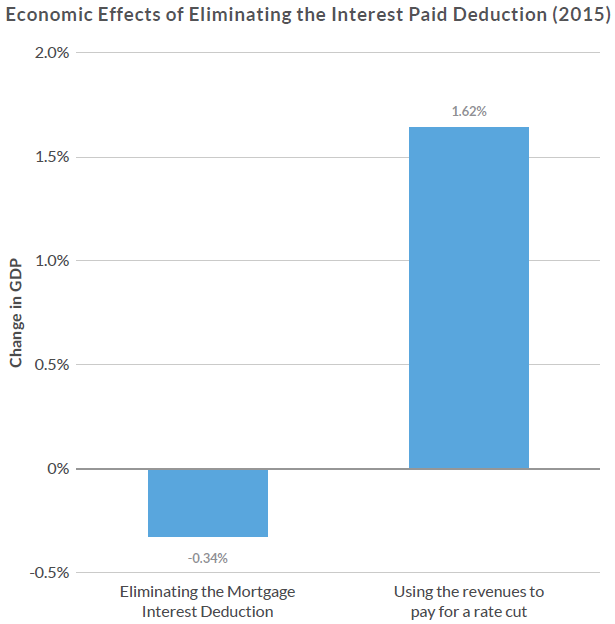
  • Eliminating the mortgage interest deduction would raise $75 billion per year. Reducing individual tax rates by the same amount would grow the economy by 1.61% of GDP over 10 years.
    Capture12
  • Capping itemized deductions at $25,000 would bring in $188 billion per year. Reducing individual tax rates by the same amount would grow the economy by 1.99% over ten years.
    Capture13

Sensible, i.e. revenue neural, tax reform will do wonders for the economy as this study from the Tax Foundation shows. It will bring in more tax revenue to help pay the bills.  It will raise salaries for the already employed.  It will create new jobs for the millions of unemployed and underemployed people who want them.  It will thus reduce income inequality by increasing the wages of people on the bottom. Why is this so hard for so many people to understand?

                               Follow me on Twitter: https://twitter.com/jack_heidel
                     Follow me on Facebook: https://www.facebook.com/jack.heidel.3

Dodd-Frank Is Hurting the Recovery!


The Federal Reserve Bank plays an important role in our economy by trying to keep inflation low and stable but also by trying to make recessions less severe by increasing the money supply when the unemployment rate is high. My last post, “What the Federal Reserve Can and Can’t Do” emphasizes that, as Ben Bernanke says, “the Fed has little or no control over long term fundamentals,” such as economic growth which depends on increases in productivity which, in turn, are heavily influenced by fiscal and regulatory policy.
Capture8The American Enterprise Institute’s Peter Wallison explains very clearly in “The slow economic recovery explained,” why, for example, the Dodd-Frank Act of 2010 is having a harmful effect on economic growth:

  • Regulatory burdens imposed by Dodd-Frank have been particularly harsh for community banks, with $10 billion or less in assets; 98.5 % of U.S. banks fall into this category. Since Dodd-Frank was enacted in 2010, community banks’ share of banking assets has shrunk by 12%.
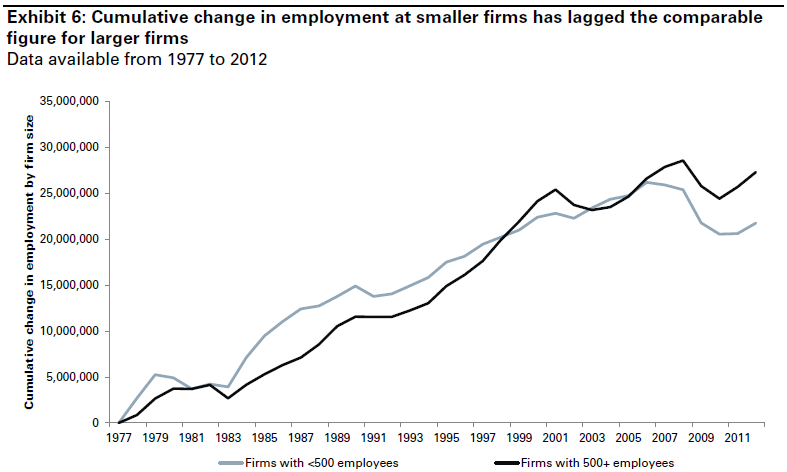
  • According to the Small Business Administration, there were approximately 23 million small businesses (with fewer than 500 employees) in 2012, compared to 18,500 firms with more than 500 employees. Large businesses have access to capital markets whereas small businesses rely on local banks for their credit needs.
  • Regulatory costs affect small banks more than large banks because the costs are fixed, independent of size of the institution. When the Consumer Financial Protection Bureau sends out voluminous regulations on mortgage lending, for example, then extensive legal fees, compliance officers and technology retooling must be paid for up front.
    Capture
  • A recent report from Goldman Sachs, “The Two-Speed Economy,” shows that large firms have grown faster than usual after 2010 while small firms have grown much slower than usual (see chart above).

Conclusion. Monetary policy alone, as conducted by the Federal Reserve, cannot return our economy to good health. This can only be accomplished by increasing productivity which is aided by smart fiscal and regulatory policy. Dodd-Frank is an example of regulatory policy which is hurting economic growth by having a harmful effect on main street banks.                                 

Donald Trump’s Tax Plan: More Bad than Good


Republican presidential candidate Donald Trump has just released his tax plan. Some of its basic features are:

  • Lowering and consolidating seven current tax brackets into three: 10%, 20% and 25%.
  • The corporate tax rate would be cut from the current level of 35% to just 15%.
  • The income tax on all businesses would be cut to 15% as well.
  • Taxing carried interest at ordinary income tax rates instead of at the lower capital gains rate.
  • Eliminating the Alternative Minimum Tax as well as the Estate Tax.
    Capture8

The nonpartisan Tax Foundation has analyzed the Trump plan and predicts the following positive long term effects:

  • 11.5% higher GDP,
  • 29% increase in capital investment,
  • 6.5% higher wages and
  • 5.3 million more full-time equivalent jobs.

The tax Foundation also performed an analysis of Jeb Bush’s tax plan and found roughly similar economic benefits except for a lesser number, 2.7 million, of new jobs created. But the Tax Foundation also predicts that the Trump plan would cut tax revenue by $11.98 trillion over ten years on a static basis or $10.14 trillion on a dynamic basis (accounting for economic growth effects of the plan). This compares with a loss of revenue of $3.6 trillion over ten years (static) or $1.6 trillion over ten years (dynamic) for the Bush plan.
In other words, for a substantially larger growth in new jobs under the Trump plan, there is an enormous cost in additional deficit spending.
Conclusion: I have previously criticized the Bush plan for increasing deficit spending and therefore adding to the debt when we should be shrinking it. The Trump plan is much, much worse in this respect, running annual deficits of over $1 trillion per year, moving in exactly the wrong direction.
The Bush tax plan, while needing changes to make it revenue neutral, is far superior to the Trump plan, which simply blows off any concern for deficits and debt.

Jeb Bush’s Tax Plan: Both Good and Bad


Republican presidential candidate Jeb Bush has just released his tax reform proposal, “My Tax Overhaul to Unleash 4% Growth.” It has many good features such as:

  • Lowering and consolidating seven current tax brackets into three: 10%, 25% and 28%.
  • Essentially doubling the standard deduction for most filers, thereby achieving huge simplification for millions of average income filers.
  • Eliminating the state and local income tax deductions and capping all others, except for charitable deductions, at 2% of Adjusted Gross Income.
  • Doubling the Earned Income Tax Credit for childless filers, thus encouraging more low income people to work.
  • Exempting taxpayers over the age of 67 from the employee-side payroll tax, encouraging them to stay in the workforce longer.
  • Cutting the corporate tax rate from 35% to 20%.
  • Allowing 100% immediate expensing for all capital investments, including inventories.
  • Creating a territorial tax system so that multinationals are not taxed on foreign earnings, and therefore incentivized to bring their foreign profits home.
  • Eliminating the deductibility of interest expenses.

The lower individual and corporate tax rates, together with the separate investment and work incentives, will create a significant economic stimulus estimated to raise GDP by at least .5% per year or higher, depending you who ask.
According to the Tax Foundation, however, the plan would reduce federal revenue on a static basis by $3.66 trillion over ten years, and even by $1.6 trillion on a dynamic basis, taking into account the new tax revenue generated by the plan.
CaptureThis is, of course, a huge problem. We badly need to speed up economic growth but we also need to lower, not increase, our annual deficit spending in order to put our debt on a downward path as a percentage of GDP.
The resolution of this quandary is to tighten up on those deductions, such as for mortgage interest, remaining in the code and also lessening the amount of the tax cuts if necessary in order to achieve overall revenue neutrality for the plan.

Will Wage Stagnation Continue Indefinitely?


It is widely deplored that wages for both middle- and lower-income workers are stagnant and have not even recovered from where they were before the beginning of the Great Recession.  The latest issue of The Economist explores this problem, “When what comes down doesn’t go up.”
CaptureThe Economist sees several factors at work:

  • As the unemployment rate continues to drop, many new jobs are paying less than the old jobs that were lost.
  • In Germany “mini jobs,” paying under $440 per month, are skyrocketing. In Britain “zero hours” contracts, with no commitment to a fixed number of hours, are becoming more common.
  • In 2013 Kelly Services, which provides temporary workers, was the second largest employer in the U.S. with a staff of 750,000. 2.9 million temps account for 2% of all jobs in the U.S.

As The Economist points out, if low pay does in fact lock in, inflation will stay low even as the unemployment rate continues to fall.  The Federal Reserve will then be likely to keep interest rates low indefinitely as well.  But this means there will be far less incentive for Congress and the President to cut back on huge deficit spending because debt is almost “free money” when interest rates are low.  Long term, massive debt, is a huge threat to our security and prosperity.
Breaking out of this pernicious low wage trap will require a bold effort by Congress and the President to boost economic growth.  By far the best way to do this is with broad-based tax reform at both the individual and corporate levels.  As I have discussed in previous posts, what is needed is lower tax rates paid for by closing loopholes and deductions.  Hopefully, the new Congress is headed in this direction!

“We’ve Got to Do Something about Income Inequality”


This is what I hear over and over again from my liberal-minded friends.  Their solution is to raise taxes on the rich and give to the poor.  This might help a little but not nearly enough.
The best way to help middle- and lower-income people is to give them more opportunities for self-advancement by providing more upward mobility in society.  Right now the middle class is being “hollowed out” as shown in the chart just below.
CaptureThere are three major reasons for this:

  • Economic Globalization which provides low cost goods from around the world and thus puts pressure on low- and semi-skilled workers in the U.S.
  • Rapid technological advancement which puts a higher premium on educational attainment and advanced skill acquisition.
  • Slow economic growth averaging only 2.3% since the end of the Great Recession in June 2009.

Globalization and technological advancement are strong worldwide forces likely to continue indefinitely.  We will simply have to adapt to them with long term strategies such as improved educational outcomes at all levels (early childhood, K-12 and post-secondary).  But speeding up economic growth is under our direct control with tried and true methods which are not being fully utilized at the present time. Such as:

  • Tax Reform. We should lower tax rates for individuals across the board, paid for by shrinking deductions for the wealthy. This will give middle- and lower-income workers, as well as new entrepreneurs, more money to spend, thereby boosting both supply and demand in the economy.
  • Increasing the Earned Income Tax Credit paid for by using some of the increased revenues from shrinking deductions for the wealthy. This would encourage more people to take and hold onto entry level jobs, thus boosting the economy by increasing the size of the workforce.

In other words, much can be done to reduce income inequality.  Redistribution of tax revenue is fine as long as it is done in a way which increases economic growth, rather than just punishing the rich.

How Do We Boost Middle Class Jobs?


Income inequality is a serious political issue these days as it should be.  America’s future well-being depends on widely shared prosperity.  One of the very best ways to lessen inequality is to increase mobility into the middle class.
Capture  The political and economic analysis group, FiveThirtyEight, has just reported new data (see above) that “Mid-tier Jobs Are Seeing Less Growth.”  The middle class has already been hollowed out by the gale-wind forces of globalization and technological advancement.  Now the Great Recession, and the slow recovery from it, has made things that much worse.  It’s long past time to focus on middle class recovery.
The best way to do this is to make the economy grow faster as follows:

  • Tax Reform. Lowering individual rates should be the first priority, paid for by closing loopholes and shrinking deductions for the wealthy. This will give middle- and lower-income workers more money to spend and encourage startup small businesses. Lowering corporate tax rates, again offset by shrinking deductions, will incentivize multi-national corporations to bring their profits back home for distribution or reinvestment.
  • Increase the Earned Income Tax Credit, paid for with some of the increased revenues from shrinking deductions for the well-to-do. This will encourage more people to take and hold onto entry level low-wage jobs, thus increasing the size of the workforce.
  • Putting More Emphasis on Career Education in High School. Not everyone wants to or needs to go to college. There are lots of well-paying middle class jobs for high skilled workers and a shortage of workers for these jobs in many labor markets.
  • Miscellaneous. Immigration reform, trade expansion, and easing regulations on small business would also help grow the economy.


Economic growth since the end of the Great Recession in June 2009 has averaged a meager 2.3%. Speeding up growth is the best way to raise wages and lower unemployment at a much faster rate.  This is the best way to boost middle class jobs!

Can We Solve All Our Fiscal and Economic Problems at the Same Time?


This website, It Does Not Add Up, is devoted to discussing our country’s most serious economic and fiscal problems.  They are:

  • Stagnant Economy. Since the end of the Great Recession in June 2009, the economy has been growing on average at the historically slow rate of about 2.3%. Slow growth means higher unemployment, stagnant wages and less tax revenue.
  • Massive Debt. U.S. public (on which we pay interest) debt is now 74% of GDP (highest since WW II) and projected by CBO to grow rapidly unless strong measures are taken to reduce it. This puts our country’s future wellbeing and prosperity at great risk.
  • Increasing Income Inequality. Incomes for the high-skilled and well-educated are increasing much faster than for the low-skilled and less-educated workers.

The new Republican majorities in Congress are stirring the waters by proposing a ten year plan to shrink the deficit down to zero, i.e. to balance the budget by 2025.  The opposition claims that this would “sharply cut the scale of domestic spending, which would mostly fall on the poor.”
Capture1But the American Enterprise Institute’s James Pethokoukis points out that social spending in the U.S., both public and private, is very generous and second only to France in the entire OECD. So here is how we could proceed to address our basic problems in a unified manner:

  • Balance the Budget by a combination of Republican spending cuts and cutting back on two major tax deductions: Employer-sponsored Health Insurance (cost: $250 billion per year) and Mortgage Interest (cost: $70 billion per year).
  • Boost Economic Growth by expanding the Earned Income Tax Credit to encourage more people to accept low paying, entry level jobs. Increase the Social Security eligibility age from 67 to 70, thereby keeping near retirees in the workforce for three additional years (this will also extend the solvency of the Social Security Trust Fund).
  • Decrease Income Inequality. Cutting back on tax deductions, in part to pay for expansion of the EITC, lessens income inequality as well as shrinking the deficit. A faster growing economy also lessens inequality by providing more opportunities for upward mobility.

In other words, addressing each of these fundamental problems in an intelligent manner contributes to solving the remaining problems as well.  This creates a virtuous circle for economic progress!

We Need Fundamental Tax Reform!


Most Americans would agree that our tax code is a mess and needs major reform.  The last reform was in 1986 when the top rate was reduced from 50% to 28% and many deductions were eliminated.  However this reform effort turned out to be short lived in the sense that many of these deductions have now been added back in.  The Romney plan of 2012, cutting all tax rates by 20% in a revenue neutral way, would have been an improvement over our current system.  But, it’s gains would likely also have been only short-lived.
CaptureConsumption taxes are now being used in many parts of the world and, in recent years, the idea of a national sales tax has gained popularity in the U.S.  The so-called Fair Tax would impose a single 30% tax on all sales at the retail level.  The proponents claim that this would raise enough income to replace all federal taxes: the individual income tax, the corporate income tax, the payroll tax and the estate tax.
The tax attorney, Michael Graetz, has evidence that a 34% tax rate would be necessary to replace just the individual and corporate income taxes alone.  This is a large discrepancy.  Regardless, a major argument against the Fair Tax is that such a high single tax of 30% or higher would create a compliance problem because of the incentive for people to try to avoid paying it.
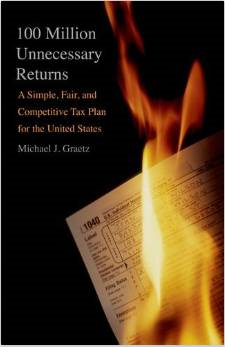
Mr. Graetz has proposed a hybrid consumption and income tax, which he calls the Competitive Tax Plan, as a more reasonable but still fundamental change to our current tax system.  Although I have discussed this proposal previously, I will summarize it again here:

  • A broad-based Value Added Tax of about 14% is enacted on goods and services.
  • Families earning less than $100,000 per year are exempted from the income tax. The tax rate would be 15% for incomes between $100,000 and $250,000, and 25% above this level.
  • The corporate income tax rate is lowered to 15%.
  • The Earned Income Tax Credit is retained and used to provide relief from the Payroll Tax for low-income families.
  • The plan is designed to be revenue neutral as verified by the Tax Policy Center.

There are many advantages of the Graetz Plan over our current system.  100 million returns, for all those with incomes under $100,000, would be eliminated.  This would, in turn, make it less politically expedient for Congress to constantly add new exemptions and preferences into the code.  Lower income tax rates for both individuals and corporations would give the economy a big boost.
The Competitive Tax Plan is an example of the type of bold, fundamental reform that we need to make to our federal tax system.