Avoiding World War III


What happened in Paris could also easily happen in London, New York City or Washington D.C. and soon will if our President does not adequately respond to the threat of terrorism.  As the Wall Street Journal declared yesterday, “For seven years Mr. Obama has used the unpopularity of the Iraq war as a shield for his retreat from anti-terror leadership and the Middle East.”
CaptureThe American Enterprise Institute’s Danielle Pletka informs us that:

  • NATO aircraft scrambled more than 500 times in 2014, with only a few exceptions, in reaction to Russian incursions into NATO member airspace.
  • In 2014, Japan scrambled aircraft almost 1000 times, with all but a few of these incidents attributed to either Russian or Chinese warplanes.
  • Russian bombers entered US airspace 10 times in 2014, double the previous average.

Ms. Pletka also suggests how we should respond to four years of carnage in the Middle East:

  • The first step is to actually have a strategy, rather than a series of reactive tactics and incremental escalations.
  • The second step is to build a coalition with sub-state and national partners that we trust and that trust us to stick with the job.
  • The good news is that there is still time to lead a decisive war against ISIS.
  • There is no need to launch broadsides against all Muslims, the Syrian people and refugees in general. It is Islam extremists who are attacking us, not mainstream Islamists.

The world is a dangerous place and we have many enemies.  On this website I am mostly focused on our own fiscal and economic problems which are very serious and need to be dealt with in a timely manner.  However the immediate safety and security of our country is the highest priority of all and, on occasion, takes precedence over everything else.  Now is a time for such heightened vigilance.


Combating the Politics of Distrust


My last post, “The Politics of Distrust” presents the view that the main reason for the divisiveness of today’s politics is “the stubborn torpor of the American economy.” If this is true then the solution is obvious: speed up economic growth!
CaptureA couple of weeks ago the economist Alan Blinder, a Hillary Clinton advisor, had an Op Ed in the Wall Street Journal, “A Fairness Agenda for Winning Over Angry Voters” with which I largely agree. Here are the highlights of Mr. Blinder’s fairness agenda:

  • A labor market tight enough to leave employers scouring the land for workers, the best tonic for workers the world has ever known. Mr. Blinder does say that looser purse strings by Congress would help create more demand but it is simply too risky to keep running up our already enormous national debt. Eventually interest rates will return to normal and interest payments on the debt will skyrocket.
  • Raising the federal minimum wage would be an enormous help for wage earners at the bottom. Many states and cities are doing this on their own which is a better way to go because of huge regional differences.
  • Increase the Earned Income Tax Credit, especially for childless workers. A very good way to incentivize work.
  • More Vocational Training and Apprenticeships. Strengthening community colleges and career education in high schools would go a long way to accomplish this.
  • Provide quality pre-K education for families who can’t afford it. Early childhood education for children from low-income families is another very good idea.
  • The tax code is a national disgrace. The corporate tax may be even more complex, inefficient and unfair than the personal tax. The mantra of tax reformers has always been: broaden the base, lower the rates. Amen!

What Mr. Blinder is calling a fairness agenda turns out to be a growth agenda in disguise. I would add a few more items like deregulation to encourage entrepreneurship and business expansion but basically Mr. Blinder has suggested an attractive program for economic growth which should appeal to a broad collection of political interests.

Follow me on Twitter: https://twitter.com/jack_heidel
Follow me on Facebook: https://www.facebook.com/jack.heidel.3

The Politics of Distrust


I define myself as a fiscal conservative with a social conscience, because I want to address budget deficits and income inequality at the same time.  There is so much divisiveness in politics these days that liberals accuse me of favoring austerity while, at the same time, conservatives accuse me of being soft on welfare.
The author Jay Cost has an article, “The Politics of Distrust” on this topic in yesterday’s Wall Street Journal.  He says that the principal cause of this distrust is “the stubborn torpor of the American economy.”
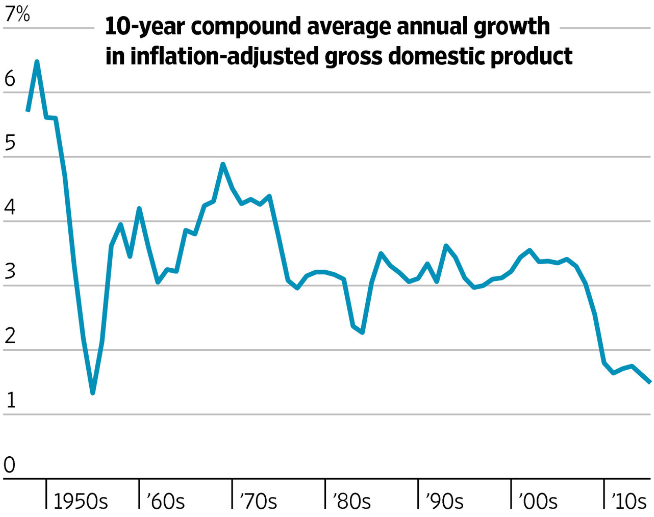
Capture0According to Mr. Cost:

  • For roughly half a century after WWII economic growth averaged 3.6% a year.
  • Over the past 14 years, real growth has averaged only 1.7%.
  • Persistently weak economic growth has contributed to our sour civic mood in three important ways:
  1. It has prompted voters to turn against the incumbent party time and again.
  2. Underwhelming growth has heightened anxieties about economic anxiety – liberals blame the unfairness of market-based capitalism and conservatives blame the corrupting hand of government – in taxation, regulation and monetary policy.
  3. Finally, weak economic growth has damaged the credibility of the experts – the experts failed to foresee the slowdown of the early 2000s, failed to anticipate the housing bubble, failed to predict that economic growth would remain weak after it burst, and failed to implement policies to return it to our postwar norm.
  • These trends amount to a comprehensive assault on the political equilibrium of the past half century. During the postwar era public policy could evolve because broad agreement existed. Now the consensus has vanished and we are left with gridlock, indecision and drift.
  • The tonic to this stalemate is as obvious as it is elusive: economic growth that approximates the levels of the late 20th century.

Perhaps surprisingly there is a fair amount of agreement between liberals and conservatives on how to speed up economic growth. This will be the subject of my next post.

What the Federal Reserve Can and Can’t Do


I have a good impression of Ben Bernanke, chair of the Federal Reserve from 2006-2014. Partly because he comes across as being both competent and honest and partly because Sheila Bair, chair of the Federal Deposit Insurance Corporation from 2006-2011, and whom I greatly admire, gives him high marks in her book, “Bull by the Horns,” about the financial crisis.
CaptureMr. Bernanke has an excellent Op Ed in yesterday’s Wall Street Journal, “How the Fed Saved the Economy,” clearly describing what the Federal Reserve both can and can’t do. What it can do is:

  • Make recessions less severe. The unemployment rate has been steadily dropping and now is apparently almost back to normal at 5.1% even though the relatively low labor-force participation rate and lack of wage pressure indicate remaining weakness.
  • Keep inflation low and stable. The Fed’s expansionary monetary policy has helped bring down unemployment without igniting inflation whose underlying rate is currently only 1.5%.

Mr. Bernanke states that “the Fed has little or no control over long-term economic fundamentals – the skills of the workforce, the energy and vision of entrepreneurs, and the pace at which new technologies are developed and adapted for commercial use.” He goes on to say that “further economic growth will have to come from the supply-side, primarily from increases in productivity. … Fiscal-policy makers in Congress need to step up” by adopting policies to:

  • Improve worker skills. (how about immigration reform, better vocational education, reforming SSDI and expanding the EITC to boost incentives to work)
  • Foster capital investment. (how about both individual and corporate tax reform and relaxing Dodd-Frank regulations on main street banks)
  • Support research and development. (how about making life easier for entrepreneurs with fewer regulations)

Mr. Bernanke has a very good handle on our current financial situation. The Federal Reserve has done and is doing its job. It’s time (long past time!) for fiscal policy makers (i.e. Congress and the President) to adopt policies, such as above, to speed up economic growth.

Solving the Student Debt Problem


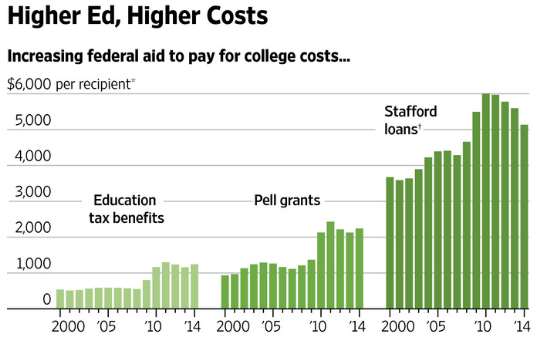
I have devoted several posts recently, herehere, and here, to discussing the rapidly increasing costs of higher education (see chart below) and the corresponding rapid rise of student debt.
Capture7Here are the basic facts:

  • There are too few college graduates in the U.S. At least ten OECD countries have a higher percentage of college graduates than we do.
  • America is graduating inequality. College degree attainment has increased between 1970 and 2011 for all income groups; however this is happening much more quickly for higher income groups.
  • Not all college degrees are created equal. Students at private, nonprofit institutions graduate at higher rates, and with lower debt, than students from public institutions who, in turn, graduate at higher rates and with lower debt, than students from for-profit institutions.
  • The Federal Reserve Bank of New York has found a close connection between subsidized loan and Pell Grant limits and the increase in college tuition costs.
  • The Federal Reserve Bank of St. Louis has found that “white and Asian college grads do much better than their counterparts without degrees, while college-grad Hispanics and blacks do much worse proportionately.”
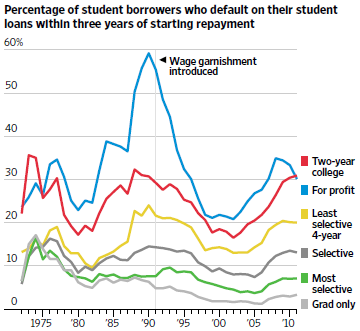
  • The percentage of student borrowers at for-profit as well as community colleges who default on their loans has greatly increased since the year 2000 (see below)
    Capture1In other words, our current federal student loan program is not only driving up college costs for everyone but is also creating a huge financial burden for the very low-income students who are most in need of financial aid to succeed in college.
    The way to respond to this is to put strict lids on the amount of subsidized loans available to both undergraduate and graduate students ($30,000 and $60,000 respectively) and, at the same time, use the savings achieved in doing this to increase the size of Pell Grants available for the lowest income students who need the most help.
    Conclusion: our high-tech society needs more college trained workers and we should especially encourage capable low-income young people to go to college. We could also do a much better job of targeting Pell grants instead of loans to this group of students.

The Pope, the United Nations and Global Poverty


This is a big week in the U.S. Pope Francis is coming here and the UN will convene a conference in NYC to endorse international development goals for the next 15 years. As I explained in a recent post, “The Dung of the Devil,” the Pope should pay more attention to the recent accomplishments of free enterprise in decreasing the amount of poverty and economic inequality around the world.
In an article just a few days ago in the Wall Street Journal, Bjorn Lomborg, the Director of the Copenhagen Consensus Center, explains that the U.N. is likely to endorse 169 targets for global investment for the next 15 years. Mr. Lomborg demonstrates with cost-benefit analysis that focusing on just 19 of these goals would accomplish far more than adopting everything on the U.N.’s much longer list.
Capture1Here are a few of Mr. Lomborg’s items:

  • Completing the World Trade Organization’s Doha agreement would return $2000 for every dollar spent to retrain and compensate displaced workers.
  • The elimination of fossil fuel subsidies would be worth $15 for every dollar spent in direct support of the very poor who are unable to afford higher fuel prices. By contrast, trying to drastically increase the production of renewable energy would return less than a dollar for every dollar spent because renewable forms of energy remain so expensive.
  • Tripling access to preschool in sub-Saharan Africa would have benefits worth more than $30 for every dollar spent because of improved future earnings. On the other hand, efforts to improve exams and teacher accountability are much harder to achieve and the benefits would only amount to $5 for every dollar spent.
  • Other actions: boosting agricultural yields, cutting indoor air pollution with clean cook stoves, increasing access to family planning, fighting malaria and combatting malnutrition are other examples where investment would lead to big dollar returns.

Conclusion: Free enterprise economics has done much in recent years to eliminate poverty and inequality around the world. Additional public and private investment, focusing on just a relatively few major goals, can accomplish even more.

Jeb Bush’s Tax Plan: Both Good and Bad


Republican presidential candidate Jeb Bush has just released his tax reform proposal, “My Tax Overhaul to Unleash 4% Growth.” It has many good features such as:

  • Lowering and consolidating seven current tax brackets into three: 10%, 25% and 28%.
  • Essentially doubling the standard deduction for most filers, thereby achieving huge simplification for millions of average income filers.
  • Eliminating the state and local income tax deductions and capping all others, except for charitable deductions, at 2% of Adjusted Gross Income.
  • Doubling the Earned Income Tax Credit for childless filers, thus encouraging more low income people to work.
  • Exempting taxpayers over the age of 67 from the employee-side payroll tax, encouraging them to stay in the workforce longer.
  • Cutting the corporate tax rate from 35% to 20%.
  • Allowing 100% immediate expensing for all capital investments, including inventories.
  • Creating a territorial tax system so that multinationals are not taxed on foreign earnings, and therefore incentivized to bring their foreign profits home.
  • Eliminating the deductibility of interest expenses.

The lower individual and corporate tax rates, together with the separate investment and work incentives, will create a significant economic stimulus estimated to raise GDP by at least .5% per year or higher, depending you who ask.
According to the Tax Foundation, however, the plan would reduce federal revenue on a static basis by $3.66 trillion over ten years, and even by $1.6 trillion on a dynamic basis, taking into account the new tax revenue generated by the plan.
CaptureThis is, of course, a huge problem. We badly need to speed up economic growth but we also need to lower, not increase, our annual deficit spending in order to put our debt on a downward path as a percentage of GDP.
The resolution of this quandary is to tighten up on those deductions, such as for mortgage interest, remaining in the code and also lessening the amount of the tax cuts if necessary in order to achieve overall revenue neutrality for the plan.

The Slow Growth Economy We’re Stuck In


We have very high debt and Paul Krugman says in “Debt Is Good” that we need more! The Congressional Budget Office’s latest report this week, “An Update to the Budget and Economic Outlook: 2015 – 2025” predicts slow economic growth for the next ten years, averaging 2.1% per year (see chart below).
CaptureUnfortunately, high debt and slow growth are a deadly, self-reinforcing, combination. Today’s Wall Street Journal has a chart (pictured below) showing clearly how budget deficits are likely to increase over the next ten years. The public debt (on which we pay interest) is predicted to grow from 74% of GDP today to 77% of GDP in 2025, increasing by a total of $7 trillion over this time period.
Capture1Here is another connection between slow growth and high debt:

  • Slow Growth means higher than necessary unemployment and under-employment as well as minimal raises for employed workers. The resulting economic slack leads to
  • Low Inflation. But low inflation means that the Federal Reserve can maintain
  • Low Interest Rates to try to encourage more borrowing to stimulate the economy. This means, in turn, that Congress can run up huge deficits without having to pay much interest on this almost “free” money. This eventually leads to:
  • Massive Debt. But what happens when inflation does take off, which has happened before and is likely to happen again? Then the Federal Reserve is forced to raise interest rates quickly and we are stuck with huge interest payments on our accumulated debt. And meanwhile entitlement spending on Social Security, Medicare and Medicaid is also growing rapidly. At this point debt increases very rapidly which leads to a severe
  • Fiscal Crisis.

Of course things don’t have to happen like this. Congress might become more responsible and either cut spending and/or raise taxes and start shrinking our huge deficits. Or perhaps slow growth really is the new normal and interest rates will remain low indefinitely. But slow growth is not pain free; there are many millions of unemployed and under-employed Americans who want to work and whose lives are stunted otherwise.
Slow growth is a very destructive path to be following. We badly need to adopt policies to speed it up!

Higher Ed: Higher Costs, More Inequality. What to do?


Several months ago I discussed “How the American Education System Contributes to Inequality.” It so happens that students from high-income families graduate from college in much greater numbers and also with much less debt, compared with students from low-income families.
CaptureA new study from the New York Federal Reserve has found a connection between a rapid increase in student aid in recent years and the rapid increase in college costs. In particular:

  • A $1 increase in the subsidized loan cap leads to a tuition increase of 65 cents, and
  • A $1 increase in the Pell Grant limit leads to a tuition increase of 55 cents.
  • Furthermore, private schools, both nonprofit and for-profit, are bigger offenders than public schools, even though declining state subsidies for higher education primarily affect public universities.
  • At the present time undergraduates can borrow a maximum of $57,500 from the federal government.
  • Under the decade-old Grad Plus program, graduate students can borrow any amount their school charges. In the seven years before Grad Plus, undergraduate tuition was rising faster than grad school costs. In the seven years after, the reverse occurred.
    Capture1Clearly this is an untenable situation. The solution, in my opinion, is to strictly limit the total amount of federal loans for both undergraduate and graduate students and force schools to compete on price. For example:
  • Limit the total amount borrowable by an undergraduate, from the federal government, to $30,000, the average amount borrowed today, and then let it adjust it each year for inflation.
  • Limit the total amount borrowable by a graduate student to $60,000, the average amount borrowed today, adjustable each year by inflation.
  • Students who want to borrow additional funds may do so on the private market, with no subsidies or guarantees provided by the federal government.

Such a program would provide much needed financial discipline to colleges and universities and reduce and stabilize ballooning student loan costs for the federal government.

Can America’s “Fourth Revolution” Be Avoided?


My last post, “America’s Fourth Revolution,” presented a persuasive argument by the political scientist, James Piereson, that our currently dysfunctional political system will be unable to solve our most fundamental problems of massive debt, accompanied by a rapidly aging population and slowing economic growth. This will result, according to Mr. Piereson, in a severe crisis leading to a fourth revolution, overthrowing the New Deal liberal consensus which has prevailed since 1932.
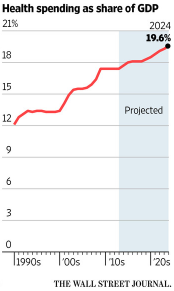
It is commonly understood that entitlement spending: Social Security, Medicare and Medicaid, is the main driver of our rapidly growing national debt. A recent report from the Centers for Medicare and Medicaid Services, summarized in the Wall Street Journal, shows that U.S. healthcare spending is likely to rise from just under 18% today to 19.6% of GDP in 2024.
Capture2Barron’s editor, Thomas Donlan, has just reported that the Director of the Congressional Budget Office, Keith Hall, stated in a recent hearing of the Senate Budget Committee that if spending for Medicare and Medicaid, as a percentage of GDP, fell by 25% over ten years, and then stayed in line with GDP after that, the U.S. would have a budget surplus of 2% of GDP in 2040 instead of the otherwise projected deficit of 6.6% of GDP. Furthermore debt held by the public would fall to 24% of GDP, a remarkable achievement.
This is significant because one country, The Netherlands, spends 12% of GDP on healthcare, and every other country in the world (except for the U.S.) spends less than 12%.
Conclusion: all the U.S. needs to do, so to speak, is to bring healthcare costs in line with the rest of the world and our entire deficit spending problem would be solved! Nobody is claiming that this will be easy but it certainly is within the realm of possibility. It is also far superior than waiting to act until we have another fiscal crisis and thus risking a huge change, a revolution, in our way of life.