Letting Young People Drift and the Liberal Disconnect


The New York Times had an excellent lead editorial on Sunday, “The Cost of Letting Young People Drift,” describing how 5.5 million young Americans, ages 16 – 24, are neither working nor in school.  “At a time when the economy is requiring workers to have higher levels of skills, one in seven of America’s young adults can’t even get started.”

CaptureThe NYT editorial is based on new research, “Zeroing In on Place and Race: youth disconnection in America’s cities” performed by Measure of America.  The report points out that the problem has gotten much worse since the Great Recession in 2008, as shown in the chart below.
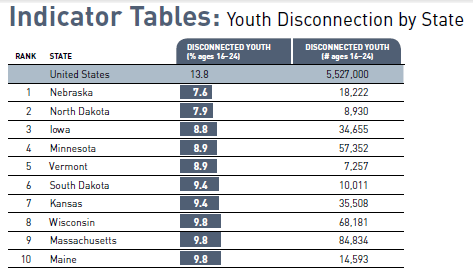
Capture1It also breaks down the youth disconnection rate by state.  For example, Nebraska (7.6%), North Dakota (7.9%) and Iowa (8.8%) have the lowest percentages, while Mississippi (18.5%), West Virginia (19.6%) and Louisiana (19.8%) have the highest percentages (as shown below).
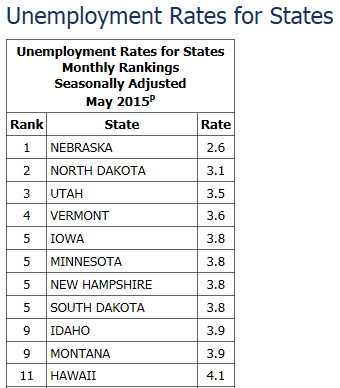
Capture2Capture3But also look at the latest “Unemployment Rates for States” published by the Bureau of Labor Statistics.  There is a very close connection between a state’s unemployment rate and its youth disconnection rate, as shown below. In other words, one of the best ways to keep young people connected is to give them a better chance of finding a job.
Capture4Capture6But it requires faster economic growth to provide more jobs.  Just yesterday the NYT had an editorial, “Obstacles to Economic Growth,” lamenting our very slow rate of economic growth of about 2.2% for the past six years.  According to the NYT, “What’s needed most is public and private investment in the economy sufficient to support strong growth and rising productivity.”  The editorial then goes on to berate Congress for being more interested in budget cuts than in new spending programs to stimulate the economy.  According to the NYT, “the pathway to prosperity is clear for leaders who will dare to take it.”
The NYT thus recognizes the need for more private investment to stimulate the economy but has no apparent interest in policy measures to encourage it.  How can a news organization as sophisticated as the NYT be so passionate about wanting to improve society and so clueless about the best way to do it?

How to Tame the Regulatory State


I have just been reading a fascinating new book by Charles Murray, “By the People: rebuilding liberty without permission,” describing how the U.S. regulatory agencies were created and the many abuses they impose upon us.
Capture  As Mr. Murray explains, a Regulatory Agency first promulgates substantive rules of conduct.  A complaint that an Agency rule has been violated is then prosecuted by the Agency and adjudicated by the Agency.  If the Agency ultimately finds a violation, then and only then, the affected private party can appeal to an independent judicial court.  But an Agency decision, even before the court, possesses a very strong presumption of correctness on matters both of fact and law.
“If the enabling legislation is silent or ambiguous, Congress has in effect left a gap in the statute for the Agency to fill.  If the Agency in filling that gap has interpreted the statute in a ‘reasonable’ manner, the court will give effect to that judgment, deferring to the Agency.”
Mr. Murray proposes a new standard that “All regulations that are arbitrary, capricious or an abuse of discretion are automatically eligible for civil disobedience.” To this end a private legal-aid foundation should be set up to provide legal assistance to ordinary Americans who are being victimized by the regulatory state.  It would be funded by what Mr. Murray refers to as the Madison Fund.  A $100 million endowment from a wealthy individual would be sufficient to get it started.
Its purpose would be:

  • To defend people who are innocent of the regulatory charges against them.
  • To defend people who are technically guilty of violating regulations that should not exist, by drawing out the litigation as long as possible, making enforcement of the regulations more expensive to the regulatory agency than they’re worth and reimbursing fines that are levied.
  • To generate as much publicity as possible, both to raise public awareness of the government’s harassment of ordinary people and to bring the pressure of public opinion to bear on the problem.

The goal is to achieve a “No Harm, No Foul” regulatory regime.  A good analogy is to force regulators to use the same strategy as used by state troopers on interstate highways.  A majority of drivers are engaged in civil disobedience just about all the time.  But normal practice is to stop only those people who are driving significantly faster than the flow of traffic or are driving erratically.
As Mr. Murray concludes, “We’re all biased, but only people within government have the power to impose their biases on their fellow citizens with the force of law.”

How the Obama and Republican Budgets Compare


The Budget Committees for both the House of Representatives and the Senate have now passed plans to achieve balanced budgets within a ten year period.  My last two posts have discussed the compelling need to get deficit spending under control and an overall rationale for how to approach this difficult task. Today I will take a look at the major differences between the Obama budget and the House and Senate budgets.  The two congressional budgets are quite similar and will surely be reconciled into a single budget.
CaptureHere are the major differences:

  • Revenue. The President wants to raise taxes by $3 trillion over 10 years to pay for more spending while the Republicans wants revenue-neutral tax reform in order to increase economic growth.
  • Spending. Under current policy the government will spend $48.6 trillion over the next ten years which represents a 5.1% annual rate of spending increase over the present. The President wants to spend an additional $1 trillion over this time period on new initiatives. The Republicans propose spending about $5.4 trillion less, or $43.2 trillion, which still works out to a 3.3% annual rate of increase over the present.
  • Deficits. Under current policy the deficit would start to increase, as a percentage of GDP, in 2018. The President proposes to stabilize the deficit at 2.5% of GDP. The Republicans would balance the budget within ten years by shrinking the deficit down to zero.
  • Public Debt. Under current policy the public debt (on which interest is paid) will increase to 79% of GDP by 2025. The President’s budget would stabilize the debt at the current level of 73% of GDP. The Republican’s balanced budget would shrink the debt to 57% of GDP by 2025.


There are stark differences between the President’s proposed budget and the Republican alternative.  Which is the better route to progress and prosperity?  Is it to raise taxes, increase government spending and only stabilize the debt or is it to streamline taxes, slow down the growth of spending and shrink the debt?  This is a fundamental question of government policy which will not be quickly resolved.  But at least the question is being raised in a dramatic way!

How Likely Is Financial Collapse?


The financial crisis of 2008 was the biggest shock to our financial system since the Great Depression of the 1930s.  It caused a deep recession from which we are still recovering.  To aid the recovery the Federal Reserve launched an unprecedented expansion of the money supply, referred to as quantitative easing, as well as keeping short term interest rates near zero. As explained by James Rickards, a portfolio manager at West Shore Group, in his new book, “The Death of Money, the coming collapse of the international monetary system,” such a severe recession would normally have caused a corrective period of deflation.  Quantitative easing has warded off deflation and, so far, without igniting inflation.
CaptureWe are now in a catch-22 situation.  Congress could and should adopt several policy changes to speed up the recovery as I described several days ago in “The Federal Reserve Cannot Revive the Economy by Itself.”  But, if and when the economy does start growing faster, it will require great skill by the Fed to exit from its current policies without harm.  If it contracts the money supply too quickly, it risks a sharp rise in interest rates.  If it contracts the money supply too slowly, it risks a sharp rise in inflation. Mr. Rickards doubts that the Fed will be able to accomplish this fine tuning without another major crisis.  Here are his Seven Signs of what to look for:

  • The price of gold ($1300 per ounce today). A rapid rise to $2500 will anticipate inflation. A rapid decrease to $800 signals severe deflation.
  • Gold’s continued acquisition by Central Banks. Large purchases by China, for example, will announce inflation.
  • IMF governance reforms, e.g. towards more voting power for China, will be an inflation warning.
  • The failure of regulatory reform, i.e. reinstatement of Glass-Steagall in addition to the Volcker Rule, will increase the chances of systemic failure.
  • System crashes, resulting from high-speed, highly automated, high volume trading. An increasing tempo of such events will cause disequilibrium which could close markets.
  • The end of QE, could give deflation a second wind and lead to a new round of QE.
  • A Chinese collapse (predicted by Rickards), will lead first to deflation and then inflation.

We all hope that the Federal Reserve can steer clear of a new, and much deeper, financial crisis.  But it doesn’t hurt to have guideposts and Mr. Rickards knows what he’s talking about.

Freedom and Equality


The Wall Street Journal published its first issue on July 8, 1889 and today it is appropriately celebrating its 125th anniversary.  The lead editorial refers to its consistent editorial policy over the years as well as admitting several mistakes along the way. “These columns emphasize liberty, but on occasion those who prize equality can provide a necessary corrective.  The best example is the civil rights movement … Yet those who promote freedom typically do better by equality than the progressives who elevate equality do by freedom.”
CaptureToday’s WSJ Op Ed page is devoted to “Ideas for Renewing American Prosperity” provided by many different luminaries (who were asked to propose one change in American policy, society or culture to revive prosperity and self-confidence), such as:

  • George Shultz, Return to Constitutional Government, meaning that “the president governs through people who are confirmed by the Senate and can be called upon to testify by the House or the Senate at any time. They are accountable people,” as opposed to unaccountable White House aids.
  • Heather MacDonald, Encourage Two-Parent Families. “Children raised by single mothers fail in school and commit crime at much higher rates than children raised by both parents. Single-parent households are far more likely to be poor and dependent on government assistance. But far more consequential is the cultural pathology of regarding fathers as an optional appendage for child rearing.”
  • George Gilder, Listen to Peter Drucker on Regulations. “At least half the bureaus and agencies in government regulate what no longer needs regulation.” We need “a new principle of effective administration under which every act, every agency, and every program of government is conceived as temporary and as expiring automatically after a fixed number of years.”
  • Sheila Bair, Find a Better Way to Tax the Rich. “By eliminating corporate income taxes, we would ease pressure on U.S. wages, bring back jobs and repatriate an estimated $2 trillion in profits stashed elsewhere. … It would be smarter to tax corporate profits once, at the shareholder level, and apply the same, higher rates to capital gains and dividends that apply to us working stiffs.”

These sentiments are really just non-ideological common sense.  They might seem to be overly idealistic but are, nevertheless, quite doable if enough of our national leaders would just make them a priority.  This is why we so badly need independent-minded non-partisans in national office!

Considering a Wealth Tax for the U.S.


What should a country do when it has

  • Massive accumulated debt and annual deficits predicted to grow indefinitely.
  • A rapidly growing population of retirees heavily dependent on expensive entitlement programs such as Social Security and Medicare.
  • A national Congress which is unwilling to make significant spending cuts for fear of offending powerful constituent groups.
  • Growing income inequality and wealth inequality.
  • A stagnant economy and high unemployment which makes inequality worse.
  • An inefficient income tax system which does not take in enough tax revenue to pay the bills.

The best response by far is to implement broad-based, pro-growth, tax reform.  I have often discussed how to make major changes to our current income tax system.  I have also described an attractive way to introduce a consumption tax, the so-called Graetz Plan.
CaptureAnother way to reform taxes is to introduce a wealth tax.  The economist Ronald McKinnon has described a way to do this in a Wall Street Journal column, “The Conservative Case for a Wealth Tax”.  His plan is to implement a federal wealth tax in addition to the federal income tax.  It would consist of a flat tax of about 3% imposed on household wealth in excess of a $3 million exemption which would exclude 95% of the population.  In addition to bringing in a significant amount of new revenue each year, which is its principal objective, it would serve the purpose of making a flatter, pro-growth, income-tax system more palatable to people who are concerned about inequality, and therefore to a much wider audience.
The economics journalist, Daniel Altman, recently reported in the New York Times, “To Reduce Inequality, Tax Wealth, not Income” that American household wealth totaled more than $58 trillion in 2010.  The most recent issue of Forbes Magazine reports that there are now 492 billionaires in the U.S. with a total wealth of $2.3 trillion.  A 2% tax on the wealth of just these billionaires alone would raise $46 billion.  A 0.5% tax on the wealth of all Americans would raise $290 billion annually.  These examples show that a “moderate” wealth tax could bring in a significant amount of new tax revenue which would make a big dent in shrinking our annual deficit.
We have to do something and do it quickly.  The problem will occur when interest rates return to their normal level as they surely will before long.  When this happens, interest payments on our national debt will sky rocket.  It’s going to be painful regardless, but let’s try to head for the softest landing we can manage!

A Breath of Fresh Air


U.S. Representative David Camp (R, Michigan), Chair of the House Committee on Ways and Means, has just introduced the “Tax Reform Act of 2014” and describes it in a column in yesterday’s Wall Street Journal, “How to Fix Our Appalling Tax Code”.  This legislation, developed over the past three years by the committee he chairs, has lots of attractive features.  Mainly, however, it would give the economy a substantial boost.  Congress’s Joint Committee on Taxation estimates that it would increase GDP by $3.4 trillion over the next ten years and create 1.8 million new jobs.
CaptureIt will accomplish this goal by trimming or eliminating tax breaks and loopholes for the wealthy in order to reduce tax rates for almost everyone.  For example, the home mortgage deduction will be cut, for new homeowners, from the current value of $1,000,000 to $500,000.  The deduction for state and local taxes will be eliminated.  The charitable deduction will only apply for contributions in excess of 2% of income.  The middle class is protected by raising the standard deduction to $11,000 per individual or $22,000 per couple.  This means that 95% of taxpayers will be able to avoid itemizing.
The two basic tax rates would be 10% up to $75,000 in income, then 25% up to $400,000.  Over $400,000 there would be a 10% surcharge on salaried or “non-production” income.  The corporate tax rate would be cut from 35% to 25%, again by eliminating special exemptions and loopholes.
All of these features add up to a dramatic simplification of our tax code which will save an estimated $168 billion annually in preparation fees.
But always keep in mind the larger purpose of broad based tax reform like this.  In the words of the economist Glenn Hubbard, it is “a policy shift in favor of mass prosperity – dynamism and inclusion.”  It will do more for the poor than raising the minimum wage because it will actually create new jobs and better paying jobs.
This legislation represents a fantastic starting point for a national discussion on pro-growth tax reform.  Let’s get on with it!

What Is the State of the U.S. Economy?


On the eve of the President’s State of the Union address, the New York Times gives an answer to this question in today’s paper, “Obama’s Puzzle: Economy Rarely Better, Approval Rarely Worse”.  The charts below do show the basic trends all moving in the right direction.  But is this good enough?
CaptureThe unemployment rate is moving steadily downward but it is still a high 6.7% almost five years after the recession ended in June 2009.  And this is with a labor participation rate of only 58.6%, which is historically very low.
The budget deficit is dropping but is still unsustainably high.  In the five years, 2009 – 2013, deficits have totaled $6 trillion dollars.  As soon as interest rates return to their historical average of 5%, interest on this $6 trillion in new debt alone will total $300 billion per year, forever!  Furthermore, the Congressional Budget Office, the most credible source of budget information, predicts that the deficit is likely to resume an inexorable climb within a few years as baby boomers retire in ever greater numbers, rapidly driving up entitlement costs.
Economic growth was stronger than expected in the last quarter of 2013 and this is a good sign.  But it has averaged only about 2% since the recession ended which is very low by historical standards, in a post recessionary period.
The point is, do we really need to settle for such mediocre performance: a stagnant economy, high unemployment and massively accumulating debt?  Should we just declare that in a highly competitive global economy with an ever higher premium on information and technology, that we just can’t do any better than we already are?  Isn’t there some way to make our economy grow faster in order to provide more and higher paying jobs?
I think that the answer to this last question is an emphatic yes!  In fact, this is what my blog is all about.  Just read some of the other recent posts and let me know if you disagree with what I am saying!

Harnessing Market Forces versus Offsetting Market Forces


The economist Matthew Slaughter writes in today’s Wall Street Journal that ’High Trade’ Jobs Pay Higher Wages. He points out that the 22.9 million Americans who work for U.S. headquartered multinational companies made an average of $73,338 in 2011 compared with the overall average wage of about $55,000 that year.  “Workers in multinational firms earn more, as global engagement fosters innovation and productivity growth.”
“There is a growing concern about stagnant or falling incomes, yet most of the measures proposed to deal with the issue – raising the minimum wage and reinstating unemployment benefits – purport to help workers by offsetting market forces.  Less attention is given to harnessing market forces.”
CaptureThis can be done by “liberalizing U.S. trade, investment, immigration and tax policies.”  In other words, we need more trade agreements like NAFTA, which has been so successful in increasing trade in North America.  We need more high skilled workers, both domestic and foreign.  We need lower corporate tax rates to encourage multinational corporations to bring their trillions of dollars in overseas profits back home.
We should always strive for a more equal society with less income inequality.  But the best single way to do this is to create more opportunity by growing the economy, i.e. by harnessing market forces.

How Do We Increase Economic Mobility?


As the Wall Street Journal reported several days ago, “Economic Mobility Is the New Flashpoint”.  “Both parties agree the opportunity gap is widening, but the proposed solutions are starkly different.”  The Democrats want to increase the minimum wage, extend unemployment benefits, and expand access to college.  The Republicans suggest a whole potpourri of approaches such as reforming welfare (including food stamps), extending school choice, cutting taxes, and relaxing regulations on new businesses.
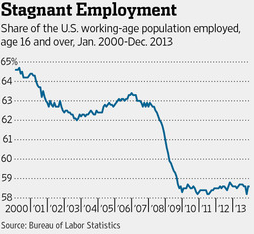
A look at the latest jobs report from the Labor Department should provide the focus which Congress needs to figure out how to increase economic opportunity.  Although the unemployment rate dropped substantially to 6.7% from 7.0% at the beginning of December, only 74,000 new jobs were created in December.  The explanation is that 347,000 left the labor force last month.  The labor force participation rate, the share of the U.S. working-age population employed, age 16 and over, has dropped from 64.5% in 2000, to just under 63% at the beginning of 2008 to near a post-recession low of 58.6% last month (see chart below).
CaptureIn other words, Congress should be totally focused on speeding up economic growth in order to create more jobs.  Since new businesses create the most new jobs, we should indeed relax as many regulations as possible which impede entrepreneurship.  We should lower the corporate tax rate from its very high current value of 35% to get American multinational companies to bring their trillions of overseas profits back home for reinvestment in the U.S.  Moving to a national consumption tax (see the Graetz Plan discussion in my January 7 post), could mean dropping the corporate tax rate to as low as 15%.
Isn’t is obvious that the best thing we can do to give low income people an opportunity to rise up the economic ladder is to just give them a job in the first place?  If they’re ambitious they’ll take any opportunity they can get and run with it!