Are We Doing Enough to Help the Poor?


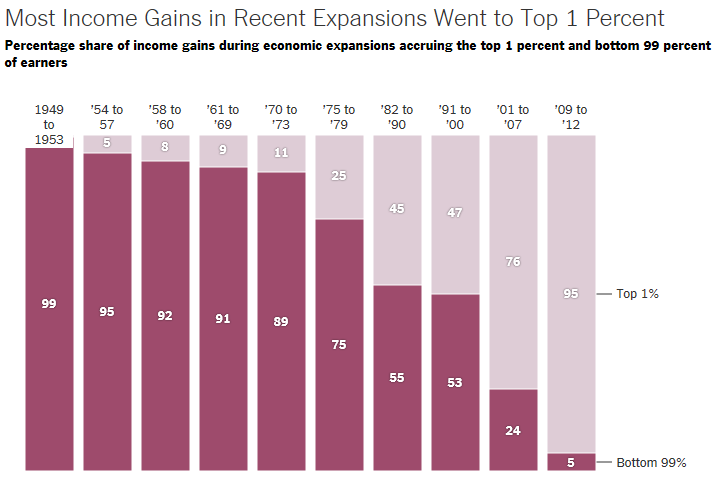
Income inequality in the U.S. is getting worse and one reason is that the middle class is being “hollowed out” by a lack of sufficient job opportunities.
CaptureThe result is more people at the bottom end of the income scale.  Not surprisingly, it turns out that many of these low-wage workers are receiving public assistance, as documented by the UC Berkeley Labor Center, and the New York Times.
Capture1The authors point out that if these workers received higher wages, they would not require as much public support which, in turn, would save money for the taxpayers.  This is a true but not a practical means for helping the poor.  Employees are paid what they’re worth based on the law of supply and demand.  Companies will pay as much as they have to in order to find and retain well qualified workers.  Furthermore, a minimum wage which is too high will simply lead to a higher rate of unemployment.
There is really only one good way to raise the overall wage level, especially at the bottom end of the scale.  It is to speed up economic growth, thereby lowering the unemployment rate and creating more demand for workers.
This is exactly what has happened in Omaha NE where I live.  The official unemployment rate is 3.2% and there is a labor shortage.  A new minimum wage ($8/hour now, $9/hour next January) was approved by the voters last November.  But low-skill entry level jobs are paying $10/hour or more because of the scarcity of workers.
There are plenty of opportunities to succeed in Omaha.  Support yourself with a low-wage job and go to Metropolitan Community College to learn a high-skill, high-wage trade.  Most people are capable of following this route to a better life!
How the American Higher Education System Contributes to Inequality


Income inequality in the U.S. is a major problem, getting worse all the time.  There are many reasons why this is happening and many suggestions for how to deal with it.  On the other hand, it is well appreciated that a college degree is one of the best tickets for upward mobility into the middle class.  A new book by Suzanne Mettler, “Degrees of Inequality,” shows how American higher education is actually increasing the divide between the haves and have-nots.  She points out that:

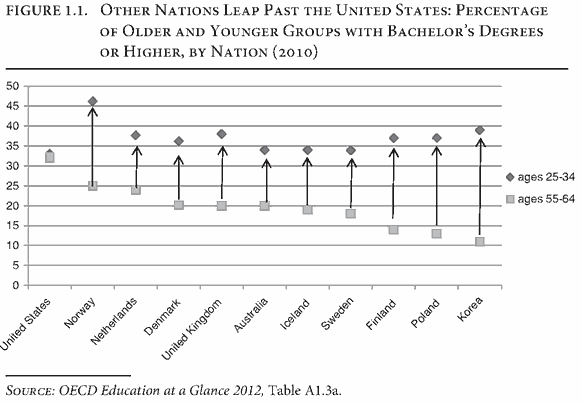
  • There are too few college graduates in the U.S.  In 2010 Americans between ages 25 and 34 had a college graduation rate of 33%. At least 10 OECD nations have higher rates (see below). American world leadership in the future will be jeopardized if we don’t continue to be an educational leader as we have been in the past.

    Capture

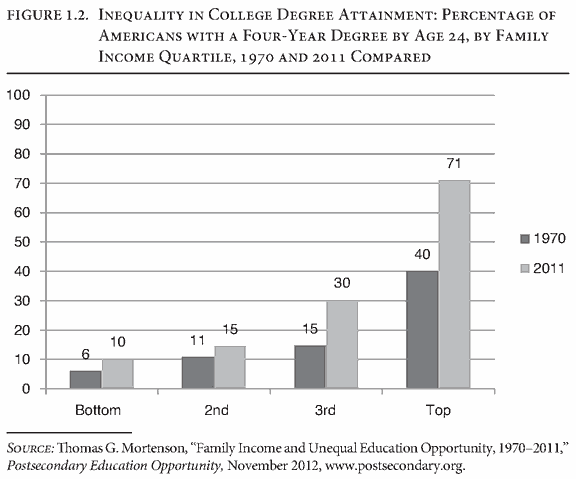
  • America is graduating inequality. College degree attainment has increased between 1970 and 2011 for all income groups. However this is happening much more quickly for higher income groups. 83% of 18 to 24 year olds now have a high school diploma and 75% of this group start college. But the completion rate by age 24 is only 47%, mostly from the higher income groups (see below).Capture1
  • Not all college degrees are created equal. Students at private, nonprofit institutions graduate at higher rates than students from public institutions who, in turn, graduate at much higher rates than students from for-profit institutions. And graduates of the for-profits have larger loan debt than for graduates from private nonprofit and public institutions.

Capture2

Students at for-profit educational institutions tend to be from lower-income families.  As noted, they have lower graduation rates and end up with higher debt levels.  Clearly the three tier system of American higher education has a harmful effect on the young adults who need the most help in moving up the economic ladder.
How should society address this major problem in an era of tight public spending?  One answer is to increase regulation of the government-run student loan program.  All educational institutions should be held at least partially responsible for the defaulted loans of their former students.
Another approach is to increase financial support for community colleges so that they can provide more programs for the low-income students who are most likely to attend them.

How Do We Boost Middle Class Jobs?


Income inequality is a serious political issue these days as it should be.  America’s future well-being depends on widely shared prosperity.  One of the very best ways to lessen inequality is to increase mobility into the middle class.
Capture  The political and economic analysis group, FiveThirtyEight, has just reported new data (see above) that “Mid-tier Jobs Are Seeing Less Growth.”  The middle class has already been hollowed out by the gale-wind forces of globalization and technological advancement.  Now the Great Recession, and the slow recovery from it, has made things that much worse.  It’s long past time to focus on middle class recovery.
The best way to do this is to make the economy grow faster as follows:

  • Tax Reform. Lowering individual rates should be the first priority, paid for by closing loopholes and shrinking deductions for the wealthy. This will give middle- and lower-income workers more money to spend and encourage startup small businesses. Lowering corporate tax rates, again offset by shrinking deductions, will incentivize multi-national corporations to bring their profits back home for distribution or reinvestment.
  • Increase the Earned Income Tax Credit, paid for with some of the increased revenues from shrinking deductions for the well-to-do. This will encourage more people to take and hold onto entry level low-wage jobs, thus increasing the size of the workforce.
  • Putting More Emphasis on Career Education in High School. Not everyone wants to or needs to go to college. There are lots of well-paying middle class jobs for high skilled workers and a shortage of workers for these jobs in many labor markets.
  • Miscellaneous. Immigration reform, trade expansion, and easing regulations on small business would also help grow the economy.


Economic growth since the end of the Great Recession in June 2009 has averaged a meager 2.3%. Speeding up growth is the best way to raise wages and lower unemployment at a much faster rate.  This is the best way to boost middle class jobs!

Can We Solve All Our Fiscal and Economic Problems at the Same Time?


This website, It Does Not Add Up, is devoted to discussing our country’s most serious economic and fiscal problems.  They are:

  • Stagnant Economy. Since the end of the Great Recession in June 2009, the economy has been growing on average at the historically slow rate of about 2.3%. Slow growth means higher unemployment, stagnant wages and less tax revenue.
  • Massive Debt. U.S. public (on which we pay interest) debt is now 74% of GDP (highest since WW II) and projected by CBO to grow rapidly unless strong measures are taken to reduce it. This puts our country’s future wellbeing and prosperity at great risk.
  • Increasing Income Inequality. Incomes for the high-skilled and well-educated are increasing much faster than for the low-skilled and less-educated workers.

The new Republican majorities in Congress are stirring the waters by proposing a ten year plan to shrink the deficit down to zero, i.e. to balance the budget by 2025.  The opposition claims that this would “sharply cut the scale of domestic spending, which would mostly fall on the poor.”
Capture1But the American Enterprise Institute’s James Pethokoukis points out that social spending in the U.S., both public and private, is very generous and second only to France in the entire OECD. So here is how we could proceed to address our basic problems in a unified manner:

  • Balance the Budget by a combination of Republican spending cuts and cutting back on two major tax deductions: Employer-sponsored Health Insurance (cost: $250 billion per year) and Mortgage Interest (cost: $70 billion per year).
  • Boost Economic Growth by expanding the Earned Income Tax Credit to encourage more people to accept low paying, entry level jobs. Increase the Social Security eligibility age from 67 to 70, thereby keeping near retirees in the workforce for three additional years (this will also extend the solvency of the Social Security Trust Fund).
  • Decrease Income Inequality. Cutting back on tax deductions, in part to pay for expansion of the EITC, lessens income inequality as well as shrinking the deficit. A faster growing economy also lessens inequality by providing more opportunities for upward mobility.

In other words, addressing each of these fundamental problems in an intelligent manner contributes to solving the remaining problems as well.  This creates a virtuous circle for economic progress!

Too Much Income Inequality is Harmful to Society


It is well understood that income inequality is increasing in the U.S. and that there are lots of reasons for it.  Globalization provides low cost goods from around the world and thus puts pressure on low-wage workers in our own country.  Rapid technological advancement puts a high premium on educational attainment and skill acquisition and thus helps individuals who are highly motivated to succeed.  The Great Recession and our slow recovery from it have held back the growth of employment and wages increases for middle- and lower-income workers.
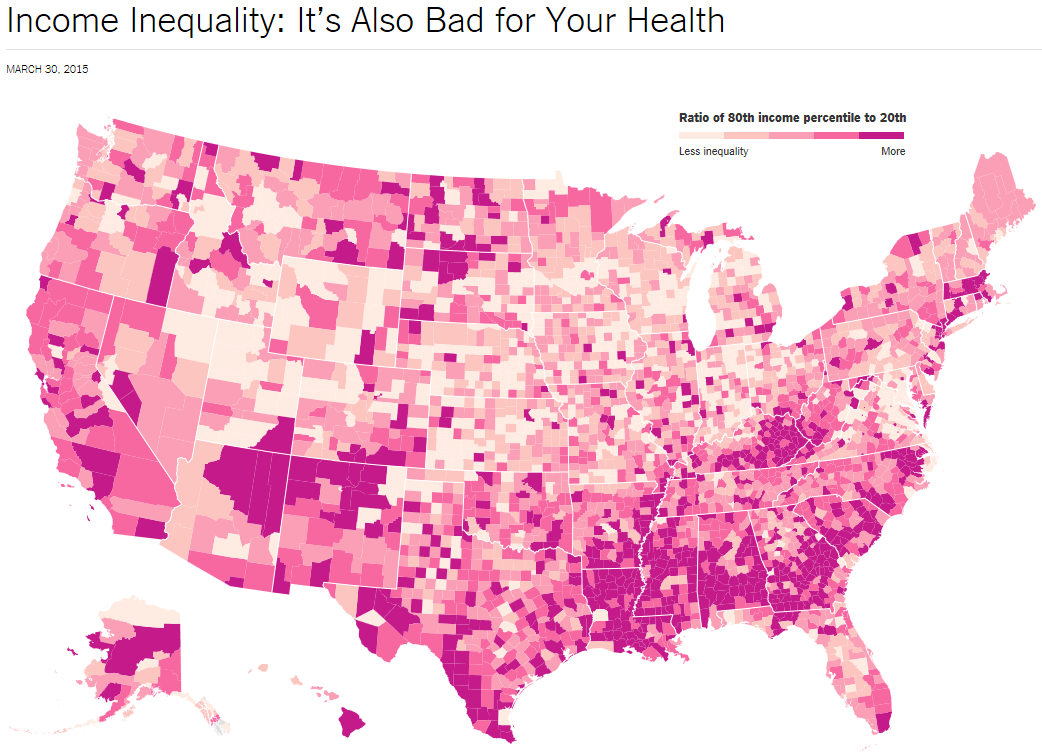
CaptureIncreasing income inequality is a pernicious social condition and has lots of unpleasant consequences.  A new study of U.S. counties has shown that there is a strong correlation between more inequality in a particular geographical area and shorter average live spans.  It is quite reasonable to expect that higher-income people will be more health conscious than lower- income people. Excessive inequality is bad for lots of reasons.
The question is what we can do about it.  Here are two good ways to address it:

  • Faster economic growth would help a lot. The American Enterprise Institute’s Michael Strain has recently proposed a fairly modest plan for increasing employment by cutting tax deductions for the wealthy, increasing the Earned Income Tax Credit for the poor and at the same time decreasing deficit spending. I have made a more substantial proposal along the same lines.
  • Boost educational performance across the board. College-ready middle class kids will take care of themselves so the emphasis should be on the 70% of young adults who will not go to a four year college. There are lots of good jobs available for the highly skilled and so we need more career education in high school. We also need more early childhood education to prepare kids from low-income families to get off to a good start in elementary school.

Increasing economic growth and expanding educational opportunities for the non-college bound will require little, if any, new federal spending.  Such policies as above are simply common sense ways to reduce income inequality and achieve a more inclusive society.

The American People Are Amazingly Upbeat!


I think of myself as a political moderate, conservative on fiscal matters and somewhat liberal on social issues.  My blog posts are usually based on a recent newspaper article or think tank study presenting one side or the other of an important issue in an intelligent way.  In other words, I seldom bother to refute what I consider to be dumb ideas.  I assume that they will eventually die of their own dead weight.  My favorite approach is to respond to an attractive article with which I may have a somewhat different point of view.
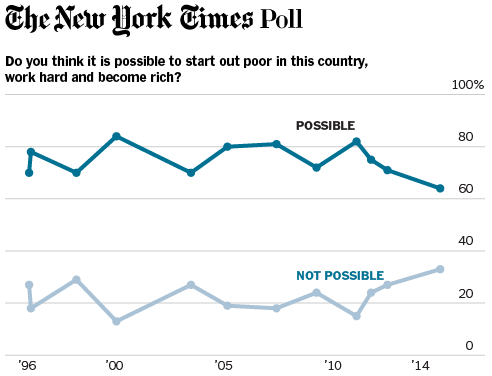
CaptureToday’s New York Times has such an article, “Many Feel American Dream is Out of Reach, Poll Shows,” pointing out that 64% of a NYT Poll respondents think that it is possible to start out poor and become rich (see above chart), which opinion has dropped from 72% in 2009.  The Poll also reports that:

  • 81% of Americans have confidence in their own local banks whereas only 41% have confidence in Wall Street bankers and brokers.
  • 52% think the economic system in the U.S. is basically fair, since all Americans have a chance to succeed, whereas 45% think it is unfair.
  • 54% of Americans think that over-regulation of the economy, which interferes with economic growth, is a bigger problem than under-regulation, which may create an unequal distribution of wealth.

For almost two-thirds of Americans to be upbeat about the American Dream, after six or seven years of recession and slow recovery is to me a very positive sign.  After a severe financial crisis, it is not at all surprising that “main street” bankers have a much higher favorability rating than “Wall Street” bankers.
Several months ago I reported on a survey taken by the progressive Global Strategy Group showing that 80% of voters consider economic growth more important than income inequality.
Both today’s NYT Poll and the previous GSG Survey are saying loud and clear that Americans put a high premium on economic growth and this is where our national leaders should be concentrating their time and energy.  The new Republican majority in Congress has an almost historic opportunity to get this right.  Let’s hope they don’t blow it!

Inequality Does Not Reduce Prosperity


In the national elections this year four states: Alaska, Arkansas, Nebraska and South Dakota raised their state minimum wage rates above the national rate of $7.25 per hour and, at the same time, elected Republicans to the U.S. Senate, in three cases replacing Democratic incumbents.  Does this represent contradictory behavior by the voters?
CaptureThe American Enterprise Institute’s James Pethokoukis recently reported (see above) that the U.S. has the third highest rate of billionaire entrepreneurs behind only Hong Kong and Israel, as well as by far the most billionaires over all.  These are the high-impact innovators like Bill Gates, Steve Jobs and Mark Zuckerberg and the Google Guys.
These observations are put in context by the Manhattan Institute’s Scott Winship who recently reported that “Inequality Does Not Reduce Prosperity.” Here is a summary of his findings:

  • Across the developed world, countries with more inequality tend to have higher living standards.
  • Larger increases in inequality correspond with sharper rises in living standards for the middle class and poor alike.
  • In developed nations, greater inequality tends to accompany stronger economic growth.
  • American income inequality below the top 1 percent is of the same magnitude as that of our rich-country peers in continental Europe and the Anglosphere.
  • In the English-speaking world, income concentration at the top is higher than in most of continental Europe; in the U.S., income concentration is higher than in the rest of the Anglosphere.
  • With the exception of a few small countries with special situations, America’s middle class enjoys living standards as high as, or higher than, any other nation.
  • America’s poor have higher living standards than their counterparts across much of Europe and the Anglosphere.

Conclusion: Americans are fair-minded and would like to help the working poor do better.   But Americans also appreciate the value of innovation and entrepreneurship.  When there is a tradeoff between increasing prosperity and reducing inequality, greater prosperity comes first.

The Great Wage Slowdown and How to Fix It

With a new Congress just elected, this is a good time to reflect about what changes should be made in public policy. Our biggest economic problem is to speed up growth in order to provide more and better paying jobs.  In addition, a faster growing economy would bring in more tax revenue which would help pay our bills and reduce the deficit.
CaptureA column in today’s New York Times, “The Great Wage Slowdown, Looming over Politics,” by David Leonhardt, proposes a cut in the marginal tax rate for the middle class as a way of boosting their incomes.  As can be seen in the above chart, median household income has been flat since the year 2000, and even lower since the 2008 recession.  Mr. Leonhardt goes on to say that any tax cut for the middle class should be balanced by a tax increase for the wealthy.
It so happens that I proposed such a plan several months ago as a way of boosting the economy and reducing inequality at the same time. The idea is to enact broad-based tax reform whereby tax rates are lowered for all, offset by shrinking tax deductions.  The 64% of taxpayers who do not itemize deductions will receive a big tax cut.  But these are the very middle-class wage earners with stagnant incomes.  So they will likely spend their tax savings, thereby giving the economy a big boost.
More specifically:

  • Individual tax deductions total about $1 trillion per year.
  • Let’s suppose that these deductions are cut in half to $500 billion per year.
  • Let’s further suppose that half of this amount, or $250 billion per year, is cut from the taxes of the 64% who do not itemize deductions.
  • If these 64% spend just 2/3 of their new income (instead of saving it or paying off debt), this will total $170 billion which is 1% of GDP.
  • This would increase the rate of growth of GDP from the 2.2% average, since the end of the Great Recession, to 3.2%. This represents an enormous boost to the economy and would return average GDP growth to about its 3.3% average since 1947.

    Mr. Leonhardt suggests that presidential contenders in 2016 would greatly benefit from proposing a tax rate cut for the middle class. Here’s a specific plan they can use!

Income Inequality and Rising Health-Care Costs


There seems to be a general consensus on the reality of increasing income inequality in the U.S. and even some agreement on its two main causes: globalization and the rapid spread of technology. The slow growth of the economy since the end of the recession has made the inequality problem that much worse.
CaptureNot surprisingly, slow economic growth in the past five years has led to stagnant wages for many workers.  My last post addressed this problem.  The above chart from the New York Times shows that incomes for top wage earners have been rising in recent years while they have been stagnant for middle- and lower-income workers.
But there is more to it than this.  In yesterday’s Wall Street Journal, Mark Warshawsky and Andrew Biggs point out that, “Income Inequality and Rising Health-Care Costs,” in the years 1999 – 2006, total pay and benefits for low income workers rose by 41% while wages rose by only 28%, barely outpacing inflation.  For workers making $250,000 or more total compensation rose by a lesser 36% while wages grew by a greater 35%.  This apparent anomaly is explained by the fact that health insurance costs are relatively flat across all income categories, thus comprising a much larger percentage of the total pay package of low-income workers than for high-income workers.
Capture1In fact, the Kaiser Foundation has shown that low-wage workers tend to pay higher health insurance premiums, as well as receiving lower insurance benefits, than higher paid workers (see the above chart).
Overall, what this means is that employer provided healthcare is taking a huge chunk out of the earnings of low-income workers which makes income inequality much worse than it would be otherwise. Of course, the cost of healthcare is a huge burden for the entire U.S. economy, currently eating up 17.3% of GDP, twice as much as for any other developed country.
For both of these reasons it is an urgent matter for the U.S. to get healthcare costs under control.  Avik Roy of the Manhattan Institute has an excellent plan to do just this as I have discussed in several recent posts.

Economic Expansion Is Not Enough


The Washington Post reporter Robert Samuelson gives our economy today a B-, because the unemployment rate has inched down to 6.1%, fulltime employment is up to 105.8 million in 2013 from 99.5 million in 2010, and full-time women’s pay reached a high of 78% of men’s pay in 2013.  The big negative, of course, is that median household income was $51,939 in 2013, down from $56,436 in 2007, just before the financial crisis.
The Bard College economist Pavlina Tcherneva, as summarized by the reporter Neil Irwin in yesterday’s New York Times, shows what has gone wrong with economic and monetary policy since the end of the Great Recession in June 2009. The American Recovery and Reinvestment Act of 2009 (an $850 billion stimulus package) did boost the economy but it primarily aided “the skilled, employable, highly educated, and relatively highly-paid wage and salary workers.”
Capture2On the other hand the Federal Reserve’s quantitative easing policies have kept interest rates remarkably low and have thereby caused investors to buy stocks rather than bonds in order to get higher returns.  This has artificially boosted stock prices and has been especially advantageous to the top 10% and, even more so, the top 1%.
CaptureWhat is needed, according to Ms. Tcherneva, is a targeted, bottom-up approach to fiscal policy, which provides more and better paying jobs directly to middle- and lower-income wage earners.  Her suggestion is for public works jobs, public service employment, green jobs, etc., all of which would require large infusions of federal money thereby worsening the federal deficit.
A much better approach would be broad based tax reform, lowering tax rates across the board, paid for by closing the loopholes and deductions which primarily benefit the rich.  Since the 64% of taxpayers who do not itemize deductions would receive an effective pay boost, this would amount to a tax reform program targeted to exactly the middle- and low-income wage earners who have not yet recovered from the recession.  These folks would most likely spend their extra income, thus further boosting the economy (see my previous post).