The GOP Congress Needs to Get Back to Fundamentals


Granted that it is hard to implement good policy with a populist President like Donald Trump who is most interested in stirring up his base, nevertheless the Republican Congress is making some serious policy mistakes:

  • Healthcare. The GOP should accept the fact that universal healthcare is a desirable societal goal and is here to stay. The Graham-Cassidy bill is bad policy because some states, such as debt-ridden Illinois, can’t possibly handle healthcare on their own. The fact that the ACA needs operational fixes gives the Republicans leverage for insisting on cost lowering changes in a bipartisan bill.
  • Tax Reform. The GOP should focus on the most serious problems in our tax system. The complexity of the tax code is partly responsible for the fact that taxes paid lag true tax liabilities by an estimated 16% or $406 billion per year.  As an example of waste, the IRS has paid out $132 billion in EITC benefits over the last decade to people who were ineligible.
    Our uncompetitive corporate tax rate of 35% encourages multinational companies to leave their profits overseas rather than bringing them back home for reinvestment.  Even so, corporate tax revenue as a share of GDP is less than in most other developed countries.
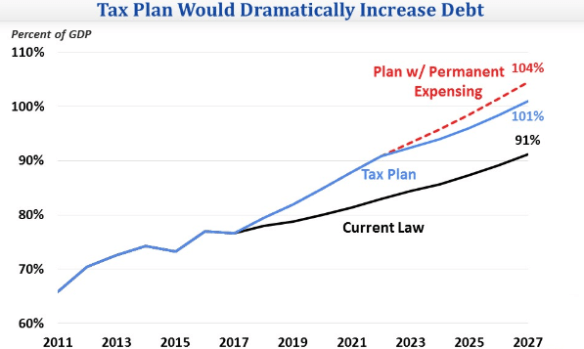
    Republicans claim to be the party of fiscal responsibility and should therefore be highly uncomfortable with any tax plan which reduces federal revenue and increases our already very large annual deficits.  With a low unemployment rate of 4.4%, any additional artificial (deficit financed) fiscal stimulus is likely to kick off a new round of inflation.

Conclusion. Republicans have a relatively short window of opportunity to enact policy changes beneficial for the country. They need to get serious about what is really important before time runs out.

Follow me on Twitter 
Follow me on Facebook 

Why Is Political Progress So Difficult in the United States?


With Donald Trump expanding the culture wars and the Democrats lining up with the progressive policies of Bernie Sanders, the national political scene seems to be getting more confusing all the time.


And yet there is remarkable consensus on many levels about what the country really needs:

  • Faster economic growth would help provide more jobs and better paying jobs for the blue-collar workers which both parties are trying to appeal to.
  • Tax reform meaning to reduce tax rates, shrink deductions and generally simplify the tax code has widespread bipartisan support, as one way to provide the growth which everyone wants.
  • Shrinking the debt as a percentage of GDP is widely recognized as critical to the future well-being of our country and especially for the poor who are most dependent on social welfare programs.  How to curtail spending sufficiently to get this done is inevitably a highly contentious issue.
  • Healthcare for (almost) all is now the law of the land, given that the GOP has failed to repeal the Affordable Care Act. The emphasis going forward should be to control healthcare costs for both individuals and families as well as for the federal government (the taxpayers).
  • Immigration and DACA. There appears to be strong bipartisan support in Congress for giving the Dreamers legal status in the U.S. With a very low (4.4%), and still dropping, unemployment rate, a huge labor shortage is developing in many states, including Nebraska. What the U.S. needs is an expanded guest worker visa program so that all employers are able to find the (legal) employees they need to conduct business. Perhaps DACA reform will lead to broader immigration reform as well.

Conclusion. The above issues should be largely amenable to bipartisan consensus. Both parties would benefit from putting aside petty differences and working together to solve them.

Follow me on Twitter 
Follow me on Facebook 


Achieving Permanent, Revenue Neutral, Pro-Growth Tax Reform


As Congress turns its attention to tax reform, there is a clear bipartisan consensus on the fundamental principles to employ, see here, herehere, and here.


For example:

  • Promote growth and increase wages for working families
  • Modernize our outdated business and international tax system.
  • Rely on reasonable economic assumptions
  • Make sure that any rewrite of the tax code is revenue neutral

The Tax Foundation has outlined several different approaches to tax reform which meet the above guidelines.  Their Option A is especially attractive:

  • The corporate tax is reduced to 22.5% and full expensing for business investment is allowed.
  • GDP increases by 7.1% long term which translates to a .7% increase per year for ten years, which is substantial economic growth.
  • All income groups, except for the top 1%, will see an after-tax increase in income.
  • Individual Tax brackets are consolidated into the three rates of 12%, 20.5% and 37% and the standard deduction is nearly doubled (from $6350 to $12,000).
  • All itemized deductions are eliminated except for home mortgage interest (limited to $500,000) and charitable contributions.
  • Capital gains and dividends are taxed as ordinary income with individuals being allowed to deduct 40% of qualified dividends and long-term capital gains.
  • The estate tax is eliminated.
  • This tax plan is revenue neutral on a static basis.

Conclusion. There are many attractive features in this plan. Being revenue neutral, with strong economic growth, means that the increase in tax revenue will shrink our huge current annual deficits.  Only the very wealthy top 1% of taxpayers will see their income (slightly) decreased.  The substantial decrease in the corporate tax rate will incentivize multinational corporations to bring their overseas profits back home for reinvestment.

Follow me on Twitter 
Follow me on Facebook 

A Different Perspective on U.S. Healthcare Reform


U.S. healthcare policy is now in limbo. The Affordable Care Act has withstood Congressional attempts to repeal it, but it has many flaws which need to be repaired.  Primarily, the ACA expands access to healthcare in the U.S. (good) but does nothing to control burgeoning costs for both individuals and the federal budget (bad).


One option for both further expansion of access as well as cost control is Bernie Sanders’ single-payer “Medicare for All” plan.  A different option is universal catastrophic care for all Americans not already covered by Medicare or Medicaid (including those receiving employer provided health insurance).


A different perspective is provided by an editorial in the New England Journal of Medicine.  According to the authors, Eric Schneider and David Squires, the U.S. also faces (in addition to the challenge of much better cost control) several performance challenges such as:

  • Lack of access to affordable and comprehensive insurance coverage for too many people.
  • Relative underinvestment in primary care. Other developed countries have a higher percentage of their professional workforces dedicated to primary rather than specialty care and deliver a wider range of services at first contact.
  • Administrative inefficiency of the U.S. healthcare system. The solution here is to change our reimbursement systems to use global payments, fee schedules, formularies and defined benefits.
  • Disparities in the delivery of care. People with low incomes, low educational attainment, and other social and economic challenges face greater health risks and thus need even greater access to primary healthcare.

Conclusion. The U.S. compares poorly with other advanced countries in both the quality and cost efficiency of its healthcare system. Healthcare costs in the U.S, are a huge drain on the economy and will ultimately cause huge fiscal problems if not brought under much greater control.

Follow me on Twitter 
Follow me on Facebook 

Moving Forward on Healthcare Reform: Single payer?


It is frequently stated that the current Republican Congress is ineffective in getting anything done. That is not entirely true.  A big issue was decided this past summer.  The failure of Congress to repeal and/or replace the Affordable Care Act means that the goal of universal healthcare for all Americans is here to stay.


The question now is the best way to implement universal healthcare.  Senator Bernie Sanders (D, VT) has just introduced a single payer universal plan, “Medicare for All.”  Here are some of the problems associated with such a plan:

  • At least three states, Vermont, Colorado and California have recently rejected state-wide single-payer plans because of the huge costs involved.
  • The Urban Institute estimates that Medicare for All would increase federal spending by $32 trillion for the first ten years (compared to a very high current total national debt of $20 trillion).
  • Medicare is an inefficient hidebound system with over 140,000 procedure codes where private sector cost-saving measures, like competitive bidding for routine services, are rarely used.
  • There are now 155 million Americans who receive and like their employer provided health insurance and who will resist moving to a Medicare for All plan especially at the cost of a huge tax increase.

On the other hand the cost of healthcare in the U.S., public and private, now eats up 18% of GDP, almost twice as much as for any other developed country, and major changes need to be made to give individuals more direct responsibility for the cost of their own healthcare.
One attractive alternative is to limit the tax deduction for employer provided care to the cost of catastrophic coverage, at a cost of about $3000 per person per year.  It could be made progressive by tying deductibles to income.

Conclusion. Healthcare spending in the U.S. is way too high and something major needs to be done. Universal catastrophic care for all Americans not already covered by Medicare and Medicaid is an attractive alternative to single-payer Medicare for All.

Follow me on Twitter 
Follow me on Facebook 


Why Our National Debt Is a Very Serious Problem for All Americans, but Especially the Poor


Congress has just postponed the debt ceiling until December 8 but at least they didn’t repeal it.  It is crucial to retain regular and explicit debt ceilings as a reminder of the urgency of putting our debt on a downward course (as a percentage of GDP).
As a reminder:

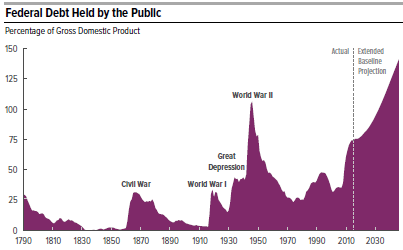
  • The debt now stands at 77% of GDP (for the public part on which we pay interest), the highest it has been since right after WWII. The $15 trillion public debt right now is essentially “free” money because interest rates are so low. But interest rates will inevitably return to more normal, and higher, historical levels and, when this happens, interest payments on the debt will skyrocket.
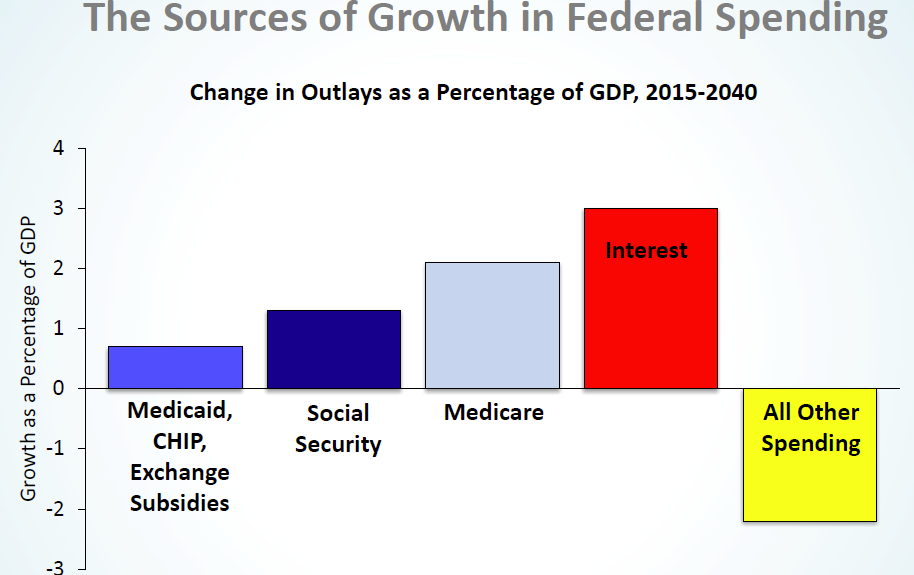
  • The entitlement programs of Social Security. Medicare and Medicaid are the drivers of our debt problem because their costs are increasing so rapidly. Medicaid costs the federal government almost $400 billion per year. Medicare costs the federal government $400 billion per year more than it receives in FICA taxes and premiums paid.

The attached chart demonstrates the scope and urgency of the problem.  By 2032, just fifteen years from now, all federal tax revenues will be required to pay for Social Security, Medicare, Medicaid and interest payments on the debt. This means that all of ordinary discretionary spending: on defense, various government operations and social welfare programs will be paid for entirely from new deficit spending and, in the process, will almost inevitably suffer huge cutbacks.  The lower-income and poor people, who are the most reliant on government programs to get by, will be the most adversely affected.

Conclusion. Such a dreary scenario of drastically tightened government spending does not have to occur. It can be avoided by immediately starting to make sensible curtailments, not actual spending cuts, all along the line.  Do our national leaders have the common sense and fortitude to do this?

Follow me on Twitter 
Follow me on Facebook 


Why Entitlement Spending Is So Difficult to Control


The readers of this blog know that my favorite topic is our very large national debt, now 77% of GDP (for the public part on which we pay interest) and predicted by the Congressional Budget Office to keep steadily getting worse, without major changes in current policy.


It is also well documented (see chart)  that our entitlement programs of Social Security, Medicare and Medicaid are the drivers of the huge annual budget deficits which make the accumulated debt so much worse and worse.
The economist John Cogan has an informative interview in yesterday’s Wall Street Journal explaining why entitlement spending is so difficult to control. First of all, according to Mr. Cogan, only three modern presidents have made any effort to control entitlement spending:

  • FDR who persuaded Congress to repeal unjustified disability entitlements to 400,000 WWI, Philippine War and Boxer Rebellion veterans.
  • Ronald Reagan “slowed the growth of entitlements like no other president ever had.”
  • Bill Clinton’s welfare-reform plan not only reduced welfare’s burden on taxpayers but also benefitted the recipients, whom the old program had been harming.


Mr. Cogan identified three necessary political conditions for any entitlement reform. They are:

  • Presidential leadership “without which there has never been a significant reduction in an entitlement.”
  • Significant agreement among the general public and the elected representatives that there’s a problem.
  • Bipartisan consensus on the solution for correcting the problem.

Conclusion.  Think about it.  This is a quite a gloomy assessment.  Nothing will get done on the primary reason for our huge debt problem without both presidential leadership and bipartisan political support. When is this going to happen?

Follow me on Twitter 
Follow me on Facebook 

Global Warming and Debt Are Both Creeping Catastrophes


Three devastating hurricanes have struck the U.S. in recent years: Katrina (2005), Sandy (2012) and now Harvey (2017). Hurricanes and tropical storms are natural events which have occurred since the distant past, long before global warming became a problem.
What has changed is that the oceans are now steadily getting warmer by absorbing much of the heat reflected back to earth by greenhouse gases (see chart).  Warmer water has more latent energy and this makes hurricanes more severe. The warmer the oceans become, the more devastating future hurricanes will be.


It is (past) time to get serious about global warming.  As the world’s strongest country, it is up to the U.S. to provide leadership on this very serious problem.  The best way we can respond is by adopting a (revenue neutral) carbon tax to discourage future carbon emissions as much as possible.  This problem is not going to disappear but it is within our power to limit the damage it causes before it gets a lot worse.
The exact same thing is true about our national debt.  At 77% of GDP (for the public part on which we pay interest), it is the highest it has been since the end of WWII. Right now interest rates are so low that our debt is almost “free money.”  But interest rates will eventually return to more historically normal levels.  When this happens, interest payments on the debt will rise by hundreds of billions of dollars per year.  At that point a severe Fiscal Crisis will not be far behind.
Again, debt is a solvable problem if only our national leaders will take it seriously.  All it requires (so to speak, because it won’t be easy!) is to limit future federal spending in sensible ways.

Conclusion. Both global warming and national debt are serious, urgent problems. The sooner we get started on addressing them, the better off we will be.

Follow me on Twitter 
Follow me on Facebook 

What Do I Mean When I Say I’m a Fiscal Conservative?


Americans are a very fortunate people. We are protected by two oceans and friendly neighbors to our north and south.  We are the strongest country in the world, both economically and militarily.  We provide the world with cutting edge leadership in many areas such as technology, finance, energy production, scientific research and university education.
In short we live in a very successful, prosperous and complex society.  We do have serious problems but they are being addressed by our elaborate legal and governmental processes and structures. Slowly but surely life in America is getting better and better all the time.
Given our country’s size, complexity and dominance in the world, it is inevitable that government will also grow in size and structure in order to take on new responsibilities. It is completely unrealistic to think that we can return to a more limited form of government that existed in the past.
When I say, then, that I’m a fiscal conservative, I am not advocating for less government but merely that we pay for the government that we have, in other words, act in a fiscally responsible manner.


And we are not doing this at the present time:

  • Our national debt, now 77% of GDP (for the public debt on which we pay interest), is the highest since right after WWII. It is predicted by the Congressional Budget Office that it will keep steadily getting worse without major changes in current policy.
  • The urgency of the debt problem is based on the fact that interest rates are now so low that it is almost “free” money. But interest rates will inevitably return to more normal historical levels and, when this happens, interest payments on the debt will skyrocket. Eventually this will lead to a Fiscal Crisis, much worse than the Financial Crisis of 2008.
  • The solution to this problem need not be drastic. Federal spending is growing by 5% per year while tax revenues are growing by 3% per year. If we would just hold spending increases down to 2.5% per year, the federal budget would be balanced in a few years and our debt would start shrinking as a percentage of GDP.

Conclusion. Spending restraint, with very few actual spending cuts, is all that it will take to put our debt problem on a path to solution. Surely we are capable of acting in a fiscally responsible manner like this!

Follow me on Twitter 
Follow me on Facebook 

Should I Run for the U.S. Senate?


For the past almost five years, beginning in November 2012, I have been blogging about fiscal and economic issues facing the United States. With the unemployment rate now down to 4.3%, and the economy growing at 2% annually and likely to pick up speed, our biggest problem by far is an exploding national debt, currently 77% of GDP (for the public debt on which we pay interest), the highest since the end of WWII.
There are two announced candidates so far for the Nebraska Senate seat which becomes open in January 2019:

  • The incumbent, Senator Deb Fischer, a Republican
  • Jane Raybould, Lincoln City Councilwoman, a Democrat.

There is always enormous pressure on members of Congress to maintain or increase spending for popular projects and little pressure to cut anything. In general, Republicans deplore large deficits and debt but are ineffective in implementing fiscal restraint while Democrats simply don’t want to talk about the debt problem at all. I am a non-ideological (registered independent) fiscal conservative and social moderate, highly focused on substantially shrinking our annual deficits over a short time period.


Here are my options for the Senate race:

  • Enter the Republican Primary. I would get almost no traction running against the incumbent Republican in the Primary, even though she is a big spender, and I am antiabortion and support a national 20 week cutoff for most abortions.
  • Run as an independent. This is futile without huge name recognition or financial resources, of which I have neither.
  • Enter the Democratic Primary. The announced candidate has a strong party affiliation which I lack. But she has little chance of defeating Senator Fischer in the general election whereas I could by credibly hammering Fischer as a big spender.

Please respond! Please give me you input on this matter one way or another. My email address is jackheidel@yahoo.com.  Would you support me as a Senate candidate?  Congress badly needs more members who are serious about shrinking our debt and I am such a person.  More later!

Follow me on Twitter 
Follow me on Facebook