Wealth Inequality I. What Is It?


The subject of income inequality has generated much interest and concern in recent months.  Now we will also be hearing a lot about wealth inequality, based on the highly credible new work, “Capital in the Twenty-First Century” by the French economist, Thomas Piketty.  The New York Time’s Eduardo Porter, summarizes the basic message in his recent column “A Relentless Widening of Disparity in Wealth”, which is clearly displayed in the two charts below.
CaptureThe value of private capital as a percentage of national income worldwide has been growing steadily since about 1950 and Mr. Piketty predicts that this trend will continue indefinitely.  The trend is equally true, not only in the U.S., but also in other developed countries as is illustrated in the chart.  It happens because the income from wealth, i.e. return on investment, typically grows faster than wages and GDP.
As Mr. Porter says, “It means future inequality in the United States will be driven by two forces.  First of all, a growing share of national income will go to the owners of capital.  Of the remaining labor income, a growing share will also go to the top executives and highly compensated stars at the pinnacle of the earnings scale.”
This trend has now been in effect ever since 1870, with the exception of the period between World War I and World War II, when a massive amount of wealth was destroyed.  The forces of globalization and growth of technology are contributing to both types of inequality, especially in the developed world (see my post of January 23), and these forces will almost surely continue unabated.  So the wealth and income inequality gaps are just going to keep getting worse.
How much inequality can exist in a democracy?  The number of losers (the low income, the poor, and even the struggling middle class) will gradually get bigger and bigger and will become more and more frustrated and express their discontent at the ballot box.  This threatens the future of capitalism and free enterprise, the economic principles on which our way of life is founded.
Something has to be done!  Stay tuned for my next post!
Does Free Trade Increase Inequality?


Several days ago, David Bonior, a former Congressman from Michigan, wrote in the New York Times about “Obama’s Free-Trade Conundrum”. “The President cannot both open markets and close the wage gap.”  There is an “academic consensus that trade flows contribute to between 10 and 40 percent of inequality increases.”  This happens because “there is downward pressure on middle-class wages as manufacturing workers are forced to compete with imports made by poorly paid workers from abroad.”
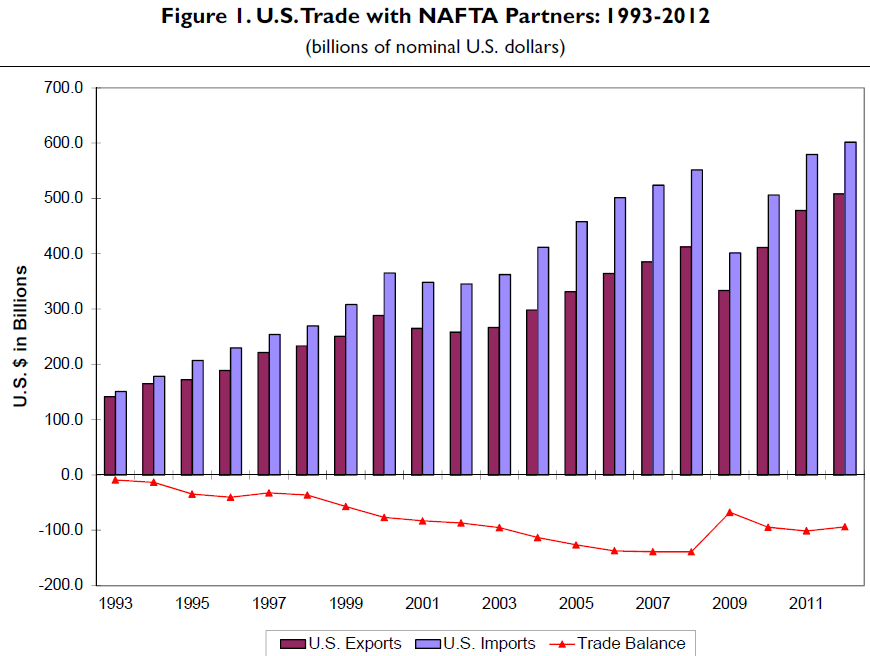
CaptureBut there is another point of view, provided, for example, by the report “NAFTA at 20: Overview and Trade Effects”, prepared by the Congressional Research Service about a year ago.  “U.S. trade with its NAFTA partners has more than tripled since the agreement took effect (in 1993).  (Canada and Mexico) accounted for 32% of U.S. exports in 2012.  40% of the content of U.S. imports from Mexico and 25% of U.S. exports from Canada are of U.S. origin.  In comparison, U.S. imports from China are said to have only 4% U.S. content.”  In other words, NAFTA at least has been a huge success.
Being able to trade with others is the foundation of private enterprise.  Foreign trade is simply an extension of domestic trade.  To limit trading opportunities with other countries would be a huge barrier to economic growth and therefore to future prosperity as well.
But at the same time we do want a more equal society as well as well as a more prosperous one.  The key to resolving this “conundrum”, as Mr. Bonior puts it, is to address “opportunity inequality” as well as “income inequality.”
It is estimated that each billion dollars in U.S. exports provides employment for about 5000 workers.  Nebraska, for example, exported $12.6 billion worth of goods and services in 2012 which translates into 63,000 jobs.
More jobs and better jobs are what create economic opportunity.  One way to create more jobs and better jobs is to promote foreign trade by removing as many trade barriers as possible.  Hopefully Congress and the President can work together to get this done!

Invested in America


The Business Roundtable, an association of chief executive officers of leading U.S. companies, has just issued a new report, “Invested in America: A Growth Agenda for the U.S. Economy”, describing four actions which policymakers can take to rejuvenate the U.S. economy.
CaptureThey are:

  • Restore Fiscal Stability: constrain federal spending in a manner that reduces long-term spending growth, making both Medicare and Social Security more progressive and less expensive.
  • Enact Comprehensive Tax Reform: adopt a competitive, pro-growth tax framework that levels the playing field for U.S. companies competing in global markets.  Several studies estimate that cutting the U.S. corporate tax rate by 10 % (e.g. from 35% to 25%) would boost GDP by 1% or more.
  • Expand U.S. Trade and Investment Opportunities: pass updated Trade Promotion Authority legislation and use TPA to complete many new trade agreements which are already pending.
  • Repair America’s Broken Immigration System: increase the number of visas for higher skilled workers and provide legal status for the millions of undocumented immigrants currently living in the U.S.

These are the same “big four” policy changes which many progressive business leaders as well as evenhanded think tank experts often recommend.  They are really just common sense ideas which reasonable people should be able to come together on.
Isn’t it obvious that we’ll soon be in big trouble if we don’t get our enormous budget deficits under control?  And that controlling entitlement spending is key to getting this done?
Isn’t it just as obviously commonsensical that even U.S. based multinational corporations will try to avoid locating business operations in countries like the United States with very high corporate tax rates?
Isn’t it likewise obvious that foreign trade is just an extension of domestic trade and that the world is better off with as much trade as possible?
Finally, the secret of a vibrant, growing economy is to encourage as much initiative and innovation as possible.  Who take more initiative than the immigrants who figure out how to get here in the first place?
We don’t have to accept a sluggish economy, high unemployment and massive debt!  But we do need to take intelligent action to extricate ourselves from the predicament we are in!

A Global Perspective on Income Inequality II. Where Are the Jobs?


My last post on January 23 shows vividly what the challenges are in restoring the American middle class to the prosperity which existed up until the Great Recession hit in late 2007.  The problem, of course, is the gale strength force of globalization which is lifting up low wage workers all over the developing world and creating huge competition for the many low-skilled workers in the United States.
In today’s New York Times, the former Obama Administration car czar, Steven Rattner, writes about “The Myth of Industrial Rebound” in the United States, explaining why manufacturing jobs are coming back much more slowly than other jobs.  “Manufacturing would benefit from the same reforms that would help the broader economy: restructuring of our loophole-ridden corporate tax code, new policies to bring in skilled immigrants, added spending on infrastructure and, yes, more trade agreements to encourage foreign direct investment.”
CaptureThe above chart shows the huge decline in manufacturing jobs relative to other parts of the economy such as the education and health sector as well as the professional and business sector.  Of course, these more rapidly growing service sectors are the ones benefitting from the information technology revolution.  In manufacturing, on the other hand, the low skill jobs are going overseas while the high skill jobs, using technology such as robots, are much fewer in number.
Conclusion: in order to increase manufacturing jobs in the U.S., we better government policies, as outlined above by Mr. Rattner.  But we also need to recognize that there aren’t going to be as many high skilled manufacturing jobs in the future.  We are going to need much better K-12 and post-secondary educational outcomes to prepare the middle class for the high skilled service jobs which will predominate in the future.

Harnessing Market Forces versus Offsetting Market Forces


The economist Matthew Slaughter writes in today’s Wall Street Journal that ’High Trade’ Jobs Pay Higher Wages. He points out that the 22.9 million Americans who work for U.S. headquartered multinational companies made an average of $73,338 in 2011 compared with the overall average wage of about $55,000 that year.  “Workers in multinational firms earn more, as global engagement fosters innovation and productivity growth.”
“There is a growing concern about stagnant or falling incomes, yet most of the measures proposed to deal with the issue – raising the minimum wage and reinstating unemployment benefits – purport to help workers by offsetting market forces.  Less attention is given to harnessing market forces.”
CaptureThis can be done by “liberalizing U.S. trade, investment, immigration and tax policies.”  In other words, we need more trade agreements like NAFTA, which has been so successful in increasing trade in North America.  We need more high skilled workers, both domestic and foreign.  We need lower corporate tax rates to encourage multinational corporations to bring their trillions of dollars in overseas profits back home.
We should always strive for a more equal society with less income inequality.  But the best single way to do this is to create more opportunity by growing the economy, i.e. by harnessing market forces.

Why a High Corporate Income Tax Is So Damaging to Our Economy


My previous post, “Fundamental Tax Reform Is the Key to Solving Our Economic and Fiscal Problems II.  The Graetz Plan”, describes a tax reform plan which establishes a 14% national consumption (VAT) tax, exempts families earning under $100,000 from paying any income tax and also reduces the Corporate Income Tax to 15%.  All of this is done in a revenue neutral manner while also preserving all of the progressivity of our current income tax system.
CaptureA recent Op Ed column in the New York Times, by the economist Lawrence Kotlikoff, “Abolish the Corporate Income Tax”, makes the case that such a proposal “might sound like a gift to the rich, but it would actually help workers. … Apple’s tax return says it all:  The company, according to one calculation, paid only 8% of its worldwide profits in United States corporate income taxes, thanks to piling up most of its profits and locating far too many of its operations overseas.”
Our corporate income tax rate, at 35%, is one of the highest in the world and this is what encourages American multinational companies to move their business to other countries.  Whether we abolish the corporate income tax entirely, or just reduce it to 15%, is less important than recognizing the need to overcome popular prejudice about big business and make fundamental changes in our tax structure.
Solving our country’s many problems, from rising inequality at home to projecting adequate strength around the world, requires that the U.S. have a strong economy.  An annual growth rate of 2% of GDP is not nearly good enough to end our current economic stagnation.  To accomplish this will require overcoming the strong headwinds of increasing global competition and the replacement of people with machines.  We will need innovative thinking and initiative to break out of the old ways of doing things which are holding us back.
Are the American people “exceptional” enough to accomplish this challenging task?

An Optimistic View of America’s Future!


In the latest issue of Barron’s, Frederick Rowe, the managing partner of Greenbrier Partners Capital Management, asks in “More Than a Sugar High?” , “Can you imagine a country that is managed in an economically rational manner, creating the wealth that’s necessary to take proper care of the citizens who get left behind? … What if our economic recovery is more than a sugar high?  What if there is more here than insanely stimulative monetary policy from the Federal Reserve?  What if the U.S. has already begun to steer an economic course to a period of unprecedented and genuine prosperity, achievement, and problem solving?”
Here are eight factors which Mr. Rowe gives to point us in the right direction:

  • North American Energy Independence (already on the horizon).
  • Sensible Immigration Reform: encouraging our most enterprising and hard-working people to become citizens rather than chasing them away.
  • Repatriation of Corporate Income: if a company domiciled in the U.S. makes money in Argentina and wants to invest it in the U.S. we double-tax the daylights out of it.  It would be hard to imagine a more counterproductive tax policy.
  • Changing Directors and Their Thinking: the once unthinkable mindset of corporate directors acting on behalf of long-term owners (rather than the CEOs with whom they play golf) is actually gaining traction.
  • Lowering Corporate Taxes: the tax-writing committees in Congress are working on this.
  • Increasing Technological Leadership: the most dynamic technology companies in the world are domiciled in the U.S. Technology, in the short run, displaces workers.  But eventually workers catch up because new technology creates new kinds of jobs that were never imagined before.
  • Americanization of the World: more than three billion people around the world will soon be able to afford to live much more like the 300 million Americans do.  So companies which make it big here have an automatic global opportunity.
  • Obamacare:  Even this bureaucratic catastrophe provides a large opportunity for economic opportunity.  Think of Jimmy Carter’s failures which led to Ronald Reagan’s successes.

“Let your imagination run and consider all the things that can be accomplished by an energy-independent, cash-generating, cash-repatriating country that is a hotbed of technological innovation.”
I can’t possibly say it any better than this!

Should the Minimum Wage Be Raised?

In today’s New York Times, the economist Arindrajit Dube has an Op Ed column in the Great Divide series, “The Minimum We Can Do”, pointing out that today’s minimum wage of $7.25 per hour is only 37% of today’s median hourly wage of about $20 per hour.  This compares with the 1968 minimum wage of $10.60 per hour (in today’s dollars, adjusted for inflation) which was 55% of the median wage at that time.  This is in line with the current Democratic proposal to raise the minimum wage to $10.10 per hour.
The standard argument against raising the minimum wage is that it will reduce employment because “when labor is made more costly, employers will hire less of it.”  However Mr. Dube offers empirical data which “suggest that a hypothetical 10% increase in the minimum wage affects employment in the restaurant or retail industries by much less than 1 percent” and therefore very little.
Basically Mr. Dube is arguing that raising the minimum wage won’t hurt the economy and it will help many low-paid workers.  The problem with this point of view is that it distracts attention from what we really should be doing: namely, everything we possibly can to speed up economic growth.  By far the best way to raise wages is to increase the value of labor by creating more jobs!
I may sound like a broken record, repeating the same thing over and over again, but we badly need to concentrate on the fundamentals of growing the economy: lowering tax rates, individual and corporate, to stimulate business investment and risk taking by entrepreneurs; removing onerous regulatory burdens, especially on new businesses and existing small businesses; and emphasizing career education and job training to fill the millions of high skill job openings which exist.
There are strong headwinds facing our economy: bad demographics (rapidly retiring baby boomers), pressure from technological progress and globalization which put a high premium on education and advanced skills, and massive national debt which will become a huge burden as interest rates inevitably increase.
These strong headwinds aren’t going away.  To overcome them we need national leaders who are able to rise above ideology and focus on the fundamentals.
Conclusion: we should raise the minimum wage when unemployment drops to 6% or, perhaps, tie a raise in the minimum wage to a tax reform measure which significantly lowers tax rates.

Where Are the Jobs? III. The Real Inequality Gap


Today’s Wall Street Journal has a story “Job Gap Widens in Uneven Recovery”, which shows how unbalanced the economic recovery is.  For workers aged 25 and older, unemployment is only 6%, compared to the overall unemployment rate of 7.3%.  But for the young, ages 16 – 24, unemployment is 15%.  Since the end of the recession in June 2009, wages have risen by 12% for the highest paid 25% of all workers.  For the lowest paid 25%, wages have only risen by 6% over this time period.
“Households earning $50,000 or more have become steadily more confident over the past year and a half.  Among lower income households, confidence has stagnated.  The gap in confidence between the two groups is near its widest ever.  That isn’t only bad for those being left behind.  It’s also hurting the broader recovery, because it means families are able to spend only on essential items.  Consumer spending rose just .1% in September 2013, after adjusting for inflation.”
Unfortunately, this data is entirely consistent with other gloomy economic trends which I have been reporting on recently such as the threat of technology to the middle class, the increased competition from globalization, and the shrinking size of the labor pool because of baby boomer retirements.
The New York Times has a running series of articles on “The Great Divide” and how to address it.   Here is a clear cut example of this divide: how older, better trained and more affluent Americans are recovering from the recent recession more quickly than the less well off.  This evident unfairness is damaging to the health of our society.  The question is how do we address it in an effective manner?
The basic problem is the overall slow growth of the economy, about 2% of GDP per year, since the recession ended in June 2009.  There are many things that policy makers can do to speed up this growth if they were only able to set aside ideological differences.  The best single action by far is tax reform, for both individuals and corporations, lowering overall rates in exchange for reducing deductions and loopholes which primarily benefit the wealthy.
Here is yet another reason why it is so important to speed up the growth of our economy.  How exasperating that our national leaders cannot figure out a way to come to together and get this done!

A Pessimistic View of America’s Future II. What Does Everyone Want?


In my previous post I laid out the view of the economist, Tyler Cowen, in his new book “Average is Over”, that the powerful trends of globalization, technology, and ever increasing machine intelligence (such as Google’s search engines), will lead to a super elite 10-15% of American’s who will have the ability and self-discipline to master tomorrow’s technology and profit from it.  The average middle class worker will be increasingly replaced or downgraded by intelligent machines.  Social and economic inequality will continue to grow and this new trend will be very hard to overcome.  This is a bleak prospect for the future of America.
What can be done to resist this trend and to try to turn it around?  Jim Clifton, the CEO of the Gallup Organization, says in “The Coming Jobs War”, that “what everyone in the world wants is a good job” and he has many ideas about how to boost the economy in order to produce more good jobs.  According to Mr. Clifton, there is no shortage in this country of creativity, new inventions and innovation.  What is lacking are successful business models to commercialize the good ideas which are already out there and create customers for new products.  We need entrepreneurship.  “Entrepreneurship has a direct impact on supply and demand, but with a distinction.  It doesn’t just provide supply, it builds demand.”
Next question: how do we boost entrepreneurship?  We get government out of the way as much as possible.  This means the lowest possible tax rates (offset by eliminating tax loopholes for the wealthy) and fewer burdensome regulations (such as the employer mandate for health insurance).
 As a society we have to decide which is more important:  creating more and better jobs by growing the economy faster or making everyone more equal with higher taxes and more income redistribution.  We can’t have it both ways.  To reverse or at least slow down the trends which are now shrinking the middle class,  the best policy is to go all out for entrepreneurship and investment!