Conservatives Need to Take Income Inequality More Seriously


Americans are currently having a lengthy discussion about income and wealth inequality. A contribution by the Manhattan Institute’s Diana Furchtgott-Roth, “The Myth of Increasing Income Inequality”, points out, for example, that

  • The lowest 20% income quintile only has 1.7 persons per family unit while the highest quintile has 3.1 persons per family unit.
  • In 1970, 18% of households had only one person as compared with 27% of households in 2012.
  • In 1970 62% of women were married compared with 52% of women in 2012.

Clearly each of these factors will increase income disparities between households. Another recent study, from the National Bureau of Economic Research “Is the United States Still a Land of Opportunity? Recent Trends in Intergenerational Mobility”, concludes that, although the rungs of the income ladder have grown further apart, the chances of climbing from lower to higher rungs has not changed.
CaptureBut from a public perception point of view the Pew Research Center’s recent report, “Most See Inequality Growing, but Partisans Differ over Solutions”, is much more significant. It points out that:

  • 54% of all Americans say that taxes should be raised on the wealthy and corporations in order to expand programs for the poor.
  • Only 35% believe that lowering taxes on the wealthy to encourage investment and economic growth would be a better approach.
  • Unfavorable opinions of the Tea Party have increased from 25% in 2010 to 49% today.
  • The public has more confidence in Democrat’s handling of healthcare by a 45% to 37% margin.
  • Just 42% to 38% favor Republicans in handling the economy.

My conclusion from all of this data is that fiscal conservatives need to do a much better job of showing sympathy and concern for those who are struggling at the lower ends of the income scale. Success in implementing the sound policies which are needed to turn things around depends on accomplishing this!

How Do We Break Out of Our Economic Rut?


The U.S. economy is in a rut. On the one hand, growth is stagnant, unemployment is high and huge deficits are leading to massive debt. On the other hand our population has an increasing number of retirees and also an increasing number of low income (often immigrant and minority) service workers. These groups demand more services in the form of entitlements and social welfare programs. In a democracy these needs are hard to deny. Is it possible to better stimulate the economy, alleviate inequality and shrink deficit spending at the same time?   I believe it is!
Capture 

  • Stimulating the economy. The best way to do this is to lower both individual and corporate tax rates in a revenue neutral way by eliminating, or at least greatly reducing, tax preferences. Faster growth of GDP will both reduce unemployment and bring in more tax revenue and thereby lower the deficit.
  • Reducing inequality. I join many others to propose a large scale, government funded, infrastructure development program, badly needed for its own sake, but also as a way of putting hundreds of thousands, if not millions, of people back to work. However, and this is essential, it has to be paid for by a major new source of revenue. My own preference is to establish a new tax, on the assets of very wealthy people, say with a net worth of $10,000,000 or more. An asset tax of between one and two percent per year would bring in several hundred billion dollars and also represents a highly visible way of reducing inequality without adversely affecting the economy.
  • Shrinking the Deficit. One of the biggest problems with many federal programs is that there is neither built in quality control nor cost control. There is little incentive for either Congress or federal bureaucrats to set priorities and control costs. A good way to change this system is to devolve many federal programs back to the states where such controls do exist. I will have more to say about this in future posts.

Big changes are needed at the federal level to get our economy back on track and put people back to work. There are ways to do this and we simply need leaders with enough vision and determination to get the job done!

The Looming Demographic and Generational Showdown


An extraordinary new book has just been published by the Pew Research Center’s Paul Taylor, “The Next Generation: Boomers, Millennials and the Looming Generational Showdown”, describing huge demographic changes which are already beginning to wash across the American political landscape. They are in brief outline:

  • The retirement explosion. Today’s 45 million aged 65+ population will increase to 70 million by 2030.
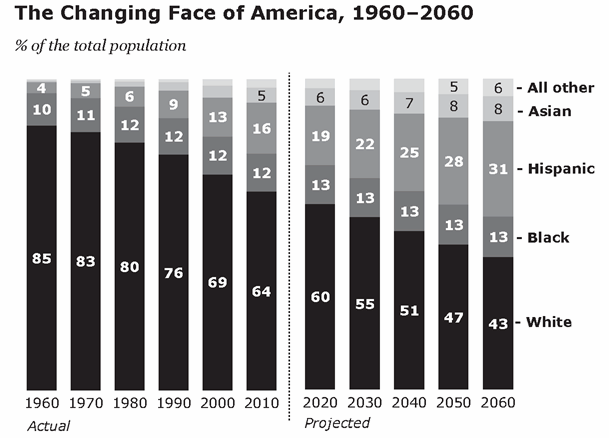
  • The color explosion. Today’s 65% Caucasian population will likely shrink to 43% by 2060.
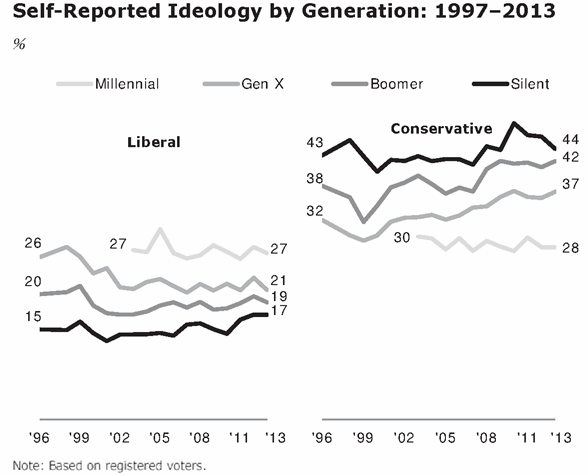
  • The ideology gap. The four current American generations; the Silents, the Boomers, the Gen Xers, and the Millennials are increasingly less conservative and more liberal.
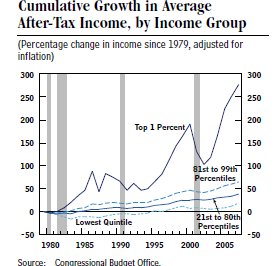
  • The inequality gap. Both income and wealth inequality are growing rapidly and this trend is likely to continue.

Each of these trends is firmly established by data as shown in the accompanying charts. There are huge political implications for these mega-trends. For starters, the biggest threat to our nation’s finances is the rapidly increasing cost of entitlements, especially Social Security and Medicare. Where will the political will to control this spending come from when there are ever more retirees who want to keep their benefit programs?
CaptureWith a surging immigrant population, primarily Hispanic and Asian, constantly gaining more political clout, it becomes more and more urgent to move our 12 million undocumented aliens out of the shadows with some kind of legal status. A broad based guest worker program would be a good way to get started.
Capture1The ideology gap is more difficult to interpret. The four groups are more conservative than liberal and people in general become more conservative as they grow older. Nevertheless, there is an overall trend towards liberalism as age decreases.
Capture2Finally, the growing inequality gap will inevitably create much resentment if ignored by our political system.
Capture4Each of these four mega-trends will create pressure for more federal spending to address the needs and interests of various segments of society. We already have huge deficits, and rapidly increasing national debt, to contend with. How do we balance the pressure for more spending with the need for fiscal restraint? Stay tuned!

The Long Run and the Short Run


“I agree with you that something must be done now. The trick is what will work the best in the short term to trigger the agreement between the fiscal conservatives and the modern liberals to cut costs and balance the budget that we both agree on. We can agree to disagree on the solution details but I hope you are successful in achieving the short term goals you are working tirelessly on.
Just as big a question is what will work the best in the long run to prevent it from happening again. I will continue to work on changing the intellectual environment that I see as a precondition to solidifying your short-term gains and preventing a re-occurrence.”
Capture
These are the words of my Omaha libertarian friend, David Demarest, with whom I have an ongoing dialogue.  He wants to cut back and limit the scope of government.  I’m willing to have a more expansive government as long as we’re willing to pay for it.
The secret to solving many of our current problems (stagnant economy, high unemployment, massive debt, increasing inequality) is to grow our economy faster.  The best way to accomplish this is by boosting investment and entrepreneurship with broad-based tax reform, by lowering tax rates for both individuals and corporations, paid for by eliminating deductions and closing loopholes.
But some people think that lowering tax rates means lower taxes on the rich.  To counteract this perception, and at the same time to raise additional tax revenue to lower the deficit, I propose to  levy a new wealth tax of 1% of assets with an exemption of $10 million per person to make sure that the tax only applies to the “truly wealthy.”
I believe that a program along these lines is the best way to get our economy back on track.  But, at the same time we need to figure out how to avoid falling back into another slow growth, high debt trap anytime soon.
A good way to achieve long run protection is with a balanced budget amendment.  It would need to be flexible, allowing for emergencies, and also phased in over several years to allow citizens and legislators time to make the necessary adjustments to spending and taxes.

Do We Really Need a Wealth Tax?


Our dire fiscal and economic problems are crying out for a bold solution.  We need to simultaneously stimulate our economy to grow faster and create more jobs, raise sufficient tax revenue to pay for our growing spending commitments, and address a widening inequality gap which threatens to undermine the basic principles of a free and just society.  How are we going to accomplish all of these tasks at the same time?
It seems to me that the best way is to thoroughly reform our income tax system based on the following principles:

  • Lower tax rates on marginal income to encourage more investment and entrepreneurship.  Such changes can be made revenue neutral by eliminating deductions, loopholes and other tax preferences.  This would apply to corporations as well as individuals.
  • Establish a new low percentage (1% – 2%) wealth tax with a relatively high personal exemption ($5 million – $10 million).  This would bring in approximately $200 billion per year to be used for reducing the deficit.  Equally as important it would be a visible sign that the wealthy are making a significant contribution towards solving our fiscal problem.  This will make it more acceptable to lower marginal tax rates on income in order to boost economic growth.

Fiscal conservatives often oppose any increase in tax revenue because, they think, it is likely to be used for new spending rather than for lowering the deficit.  One way to overcome this concern is to pass a Balanced Budget Amendment to the Constitution. This would make it much harder to increase spending.  The problem is that it will be very hard for Congress to pass such an amendment and have it ratified by ¾ of the states.
But something has to be done.  The longer we wait and the more debt we build up, the more painful it will be to extract ourselves when the next crisis occurs as it surely will.

Wealth and Taxation


As I reported in my last blog post a few days ago, wealth inequality in the United States and the rest of the developed world is growing rapidly and is likely to get much worse in the foreseeable future.   This is happening because income from wealth, i.e. the return on investment, typically grows faster than wages and GDP.  As income inequality also grows, and top wage earners have more and more money to invest, then the gap between investment income and wage income will become even wider.  There is nothing wrong with this and the more money that is reinvested in our economy, the faster it will grow and the more jobs that will be created.
At the same time that huge new wealth is being created we have an archaic tax system in the U.S. which is not only incredibly complicated and inefficient, but also discourages investment because the top individual and corporate rates are so high.  And it doesn’t collect enough tax to pay our bills.  We have huge deficits already and the CBO says that they’ll just keep getting worse.
Making government operate more efficiently with less spending is highly desirable but will only go so far.  Every government program has a constituency of supporters who complain when their own program is targeted for cuts.  And the biggest and most expensive, the entitlement programs of Social Security and Medicare, have the largest constituency of all, over 50 million retirees at the present time and growing rapidly as the baby boomers retire at the rate of 10,000 per day.
This huge crunch can only be resolved by fundamental tax reform.  Several different ways have been proposed to do this:

  • Reform the current income tax system by broadening the base, lowering rates and eliminating deductions and loopholes to pay for it.  The problem with this approach is that no one wants to give up their own deductions (for mortgage interest, charitable contributions, employer provided healthcare, state and municipal taxes, etc.)
  • Introduce a consumption tax such as the Graetz Plan which I described in my January 7, 2014 post.  It would establish a 14% Value Added Tax on consumption, supplemented by a lower but still progressive tax on incomes over $100,000.  It would avoid being regressive on low wage workers by using an Earned Income Tax Credit to offset the Payroll Tax.
  • Introduce a wealth tax.

Sorry, I’m over my (self-imposed) word limit already.  I’ll describe a possible wealth tax in my next post!

Wealth Inequality I. What Is It?


The subject of income inequality has generated much interest and concern in recent months.  Now we will also be hearing a lot about wealth inequality, based on the highly credible new work, “Capital in the Twenty-First Century” by the French economist, Thomas Piketty.  The New York Time’s Eduardo Porter, summarizes the basic message in his recent column “A Relentless Widening of Disparity in Wealth”, which is clearly displayed in the two charts below.
CaptureThe value of private capital as a percentage of national income worldwide has been growing steadily since about 1950 and Mr. Piketty predicts that this trend will continue indefinitely.  The trend is equally true, not only in the U.S., but also in other developed countries as is illustrated in the chart.  It happens because the income from wealth, i.e. return on investment, typically grows faster than wages and GDP.
As Mr. Porter says, “It means future inequality in the United States will be driven by two forces.  First of all, a growing share of national income will go to the owners of capital.  Of the remaining labor income, a growing share will also go to the top executives and highly compensated stars at the pinnacle of the earnings scale.”
This trend has now been in effect ever since 1870, with the exception of the period between World War I and World War II, when a massive amount of wealth was destroyed.  The forces of globalization and growth of technology are contributing to both types of inequality, especially in the developed world (see my post of January 23), and these forces will almost surely continue unabated.  So the wealth and income inequality gaps are just going to keep getting worse.
How much inequality can exist in a democracy?  The number of losers (the low income, the poor, and even the struggling middle class) will gradually get bigger and bigger and will become more and more frustrated and express their discontent at the ballot box.  This threatens the future of capitalism and free enterprise, the economic principles on which our way of life is founded.
Something has to be done!  Stay tuned for my next post!

Where Have All the Raises Gone?


In yesterday’s New York Times an editorial asks the question “Where Have All the Raises Gone?”, pointing out that wages for college graduates have been stagnant since 2001 (see the chart below.)  A report referred to in the NYT editorial suggests that as the information technology revolution has matured, employer demand for cognitive skills has waned and so some college graduates have had to take lower paying jobs, displacing less educated lower skilled workers in the process.  This makes sense and, of course, new hiring has slowed down even more as a result of the recession.
CaptureThe question then becomes, what, if anything can government do to counteract and overcome this trend?   According to the NYT, “what’s needed to raise pay are policies like a higher minimum wage, trade pacts that foster high labor and regulatory standards, and more support for union organizing.”
Of course there is another point of view and it is expressed very well in yesterday’s Wall Street Journal by Mortimer Zuckerman, the Chairman and Editor-in-chief of U.S. News and World Report, “Fight Inequality With Better Paying Jobs”. Mr. Zuckerman declares that “income inequality isn’t so much the problem as income inadequacy.  A more robust economy, stoked by growth-oriented policies from Washington, would help produce the jobs and opportunities that millions of Americans need to climb the economic ladder.”  He suggests that what is needed is:

  • Lower corporate tax rates so that American multinational companies will bring their foreign earnings back home.
  • Get healthcare costs under control (Obama Care doesn’t do this).
  • Cut back on unnecessary regulations to encourage more business investment.
  • Train more skilled workers.  The National Federation of Independent Businesses reports that 38% of its members have job openings they can’t fill.
  • Restore H1-B visa levels to the higher levels of earlier years – 195,000 per year compared to only 65,000 today.  Skilled immigrants start many new businesses and this is the biggest source of new job creation.

In other words there are lots of things the federal government can do to boost the economy.  As Mr. Zuckerman says, “The political system is failing us.  Washington doesn’t seem to be listening as our political parties are focused more on ideological conflict than the good of the country.”

Truth and Myth about Inequality


Two of my favorite columnists are the Brooking Institution’s William Galston, a social economist who has a weekly column in the Wall Street Journal and the economics journalist Robert Samuelson who writes for the Washington Post.  
Most people agree that income inequality in the U.S. is steadily getting worse.  Mr. Galston make a good case (see my last post) that it is primarily caused by the large gap between the rising productivity of American workers and the stagnant level of their pay which has developed since 1973.  He thinks that we need a fundamentally new social contract which links worker compensation to productivity.  This, of course, is a tall order and it is not at all clear how such a new order would be achieved.
CaptureMr. Samuelson has a different perspective: “Myth-making about Economic Inequality”.  For example:

  • The poor are not poor because the rich are rich
  • Most of the poor will not benefit from an increase in the minimum wage because only 6% of the 46 million poor people have full time jobs
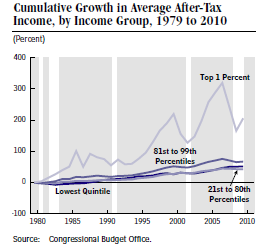
  • All income groups have gained in the past three decades, even though the top 1% has gained the most (see the above chart from the CBO, December 2013)
  • Widening economic inequality did not cause the Great Recession

These two perspectives on inequality are quite different but not contradictory.  Basically what Mr. Samuelson is saying is that we have to be careful in how we address this problem or we’ll just make it worse.  Raising taxes on the rich is unlikely to help and might hurt if it slows down the economy.  Raising the minimum wage will only raise a fairly small number of people out of poverty and may cause a lot of unemployment along the way.
My solution: focus on boosting the economy to create more jobs in the short run (tax reform, immigration reform, trade expansion) and improved educational outcomes for the long run (early childhood education, increasing high school graduation rates, better career education).
But I agree with Mr. Galston that it is imperative to lessen income inequality, one way or another.  Otherwise as a society we’ll have big trouble on our hands.

Poverty, Inequality and the Minimum Wage II. Cities Are Expensive!


Poverty and inequality are getting worse in the United States.  The question is what to do about it.  One proposal is to raise the minimum wage from its current value of $7.25 per hour to $10.10 per hour.  The Congressional Budget Office has studied the tradeoffs in doing this.  Approximately 16 million people, at the bottom end of the wage scale, would see their incomes go up.  But 500,000 people would see their incomes go down because they’d lose their jobs!  Does the positive outweigh the negative?  It’s not clear!
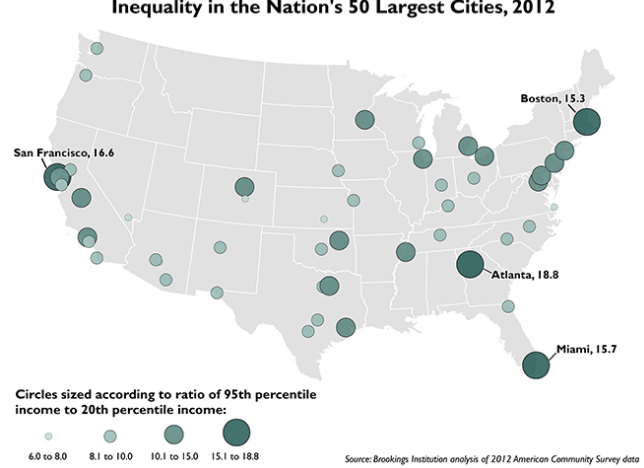
CaptureBut here is another aspect of the problem.  The Brookings Institution has just published a new study “All Cities Are Not Created Unequal”, pointing out that the 50 largest cities in the U.S. have higher rates of inequality than does the country as a whole.  Brookings looks at the so-called 95/20 ratio between the 95th percentile of wage earners compared to the 20th percentile.  The national average for this ratio is 9.1 with the 95th percentile earning (in 2012) $191,770 and the 20th percentile earning $20,968.  But many large cities such as San Francisco (16.6), Boston (15.3) and New York City (13.2) have much higher ratios.  The midsized city of Omaha has a ratio of 8.2 which is below the national average.
In other words the problems of poverty and inequality are much worse in some parts of the country than in others.  This suggests that at least part of the solution to addressing this problem should come at the state and local level.  It makes sense for California, Massachusetts and New York, for example, or at least San Francisco, Boston and New York City, to establish their own higher minimum wages.
This is not to say that a higher minimum wage at the national level is not also needed (more coming).  But the whole country cannot be expected to bail out a few major cities where the problem is much worse than elsewhere.