
Is A Carbon Tax Practical?


The evidence for global warming is overwhelming and largely beyond dispute.  On the other hand, our industrialized world is highly dependent on the fossil fuels which produce it. This is what makes global warming such a hot political potato.
Capture9Yesterday the New York Times columnist Eduardo Porter described a carbon tax which has been implemented in British Columbia and has gained wide political acceptance.  Its general features are:

  • It was introduced in 2008 by the Liberal Party which is actually quite conservative. It survived a challenge by the left-leaning New Democratic Party in 2009.
  • The economy in British Columbia grew faster than its neighbors even as its greenhouse gas emissions declined.
  • The tax rose from $10 (Canadian) per ton of carbon dioxide in 2008 to $30 (Canadian) in 2012. It raised the cost of a gallon of gasoline by 19 cents (U.S.)
  • Despite the price increases, voters warmed to the tax. In 2015 only 32% of British Columbians opposed it, down from 47% in 2009.
  • Every single carbon tax dollar is returned to families and businesses through a variety of tax breaks.

British Columbia’s experience shows that a carbon tax can work in practice. Here are a couple of reasons why such a tax should appeal to a broad political cross spectrum in the U.S.

  • A properly calibrated carbon price in the United States could effectively replace all the climate-related regulations businesses hate so much, including renewable fuel mandates and President Obama’s Clean Power Plan.
  • A carbon tax could become part of a broad fiscal overhaul, using the revenue, for example, to offset cuts in payroll taxes.

Conclusion. The rapidly changing climate and weather patterns caused by global warming are a threat to human civilization. Reasonable measures can be taken to mitigate the effects with minimal economic disruption.  As the world’s strongest economy and leading superpower, the U.S. should be providing more leadership towards addressing this very serious problem.

Follow me on Twitter: https://twitter.com/jack_heidel
Follow me on Facebook: https://www.facebook.com/jack.heidel.3

Why the U.S. Strategic Defense Initiative Is So Important


North Korea recently launched another long-range rocket as reported by the New York Times, the Wall Street Journal, and the Washington Post The editorial boards of all three newspapers deplore this development but differ in suggesting how the U.S. should respond.

  • The NYT says that sanctions should be imposed to limit North Korea’s ability to finance warheads and missiles. Such sanctions would most acutely be felt by the Chinese companies doing business with North Korea.
  • The WP supports economic sanctions as well as deploying an advanced missile defense system in South Korea as quickly as possible.
  • The WSJ is concerned about the “rogue state” ICBM threat in general. North Korean missiles can now reach Los Angeles, Denver and Chicago. Iran recently conducted two ballistic missile launches in violation of the recent nuclear deal.

Ronald Reagan’s launch of the SDI in the 1980s helped win the cold war. The Bush Administration is responsible for the missile defenses which exist today, including long-range missile interceptors in Alaska and California and Aegis systems aboard Navy warships.  The Obama Administration has cut its missile defense budget request from $9.8 billion in 2016 to $9.1 billion for 2017.
Capture6Admiral Bill Gortney, Commander of the North American Aerospace Defense Command, says that “We’re ready 24 hours a day if he’s (Kim Jong Un) dumb enough to throw something at us.”  But any miss would be catastrophic and a 100% interception rate won’t happen without engineering advances and presidential leadership.
SDI should be a very high priority within the overall military budget.  Our national security depends on it!

Follow me on Twitter: https://twitter.com/jack_heidel Follow me on Facebook: https://www.facebook.com/jack.heidel.3


The Close Connection between Fossil Fuels and Economic Growth


One of my favorite economics journalists, Eduardo Porter, has a column which appears each Wednesday in The New York Times.  His column this week, “Imagining a World Without Growth,” shows that economic growth took off consistently around the world only about 200 years ago and that two things powered it: innovation and lots of carbon-based energy from fossil fuels.
Capture0The United Nations climate conference, meeting this week in Paris, is asking all countries to greatly cut back on their use of fossil fuels.  Mr. Porter, in an earlier column, described what severe cutbacks in fossil-fuel energy could look like:

  • In order to meet the consensus goal of keeping the earth’s atmospheric temperature from rising more than 2 degrees C from preindustrial times (and we’re half way there already), CO2 emissions will have to fall to at most 1.6 tons per year for every person on earth by 2050. This is less than 1/10 of the present U.S. average and less than 1/3 of the present world average.
  • Within about 15 years every car sold in the U.S. will have to be electric. By midcentury more than half of the U.S. economy will run on electricity. Up to 60% of power will have to come from nuclear sources.
  • To meet these ambitious goals the U.S. will have to decarbonize its energy supply at an average pace of 4% per year for the next 40 years. This is 10 times faster than the Energy Information Administration’s current plan.
  • This is not achievable by going after low-hanging fruit such as replacing coal with natural gas in power plants. Rather, for example, carbon capture and storage will have to become widely available starting within about 10 years.

Meeting the goal of limiting the average world-wide temperature increase to 2 degrees C will thus require a severe regimen of regulatory actions which will have negative economic consequences.  In fact it is difficult to image how such a strict regimen could ever be put in place or enforced without much public dissatisfaction.
We thus have two options for dealing with global warming.  We can ignore it at our peril or we can introduce a market mechanism to change people’s fundamental behavior and attitude about energy use.  What market mechanism?  A (revenue neutral) carbon tax, of course!  How else?

Follow me on Twitter: https://twitter.com/jack_heidel
Follow me on Facebook: https://www.facebook.com/jack.heidel.3

A Path for Climate Change beyond Paris


The United Nations climate conference has just opened in Paris.  The pledges that countries are making fall way short of what many say is needed to solve the problem of climate change.  The Deep Decarbonization Pathways Project based in Paris and New York describes what will be needed to get the job done:
Capture

  • The 2 degree C temperature increase benchmark is used even though it is an arbitrary threshold. “Hell is not going to break loose at two degrees – it will take hundreds of years to unfold.” The world has so far warmed .9 degree C since 1880, halfway to the threshold.
  • The technologies available today, such as solar power and wind turbines, while good enough to get a running start on the transition, are not good enough to finish it.
  • Many countries will need to keep burning coal or natural gas to generate power while capturing the carbon dioxide emerging from smoke stacks, compressing it and injecting it deep underground. In fact most fossil fuel energy producers do not appear to be putting much effort into this approach.
  • Governments could easily flub the energy transition by failing to plan far enough ahead. Most countries are setting 10 and 15 year targets that can be met with incremental changes.
  • To achieve emissions goals, entire economies, including transportation, needs to be electrified as much as possible. Spending a lot of effort, as the U.S. is doing, trying to make gasoline cars more efficient, may be going down a blind alley.
  • Another potential dead end would be an overreliance on natural gas, which emits only half as much carbon as coal. This helps in the short run but gas has to go away within a few decades. Thus heavy investment in natural gas pipelines and power plants now could undermine long term goals.

The point is that the DDPP, designed to hold a global temperature increase to just 2 degrees C from preindustrial times, is extremely demanding.  It will require massive governmental interference in the energy economies of both developed and developing countries all over the world.    A far, far better approach is for leading world economies such as the U.S., Western Europe, China and Japan to provide leadership by implementing a tax on carbon emissions and thereby create an economic incentive for the fossil fuel industry to decarbonize itself.

Follow me on Twitter: https://twitter.com/jack_heidel
Follow me on Facebook: https://www.facebook.com/jack.heidel.3
 

How to Defeat ISIS


The lead story in yesterday’s New York Times, “Experts Explain How Global Powers Can Smash ISIS,” starts out “Much of the world agrees that the Islamic State needs to be crushed.  But how can that be accomplished?”
CaptureHere is the strategy espoused in the NYT article and also by Garry Kasparov, writing in the Wall Street Journal:

  • Assad must go. “For the U.S. and the West to ally with Iran, Russia and the Assad regime in Syria would be morally repugnant, strategically disastrous and entirely unnecessary.”
  • The importance of the Sunnis. “To beat ISIS you need the enlistment of the Sunnis and this won’t happen as long as Assad remains in power.” Removing Assad “would immediately have the support of Turkey and Saudi Arabia.” “The 2007 U.S. military surge in Iraq was so successful because it included the protection and recruitment of Sunni tribes to fight Sunni extremists.” “The hasty exit from Iraq left the Sunnis at the mercy of a hostile Shiite government.”
  • Troops on the ground. “Anything less than a major U.S. and NATO-led ground offensive against ISIS will be a guarantee of continued failure and more terror attacks in the West.”
  • Long term governance. “For the long term, eradicating the Islamic State and other violent Jihadi groups will require drastic reforms in the nature of Middle East governments. ISIS thrives on their failures.”

After the Paris attacks, the West now realizes that ISIS represents a huge threat to world peace and stability.  Hopefully the U.S. is also beginning to realize that only it can provide the leadership to organize an effective response.
I will soon return to talking about the fiscal and economic issues which I usually dwell on.  Every once in a while another major issue intervenes and takes precedence.

Follow me on Twitter: https://twitter.com/jack_heidel
Follow me on Facebook: https://www.facebook.com/jack.heidel.3

What Defines a (Fiscal) Conservative?


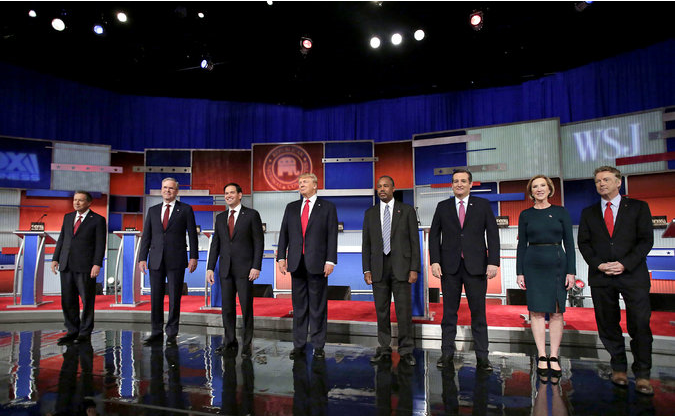
After four debates among the Republican presidential candidates, differences between them are becoming clearer.  The New York Times has an interesting article about this in today’s paper, “G.O.P. Fight Is Now a Battle Over What Defines a Conservative.”
CaptureHere are my views on the four issues discussed:

  • A Wall or a Path? We need to solve our illegal immigration problem and the key is to set up a viable guest worker program. The fact is that our economy needs foreign workers for many jobs which require hard physical labor such as in agriculture, meatpacking and construction trades. If businesses are able to bring in immigrants when sufficient domestic labor is not available, then other issues such as border security and verifying legal status can easily be resolved.
  • The U.S. Place in the World. U.S. leadership makes the world a safer place. This means we need a strong military presence all around the world as well as active alliances, trade and military, with many other countries.
  • Of Banks, Bailouts and Blame. The cause of the financial crisis was the bursting of the housing bubble, in turn caused by an unrealistic government housing policy as well as lax enforcement of existing regulations. Blaming greedy bankers is a copout. The Dodd-Frank Law is overkill which creates a drag on the economy by hampering smaller financial institutions and community banks. The best way to control large banks is to increase their capital requirements.
  • Who Should Get Tax Cuts? The main purpose of tax reform should be to boost the economy without increasing deficit spending. The way to do this is with across the board cuts in tax rates, paid for by closing loopholes and shrinking deductions. Here are some details. The 64% of taxpayers who do not itemize deductions will get an immediate tax cut and income inequality will be greatly reduced.

Getting the answers to these issues correct will have a large effect on the future wellbeing of our country.  The Republican presidential candidates should be commended for grappling with them in a productive manner.


I Am One of Paul Krugman’s “Very Serious People”


There is a stark contrast between the fiscal and economic policies being proposed by the presidential candidates from the two different parties. The Democrats want to tax the rich to reduce income inequality while the Republicans want major tax reform in order to speed up economic growth.
CaptureI favor the latter approach as long as it does not increase deficit spending.  The Keynesian economist Paul Krugman mocks deficit hawks like me as “Very Serious People.”  But in my “serious” view we have a choice between two very different paths for our economic future:

  • Slow Growth. Continue on our present path of slow 2% annual growth. The official unemployment rate has dropped to 5% but slack in the economy caused by the low labor participation rate keeps raises low and millions still unemployed or under-employed. The slow economy also keeps inflation and interest rates low. This permits Congress and the President to shrug off deficit spending and debt accumulation because it’s virtually “free money,” being borrowed at very low interest rates.   Our present course not only prolongs income inequality but also allows the debt to keep ramping up indefinitely. The longer this continues, the greater will be the disruption when inflation and interest rates do eventually return to normal historical levels.
  • Faster Economic Growth.   There are many things we can do to speed up economic growth. Tax reform is first and foremost but deregulation (relax Obamacare and Dodd-Frank), trade expansion (pass TPP) and immigration reform (with an adequate guest worker program) would also help. But, contrary to what the Republican presidential candidates say, tax reform must be revenue neutral to be sustainable. That way the economic growth it produces will lower deficit spending rather than increasing it.  This is critical because economic growth will create new jobs and raise pay for existing jobs, thereby creating inflationary pressure. Inflation will lead to higher interest rates which in turn will make our debt much more expensive than it is now.

Conclusion. We can make our economy grow faster if we simply put our mind to it. But then inflation and interest rates will go up and interest payments on the debt will become an increasing burden on society.  This is why it is so important to put our debt on a downward path as a percentage of GDP.  We can make it happen if we want to.

Austerity’s Grim Legacy?


There is a very important debate going on in the country right now as I have discussed in my last three posts:

  • The Republican presidential candidates are proposing big tax cuts to stimulate the economy but at the cost of huge increases in annual deficits and the accumulated debt.
  • The Democratic candidates want to raise taxes on the wealthy but even raising the top tax rate from 39.6% to 50% would have only a modest effect in lowering income inequality.
  • The Tax Foundation has an excellent plan to lower tax rates for all in a revenue neutral manner by closing loopholes and limiting deductions. Their plan would give the economy a big boost and actually lower deficits by bringing in more tax revenue.

Now comes Paul Krugman in Friday’s New York Times, “Austerity’s Grim Legacy”  saying that “Some of us tried in vain to point out that deficit fetishism was both wrong-headed and destructive, that there was no good evidence that government debt was a problem for major economies, … And we were vindicated by events.  More than four and a half years have passed since Alan Simpson and Erskine Bowles warned of a fiscal crisis within two years; U.S. borrowing costs remain at historic lows.”
Capture12How can such an obviously intelligent and articulate economist miss what is so very, very clear to so many lesser mortals?  Interest rates will not stay low forever!  And when they do go up, interest payments on our rapidly expanding debt will skyrocket! The Congressional Budget Office estimates that the interest payment on our debt will increase from 1.7% of GDP today to 3.6% of GDP in 2025, or $827 billion in 2025 compared with $227 billion in 2015.  Where will the money to pay this new $600 billion expense come from?
It is absolutely crazy not to take our enormous debt seriously.  We simply must put this huge debt on a downward path as a percentage of GDP.  It can be done but it will take a concerted effort by our national leaders to do it.

                                    Follow me on Twitter: https://twitter.com/jack_heidel
                         Follow me on Facebook: https://www.facebook.com/jack.heidel.3

The Republicans Need to Get Real about Tax Reform


The Republican presidential candidates have been releasing tax plans and they have been analyzed by the nonpartisan Tax Foundation. It turns out that most of these plans lose revenue over a ten-year period even on a so-called dynamic scoring basis where the stimulatory effects of the plan are taken into effect.  Such callous disregard for the huge annual deficits we are now running, and our huge accumulated national debt, is totally unacceptable especially from the political party which bills itself as being fiscally responsible.
CaptureThe left-leaning New York Times points this out yesterday in its lead editorial, “Why the Republican Tax Plans Won’t Work.”  According to the NYT:

  • Tax Revenues will need to increase by 40% over the next 10 years just to keep federal spending even with inflation and population growth.
  • Further additional revenues will be needed to pay for health care for the elderly, transportation systems, climate change and likely increased interest payments on the national debt.
  • Thus taxes will have to go up and can only be imposed realistically on the wealthy who have had the biggest income gains in recent years.
  • Democratic presidential candidates do propose tax cuts but only for low- and middle-income Americans.
  • Democrats are calling for new taxes on financial transactions.
  • Democrats also propose to raise wages, support higher minimum wages, support unions and expand profit-sharing and employee ownership.

This is the program the Democrats will be pushing if they win the presidency next year. It has some attractive features but the likely overall outcome will be increased deficit spending, a rapidly increasing debt and a continued stagnant economy.
Meaningful tax and regulatory reform will both be needed to get the economy growing faster than the 2% average of the past six years.  Any credible tax reform program simply must be at least revenue neutral so that, combined with spending restraint, it will put our national debt on a downward path.

Follow me on Twitter: https://twitter.com/jack_heidel
                   Follow me on Facebook: https://www.facebook.com/jack.heidel.3

Jeb Bush’s Tax Plan: Both Good and Bad


Republican presidential candidate Jeb Bush has just released his tax reform proposal, “My Tax Overhaul to Unleash 4% Growth.” It has many good features such as:

  • Lowering and consolidating seven current tax brackets into three: 10%, 25% and 28%.
  • Essentially doubling the standard deduction for most filers, thereby achieving huge simplification for millions of average income filers.
  • Eliminating the state and local income tax deductions and capping all others, except for charitable deductions, at 2% of Adjusted Gross Income.
  • Doubling the Earned Income Tax Credit for childless filers, thus encouraging more low income people to work.
  • Exempting taxpayers over the age of 67 from the employee-side payroll tax, encouraging them to stay in the workforce longer.
  • Cutting the corporate tax rate from 35% to 20%.
  • Allowing 100% immediate expensing for all capital investments, including inventories.
  • Creating a territorial tax system so that multinationals are not taxed on foreign earnings, and therefore incentivized to bring their foreign profits home.
  • Eliminating the deductibility of interest expenses.

The lower individual and corporate tax rates, together with the separate investment and work incentives, will create a significant economic stimulus estimated to raise GDP by at least .5% per year or higher, depending you who ask.
According to the Tax Foundation, however, the plan would reduce federal revenue on a static basis by $3.66 trillion over ten years, and even by $1.6 trillion on a dynamic basis, taking into account the new tax revenue generated by the plan.
CaptureThis is, of course, a huge problem. We badly need to speed up economic growth but we also need to lower, not increase, our annual deficit spending in order to put our debt on a downward path as a percentage of GDP.
The resolution of this quandary is to tighten up on those deductions, such as for mortgage interest, remaining in the code and also lessening the amount of the tax cuts if necessary in order to achieve overall revenue neutrality for the plan.