One Thing Congress and the President Are Doing Right


This blog is mostly devoted to a discussion of the big fiscal and economic problems facing our country.  A growing and fiscally prudent economy will do the most good for the greatest number of Americans.  I have also argued that “A Strong Country Requires a Strong Economy” in the sense that our adversaries take us more seriously because we have the world’s dominant economy.
In addition, I strongly believe that U.S. power plays a critical role in maintaining stability around the world.  More bluntly, the world is better off because the good guys are also the strong guys.  It is often said that we can’t police the whole world but whether we want to or not we have this role.
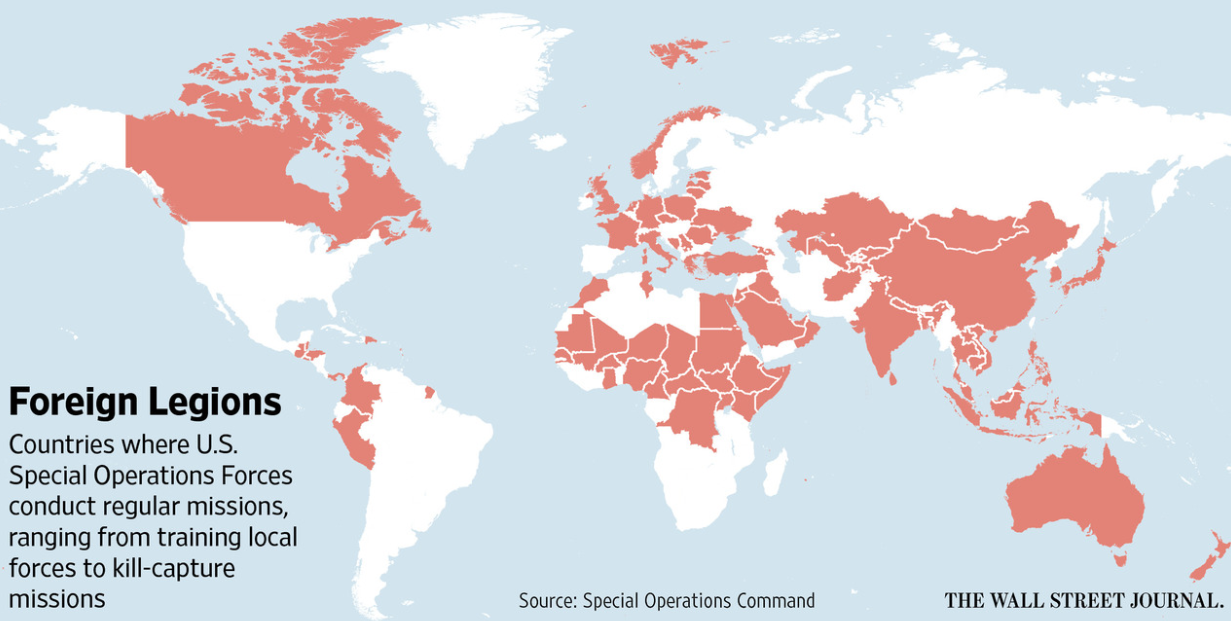
CaptureIn this regard, the Wall Street Journal has just published an informative article, “New Way the U.S. Projects Power around the Globe: Commandos.” The U.S. Special Forces currently has 70,000 people in uniform and an annual budget of $10 billion.  Last year they operated in 81 different countries on six continents.  For example:

  • Navy SEALs and Army Green Berets are stationed in the Baltics, training troops from Lithuania, Estonia and Latvia for the type of proxy warfare Russia is conducting in eastern Ukraine.
  • U.S. forces are helping Filipino forces stymie al Qaeda aligned Abu Sayyaf Group.
  • The U.S. has trained Columbian troops to fight rebels and drug traffickers.
  • A Navy Seal raid killed Osama bin Laden in his Pakistani hideout.
  • U.S. special operators work with Ugandan troops to hunt the leader of the Lord’s Resistance Army.
  • 1,300 troops from 18 western nations are training commandos from 10 African countries to fight extremist organizations such as Islamic Maghreb and Boko Haram.

The world is a messy, chaotic place.  Our own wellbeing depends on maintaining at least a minimal degree of stability.  We have accepted this responsibility and are meeting it head on.  This represents America at its best.

Providing Regulatory Relief for Main Street Banks

The major congressional response to the Financial Crisis was the passage of the Dodd-Frank Act in 2010, putting many restrictions on U.S. financial institutions in hopes of ending “too big to fail.”  The problem is that the new regulations often apply to the many low risk, traditional, main street banks which did not cause the financial crisis.  The new regulations hamper the ability of these smaller banks to lend money to their regular customers, thereby slowing down the economic growth we need for full recovery from the recession.
CaptureThomas Hoenig, Vice Chair of the Federal Deposit Insurance Corporation, has recently made some common sense recommendations for alleviating this problem.
He proposes to provide relief for financial institutions which meet the following criteria:

  • Banks that hold zero trading assets or liabilities.
  • Banks that hold no derivative positions other than interest rate swaps and foreign exchange derivatives.
  • Banks whose total value of all derivative exposures is less than $3 billion.
  • Banks which have a ratio of equity-to-assets of at least 10%. Most community banks meet this criteria and the number is within reach for those which do not.

Of more than 6500 commercial banks, only about 400 do not meet the first three criteria.  None of the banks with more than $100 billion in total assets meet these criteria. Banks which qualify could receive relief such as:

  • Exemptions from Basel capital standards and risk-weighted asset calculations.
  • Allowing for examiner judgment in eliminating requirements to refer “all possible or apparent fair lending violations to Justice” if judged to be de-minimis or inadvertent.
  • Exemptions from appraisal and stress test requirements.
  • Allowing an 18-month examination cycle as opposed to the current 12-month cycle.

Mr. Hoenig’s conclusion: “For the vast majority of commercial banks that stick to traditional banking activities, and conduct their activities in a safe and sound manner with sufficient capital reserves, the regulatory burden would be eased.  For the small handful of firms that have elected to expand their activities beyond commercial banking, the additional regulatory burden is theirs to bear.”

Are We Doing Enough to Help the Poor?


Income inequality in the U.S. is getting worse and one reason is that the middle class is being “hollowed out” by a lack of sufficient job opportunities.
CaptureThe result is more people at the bottom end of the income scale.  Not surprisingly, it turns out that many of these low-wage workers are receiving public assistance, as documented by the UC Berkeley Labor Center, and the New York Times.
Capture1The authors point out that if these workers received higher wages, they would not require as much public support which, in turn, would save money for the taxpayers.  This is a true but not a practical means for helping the poor.  Employees are paid what they’re worth based on the law of supply and demand.  Companies will pay as much as they have to in order to find and retain well qualified workers.  Furthermore, a minimum wage which is too high will simply lead to a higher rate of unemployment.
There is really only one good way to raise the overall wage level, especially at the bottom end of the scale.  It is to speed up economic growth, thereby lowering the unemployment rate and creating more demand for workers.
This is exactly what has happened in Omaha NE where I live.  The official unemployment rate is 3.2% and there is a labor shortage.  A new minimum wage ($8/hour now, $9/hour next January) was approved by the voters last November.  But low-skill entry level jobs are paying $10/hour or more because of the scarcity of workers.
There are plenty of opportunities to succeed in Omaha.  Support yourself with a low-wage job and go to Metropolitan Community College to learn a high-skill, high-wage trade.  Most people are capable of following this route to a better life!

Can We Solve All Our Fiscal and Economic Problems at the Same Time?


This website, It Does Not Add Up, is devoted to discussing our country’s most serious economic and fiscal problems.  They are:

  • Stagnant Economy. Since the end of the Great Recession in June 2009, the economy has been growing on average at the historically slow rate of about 2.3%. Slow growth means higher unemployment, stagnant wages and less tax revenue.
  • Massive Debt. U.S. public (on which we pay interest) debt is now 74% of GDP (highest since WW II) and projected by CBO to grow rapidly unless strong measures are taken to reduce it. This puts our country’s future wellbeing and prosperity at great risk.
  • Increasing Income Inequality. Incomes for the high-skilled and well-educated are increasing much faster than for the low-skilled and less-educated workers.

The new Republican majorities in Congress are stirring the waters by proposing a ten year plan to shrink the deficit down to zero, i.e. to balance the budget by 2025.  The opposition claims that this would “sharply cut the scale of domestic spending, which would mostly fall on the poor.”
Capture1But the American Enterprise Institute’s James Pethokoukis points out that social spending in the U.S., both public and private, is very generous and second only to France in the entire OECD. So here is how we could proceed to address our basic problems in a unified manner:

  • Balance the Budget by a combination of Republican spending cuts and cutting back on two major tax deductions: Employer-sponsored Health Insurance (cost: $250 billion per year) and Mortgage Interest (cost: $70 billion per year).
  • Boost Economic Growth by expanding the Earned Income Tax Credit to encourage more people to accept low paying, entry level jobs. Increase the Social Security eligibility age from 67 to 70, thereby keeping near retirees in the workforce for three additional years (this will also extend the solvency of the Social Security Trust Fund).
  • Decrease Income Inequality. Cutting back on tax deductions, in part to pay for expansion of the EITC, lessens income inequality as well as shrinking the deficit. A faster growing economy also lessens inequality by providing more opportunities for upward mobility.

In other words, addressing each of these fundamental problems in an intelligent manner contributes to solving the remaining problems as well.  This creates a virtuous circle for economic progress!

Too Much Income Inequality is Harmful to Society


It is well understood that income inequality is increasing in the U.S. and that there are lots of reasons for it.  Globalization provides low cost goods from around the world and thus puts pressure on low-wage workers in our own country.  Rapid technological advancement puts a high premium on educational attainment and skill acquisition and thus helps individuals who are highly motivated to succeed.  The Great Recession and our slow recovery from it have held back the growth of employment and wages increases for middle- and lower-income workers.
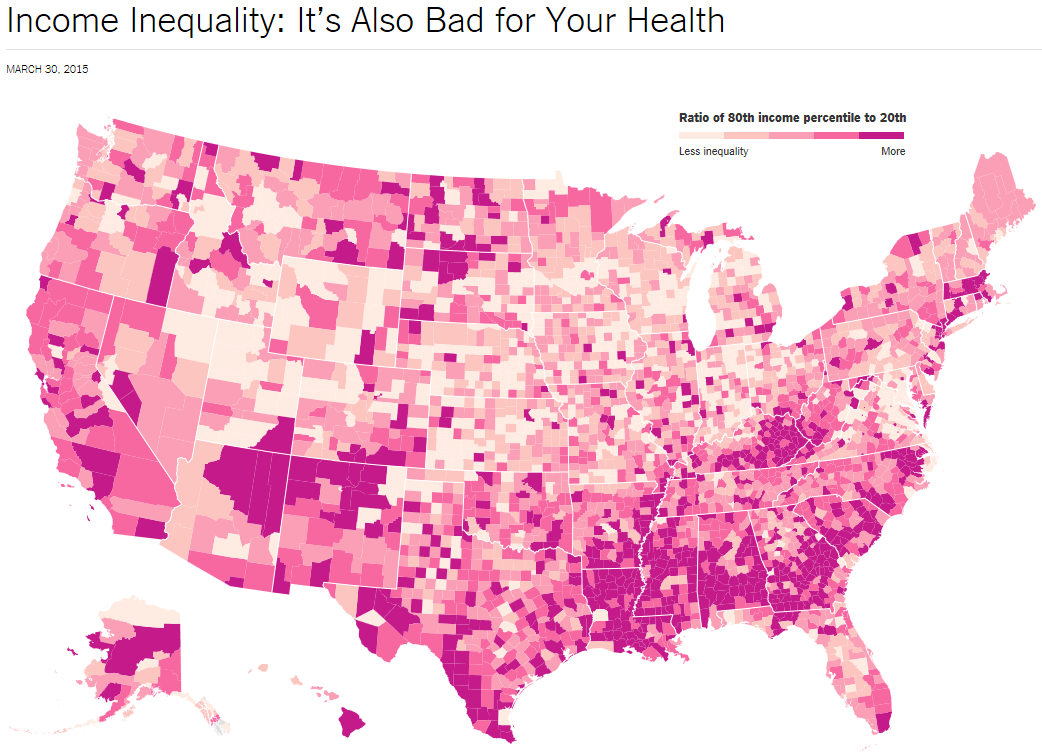
CaptureIncreasing income inequality is a pernicious social condition and has lots of unpleasant consequences.  A new study of U.S. counties has shown that there is a strong correlation between more inequality in a particular geographical area and shorter average live spans.  It is quite reasonable to expect that higher-income people will be more health conscious than lower- income people. Excessive inequality is bad for lots of reasons.
The question is what we can do about it.  Here are two good ways to address it:

  • Faster economic growth would help a lot. The American Enterprise Institute’s Michael Strain has recently proposed a fairly modest plan for increasing employment by cutting tax deductions for the wealthy, increasing the Earned Income Tax Credit for the poor and at the same time decreasing deficit spending. I have made a more substantial proposal along the same lines.
  • Boost educational performance across the board. College-ready middle class kids will take care of themselves so the emphasis should be on the 70% of young adults who will not go to a four year college. There are lots of good jobs available for the highly skilled and so we need more career education in high school. We also need more early childhood education to prepare kids from low-income families to get off to a good start in elementary school.

Increasing economic growth and expanding educational opportunities for the non-college bound will require little, if any, new federal spending.  Such policies as above are simply common sense ways to reduce income inequality and achieve a more inclusive society.

Status Quo on the Budget Is Not Good Enough!


As I like to remind readers, I am a non-ideological fiscal conservative.  I am not hard core anything.  I just want to find practical, workable solutions for difficult and complicated problems.  There is basically only one exception to my generally moderate outlook.  I detest huge amounts of deficit spending except for unusual circumstances.  Most of the time we should be willing to either raise taxes and/or cut spending to do what needs to be done and to live within our means.
This is why the current efforts by the Budget Committees of both the House and the Senate to devise a plan to balance the budget, i.e. eliminate deficit spending, over a ten year period is so exciting to me.
An analysis in today’s New York Times suggests that Congress should be content to just extend the so-called Ryan-Murray Budget from 2014-2015.  “Ryan-Murray didn’t decisively move the needle one way or the other, which is why it was able to attract bipartisan support.  Rather it preserved the status quo.  In a world of divided government and polarized politics, keeping the government running without a lot of brinkmanship and high drama may be the best we can hope for.”
CaptureAs I pointed out in my last post, current policy will raise government spending by 5.1% annually over the next ten years.  The President wants to increase spending by an additional $1 trillion over this time period.  The Republican budgets, which lead to balance in ten years, still allow spending to increase by 3.3% annually.  The difference between the two plans is illustrated in the above chart from last Sunday’s Omaha World Herald.
Congress is finally in a position this year to start digging us out of the deep fiscal hole we have fallen into.  Let’s hope that too much “bipartisan” status quo thinking doesn’t get in the way of progress!

How the Obama and Republican Budgets Compare


The Budget Committees for both the House of Representatives and the Senate have now passed plans to achieve balanced budgets within a ten year period.  My last two posts have discussed the compelling need to get deficit spending under control and an overall rationale for how to approach this difficult task. Today I will take a look at the major differences between the Obama budget and the House and Senate budgets.  The two congressional budgets are quite similar and will surely be reconciled into a single budget.
CaptureHere are the major differences:

  • Revenue. The President wants to raise taxes by $3 trillion over 10 years to pay for more spending while the Republicans wants revenue-neutral tax reform in order to increase economic growth.
  • Spending. Under current policy the government will spend $48.6 trillion over the next ten years which represents a 5.1% annual rate of spending increase over the present. The President wants to spend an additional $1 trillion over this time period on new initiatives. The Republicans propose spending about $5.4 trillion less, or $43.2 trillion, which still works out to a 3.3% annual rate of increase over the present.
  • Deficits. Under current policy the deficit would start to increase, as a percentage of GDP, in 2018. The President proposes to stabilize the deficit at 2.5% of GDP. The Republicans would balance the budget within ten years by shrinking the deficit down to zero.
  • Public Debt. Under current policy the public debt (on which interest is paid) will increase to 79% of GDP by 2025. The President’s budget would stabilize the debt at the current level of 73% of GDP. The Republican’s balanced budget would shrink the debt to 57% of GDP by 2025.


There are stark differences between the President’s proposed budget and the Republican alternative.  Which is the better route to progress and prosperity?  Is it to raise taxes, increase government spending and only stabilize the debt or is it to streamline taxes, slow down the growth of spending and shrink the debt?  This is a fundamental question of government policy which will not be quickly resolved.  But at least the question is being raised in a dramatic way!

When Liberals Blew It


“It is important and right that all privileges of the law be ours, but it is vastly more important that we be prepared for the exercise of these privileges.”
                                                                       Booker T. Washington, 1856 – 1915

My last two posts have discussed the theme of a new book by Dennis Prager, “Still the Best Hope: why the world needs American values to triumph.” Mr. Prager’s thesis is that there are three competing ideologies for the allegiance of humankind, namely Islamism, Leftism and Americanism and, furthermore, that these three ideologies are incompatible.  Any one of them succeeds at the expense of the other two.
As I said on March 8, Mr. Prager’s broad framework helps me place my own ideological views into perspective.  Here is one example of this. As everyone knows, 2015 is the 50th anniversary of the March from Selma to Montgomery.  But it is also the 50th anniversary of Daniel Patrick Moynihan’s report “The Negro Family: The Case for National Action.”  Nicholas Kristof’s Op-Ed in today’s New York Times, “When Liberals Blew It” reminds us how prescient Moynihan was about a breakdown in family structure and how reviled he was by liberals when he issued his report.  Mr. Kristof points out that:

  • In 2013, 71% of black children were born to an unwed mother (compared to 53% of Hispanic children and 36% of white children), far more than in 1965.
  • Growing up with just one biological parent reduces the chance that a child will graduate from high school by 40%.
  • A father’s absence from the home increases antisocial behavior especially for boys.

CaptureA column by the black author, Jason Riley, in yesterday’s Wall Street Journal, “Drawing the Wrong Lessons from Selma about America today,” points out that the main problem for blacks today is not racial discrimination but rather:

  • A lack of preparation for many jobs which are now available.
  • A black subculture which rejects attitudes and behaviors conducive to upward mobility.
  • That too few blacks are taking advantage of the opportunities now available to them.

In other words, more and more spending on welfare and public services is not what blacks need for further advancement.  Rather it is to stop thinking of themselves as victims and to develop a greater sense of personal responsibility.  This is the American way to get ahead!

Does ‘Middle Class Economics’ Really Work?


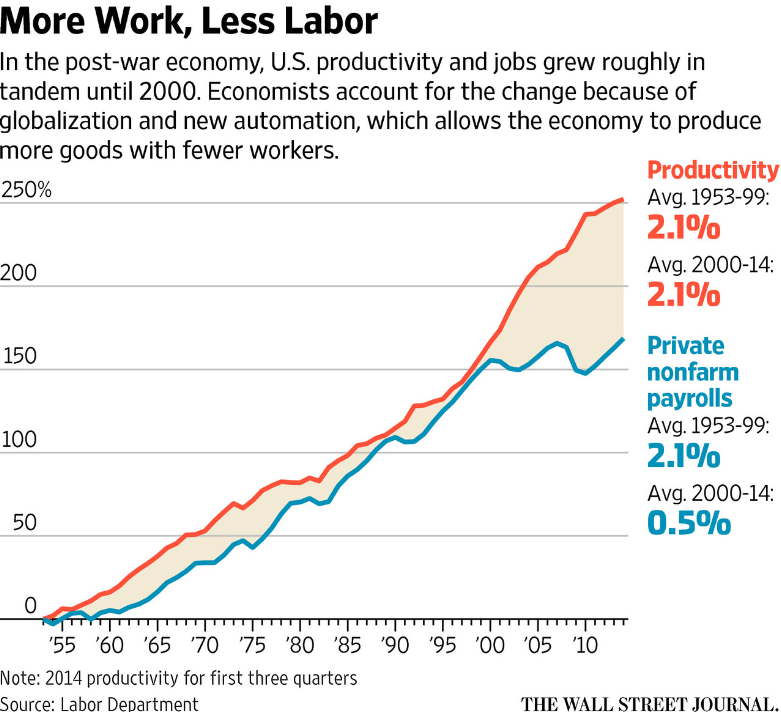
An article in yesterday’s Wall Street Journal, “What Clever Robots Mean for Jobs,”  illustrates the stark fact that “automation is commandeering much middle-class work such as clerk and bookkeeper, while creating jobs at the high- and low-end of the market.  This is one reason the labor market has polarized and wages have stagnated over the past 15 years.”
CaptureThe above chart shows the divergence between productivity growth and payrolls beginning in the year 2000.  It is a vivid portrayal of the “hollowing out” of the middle class which is causing so much grief.
Now let’s turn to a column in today’s New York Times, “What Is Middle-Class Economics,” by the journalist, Josh Barro.  The term, of course, refers to the policies by which President Obama hopes to appeal to the millions of middle-class families with stagnant incomes. According to Mr. Barro, the President’s policy proposals have three facets:

  • Tax and regulatory provisions such as tax credits for childcare, college tuition and a second earner in households where both parents work. Employers would be required to provide paid sick leave and the minimum wage would be raised.
  • Make workers more productive by expanding access to community college.
  • Increase overall economic growth with increased infrastructure spending and new trade agreements.

The problem, as Mr. Barro points out, is that such policies would have only a small effect on the taxes of a middle-income family, amounting to a cut of no more than $150 per year on average.  This is much less than the average family will save from falling gasoline prices.
On the other hand, it is generally understood that stagnant middle-class wages will not rise very much until the labor market becomes tighter as a result of falling unemployment.  Mr. Barro suggests that the government can help this process along in two ways:

  • By the Federal Reserve holding down interest rates, or at least letting them increase only very slowly.
  • With policies to make it easier to work less. The Affordable Care Act does this by decoupling health insurance from full time work. The surge in disability insurance recipients takes people out of the labor market. The rapid retirement of baby-boomers does the same thing.

Unfortunately there are many negative effects from both the Federal Reserve’s easy money policy as well as a shrinking labor participation rate.  I will return to this issue soon!

Is the Democratic Party Giving Up On Growth?


Prospects for future economic growth are decidedly grim.  The Congressional Budget Office has just reported that after a brief improvement for a couple of years, annual GDP growth will likely hover around 2.2% for the remainder of the ten year window 2015 – 2025.  This means, in turn, that the unemployment rate will also not likely fall much below its current level of 5.7% for the same ten year period.
CaptureA new report from the McKinsey Global Institute makes the even gloomier prediction that average U.S. GDP growth rate for the next 50 years will be only 1.9% per year, given current trends and policies.  A summary of this report is provided by the Brookings Institution social economist, William Galston.
On the other hand, according to New York Times columnist, Nate Cohn, the Democratic Party may be adopting a new policy direction, “The Parent Agenda, The Democrats’ New Focus.”  By this new focus he means:

  • Paid family leave
  • Universal preschool
  • An expanded earned-income tax credit and child tax credit
  • Free community college
  • Free four year college in time

Mr. Cohn points out that both President Obama as well as Hillary Clinton have endorsed such ideas.  Initiatives such as these are unlikely to go far in the current Republican Congress but they may still sound very attractive to the many hard-pressed middle class families with stagnant incomes.
The problem is that to emphasize a “family” political agenda like this is in effect to accept the conventional wisdom that faster economic growth is unattainable.  This is a defeatist attitude which is very harmful to the 20 million Americans who are either unemployed or under-employed. Here, briefly, is what could be done to boost economic growth in the short term:

  • Implement broad-based tax reform with lower tax rates for all, paid for by closing loopholes and limiting deductions.
  • Reduce regulatory burdens on business by, for example, streamlining (not repealing!) the Affordable Care Act and the Dodd-Frank Financial Reform Act.
  • Expand legal immigration with additional high-skill visas as well as an adequate guest worker program.
  • Expand international trade with new trade agreements.

These are all political footballs, of course, but also policies with much potential to speed up economic growth.  Either we take initiatives such as these or we consign our country to a future of relative economic stagnation with slow wage growth, high unemployment and increasing income inequality.