How Fast Can the Economy Realistically Be Expected to Grow?


Both President Trump and the Republican Congress want the economy to grow faster than the slow 2% growth which we have experienced since the Great Recession ended in June 2009. The Congressional Budget Office predicts (see chart below) that growth will average just 1.8% over the next ten years under current policy.
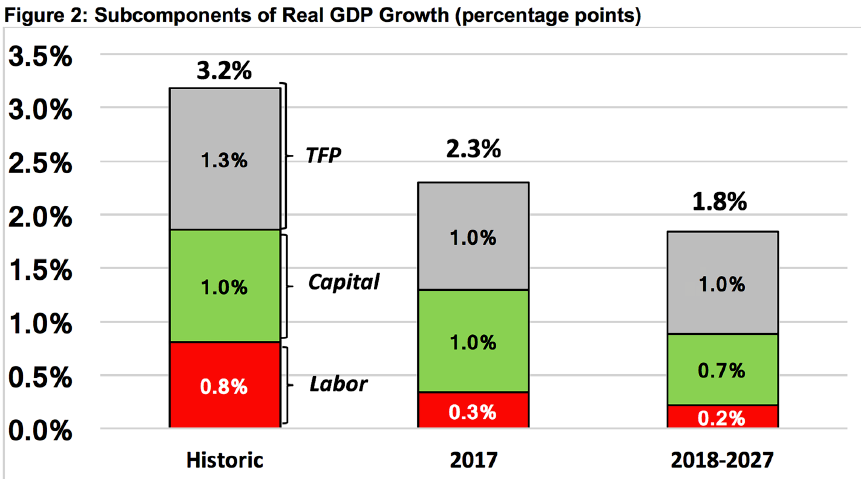

The Committee for a Responsible Federal Budget, using CBO data, believes that several policy changes can help boost growth on an annual basis as follows:

  • Immigration reform, .3%, by increasing the number of workers.
  • Tax reform, .18%, if well designed. However, deficit-financed tax reform would ultimately harm growth.
  • Increase the Social Security retirement age by two years, .15%, by keeping people in the workforce longer.
  • Reduce deficits by $4 trillion over ten years, .1%. This is enough deficit reduction to put our debt on a sustainable, downward path.
  • Continue expanding energy production at the shale boom level, .09%.
  • Repeal of the Affordable Care Act, .08%, will keep more people in the workforce.
  • Ratifying the Trans Pacific Partnership, .01%, by increasing foreign trade.
  • Increasing public investment in infrastructure, education and research by $40 billion per year, .1%.

Note that all of these changes would increase growth by an estimated .83% of GDP per year. Added to the 1.8% base this yields a growth rate of 2.63%. Unfortunately, many of these reforms are unlikely to occur.  On the other hand, various deregulatory actions being taken by the Trump administration are likely to increase growth by an unknown amount.

Conclusion. It is reasonable to anticipate that growth can and will be speeded up to about 2.5% of GDP per year under the Trump administration.  Along with the tight labor market now developing (current unemployment rate of 4.4%), blue-collar and other middle class workers should continue to receive decent pay increases for the foreseeable future.

Follow me on Twitter
Follow me on Facebook

How Donald Trump Could Redeem Himself


From a reader of my blog:
I think he is too flawed, self-centered and sociopathic to accomplish much. I believe that tax reform will become tax cuts for the wealthy (no inheritance tax, etc.) and dealing with budget deficits will not happen. I know you think Trump will be contained by the conservative members of Congress. The Republicans seem unwilling to confront him or speak out as long as his base continues to be very loyal. I think he is so wounded now that it will be hard to accomplish much.


Granted that Donald Trump is hopelessly ensnared in controversy and incapable of changing his ways, he still has many opportunities to do something positive. For example regarding our extremely serious debt problem, he could focus on:

  • Coming up with a budget that reduces the debt path. No one expects the budget to be balanced in one year. Last year’s Republican plan would have taken ten years to get the job done. The important thing is to clearly move in this direction.
  • Focusing healthcare reform on cost control. Give the Democrats credit for expanding healthcare access with the Affordable Care Act. But now focus on reining in the cost of healthcare in America.

  • Enacting fiscally responsible tax reform. Most people agree that the tax code is a complicated mess and, especially, that the corporate tax rate is too high. There are many ways to achieve lower tax rates and simplification in a revenue neutral way.
  • Stop digging the debt hole deeper by just adding new initiatives. There will always be attractive new programs which are worth pursuing. But in adding them to the federal budget, other programs which are no longer effective need to be phased out.
  • Reforming entitlements such as Social Security, Medicare and Medicaid. These are the big drivers of national debt. Without entitlement reform, all other efforts to restrain federal spending will be insufficient.

Conclusion. There is nothing easy about pursuing the above agenda. Implementing it will be highly controversial with lots of vociferous opposition.  It will take strong leadership to push it through.  But it represents a huge opportunity for a controversial president to do something worthwhile.

Follow me on Twitter
Follow me on Facebook

What Will Happen if We Have a New Fiscal Crisis?


As I often remind the readers of this blog, the two main topics are what I consider to be America’s two biggest economic and fiscal problems:

  • Slow economic growth, averaging just 2% since the end of the Great Recession in June 2009. This means fewer new jobs and smaller raises.
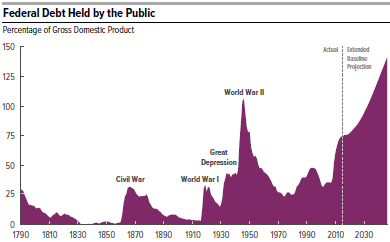
  • Massive debt, now 77% of GDP for the public part on which we pay interest, the largest since the end of WWII and predicted by the CBO to keep getting worse. As interest rates rise from their currently unusually low levels, interest payments on the debt will skyrocket.


The first problem, slow growth, is being addressed by the Trump Administration with various deregulatory actions as well as likely tax reform action by Congress.  Furthermore, the current low 4.4% unemployment rate means that the labor market is tightening on its own.


The second problem, massive debt, is much more worrisome for the future.  Right now interest rates are so low that our entire debt is essentially “free” money.  But every 1% increase will add nearly $150 billion per year in interest payments.  And this continues indefinitely (and keeps getting worse with more debt) because debt is rarely if ever paid back, it is only rolled over!  What are the likely outcomes of such an upward spiral in interest payments?  There are two possibilities:

  • First, the unthinkable. We default on our debt. This would immediately end the role of the U.S. dollar as the international currency and end our superpower status. The fallout would be disastrous for world peace and stability.
  • Second, a huge tax increase. The only alternative to default will be a large tax increase just to keep afloat on interest payments. A likely new tax for this purpose is a consumption tax in the form of a value added tax.

Conclusion. It is extremely shortsighted to keep on delaying a necessary solution to our rapidly worsening debt problem. It’s going to be unpleasant to either cut back on spending or to raise taxes but the longer we delay action the more painful it will become in the end.  Isn’t it obvious that we should get started immediately?

Follow me on Twitter
Follow me on Facebook

Quo Vadis America?


In many respects things are going quite well in the U.S. at the present time:

  • The economy is chugging along at 2% annual growth, not spectacular but better than in most other developed countries. In fact a rather severe labor shortage is developing in some industries such as construction and agriculture.   More specialized guest worker visas would help relieve these shortages. Better career and vocational education in high school as well as targeted job retraining programs for the underemployed would help prepare workers for the millions of high-skill manufacturing jobs going unfilled.
  • Pesky foreign policy problems are under control. ISIS is being squeezed in the Middle East. China appears willing to help contain the North Korean nuclear threat. Iran is mostly abiding by the 2015 nuclear agreement.
  • Congress is inching its way towards resolution of the healthcare stalemate, by repairing Obamacare rather than repealing it. It’s not clear how much tax reform will be implemented this session but there is at least a consensus on lowering the corporate tax rate to encourage multinational companies to bring their profits back home.
  • Deregulation efforts by the Trump Administration will give the economy at least a small beneficial boost.

    But there is one huge problem which is constantly being swept under the rug or being kicked down the road by both parties in Congress and by Democratic as well as Republican presidential administrations alike. I am referring, of course, to our massive national debt, now sitting at 77% of GDP (and growing) for the public part on which we pay interest.  Right now this debt is essentially “free” money because interest rates are so low.  But it’s really a ticking time bomb because sooner or later interest rates will return to more normal levels and then interest payments will skyrocket causing a huge fiscal crisis.

Conclusion. It is imperative for Congress to reform entitlement programs to make them less costly to the federal budget and to otherwise restrain discretionary federal spending across the board. The future of our country depends on our national leaders exercising much greater fiscal restraint.  They need to get much better at doing this!

Follow me on Twitter
Follow me on Facebook

Responsible Tax Reform III. Avoid Complacency about Debt


The Trump Administration has proposed a tax reform plan, with both good and bad features, and it is not yet known how Congress will respond to it.  In the meantime we should focus on what tax reform can accomplish if does right:

  • Lower tax rates. Most observers agree that lower tax rates will increase economic growth by encouraging more business investment. Since the end of the Great Recession in June 2009, GDP has grown at the historically slow rate of 2% per year. Any additional growth will be beneficial by tightening the job market, thereby creating more jobs as well as higher wages for the already employed.
  • Revenue neutrality. Our public debt (on which we pay interest) is now 77% of GDP, the highest it has been since right after WWII. At the present time interest rates are so low that the debt is almost “free” money. But interest rates will inevitably rise back to more normal levels in the future. When this does happen, whether it be sooner or later, interest payments on our ever increasing debt will skyrocket, and eat up as much as a third of federal tax revenue.  A huge fiscal crisis will then occur, far worse than the Financial Crisis of 2008.

  • Observing historical precedent. There have been five tax rate cuts in the last half century: (Kennedy (1964), Reagan (1981, 1986) and Bush (2001, 2003)).  Note that public debt was 40% or less of GDP at the time of each of these tax cuts (see chart). The revenue losses associated with each was temporary and the first three at least strongly stimulated new growth.

Conclusion. Our national debt is much too high at the present time to adopt a tax reform plan with an extravagant disregard for revenue loss. The current debt level is so high (and projected to keep getting steadily worse) that modest tax rate cuts, coupled with significant spending restraint, is clearly called for.

Follow me on Twitter
Follow me on Facebook

Responsible Tax Reform II. The Trump Plan


Responsible tax reform will be highly beneficial for the U.S. economy because:

  • Economic growth will be speeded up by lowering tax rates on businesses, thereby encouraging more investment.
  • National debt will shrink because faster growth will produce more tax revenue. But this only works if the revised tax plan is revenue neutral to begin with.

The Trump tax plan, described here and here, has the following features:

  • three tax brackets, reduced from seven. Simplification like this is a good idea.
  • double the standard deduction. This puts more money in the pockets of the average tax payer who does not itemize deductions and is therefore a good idea.
  • repeal of the alternative minimum tax. This only affects wealthy people and should be retained, if necessary, to make sure that overall reform does not increase the deficit.
  • lower capital gains tax. This will encourage more investment but should not be included unless the overall plan is revenue neutral.
  • repeal of inheritance tax. This tax feature should be retained until our annual budget deficits are eliminated, i.e. until we achieve balanced budgets on an annual basis.
  • preserving deductions for mortgage interest and charitable contributions. The mortgage interest deduction should be greatly reduced from its current level of $1 million per residence. Wealthy taxpayers don’t need that much help. Raising the standard deduction will already help middle income taxpayers.
  • cutting the corporate tax rate. This is an excellent idea as long as its revenue loss is made up elsewhere. It will encourage multinational corporations to bring their overseas profits back home for reinvestment in the U.S.

Conclusion. The Trump tax plan has some good features as well as some poor ones. Reducing tax rates is a good idea.  But adding to annual deficits is a very bad idea.  With some effort it is possible to reduce tax rates in a revenue neutral way.

Follow me on Twitter
Follow me on Facebook

Principles for Responsible Tax Reform

President Trump has just unveiled the outline of his tax reform proposal. Tax reform done right can give our economy a needed shot in the arm.  The big question is, of course, what is the right way to do it?
The Committee for a Responsible Federal Budget has proposed some sensible guidelines:

  • Promote Economic Growth and Dedicate the Gains to Deficit Reduction. The Joint Committee on Taxation and the Treasury Department have estimated that comprehensive tax reform can increase the growth rate of GDP over the next decade by .05 to .25% per year. For example, a .2% increase would reduce our debt by $550 billion over ten years (see chart). This does not fix our fiscal problems but it helps.

  • Maintain or Reduce Current Deficits. Make sure that any tax rate cuts are offset by revenue increases (i.e. shrinking tax deductions) so that the annual deficit is not increased. Ultimately, our fiscal challenges are unlikely to be solved without reducing spending, reforming entitlements and increasing revenue.
  • Set Permanent Tax Policy. The reconciliation process in the Senate, whereby a simple majority can approve legislation, disallows any increase in the debt beyond ten years. In other words, permanent tax reform will require a sixty vote majority to override a filibuster. This is the only way to achieve sound policy.
  • Avoid Unjustified Timing Shifts and Other Gimmicks. A timing shift is a gimmick if it doesn’t make economic sense. For example, gradually reducing tax rates, rather than cutting them immediately, would only delay revenue losses by shifting them to the future, and is therefore a gimmick.
  • Rely on Reasonable Economic Assumptions. A good example of a faulty economic assumption is to arbitrarily assume that a tax rate reduction will create 3% annual GDP growth and therefore pay for itself over a sufficiently long time period. Such a proposal was made by the economist Stephen Moore in yesterday’s Wall Street Journal.

Conclusion. Slow economic growth and massive debt are our country’s two biggest problems. Tax reform done right will speed up growth without worsening the debt.  I will be paying close attention to the forthcoming debate on this issue.

Follow me on Twitter
Follow me on Facebook

Why I Am Optimistic about President Trump


I voted for Hillary Clinton last November. Not because I liked her program.  I was voting against Donald Trump.  He is crude, sleazy and a terrible narcissist.  I preferred John Kasich, Governor of Ohio, in the Republican Primary.  But he didn’t make it.  I voted for Mitt Romney in 2012 but he didn’t make it either.
The question now is whether or not the Trump Administration will effectively address our country’s two biggest problems, both of which are very serious and need urgent attention:

  • Slow economic growth, averaging just 2% per year since the end of the Great Recession in June 2009. Faster growth means a tighter labor market which in turn means more workers and higher wages. This in turn means less inequality. Furthermore, it is the United States’ dominant economic strength which assures world peace and stability. The Chinese economy, now half the size of ours, will catch us eventually. But stronger U.S. growth will delay this and enable us to cope with it better when it happens.
  • Massive Debt. The public debt of $14 trillion (on which we pay interest) is now 77% of GDP, (https://itdoesnotaddup.com/2017/01/31/trump-needs-a-wall-of-fiscal-discipline/) the highest since the end of WWII and steadily getting worse. With current low interest rates the debt is now essentially “free” money. But what will happen when interest rates return to normal historical levels? At this point interest payments on the debt will rise precipitously and become a huge drain on the budget. We can’t prevent this from happening but we can lessen the impact by acting now.

Will the Trump Administration take these two problems seriously?

  • For sure on economic growth. His re-election chances in four years depend largely on the fortunes of his base of blue-collar workers. His appointments at Treasury (Mnuchin), HHS (Price), and EPA (Pruitt) all support the tax reform and deregulation needed to get this done. I am confident that Trump will avoid a disastrous trade war.capture99
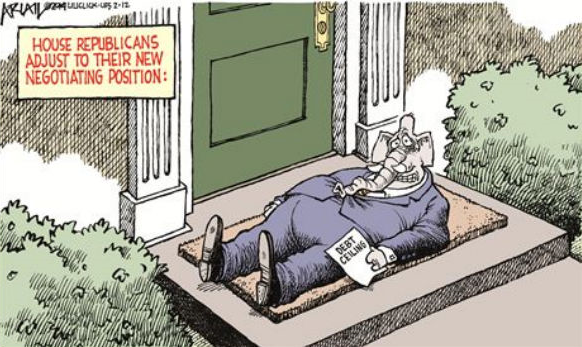
  • The debt. This is trickier because Trump has said he won’t touch Social Security or Medicare. My optimism is based on the fact that the Debt Ceiling will be re-imposed on March 16 at its level on that date. This will give Congress just a few months to raise the ceiling to a higher level. It is likely that the many fiscal conservatives in the House will insist, in return, for some sort of spending restraint such as a ten-year plan to balance the budget.

Conclusion. We’re not out of the woods yet. But there is a clear path showing the way forward.

Follow me on Twitter
Follow me on Facebook


Can We Trust Donald Trump to Do What’s Best for America?


From a reader of my blog:

You are an eternal optimist. Have you factored in these possibilities:

1. Paul Ryan and others will support the Wall and what it costs.
2.
Immigration control will limit much needed manpower.
3.
Trade wars with Mexico and other countries might severely reduce the output of
the USA.
4.
Tax reform will favor the ultra-wealthy, thus not do much to stimulate the
economy, causing a dramatic increase in the debt.
5.
Defense spending will be massive, thus up with the debt.
6.
Charter schools will lack sufficient oversight, thus poor results will follow.

You seem to convey that Trump will execute a strategy much as you think it should be done. I doubt it.

The above outcomes are unlikely for the following reasons:

  • Trump obviously likes being President, will continue to do so, and will hope to be re-elected in 2020. His re-election prospects will depend almost entirely on his boosting economic growth in order to increase the wages of his key blue-collar supporters.capture97
  • The quickest way to speed up growth is through corporate and business tax reform and deregulation. Trump’s entire team of advisors and cabinet secretaries, as well as congressional majorities, agree on this strategy. These things are likely to get done, sooner rather than later.
  • A trade war with Mexico or any other major trading partner (China, Canada, etc.) will badly hurt the economy. Trump knows this as well as anyone and won’t let it happen. A 20% tariff on Mexican imports to pay for a wall will just transfer the cost to American consumers and will be very unpopular. Trump’s people can figure this out.
  • Having 11½ million illegal immigrants in the U.S. is a significant problem and Trump has a mandate to fix it. His plan is to 1) build a wall, 2) deport the 800,000 or so lawbreakers amongst these illegals, and then 3) figure out what to do with the rest. This sounds to me like a reasonable plan and has a good chance of being successfully implemented.Conclusion. I admit to being an optimist. It keeps me going! I’ll respond to the other specifics (debt, charter schools, etc.) in the near future.

    Follow me on Twitter
    Follow me on Facebook

Trump as the Anti-Obama


Donald Trump assumes office with perhaps the lowest favorability ratings of any modern president. According to the New York Times,

  • Mr. Trump’s approval rating is only 40% among all adults and just 46% among likely voters.
  • But a recent CNN poll reports that 48% of adults think he’ll do a good job as president and 61% think he’ll bring back well-paying jobs to economically depressed areas.capture97

Contrast this with Barack Obama’s latest poll ratings:

  • According to Gallup Mr. Obama leaves office with an approval rating of 57%.
  • But Rasmussen reports that only 35% of likely voters think the country is heading in the right direction (with 55% saying that we’re headed in the wrong direction).

I interpret this to mean that the country is largely turned off by Mr. Trump’s crude speech and sleazy behavior, while still liking his economic program.  On the other hand, voters like Mr. Obama personally while disapproving of many of his policies and accomplishments.

All of this leaves Mr. Trump in an amazingly good political position:

  • With unemployment currently at a relatively low 4.7% and the economy fully recovered from the Great Recession, even modest reform in tax policy coupled with energy, healthcare and financial deregulation could provide a significant boost to long stalled economic growth.
  • He is criticized for having no clear cut political philosophy but this means he is free to do whatever makes good sense regardless of ideology. This will be a huge advantage in working with both parties to get things done.
  • He has nowhere to go but up in the polls. Such an increase in personal popularity will create the semblance of forward momentum.

Conclusion. The prospects are indeed propitious for Donald Trump to become a transformational president.

Follow me on Twitter
Follow me on Facebook