
The Source of Economic Growth


In my last post, “What the Republican presidential candidates should be saying,”  I summarized the argument by the economist, John Cochrane, that “sclerotic growth is the economic issue of our time.” Mr Cochrane shows dramatically that even small differences in the growth rate over time can make a huge difference in raising living standards.

Capture0He goes on to say that

  • There is only one source of growth. Nothing other than productivity matters in the long run.
  • The vast expansion in regulation is the most obvious change in public policy accompanying America’s growth slowdown. Most recently under the Dodd-Frank Act and the Affordable Care Act, the financial and healthcare sectors of the economy have seen radical increases in regulatory intervention. But environmental, labor, product and energy regulation have all increased dramatically as well.
  • Regulation during the financial crisis did not fail for being absent. It failed for being ineffective.
  • The best way for the government to subsidize healthcare efficiently is to give straightforward vouchers which people can use to buy insurance or to fund health savings accounts. Such vouchers should replace Obamacare, Medicaid and Medicare.
  • The basic structure of growth-oriented tax reform is lower marginal rates, paid for by broadening the base by removing exemptions and loopholes. Several additional tax principles are:
  • The ideal corporate tax rate is zero. A high corporate tax rate hurts the workers more than anyone else.
  • A growth-oriented tax system taxes consumption, not income and savings.
  • Eliminating or moving away from taxing income, would lessen the value of personal deductions such as for mortgage interest or charitable donations.
  • The estate tax is a particularly distorting tax on saving and investment. The tax code should not give strong incentives to middle-age people to stop building their businesses or investing their money.
  • Solving our immigration problem would turn 11 million illegal immigrants into productive citizens. Guest worker and e-Verify enforcement are fixable problems.

How to speed up economic growth ought to be one of the basic issues in the presidential election campaign. Here are some good ways to do this.

Follow me on Twitter: https://twitter.com/jack_heidel
Follow me on Facebook: https://www.facebook.com/jack.heidel.3
 

Economic Growth is Slowing Down: What Shall We Do about It?


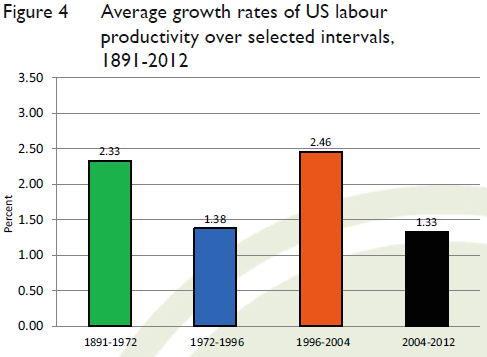
My last post, “Why Economic Growth is Slowing Down,” reports on the work of the economist Robert Gordon in his book “The Rise and Fall of American Growth.”  Mr. Gordon makes a persuasive argument that the U.S. experienced an unusually strong economic growth spurt from 1870 – 1970 and that we simply cannot expect future GDP growth to replicate such a sustained streak in the future.
Capture0Furthermore, in addition to much slower productivity growth at the present time, we are also facing strong headwinds to growth such as rising inequality, poor educational outcomes, demographic challenges, a huge debt burden and social deterioration at the bottom of the income distribution.
All of this together represents a severe double whammy holding back future economic progress in the U.S.  So what type of public policy response is called for?  Here are what I consider to be Mr. Gordon’s best ideas for simultaneously boosting productivity and combating the headwinds:

  • Toward greater equality of outcomes. Increase the minimum wage (state by state in my opinion), expand the Earned Income Tax Credit to able bodied adults without dependents, reform sentencing to keep more non-violent law breakers out of prison (which makes them unemployable, and therefore poor marriage prospects, upon release).
  • Towards greater equality of opportunity. Provide greater access to preschool education for all children growing up in low-income families. Allow college debt to be repaid as a percentage of taxable income after graduation. Reduce regressive regulatory measures such as occupational licensing.
  • Reducing Demographic Headwinds. Focus immigration reform on raising the average skill level of the working age population. This would include both blue-collar skills and college degrees.

I consider these types of reform to be relatively uncontroversial and therefore more easily doable through the political process. Other policy changes capable of speeding up growth such as broad-based tax reform (lowering tax rates paid for by shrinking deductions), major regulatory reform such as making the Affordable Care Act more flexible and the Dodd/Frank Act less restrictive, and approving the Trans Pacific Partnership to expand trade are all political hot potatoes and therefore will much harder to accomplish.

Follow me on Twitter: https://twitter.com/jack_heidel
Follow me on Facebook: https://www.facebook.com/jack.heidel.3

The Obama Legacy


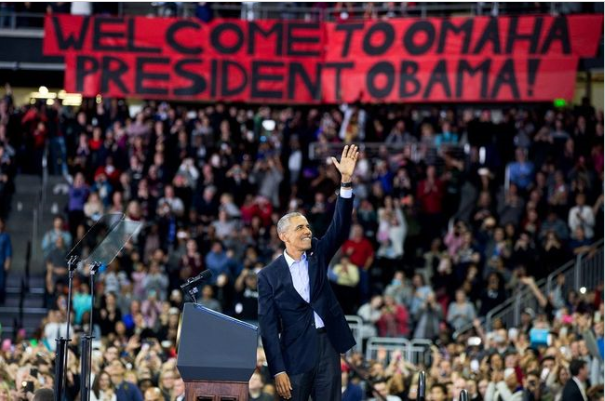
I have no antagonism for Barack Obama. He was elected because of the unpopularity of the Iraq War and George Bush who started it.  He inherited the Financial Crisis and pulled us out of it without another depression.  He has put us on the road to universal healthcare even though the structure of the Affordable Care Act does little to control costs.
Capture  But overall, the negatives of his presidency outweigh the positives.  Consider the situation we are currently in:

  • Stagnant Economy. The annual rate of growth of GDP since the end of the Great Recession in June 2009 has been an anemic 2% compared to our historical growth rate of 3% since the end of WWII. Although the official unemployment rate is down to a respectable 5%, there are millions of unemployed and underemployed people who have stopped looking for work. Obama and the Democrats in Congress have little interest in the tax reform and deregulatory measures which would boost economic growth.
  • Massive Debt. Our public debt (on which we pay interest) has doubled to over $13 trillion on Obama’s watch. As the Federal Reserve begins to raise interest rates to ward off inflation, interest payments on this debt will increase enormously. It is absolutely imperative to begin to substantially shrink our annual budget deficits. The Democratic Party, under his leadership, has expressed no willingness to do this.
  • Chaotic Middle East. The rise of ISIS in Syria, Iraq and North Africa, and the resulting refugee crisis in Europe is the result of weak U.S. leadership in the Middle East. Peace and stability depends on a strong U.S. presence in all trouble spots around the world. We neglect this responsibility at our peril.
  • Hyper-partisan Political Atmosphere. Stalemate in addressing these and other serious problems has led to the rise of extremist presidential candidates like Bernie Sanders and Donald Trump. Moderate candidates with successful experience in elected office are unable to gain political traction.

Our country is in a big mess. We are being guided by ideology rather than common sense.  I am optimistic by nature.  But it’s awfully easy to be pessimistic about our future.

Follow me on Twitter: https://twitter.com/jack_heidel
Follow me on Facebook: https://www.facebook.com/jack.heidel.3
 

Republican Congress Approves Irresponsible Budget


Congress has adjourned for Christmas having passed a final budget for the 2016 Fiscal Year extending through next September. It puts into place for this year the two year spending agreement reached between Congress and the President in October.  However Congress started out the year by passing a ten year budget plan resolution leading to a balanced budget by 2025.  The budget just passed leads instead to a deficit of $1.1 trillion in 2025.
CaptureHere are the details as described by the nonpartisan Committee for a Responsible Federal Budget:

  • Revenue: decreased under new budget by a $650 billion (over ten years) by making various temporary tax deductions permanent.
  • Discretionary Spending: increased by $50 billion for the current budget year (by breaking the sequester cap).
  • Medicare: instead of saving $430 billion over ten years, Medicare spending is increased by $95 billion over ten years.
  • 2025 Deficit: instead of shrinking to zero in ten years, it is now projected to be more than $1 trillion in 2025.
  • 2025 Debt: currently the (public, on which we pay interest) debt is 74% of GDP. The ten year balanced budget plan would reduce the debt to 56% of GDP. Instead, the debt is now on track to reach 80% of GDP by 2025.

Granted the Republican Congress hopes to develop a tax reform plan in 2016 which would lower tax rates for everyone, paid for by closing many of the loopholes and deductions just approved last week. One very good way to do this has recently been proposed by the Tax Foundation. The TF plan would boost economic growth and thereby increase tax revenue substantially over ten years.
The problem is that real tax reform is unlikely to happen without a Republican president in office.  If a Democratic president is elected in 2016, then the dire predictions made by the CRFB (above) are likely to remain valid for the foreseeable future. Our fiscal and economic future remains quite precarious at the present time!

Follow me on Twitter: https://twitter.com/jack_heidel
Follow me on Facebook: https://www.facebook.com/jack.heidel.3

Stopping Donald Trump II. Less Inequality or More Growth?


In my last post I presented the argument that voters are often more reasonable than the populist leaders who are trying to appeal to them.  They would rather hear something more optimistic than rage against a dangerous world.
Capture0But there is a difference of opinion on how to reach these voters:

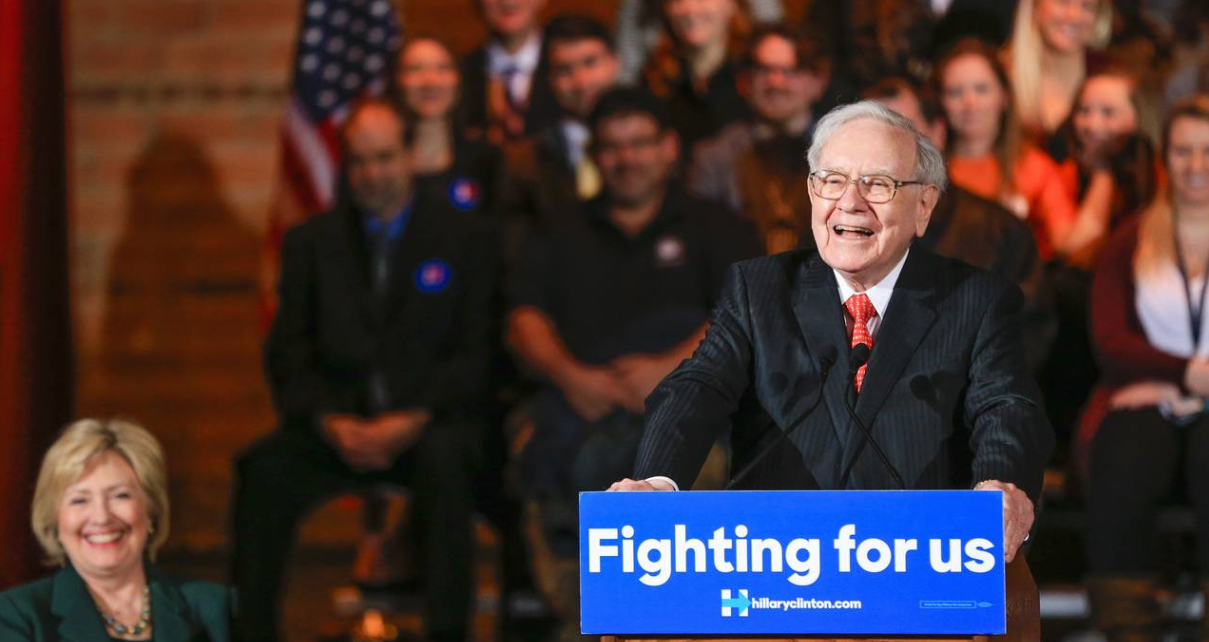
  • Leading Democratic presidential candidate Hillary Clinton endorses the Buffett Rule which calls for millionaires to pay a minimum tax of 30% on their income. Says Clinton, “I want to go even further because Warren is right. I want to be the president for the struggling, for the striving and the successful.”
  • All of the Republican presidential candidates, including Donald Trump, have tax reform plans which will grow the economy but none of which are revenue neutral. In other words, they will all add to annual deficits and therefore make our debt problem much worse than it already is.
  • The nonpartisan Tax Foundation has issued a new report, “Options for Broadening the U.S. Tax Base,” which proposes capping itemized deductions at $25,000 per individual combined with
    i)   cutting the corporate tax rate to 27%
    ii) cutting the top three ordinary income brackets by 5%, and
    iii) implementing a top capital gains tax rate of 20%.
    Such a plan would be revenue neutral and would lead to a long term GDP gain of 2.7%, a long term wage gain of 2.2% and a ten year dynamic revenue gain of $759 billion.

The Clinton plan would bring in up to $50 billion per year in new tax revenue but would do little to boost the economy. The Republican presidential tax plans are fiscally irresponsible. The Tax Foundation plan would boost the economy and reduce deficits rather than increase them.  Other specific reforms would boost the economy even more.
In other words there are clear cut ways to create more jobs and raise wages.  This is a message which should appeal to the angry and disaffected voters who are attracted to Donald Trump.

Follow me on Twitter: https://twitter.com/jack_heidel
Follow me on Facebook: https://www.facebook.com/jack.heidel.3


The Best Way to Stop Donald Trump


The main sources of background information for my posts are The New York Times and the Wall Street Journal. I read the Economist but most of the time it is either too esoteric or else too far  removed from the specifics of U.S. fiscal and economic policy which I am interested in.  But this week they have hit the nail on the head regarding Donald Trump and his fellow right-wing populists around the world.
Capture0
Says the Economist:

  • Populists differ but the bedrock for them all is economic and cultural insecurity. Stagnant wages hurt a cohort of older working-class white men whose jobs are threatened by globalization and technology. Jihadist terrorism pours petrol on this resentment and extends populism’s appeal.
  • Nobody should underestimate how hard it is to take the populists on. It is a huge mistake to dismiss their arguments by calling them fascist or extremist. Such disdain risks suggesting that political leaders are uninterested in the real grievances the populists play on.
  • The best way to overcome resentment is economic growth – not putting up walls. The best way to defeat Islamist terrorism is to enlist the help of Muslims – not to treat them as hostile.
  • Voters are often more reasonable than the populist leaders who are trying to appeal to them. Most of them would sooner hear something more optimistic than rage against a dangerous world.
  • Politicians also need to deal with the populists’ complaint that government often fails them. Reluctance to deploy more troops against the ISIS caliphate in Syria and Iraq does not appear to be a serious strategy to defeat it.

Conclusion: There is a clear path forward for candidates with a positive message of openness and tolerance and realistic plans to make the economy grow faster. Who is best situated to deliver such a message?  Stay tuned!

Follow me on Twitter: https://twitter.com/jack_heidel
Follow me on Facebook: https://www.facebook.com/jack.heidel.3
Tax Reform and Economic Growth


In a recent post I pointed out that both Republican and Democratic presidential candidates are being unrealistic with their tax reform proposals:

  • The Republican plans would stimulate the economy but at the cost of huge increases in the national debt, even taking into account the growth effects of these plans.
  • Raising the top tax rate to 50%, a Democratic idea, would bring in an additional $100 billion per year in tax revenue, but this is neither enough to make a big dent on budget deficits or appreciably lower income inequality by redistribution.
    Capture

The nonpartisan Tax Foundation has just released a new report, “Options for Broadening the U.S. Tax Base,” describing three different ways to do this:

  • Ending the exclusion of employer-sponsored health insurance
  • Removing the cap on the social security payroll tax
  • Capping itemized deductions at a fixed dollar level

Combined with marginal tax rate cuts, each of these options would lead to substantial economic growth.  However, the first option, ending the exclusion of employer-sponsored health insurance, is unlikely but rather this exclusion could be turned into tax credits as part of further healthcare reform.  Likewise, removing the cap on the social security payroll tax is more likely to be used to raise additional revenue to make social security financially sound for the long run.
However, the single measure of capping itemized deductions at $25,000 per individual could be combined with

  • Lowering the corporate tax rate to 27%
  • Cutting the top three ordinary income brackets by 5%
  • Implementing a top capital gains tax rate of 20%

Such changes would be revenue neutral and would lead to a long term GDP gain of 2.7%, a long term wage rate gain of 2.2% and a ten year dynamic revenue gain of $759 billion.
Conclusion:  it is possible to cut tax rates, broaden the tax base and grow the economy all at the same time and without increasing the deficit.  This is what we should be doing!

Follow me on Twitter: https://twitter.com/jack_heidel
Follow me on Facebook: https://www.facebook.com/jack.heidel.3

What Defines a (Fiscal) Conservative?


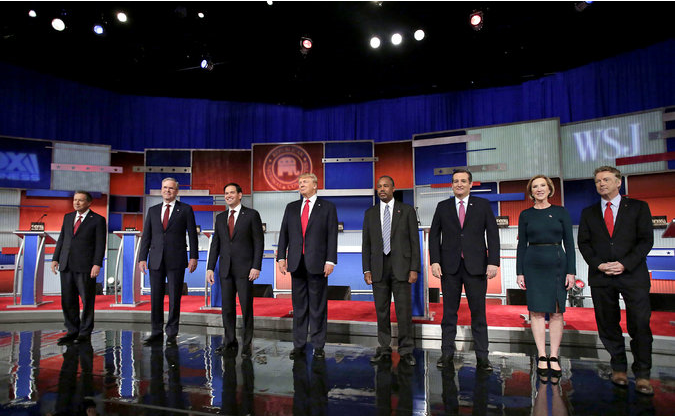
After four debates among the Republican presidential candidates, differences between them are becoming clearer.  The New York Times has an interesting article about this in today’s paper, “G.O.P. Fight Is Now a Battle Over What Defines a Conservative.”
CaptureHere are my views on the four issues discussed:

  • A Wall or a Path? We need to solve our illegal immigration problem and the key is to set up a viable guest worker program. The fact is that our economy needs foreign workers for many jobs which require hard physical labor such as in agriculture, meatpacking and construction trades. If businesses are able to bring in immigrants when sufficient domestic labor is not available, then other issues such as border security and verifying legal status can easily be resolved.
  • The U.S. Place in the World. U.S. leadership makes the world a safer place. This means we need a strong military presence all around the world as well as active alliances, trade and military, with many other countries.
  • Of Banks, Bailouts and Blame. The cause of the financial crisis was the bursting of the housing bubble, in turn caused by an unrealistic government housing policy as well as lax enforcement of existing regulations. Blaming greedy bankers is a copout. The Dodd-Frank Law is overkill which creates a drag on the economy by hampering smaller financial institutions and community banks. The best way to control large banks is to increase their capital requirements.
  • Who Should Get Tax Cuts? The main purpose of tax reform should be to boost the economy without increasing deficit spending. The way to do this is with across the board cuts in tax rates, paid for by closing loopholes and shrinking deductions. Here are some details. The 64% of taxpayers who do not itemize deductions will get an immediate tax cut and income inequality will be greatly reduced.

Getting the answers to these issues correct will have a large effect on the future wellbeing of our country.  The Republican presidential candidates should be commended for grappling with them in a productive manner.


I Am One of Paul Krugman’s “Very Serious People”


There is a stark contrast between the fiscal and economic policies being proposed by the presidential candidates from the two different parties. The Democrats want to tax the rich to reduce income inequality while the Republicans want major tax reform in order to speed up economic growth.
CaptureI favor the latter approach as long as it does not increase deficit spending.  The Keynesian economist Paul Krugman mocks deficit hawks like me as “Very Serious People.”  But in my “serious” view we have a choice between two very different paths for our economic future:

  • Slow Growth. Continue on our present path of slow 2% annual growth. The official unemployment rate has dropped to 5% but slack in the economy caused by the low labor participation rate keeps raises low and millions still unemployed or under-employed. The slow economy also keeps inflation and interest rates low. This permits Congress and the President to shrug off deficit spending and debt accumulation because it’s virtually “free money,” being borrowed at very low interest rates.   Our present course not only prolongs income inequality but also allows the debt to keep ramping up indefinitely. The longer this continues, the greater will be the disruption when inflation and interest rates do eventually return to normal historical levels.
  • Faster Economic Growth.   There are many things we can do to speed up economic growth. Tax reform is first and foremost but deregulation (relax Obamacare and Dodd-Frank), trade expansion (pass TPP) and immigration reform (with an adequate guest worker program) would also help. But, contrary to what the Republican presidential candidates say, tax reform must be revenue neutral to be sustainable. That way the economic growth it produces will lower deficit spending rather than increasing it.  This is critical because economic growth will create new jobs and raise pay for existing jobs, thereby creating inflationary pressure. Inflation will lead to higher interest rates which in turn will make our debt much more expensive than it is now.

Conclusion. We can make our economy grow faster if we simply put our mind to it. But then inflation and interest rates will go up and interest payments on the debt will become an increasing burden on society.  This is why it is so important to put our debt on a downward path as a percentage of GDP.  We can make it happen if we want to.

Austerity’s Grim Legacy?


There is a very important debate going on in the country right now as I have discussed in my last three posts:

  • The Republican presidential candidates are proposing big tax cuts to stimulate the economy but at the cost of huge increases in annual deficits and the accumulated debt.
  • The Democratic candidates want to raise taxes on the wealthy but even raising the top tax rate from 39.6% to 50% would have only a modest effect in lowering income inequality.
  • The Tax Foundation has an excellent plan to lower tax rates for all in a revenue neutral manner by closing loopholes and limiting deductions. Their plan would give the economy a big boost and actually lower deficits by bringing in more tax revenue.

Now comes Paul Krugman in Friday’s New York Times, “Austerity’s Grim Legacy”  saying that “Some of us tried in vain to point out that deficit fetishism was both wrong-headed and destructive, that there was no good evidence that government debt was a problem for major economies, … And we were vindicated by events.  More than four and a half years have passed since Alan Simpson and Erskine Bowles warned of a fiscal crisis within two years; U.S. borrowing costs remain at historic lows.”
Capture12How can such an obviously intelligent and articulate economist miss what is so very, very clear to so many lesser mortals?  Interest rates will not stay low forever!  And when they do go up, interest payments on our rapidly expanding debt will skyrocket! The Congressional Budget Office estimates that the interest payment on our debt will increase from 1.7% of GDP today to 3.6% of GDP in 2025, or $827 billion in 2025 compared with $227 billion in 2015.  Where will the money to pay this new $600 billion expense come from?
It is absolutely crazy not to take our enormous debt seriously.  We simply must put this huge debt on a downward path as a percentage of GDP.  It can be done but it will take a concerted effort by our national leaders to do it.

                                    Follow me on Twitter: https://twitter.com/jack_heidel
                         Follow me on Facebook: https://www.facebook.com/jack.heidel.3