Clinton Is Not As Bad As Trump


I’ve been saying for several months that I would endorse one of the two main presidential candidates before the election and that “Donald Trump Should Withdraw from the Presidential Race” because of his personal sleaziness and that, in any case, I could not vote for him.
But it is worse than this.  As the Wall Street Journal stated recently, “Mr. Trump would start out with more than half of the country disliking him, and most of his advisors lack governmental experience.  Too many blunders or an early recession (especially one caused by trade restrictions) could cause voters to sweep out the GOP Congress in 2018, setting up a return to an all-progressive government in 2020.” In other words the disaster of 2009-2010, when President Obama had a filibuster-proof Congress, could easily happen all over again.

capture79
Mrs. Clinton has said that she wants, ”higher taxes, more spending on entitlements, more subsidies and price controls in ObamaCare, more regulations on business, more limits on political speech, and more enforcement of liberal cultural values on schools and churches.”  The likely result of such an agenda would be more lost years of slow economic growth.  And “the costs of slow growth are corrosive.  Flat incomes lead to more social tension and political enmity.  The fight to divide a smaller pie would get uglier in a country that once was accustomed to rising possibilities.”  This is a highly conceivable result of four years of a Clinton presidency.
Conclusion. I am not exactly enthusiastic about Mrs. Clinton.  But she is predictable and much less risky than Mr. Trump.  As long as the House of Representatives remains under Republican control, which is very likely, Mrs. Clinton will have to negotiate with it to implement much of her agenda.  This could conceivably lead to bipartisan progress on such major issues as tax reform and entitlement cost control.

Follow me on Twitter
Follow me on Facebook
 

The Political Predicament We Are In


I am an optimist by nature. I am used to having things go well.  If they’re not quite right, I try to imagine how they can get straightened out.  I’m also a realist.  As long as things are moving in the right direction, I am satisfied with the status quo.
Although my optimism is natural and intuitive, I find an intellectual justification for it in, for example, the work of Matt Ridley: “The Rational Optimist: how prosperity evolves.”  He makes a persuasive argument that not only has the humane race made huge strides in recent times but that this progress is intrinsic to evolved human nature and is likely to continue indefinitely.
The British historian, Andrew Roberts, has a cogent essay in yesterday’s Wall Street Journal, “1776: Would You Like to Reconsider?”, expressing consternation about the horrible choice we have for president this year between vulgarity and corruption.

capture77
Mr. Roberts admonishes Republicans to:

  • Somehow find party leaders and candidates who confront people like Mr. Trump seriously from the start and do not coddle him in the vain hope that he’ll collapse.
  • Avoid having debates controlled by TV channels who want the GOP to split and the Democrats to win.
  • Avoid talking down America, even in an election year, which is likely to be misinterpreted abroad.
  • Drastically raise the percentages of support that guarantee a candidate a place in the debate in order to avoid too many candidates and moronically low standards of debate.
  • Figure out how to exclude candidates who have neither held public office nor held any previous significant (appointed) public position.
  • The Republican Party machine should have the last say on who is or is not a Republican and who can therefore stand under the Republican banner.

Of course, Mr. Robert’s suggestions are impractical because they are not sufficiently democratic! But he is pointing to a huge problem which must be addressed:  Right now democracy, as a political system, is on trial and is “losing out to the ideas of totalitarian state directed corporatism that seems to be delivering much higher growth and much better leaders.”
Question. Can democracy be saved with democratic methods?

Follow me on Twitter
Follow me on Facebook


The Grand New Party


With the presidential election tightening and Hillary Clinton still the favorite to win, more and more attention is being devoted to trying to figure out what will happen to the GOP after Donald Trump. William Galston from the Brookings Institute sees a three-headed Republican party:

  • Wall Street i.e. establishment (fiscal) conservatives.
  • Main Street i.e. small government conservatives who think that government is the main obstacle to growth.
  • Populists i.e. non-ideological working class people who feel left behind by the modern world.

The Wall Street Journal is analyzing the Trump phenomenon with a series of articles, “The Great Unraveling” based on an underperforming U.S. economy:

  • Technology has not led to broadly shared prosperity.
  • The Federal Reserve did not foresee the financial crisis and hasn’t delivered adequate growth.
  • Trade with China has put millions of Americans out of work.

Today’s WSJ, “Republicans Rode Waves of Populism until They Crashed the Party,”  describes the transformation of the Republican party all the way from Richard Nixon’s southern strategy, Pat Buchanan’s anti-immigration appeal in 1992, the Tea Party uprising in 2009 and 2010 until today’s populist rebellion against the establishment.

capture76The map above shows the huge political realignment which has taken shape between 1996 and 2012 and is undoubtedly even more pronounced in 2016. The main question for me is whether and to what extent the three main Republican factions can come together on important policy issues such as immigration and trade:

  • Immigration. In the last debate Mr. Trump said that after the border is secured, and the “bad guys” are deported, then we’ll figure out what to do with the rest of the undocumented immigrants. This suggests a workable approach to the illegal immigration problem.
  • Trade. The challenge is to figure out how to make the proposed Trans Pacific Partnership trade agreement compatible with the interests of working Americans.

Conclusion. Regardless of the outcome of the November 8th election, Donald Trump has had a huge effect on American politics.  Whichever party is most successful in appealing to the core working-class Trump voters will have a huge advantage in the 2020 elections.

Follow me on Twitter
Follow me on Facebook
 

How to Get Our Economy Back On Track II. Entrepreneurship!


As many commentators, including myself, have pointed out, we need faster economic growth in order to create more and better paying jobs and also to bring in more tax revenue to shrink our huge budget deficits.
The rate of economic growth equals the growth of labor productivity plus the growth of employment.  The problem is that both productivity growth and the labor force participation rate have dropped steeply in recent years.

capture63
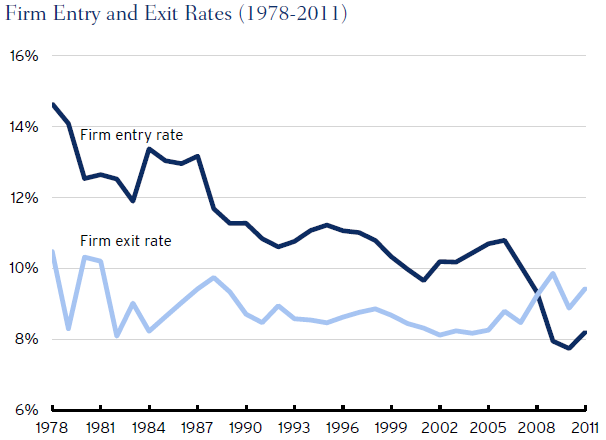
As I have pointed out in previous posts, the U.S. economy has become less entrepreneurial in recent years in the sense that there are now more firms going out of business than new firms going into business.
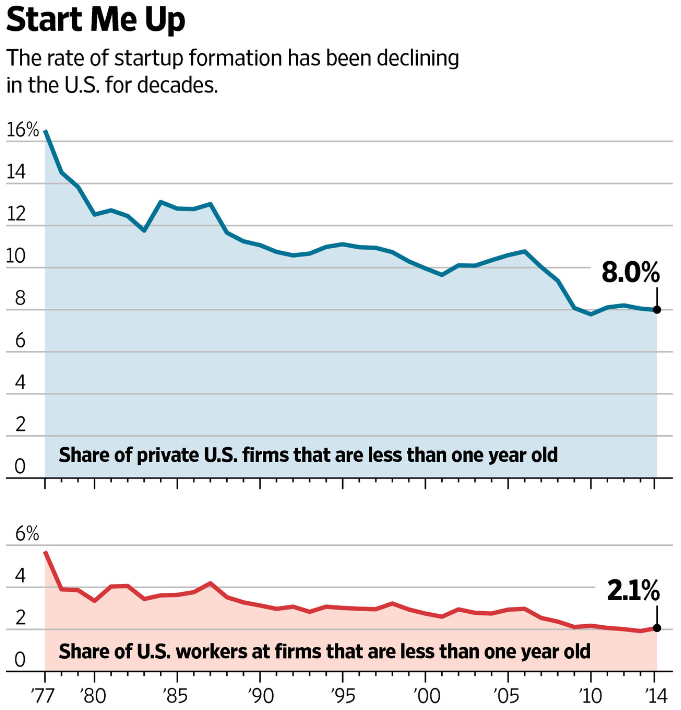
An article in yesterday’s Wall Street Journal has another way of looking at this.  The rate of startup formation has been declining in the U.S. for decades (as shown just below). It is obvious that figuring out how to boost entrepreneurship would do a lot to spur economic growth.

capture75
This can be accomplished with:

  • General growth measuresTax reform (lower marginal rates paid for by shrinking deductions), regulatory reform and simplification, maximum free trade to open markets, immigration reform to bring in more skilled workers, entitlement reforms to prevent a debt explosion.
  • Business tax incentives. Immediate write-off (i.e. expensing) of business investment. This encourages more investment by eliminating the need for depreciation over an arbitrary number of years. It is paid for by eliminating the deduction for interest expense to finance such investment.

Conclusion. Lots of voices are saying that technological innovation is slowing down and that only fiscal stimulus by the government can speed up growth.  Such pessimistic views will predominate unless the private sector is given the tools it needs to achieve growth in the most productive way.

Follow me on Twitter
Follow me on Facebook
 

The Three-Headed Republican Party


One of my favorite political and economic writers is the Brookings Institute’s William Galston who writes a regular weekly column in the Wall Street Journal.   Most recently his article, “The Three-Headed GOP After Trump, “ is particularly lucid.

capture75
Mr. Galston sees three factions in today’s Republican party:

  • Establishment conservatives who favor free trade, immigration reform, are broadly internationalist, believe in climate change, want corporate and individual tax reform, and also support entitlement reform. They would accept tax increases as part of a “grand bargain” to address our debt problem.
  • Small government conservatives ala House Speaker Paul Ryan and his “A Better Way” plan for American renewal. They believe that government is the principal obstacle to growth, especially with excessive regulation. They want major tax cuts and reductions in domestic spending as well as structural changes in Medicare and Medicaid. They are more nationalist than internationalist in outlook and oppose corporate welfare such as the Export-Import Bank.
  • Populist conservatives ala Donald Trump, many of them working class. They distrust all large institutions but do not have an ideological preference for small government. They strongly support Social Security, Medicare and Disability Insurance. They view the world outside the U.S. as more of a threat than an opportunity, and therefore oppose trade agreements and large scale immigration. “America First” is their demand.

Can these three groups coalesce into a single working majority? As I see it, Mr. Trump might have been able to accomplish this but has fallen short because he is such a sleazy individual.  Mr. Galston thinks that, after Trump, the second and third groups will be able to come together but only without the first group. I see the challenge as the traditional Republican Party, consisting of the first two groups, figuring out how to join forces with the third group.
Conclusion. A prosperous and secure future for our country depends on having a strong and viable (fiscally) conservative party.  How will this be achieved?

Follow me on Twitter
Follow me on Facebook

How to Get Our Country Back On Track


In my last two posts, here and here, I have said that I like some of Donald Trump’s policy ideas but he is too personally repugnant for me to support and vote for.  Hillary Clinton is morally less objectionable than Mr. Trump but her economic policy proposals are unlikely to have much success.
capture66The best hope for our country is to keep the Republicans in control of the House of Representatives.  They have put together an excellent plan, “A Better Way,” for reviving the American economy and boosting the American spirit.  Its main principles are:

  • Poverty. Every capable person is expected to work or prepare for work. Poverty fighting programs will be directed to get people back on their feet. The poor will have more opportunities to succeed at every stage.
  • National Security. It is a top priority to defeat radical Islamic extremism. We must restore American influence, advance free enterprise and expand the community of free nations.
  • The Economy. We need to take a smarter approach that cuts down on needless regulations while making the rules we do need more efficient, especially for our small businesses.
  • The Constitution. Agencies and bureaucracies should be subject to more scrutiny from Congress. Give Congress more say – and the final word – over what is being spent and why it is being spent.
  • Health Care. Individuals should have more control and more choices in order to improve quality and lower costs. No one should have to worry about having coverage taken away regardless of age, income or medical conditions.
  • Tax Reform. The tax code should be simpler, fairer and flatter while remaining progressive. It should be constructed to create jobs, raise wages and expand opportunity for all Americans.

Conclusion. These principles are widely supported by almost all Republicans in Congress and are more important than specific differences on immigration, trade, or entitlement policy.  Their serious consideration depends upon returning a Republican controlled House in 2017.

Follow me on Twitter 
Follow me on Facebook

Why Slow Economic Growth Is So Dangerous


In my last post I said that Donald Trump won the first presidential debate, in spite of his uneven temperament, because he was more correct on the issues.
One of the biggest problems our country faces is slow economic growth, averaging only 2% per year since the end of the Great Recession in June 2009.  This compares with an average rate of growth of 3.5% from 1950 – 2000.
In fact, even the recent job growth we have seen is now leveling off.
capture65Such slow growth is very dangerous long term for many reasons:

  • Massive Debt. Our public debt, on which we pay interest, is now 75% of GDP, the highest it has been since right after WWII. CBO predicts that this percentage will keep getting steadily worse without major policy changes. Faster growth means more tax revenue and therefore smaller annual deficits. It is imperative to put our accumulating debt on a downward path.
  • The Need for More Jobs and Better Paying Jobs. The best way to achieve broad based prosperity, and minimize populist disruption, is to create a tight job market where employers have to compete for employees. This is accomplished by making the economy grow faster.
  • Keeping Ahead of China. In 2009 China’s economy was 1/3 the size of ours; now it is 60% as big. In other words, China will soon surpass us economically if we are unable to grow faster. This would risk losing our worldwide lead in such crucial areas as new technology and financial depth, as well as our superpower status.
  • Reducing Student Loan Debt. The best way we can help former students pay off their college debt is to have good jobs waiting for them when they leave school. The faster our economic growth, the better we can do this.

Conclusion. Both our own individual success in life as well as the overall status of our nation depends upon the availability of opportunity. This is why economic growth is so important and why it is dangerous to let it lag.

Follow me on Twitter
Follow me on Facebook

The Economy Is Improving But Not Enough


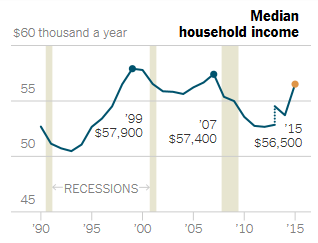
It has been widely reported that medium household incomes were up 5.2% to $56,500 in 2015.  Furthermore the lower income quintiles have gained the most.  This is very good news.
capture54But this new peak is below the previous peak of $57,400 in 2007, before the Great Recession started, which in turn is below the absolute peak of $57,900 in 1999. Now look at economic growth more broadly.
capture55The second chart shows the annual rate of real (i.e. inflation adjusted) GDP growth, by expansion period, all the way back to 1949.  What is most striking is that growth has been steadily decreasing over this entire time period and is now down to an average rate of just 2% during the current recovery. There is really only one way to reverse this steep decline.  It is to return to proven fundamentals as well explained by the economist, John Cochrane.  In summary:

  • There is only one source of growth. Nothing other than productivity matters in the long run. And, unfortunately, the business investment which leads to gains in productivity is way down.
  • The vast expansion in regulation is the most obvious change in public policy accompanying America’s growth slowdown.
  • The basic structure of growth-oriented tax reform is lower marginal rates paid for by removing exemptions and loopholes. A high corporate tax rate hurts workers more than anyone else.
  • Solving our immigration problem would turn 11 million illegal immigrants into productive citizens. Guest worker and e-Verify enforcement are fixable problems.
  • International trade with strict reciprocity between trading partners will benefit almost everyone. Manufacturing workers who lose their jobs to foreign competition need robust retraining programs for the many manufacturing jobs which still exist.

Conclusion. Faster economic growth is imminently doable. Just follow tried and true economic fundamentals!

Follow me on Twitter
Follow me on Facebook
Donald Trump Needs a More Positive Message


As regular readers of my blog posts know, I am not enthusiastic about either of our two main presidential candidates because neither of them has a good grasp of our two biggest economic problems which are:

  • Slow economic growth, averaging just 2% per year since the end of the Great Recession in June 2009. Faster growth would solve or alleviate many other problems, especially by creating more new jobs as well as delivering faster wage growth for all middle- and lower-income workers.
  • Massive debt now at 75% of GDP, the highest it has been since right after WWII, and projected by the Congressional Budget Office to get steadily worse unless big changes are made in spending and tax policies. Such major changes are difficult to make without presidential leadership.

Hillary Clinton promises “equitable” growth but her policy proposals will lead to a big increase in spending (bad idea) on projects of dubious value in speeding up economic growth. Donald Trump would hurt the economy with immigration controls and trade restrictions.  His proposal for lower tax rates (good idea) needs much improvement to avoid increasing annual deficits.
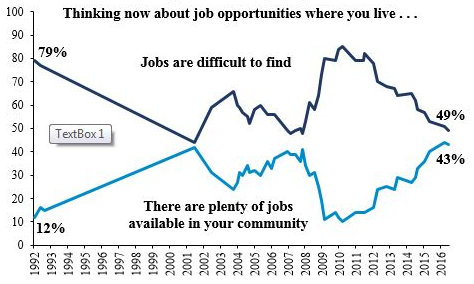
capture40Mr. Trump’s biggest problem, however, is his negative message about life in America today. Yes, we need stronger border security but we don’t need a Fortress America.  As the American Enterprise Institute has just reported, worker satisfaction is greatly improved since 2009 and workers are now much less anxious about job security than just a few years ago.
There is a really good way for Mr. Trump to sound a more positive note.  He could very easily take up the major themes of the Republican House Plan, “A Better Way” for solving America’s major economic problems.
Conclusion. There is an overwhelming desire for change in America, for new leadership which breaks out of the corruption, cronyism and elitism so rampant in Washington DC today.  But Americans are natural optimists and want a leader who can look forward to a bright future for our country.

Follow me on Twitter
Follow me on Facebook

Can U.S. Economic Growth Be Speeded Up? II. A Major Roadblock


In my last post, “Can U.S. Economic Growth Be Speeded Up?”  I pointed out that:

  • GDP growth has averaged just 2% since the end of the Great Recession in May 2009.
  • The Federal Reserve has taken unprecedented steps to keep interest rates low in the meantime but these efforts aren’t boosting GDP and, in addition, have quite harmful side effects.
  • Wages are growing and consumers are spending money but business investment is shrinking and productivity growth is slowing.
  • This means that the problem is supply side rather than demand side, contrary to what many economists are saying.

At least part of the problem is a lack of skilled workers. Two articles in today’s Wall Street Journal, here and here point out that:

  • America is now home to a vast army of jobless men, seven million of them age 25 to 54, who are no longer even looking for work. This is 15.6% of the traditional prime of working life.
  • Openings for manufacturing jobs this year have averaged 353,000 per month up from 311,000 per month in 2015 and 121,000 per month in 2009.
  • According to the Manufacturing Institute, 8 in 10 manufacturing executives say that the growing skills gap will affect their ability to keep up with customer demand.Capture39
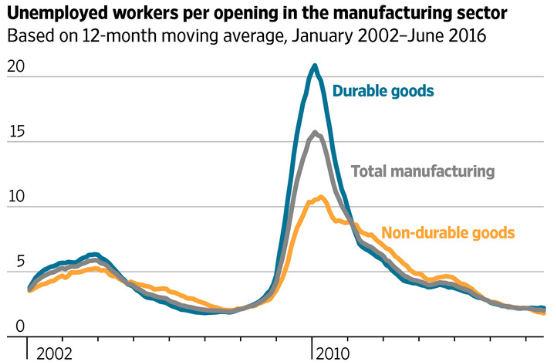
  • As shown in the above chart, at the present time there are only an average of two unemployed manufacturing workers for each job opening, way down from the level in 2010.

Conclusion. Speeding up economic growth requires new business investment in order to increase worker productivity. But a lack of skilled and trained workers will greatly hamper this effort.  The solution here is better vocational and career training in high schools and at community colleges.

Follow me on Twitter
Follow me on Facebook