The Economic Damage Caused by Very Low Interest Rates


As is well known, the Federal Reserve’s main tool in responding to the Financial Crisis in 2007 – 2009 has been quantitative easing (to lower long term interest rates) and direct reduction of the Federal Funds Rate (to lower short term interest rates). These measures definitely limited the severity of the Great Recession resulting from the Financial Crisis.  But the recession ended in June 2009, more than seven years ago.
Capture37In the meantime the continuation of such low interest rates is having many detrimental effects such as:

  • Pension funds, both public and private, have become greatly underfunded,  creating crises especially for state and local governments with defined contribution plans.
  • Retirement plans for millions of seniors have been upset by erosion of savings.
  • Inequality has increased as affluent stock owners benefit from the rapid increase of asset prices as investors reach for yield.
  • An immense misallocation of capital towards bond issuers at the expense of small business is taking place.
  • Federal debt is soaring as low interest rates make it much easier for Congress to ignore large budget deficits.
  • The next recession, when it inevitably arrives, will leave the Fed in a bind. The only tools remaining are a new round of quantitative easing (additional bond purchases) and even lower (i.e. negative) interest rates.
  • The Fed’s dual mandate of low unemployment (currently 4.9%) and price stability (low inflation) is being met but is accompanied by anemic GDP growth averaging only 2% since the end of the Great Recession. Such slow economic growth is largely responsible for the populist revolt in the 2016 presidential race.

Conclusion. Monetary policy can only accomplish so much. It is critical for the Fed to wind down its $4.5 trillion balance sheet as its bond holdings mature and to keep raising short term interest rates.  This will force Congress to step up to the plate with the changes in fiscal policy which are needed to stimulate economic growth.
Follow me on Twitter
Follow me on Facebook

Is Single-Payer Health Care a Good Idea?


My last two posts, here and here, have discussed major intrinsic problems with the Affordable Care Act.  It has been set up in an actuarially unsound manner and the cost of insurance coverage through the exchanges is growing very fast.
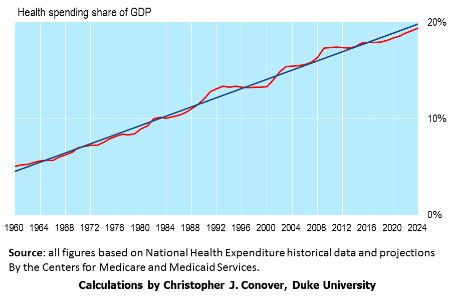
CaptureThe rapidly rising cost of American health care, public and private, is in fact one of our country’s biggest problems.  It is an affordability issue for millions of American households.  Furthermore the rapidly rising cost of the entitlement programs of Medicare and Medicaid is the fundamental driver of our exploding national debt problem.
As I see it there are two different routes we can take to solve this problem.  One way is to move towards a true free-market approach where healthcare consumers (all of us!) have more “skin in the game” in the sense that we move away from third party payment for routine care.  It is quite interesting that this is already starting to happen under Obamacare!
The other way of getting costs under control is to adopt a single-payer system, like much of the rest of the developed world.  But this would necessarily involve stringent cost controls and severe rationing and would be a lot more difficult than just enrolling everyone in Medicare. For example:

  • American doctors and nurses are very well paid. The average family physician in the U.S. earns $207,000, double the rate for general practitioners in Great Britain, which has a single-payer system. Are we going to arbitrarily chop doctor salaries in half in order to control costs?
  • The State of Vermont recently backed away from implementing its own single-payer system because the needed tax increases would have more than doubled Vermont’s annual budget. Colorado will vote in November on a petition-supported single-payer proposal, ColoradoCare, which would be paid for by a $26 billion annual state tax increase, and is therefore unlikely to pass. For a state to implement its own single-payer system at least requires budget honesty, since all states are required to balance their budgets. There is no such requirement for our federal government and so a single-payer system would be financed just like Medicare, with deficit spending. Bad idea!

Conclusion. American healthcare needs radical reform but adopting a single-payer system is not the best way to do it.

Follow me on Twitter
Follow me on Facebook


The Inherent Instability of Obamacare


The recent announcement by Aetna Insurance Company that it will exit the health insurance market in most of the states where it now operates raises a fundamental question about the stability of the Affordable Care Act. As shown by the following map  from yesterday’s New York Times, it appears that at least five states with 17% of the American population will have only one health insurer to choose from next year.
Capture33As the Wall Street Journal’s Greg Ip points out in a recent article, “the problem isn’t technical or temporary, it is intrinsic to how the law was written”  Specifically:

  • Insurance is supposed to price risk but the ACA changed this. Insurers can no longer charge or exclude coverage for pre-existing conditions, charge men and women different rates, or charge older customers more than three times as much as the young.
  • For example, a 64-year-old consumes six times as much health care as the average 21-year-old. Adhering to the 3-to-1 maximum ratio, the insurer would have to greatly overcharge the 21-year-old than his actual cost and/or greatly undercharge the 64-year-old.
  • The rational response for unsound pricing is for young and healthy customers to stay away and sick, older customers to flock to the exchanges. ACA mechanisms to prevent this type of behavior aren’t working very well.Capture32
  • One example of this is that the ACA exchanges, which provide income-based subsidies for those without employer provided health insurance, are mainly attracting those people just slightly above the poverty line who get the biggest subsidies (see chart).

I have pointed out many times that the cost of health care, especially for the entitlement programs of Medicare and Medicaid, is the fundamental driver of our exploding national debt and therefore must be curtailed.  But now, in addition to the cost problem, we are discovering that the ACA also has a fundamental access problem as well. Big changes are clearly needed in the ACA.  More details later!

Follow me on Twitter
Follow me on Facebook

The Presidential Candidates Are Clueless on the Economy


My last several posts, here and here, have discussed the economic plans of both Hillary Clinton and Donald Trump.  In short,

  • Ms. Clinton wants “equitable” growth meaning huge new public spending on such things as infrastructure, free public college tuition universal pre-K education as well as increasing the minimum wage to $15 per hour nationally and mandating paid family leave. More public spending and new mandates will provide only minimal economic growth.
  • Mr. Trump wants to restrict the labor force with immigration controls and raise the price of imports with new tariffs. He would also cut tax rates across the board (good idea) but in such a way that would increase the national debt by $10 trillion over the next ten years (very bad idea).

They both need to take our actual current economic situation into account as follows:

  • The U.S. is in its weakest recovery since post WWII. The average growth rate of 2.2% for 2012 – 2015 has now stalled in the past year to just barely 1%.

    Capture25

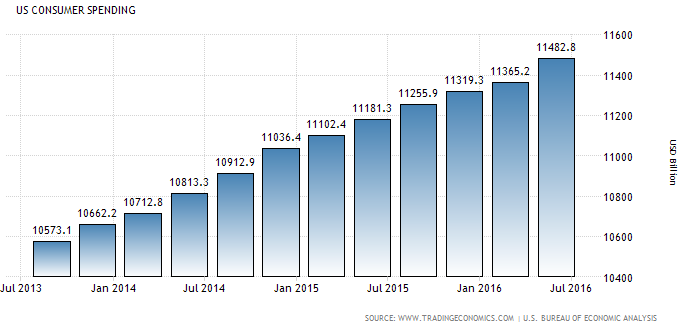
  • Consumer spending has been increasing steadily and rose 4.2% in the second quarter of 2016. In other words, consumer demand is at a high level.

    Capture26

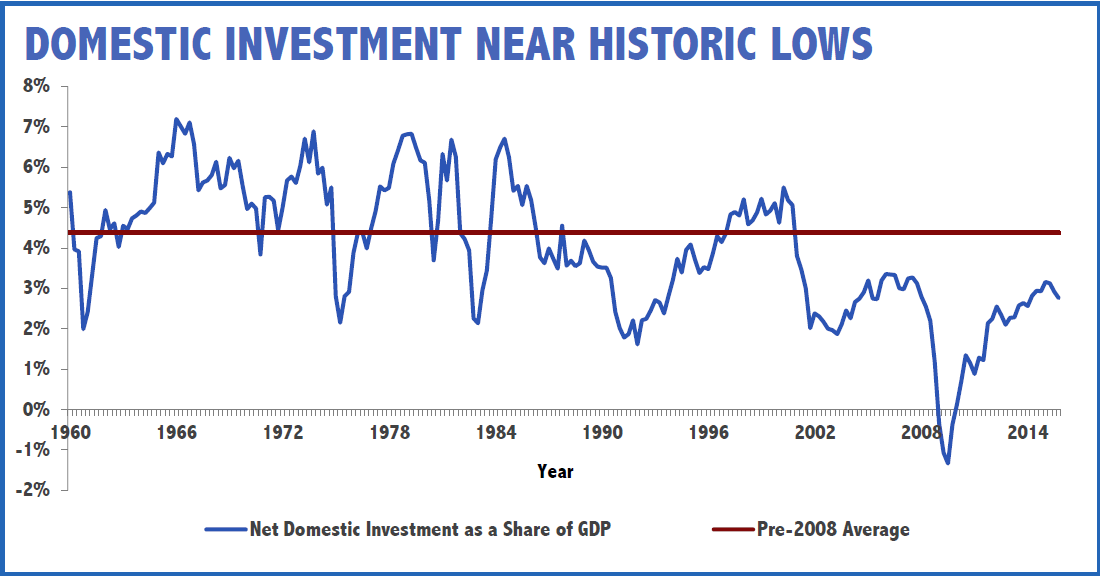
  • The problem is that business investment, i.e. supply, has decreased.

    Capture24

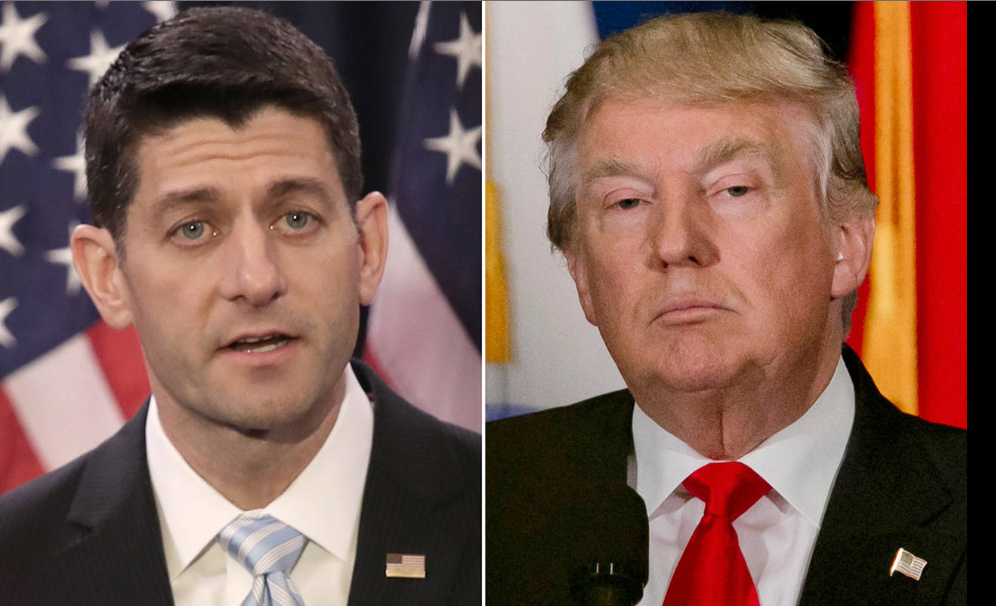
The House Republicans have “a better way.” Their tax reform plan, among many other good features, would

  • Lower the top corporate tax rate from 35% to 20% and establish a territorial system, to encourage multinational corporations to produce in the U.S. as well as bringing their foreign earnings back home for reinvestment.
  • Provide a tax-free return on new investment by allowing, for the first time ever, for full and immediate write-offs.

Conclusion. The House Republicans have a sensible plan for getting our country back on a much faster economic growth track. Regardless of who is elected president, the House is likely to stay under Republican control.  I am waiting to see if either of the presidential candidates will figure this out and adjust their campaign messages accordingly.

Follow me on Twitter
Follow me on Facebook


The Clinton Plan for “Equitable” Growth


I have tried to make it clear in my post that I have not endorsed either of the two main presidential candidates.  In fact I am waiting to see a credible plan for simultaneously spurring economic growth and getting our very large and growing national debt under much better control.
Capture12Capture13
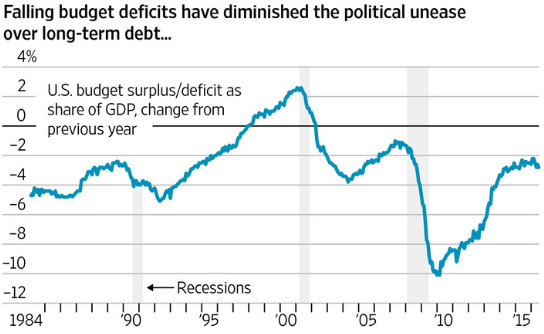
The debt problem is real and cannot be sloughed off as many try to do.  The two charts below show that while annual deficit levels have returned to what may be considered “normal” since 1984, they are still much too high and will lead to a rapidly increasing level of debt even if interest rates remain low which is by no means assured.
In other words, it is not good enough to just make the economy grow faster, it needs to be done in a fiscally responsible way.
I’ve already discussed how the Trump tax plan is unacceptable because it will substantially raise deficits and therefore make the debt much worse.

The same thing is true for the Clinton plan for “equitable” growth, but in a different way.  She wants

  • $250 billion in new spending for infrastructure.
  • Free public college tuition.
  • Universal Pre-K education.

Regardless of their individual attractiveness, it is irresponsible to propose new programs, with new spending, when deficits are already way too high and the debt is steadily climbing.

She also wants to:

  • Raise the national minimum wage to $15 per hour.
  • Mandate paid family leave.

The problem here is that both of these measures will increase unemployment and therefore slow down economic growth. Many states and cities are raising the minimum wage on their own and this way is preferable because it is locally determined.  Paid family leave should be left up to individual employers to use as an incentive to attract and retain good employees.

Conclusion. Hillary Clinton does want to make the economy grow faster which is highly desirable.  But she would do it with new federal spending and new mandates.  The new mandates will actually slow growth.  The new spending programs will add to the debt.  Both approaches are counterproductive.

Follow me on Twitter
Follow me on Facebook

“A Better Way” for Donald Trump to Make His Case


In my last post, “Donald Trump’s Best Chance to Win in November,” I said that the best way for Mr. Trump to broaden his appeal beyond working-class whites and to have any chance of winning the presidential election is for him to endorse the reform plan, “A Better Way,”  recently developed by the Republican House of Representatives.
Capture9Here is a brief and positive summary of the Trump platform so far:


  • His tax plan is highly pro-growth and will not cost nearly as much as the previously advertised $10 trillion over a decade.
  • He supports legal immigration and simply wants to solve the illegal immigration problem, one way or another.
  • He is not opposed to foreign trade per se but wants to negotiate, from a position of strength, with countries that manipulate their currencies, steal intellectual property or compel companies to disclose trade secrets as a condition of entering their markets.

His policy proposals so described are completely compatible with the House’s “A Better Way” reform plan whose planks are:


  • Poverty. Reward work. Tailor benefits to people’s needs. Improve skills and schools. Demand results.
  • National Security. Defeat the terrorists. Protect the homeland. Defend freedom.
  • The economy. Regulate smarter. End bailouts and cronyism. Put students and workers first.
  • The constitution. Make government more accountable and more representative. Restore constitutional checks on spending.
  • Health Care. More choices and lower costs. Real protections and peace of mind. Cutting edge cures and treatments. A stronger Medicare.
  • Tax reform. Simplicity and fairness. Jobs and growth.


These guiding principles are being fleshed out into complete policy documents. They do indeed represent a better way forward for our national government.  Donald Trump could do far worse than to endorse this comprehensive reform plan developed by the House Republicans.  It would show that he is serious about “Making America Great Again.”

Follow me on Twitter
Follow me on Facebook


Donald Trump’s Best Chance to Win in November


As I occasionally remind my readers, I am a non-ideological fiscal conservative and a registered independent. In November I will vote for the presidential candidate who has the most credible plan to address what I consider to be our country’s two more serious problems:

  • Slow Economic Growth, only 2.1% per year for the past seven years since the end of the Great Recession in June 2009. Faster growth will create more jobs and bigger wage gains for America’s workers.
  • Massive Debt. Our public debt (on which we pay interest) is now 75% of GDP, the highest it has been since the end of WWII, and likely to keep getting worse unless strong measures are taken to prevent this from happening.

According to current polls, Hillary Clinton is strongly predicted to be elected our next president. However her policy proposals will do little, if anything, to stimulate economic growth and are likely to make our debt much worse than it already is.
Capture8Donald Trump has a strong base of support among working class whites who are suffering in today’s economy and blame illegal immigration and unfair foreign trade for their woes.  However this base of support, while large enough for Mr. Trump to win the Republican nomination, is not nearly large enough to bring victory in November. The only way Mr. Trump can win is to greatly expand his base of support by appealing to moderate Republicans and Independents who are highly concerned about the direction our country is taking.
Capture9The best and most direct way for him to do this is to endorse the reform program, “A Better Way,” developed by the Republican House of Representatives, under Speaker Paul Ryan. This reform program has already unified the fractious Republicans in the House, and could easily serve as a vehicle for unifying the entire Republican party as well as many independents.
In my next post I will delineate how the Trump platform could easily mesh with “A Better Way.”

Follow me on Twitter 
Follow me on Facebook

Tax Reform for Faster Economic Growth


Several of my recent posts have been devoted to the topic of faster economic growth, see, for example, here. One way to do this is by making it easier to start and grow a small business.  Another way is with broad-based tax reform.
Capture11House Republicans have just released the outline of a plan for fundamental tax reform, “A Better Way: A Pro-Growth Tax Code for All Americans.”  It has the following main features:

  • The current seven tax brackets for individuals are condensed to just three: 12%, 25% and 33%.
  • The standard deduction of $12,600 (for joint returns) is raised to $24,000 and the $4,050 personal exemption is eliminated. This feature means that fewer filers will need to itemize deductions.
  • In fact, all itemized deductions for individuals are eliminated except for mortgage interest and charitable contributions.
  • To encourage business creation and expansion, the pass through tax rate for small business will be 25%. Full and immediate expensing for investments in new equipment and technology will be allowed.
  • The corporate tax rate will drop from 35% to 20%, paid for by eliminating dozens of tax carve-outs and deductions, including net interest expensing. A territorial system will be established whereby multinational firms will no longer be taxed both abroad and at home for the same dollar of income. This will encourage the multinationals to keep production facilities in the U.S. and to bring home foreign profits for reinvestment here.

The purpose of this plan, according to Kevin Brady, Chair of the House Ways and Means Committee, is “to rev up the economy, cut taxes on business, simplify the code and let American families file on a postcard.” The authors of the report claim that this tax proposal is revenue neutral, i.e. will not lower tax revenue, on a dynamic scoring basis, taking resulting economic growth into account.  If this assertion holds up under nonpartisan analysis, then this is an excellent proposal which deserves broad support.

Follow me on Twitter
Follow me on Facebook


The U.S. Middle Class Is Growing, Not Shrinking


One of the topics I discuss on this blog is income inequality (here, here, and here).  An interesting article in yesterday’s Wall Street Journal, “Upper Middle Class Sees Big Gains, Research Finds,” is highly pertinent to the inequality issue.
Capture1As can be seen in the above chart, the percentage of people in the middle class or above has greatly expanded between 1979 and 2014.  Furthermore, the basic research on this issue,by Stephen Rose at the Urban Institute, shows very clearly (in the chart below) what is happening: the higher is a family income, the faster it is increasing.
Capture3The best policy response to this phenomenon should be clear.  Rather than trying to decrease inequality with higher taxes on the wealthy, we should be trying to boost the less wealthy into higher income classes. The way to accomplish this is to:

  • Grow the economy faster with broad-based tax reform (lower tax rates paid for by shrinking deductions), immigration (guest worker) reform, (fair) trade expansion, and regulation reform (to help more small businesses get started). This will create more jobs and better paying jobs.
  • Improve education with early childhood education (to get minorities off to a better start in school), boosting high school graduation rates above the current 80% average (with better career and vocational education) and making college more affordable by putting more resources into community colleges and scholarships for low-income students.
  • Combat social inequality. The fraction of children with a single parent is the best predictor of upward economic mobility. The lower-income class marriage rate has dropped from 84% in 1960 to 48% in 2010. Policy should therefore focus on removing the marriage penalty in all government programs.

The basic forces of globalization and growing technology use are driving this societal change. The best way to respond is to enable more people to benefit from these basic trends.

Follow me on Twitter
Follow me on Facebook

Can the U.S. Economy Do Better?


In my last post I discussed the differing views of the U.S. economy held by Federal Reserve Chair Janet Yellen and her rival for the post, Larry Summers:

  • Janet Yellen thinks that the U.S. economy is steadily recovering from the Great Recession and that there is no hurry to raise interest rates back to normal levels.
  • Larry Summers thinks that the U.S. economy is suffering from secular stagnation and that there is a great need for more fiscal stimulus by the federal government.

There is another point-of-view, perhaps best expressed by the Hoover Institution’s John Cochrane in a recent Wall Street Journal Op Ed.  Let me try to summarize Mr. Cochrane’s argument:

Capture1

  • From 1950 – 2000 the U.S. economy grew at an average rate of 3.5% per year. Since 2000 it has grown at only half this rate, 1.76% annually. By 2008 the average American was more than three times better off than in 1952. Real average GDP per person grew from $16,000 to $49,000 during this period.
  • The U.S. economy is now overrun by an out-of-control and increasingly politicized regulatory state. America is now middle-aged and overweight. The solution is to eat better and exercise.
  • Consider the above chart, the World Bank’s “Distance to Frontier” ease-of-doing-business measure for 2014. The U.S. is near the top but there is plenty of room for improvement.
  • Here is what a growth agenda would involve: deep tax reform, cleaning out the insane complexity and cronyism; a thorough overhaul of social programs, getting rid of all the perverse incentives; better schools that come from increased choice and competition; a dramatic legal and regulatory simplification, restoring a transparent rule of law.
  • Growth-oriented policies will be resisted. Growth comes from productivity which comes from new disruptive technologies and businesses.

Can our political system deliver the changes that are needed? The rise of Donald Trump and Bernie Sanders show that the people want big changes and are willing to disrupt the status quo to achieve them.  This means change is possible but it won’t come easily.

Follow me on Twitter
Follow me on Facebook