It’s Easy to be Pessimistic about America’s Future


As I remind readers from time to time, this blog is concerned with America’s fundamental fiscal and economic problems: a slow economy, massive debt, and increasing income inequality. Largely because of these apparently intractable problems, more and more people are becoming pessimistic about the future of our country.
CaptureAlthough I am by nature an optimist, these matters weigh on me as well:

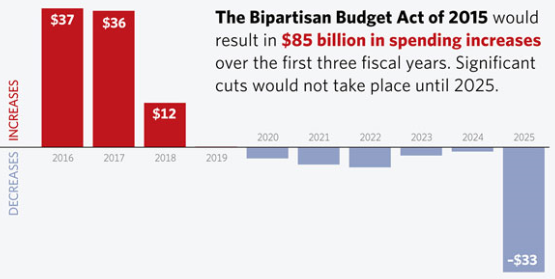
  • The just introduced “Bipartisan Budget Act of 2015” is a sell-out to the status quo. It breaks the agreed upon sequester spending limits by $112 billion over two years with essentially no attempt to create long term spending restraint.
  • As pointed out recently by the Washington Post’s Robert Samuelson, the presidential candidates are talking mainly about new entitlements (the Democrats) or tax cuts (the Republicans). In both cases this represents a flight from reality.
  • Entitlements: The number of people aged 65 or older will increase from 15% of the population today to 22% of the population in 2040. The cost of Social Security, Medicare and Medicaid will jump from 6.5 % of GDP today to 14% of GDP in 2040. We simply must control these costs by raising eligibility ages for SS and Medicare and increasing premiums for wealthier recipients.
  • Economic Growth: Annual growth has averaged only 2% of GDP since the end of the Great Recession in June 2009. Slow growth means weaker gains in wages, more unemployment and larger spending deficits. This can be fixed long term with honest tax reform, but not with unrealistic tax cuts.

Conclusion: Isn’t it obvious that we need political candidates who will speak forthrightly with the people about the need for addressing these humongous problems? Americans aren’t dumb.  They will respond to straight talk from their supposed leaders.   

Follow me on Twitter: https://twitter.com/jack_heidel
                    Follow me on Facebook: https://www.facebook.com/jack.heidel.3

The Budget Deal: A Win for the Big Spenders


A tentative budget deal has just been reached by Congress and the President to 1) suspend the debt limit until March 2017, and 2) loosen the budget sequester caps by $112 billion over the next two years.  $80 billion of the increased spending will be balanced by spending cuts elsewhere in the budget with details to be worked out later by various appropriations committees.  Specifically:

  • The current debt ceiling of $18.1 trillion will be lifted until March 2017, after a new president takes office. This will allow an expected increase in the debt of about $900 billion to take place over the next 1½ years.
  • Both military and discretionary non-military spending will increase by $40 billion each over the next 2 years with the military receiving an additional $32 billion for Overseas Contingency Operations.

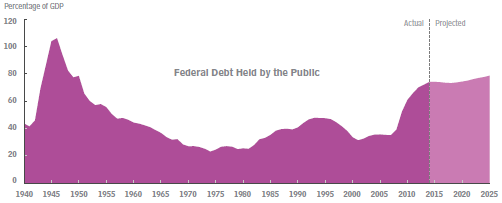
The problem is that such a deal essentially just maintains the budget status-quo. It does nothing to begin shrinking annual deficits in order to put our accumulated national debt on a downward path as a percentage of GDP.  Our current debt of 74% of GDP is very high by historical standards and simply must be brought down significantly in the near term.
Capture1As I explained in my last post, Congressional Republicans, with majorities in both the House and the Senate, should be able to apply much more leverage than was used in the deal just reached, as follows:

  • Yes, extend the debt ceiling for two years. We need to pay our debts. But insist on spending discipline from now on.
  • Allow only brief temporary budget extensions at current levels until a plan is adopted to put deficits and debt on a downward path. The Republican ten year plan for a balanced budget would be a good place to start.

It’s time for fiscal conservatives to stand up and be counted!

Follow me on Twitter: https://twitter.com/jack_heidel
                       Follow me on Facebook: https://www.facebook.com/jack.heidel.3

Resolving the Current Budget Impasse in Congress


Congress is facing two critical fiscal deadlines in the very near future. Our current debt ceiling of $18.1 trillion will be exceeded by November 4.  A temporary 2016 budget was passed that will fund the federal government at its current level through December 11.  There is much pressure on Congress to lift the sequester limits for discretionary spending which have been in effect since early in 2013.  The Republican majorities in Congress should use their leverage to promote fiscal responsibility in the following way:

  • Extend the debt ceiling by $1 trillion or enough to last about two years at our current rate of deficit spending. Control over the debt ceiling gives Congress an important tool with which to remind the voters of the urgency of shrinking the national debt. Make it clear that in return for supporting payment of existing obligations, Republicans will insist on far more spending restraint in the future.
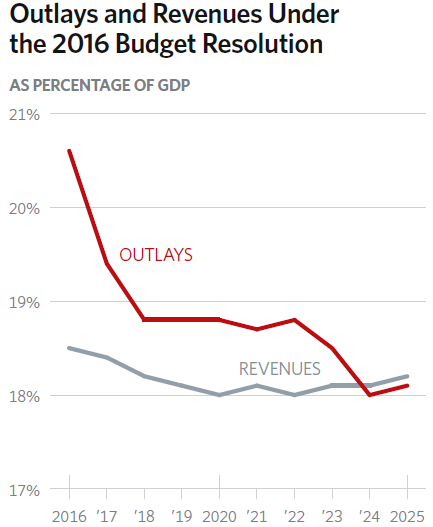
  • For example, Congress should agree to only additional short term extensions of this year’s budget at current spending levels, including sequester limits, until a long-term budget plan is locked into place along the lines of:Capture
  • The ten year budget plan adopted by Congress last Spring produces a balanced budget by 2025. Perhaps surprising to many people, it still allows spending to increase by 3.3% annually which is approximately double the current rate of inflation.

Such a plan of indefinite short term budget extensions at current levels will get the focused attention of all big spenders including conservatives who want more military spending as well as the President and his Democratic allies in Congress.  Everything should be on the table: entitlement reform, tax reform, immigration reform, etc.  There need be no deadline for agreement; the current budget could simply be renewed at short term intervals until a mutually acceptable plan was achieved.  No plan, then no budget increases.  Take your pick.
Conclusion: a national debt of 74% of GDP is in fact a fiscal crisis and the Republicans have enough leverage to force a showdown in a sensible way.  They should use it!

Follow me on Twitter: https://twitter.com/jack_heidel
Follow me on Facebook: https://www.facebook.com/jack.heidel.3
A Fiscal Conservative with a Social Conscience


My last two blogs were “Why racism exists in America” and “Educare and the Academic Achievement Gap.”  I often describe myself as a fiscal conservative but it would be more accurate to say that I am a fiscal conservative with a social conscience.
Capture0By this I mean:

  • First and foremost I want to shrink our annual federal budget deficits enough so that our national debt begins to decline as a percentage of GDP. Right now the public debt (on which we pay interest) is at 74% of GDP which is the highest it has been since the end of WWII. This high level of debt is unsustainable and will inevitably lead to a new and much worse financial crisis if it is not put on a downward path.
  • Closely related to the first goal is the need to get our economy growing faster than the 2% average rate of growth since the end of the Great Recession in June 2009. This will have the twin benefits of producing more tax revenue which will make it easier to shrink our annual budget deficits as well as creating more and better paying jobs for everyone.
  • A third goal is to reduce income inequality. The best way to do this is not with more income redistribution from those with higher incomes to those with lower incomes but rather by achieving faster economic growth which will raise incomes for all. Yet another critical way of making American society more equal is to focus on:
  • Reducing social inequality. There are many different forms of social inequality  in our society but let’s focus on one of the most severe aspects: black-white racism.  America will be a more peaceful and prosperous country if we can reduce the glaring inequalities between the two races.

I am sufficiently optimistic to think it is possible to make progress on all of these fronts at the same time. It won’t be easy but momentum is slowly but surely building in this direction.

Donald Trump’s Tax Plan: More Bad than Good


Republican presidential candidate Donald Trump has just released his tax plan. Some of its basic features are:

  • Lowering and consolidating seven current tax brackets into three: 10%, 20% and 25%.
  • The corporate tax rate would be cut from the current level of 35% to just 15%.
  • The income tax on all businesses would be cut to 15% as well.
  • Taxing carried interest at ordinary income tax rates instead of at the lower capital gains rate.
  • Eliminating the Alternative Minimum Tax as well as the Estate Tax.
    Capture8

The nonpartisan Tax Foundation has analyzed the Trump plan and predicts the following positive long term effects:

  • 11.5% higher GDP,
  • 29% increase in capital investment,
  • 6.5% higher wages and
  • 5.3 million more full-time equivalent jobs.

The tax Foundation also performed an analysis of Jeb Bush’s tax plan and found roughly similar economic benefits except for a lesser number, 2.7 million, of new jobs created. But the Tax Foundation also predicts that the Trump plan would cut tax revenue by $11.98 trillion over ten years on a static basis or $10.14 trillion on a dynamic basis (accounting for economic growth effects of the plan). This compares with a loss of revenue of $3.6 trillion over ten years (static) or $1.6 trillion over ten years (dynamic) for the Bush plan.
In other words, for a substantially larger growth in new jobs under the Trump plan, there is an enormous cost in additional deficit spending.
Conclusion: I have previously criticized the Bush plan for increasing deficit spending and therefore adding to the debt when we should be shrinking it. The Trump plan is much, much worse in this respect, running annual deficits of over $1 trillion per year, moving in exactly the wrong direction.
The Bush tax plan, while needing changes to make it revenue neutral, is far superior to the Trump plan, which simply blows off any concern for deficits and debt.

Cutting the Federal Budget, an Example: The Highway Trust Fund


As an advocate of cutting federal spending, people sometimes ask me exactly what I would cut to save money and lower the deficit. I have two standard answers to this question:

  • Often I will respond, it is up to Congress to figure this out. The important thing is to shrink the deficit one way or another. It doesn’t matter from a fiscal point of view exactly what is cut.
  • Another answer I like to give is that with the sequester already slowing down discretionary spending, we should concentrate on finding savings in entitlement programs like Social Security, Medicare and Medicaid.

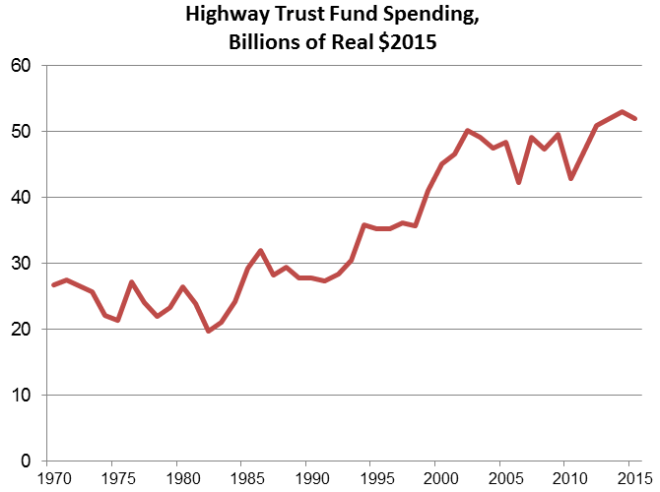
While both of these answers have validity in a general sense, nevertheless I do look for ways to cut back on discretionary spending as well. Here is a good idea from Reason magazine’s Veronique de Rugy, “Let States Build Their Own Highways.” The rationale is very simple. The federal gasoline tax of 18.4 cents/gallon brings in about $40 billion per year which goes into the Highway Trust Fund. But the HTF is spending $53 billion per year, meaning that federal gas tax revenue is being supplemented by $13 billion from general revenues. This additional $13 billion per year can be viewed as an unjustified federal expense merely adding to the deficit.
Capture2The way to address this issue is to:

  • Abolish the federal gasoline tax of 18.4 cents/gallon as of some specific date in the future, say in a year from the time such a law is enacted.
  • Turn over all responsibility for highway construction to the states.
  • States can then decide individually how much of the federal gasoline tax they wish to continue as a state gasoline tax in order to finance their own highway funding.
  • Minimal federal guidelines could be maintained if desired to insure uniform quality control by the states.

Of course, a $13 billion annual budget savings could be looked at as a drop in the bucket, not nearly large enough to make a sizable dent in the federal deficit (latest projection for fiscal year 2015: $426 billion). That would be too cynical. There are undoubtedly many other smart ways to cut back federal spending. I am constantly looking for them!

The Six Issues That Could Cause a Government Shutdown


It is now just ten days until the new government fiscal year begins on October 1 and Congress has not yet passed a budget for the new fiscal year. Although a temporary funding bill could be brought up and passed at any time, the Washington Post thinks that there are six big impediments to adopting a new budget.
CaptureThey are:

  • Planned Parenthood. 31 House Republicans insist that they will support no spending bill which has funding for Planned Parenthood. Short term funding should not be in danger because the Democrats will step in if necessary to keep the government open.
  • The Sequester. This is a much tougher issue because the Democrats want to break the 10 year Sequester spending limits. It’s the Republicans strongest leverage and they should insist on dollar for dollar spending cuts elsewhere in order to relax the Sequester cuts.
  • A Challenge to Boehner. The anti-Planned Parenthood caucus is threatening to try to oust John Boehner as Speaker if they don’t get their way. Hopefully the Democrats would help to keep Boehner because any replacement would be more conservative and less accommodating to them. I personally think that John Boehner is a miracle worker given the hyper-partisanship in Washington at the present time.
  • The Iran Nuclear Deal. Republican desire to express opposition to the Nuclear Deal could surface as a bargaining chip in budget negotiations. As bad as the Nuclear Deal is, this is a bad budget strategy.
  • The Export-Import Bank. The Ex-Im Bank expired in June. Its supporters might try to refund it as part of a budget deal for next year. It should be allowed to die unless it undergoes reform to remove subsidies for big businesses such as Boeing and GE.
  • The Highway Trust Fund. The problem is that the 18 cent/gallon federal gasoline tax is insufficient to fund our infrastructure needs. The most sensible approach is to raise the gas tax by a few cents per gallon. Attempts to provide funding from other sources should be resisted.


Bottom Line: Republicans should be flexible except on overall spending limits. It is absolutely essential to the future wellbeing of our country to strongly focus on eliminating budget deficits.

Jeb Bush’s Tax Plan: Both Good and Bad


Republican presidential candidate Jeb Bush has just released his tax reform proposal, “My Tax Overhaul to Unleash 4% Growth.” It has many good features such as:

  • Lowering and consolidating seven current tax brackets into three: 10%, 25% and 28%.
  • Essentially doubling the standard deduction for most filers, thereby achieving huge simplification for millions of average income filers.
  • Eliminating the state and local income tax deductions and capping all others, except for charitable deductions, at 2% of Adjusted Gross Income.
  • Doubling the Earned Income Tax Credit for childless filers, thus encouraging more low income people to work.
  • Exempting taxpayers over the age of 67 from the employee-side payroll tax, encouraging them to stay in the workforce longer.
  • Cutting the corporate tax rate from 35% to 20%.
  • Allowing 100% immediate expensing for all capital investments, including inventories.
  • Creating a territorial tax system so that multinationals are not taxed on foreign earnings, and therefore incentivized to bring their foreign profits home.
  • Eliminating the deductibility of interest expenses.

The lower individual and corporate tax rates, together with the separate investment and work incentives, will create a significant economic stimulus estimated to raise GDP by at least .5% per year or higher, depending you who ask.
According to the Tax Foundation, however, the plan would reduce federal revenue on a static basis by $3.66 trillion over ten years, and even by $1.6 trillion on a dynamic basis, taking into account the new tax revenue generated by the plan.
CaptureThis is, of course, a huge problem. We badly need to speed up economic growth but we also need to lower, not increase, our annual deficit spending in order to put our debt on a downward path as a percentage of GDP.
The resolution of this quandary is to tighten up on those deductions, such as for mortgage interest, remaining in the code and also lessening the amount of the tax cuts if necessary in order to achieve overall revenue neutrality for the plan.

The Slow Growth Economy We’re Stuck In


We have very high debt and Paul Krugman says in “Debt Is Good” that we need more! The Congressional Budget Office’s latest report this week, “An Update to the Budget and Economic Outlook: 2015 – 2025” predicts slow economic growth for the next ten years, averaging 2.1% per year (see chart below).
CaptureUnfortunately, high debt and slow growth are a deadly, self-reinforcing, combination. Today’s Wall Street Journal has a chart (pictured below) showing clearly how budget deficits are likely to increase over the next ten years. The public debt (on which we pay interest) is predicted to grow from 74% of GDP today to 77% of GDP in 2025, increasing by a total of $7 trillion over this time period.
Capture1Here is another connection between slow growth and high debt:

  • Slow Growth means higher than necessary unemployment and under-employment as well as minimal raises for employed workers. The resulting economic slack leads to
  • Low Inflation. But low inflation means that the Federal Reserve can maintain
  • Low Interest Rates to try to encourage more borrowing to stimulate the economy. This means, in turn, that Congress can run up huge deficits without having to pay much interest on this almost “free” money. This eventually leads to:
  • Massive Debt. But what happens when inflation does take off, which has happened before and is likely to happen again? Then the Federal Reserve is forced to raise interest rates quickly and we are stuck with huge interest payments on our accumulated debt. And meanwhile entitlement spending on Social Security, Medicare and Medicaid is also growing rapidly. At this point debt increases very rapidly which leads to a severe
  • Fiscal Crisis.

Of course things don’t have to happen like this. Congress might become more responsible and either cut spending and/or raise taxes and start shrinking our huge deficits. Or perhaps slow growth really is the new normal and interest rates will remain low indefinitely. But slow growth is not pain free; there are many millions of unemployed and under-employed Americans who want to work and whose lives are stunted otherwise.
Slow growth is a very destructive path to be following. We badly need to adopt policies to speed it up!

Paul Krugman: “Debt Is Good”


Every Monday and Friday morning when I pick up the New York Times, I immediately turn to the OP-ED page to see what liberal icon Paul Krugman is saying. In his most recent column, “Debt Is Good,” he says that “what ails the world economy right now is that governments aren’t deep enough in debt.”
CaptureHere is my response to his argument:

  • “The federal government can (now) borrow at historically low interest rates. So this is a very good time to be borrowing and investing in the future.” Our public debt (on which we pay interest) is now $13 trillion or 74% of GDP, the highest since the end of WWII, as shown in the above chart from the Congressional Budget Office. It is likely that interest rates will soon begin to go up. Every 1% rise will increase interest payments on our already existing debt by $130 billion per year. Where are the hundreds of billions of new dollars for debt service going to come from in an already tight budget? The more we add to the debt, the worse this problem will become.
  • “Having at least some government debt helps the economy function better.” I agree! But $13 trillion is way beyond what is needed for this. It is outrageously excessive!
  • “What we need are policies that would permit higher (interest) rates in good times without causing a slump. And one such policy would be targeting a higher level of debt.” The problem here is the conceit of Keynesians, like Mr. Krugman, that monetary policy alone can restore us to economic and fiscal health. Rather than accepting that the economy has entered a “new normal” with a permanently slow growth rate of about 2% (as has been the case since the end of the Great Recession in June 2009), we need policy changes such as individual and corporate tax reform (revenue neutral to be sure) and changes in the Affordable Care Act and Dodd-Frank Act to remove their job killing features.


Anybody with an ounce of common sense knows that excessive borrowing will eventually lead to disaster. Mr. Krugman seems to think that by constantly ridiculing his opponents, he can get away with denying this simple truth.