The Just Approved 2016 Federal Budget II. A Long Term Disaster


I have been writing this blog, “It Does Not Add Up” for three years now.  It deals with fiscal and economic policy at the national level.  Of the many problems in this area, there is one which looms larger than all the others.  It is our out-of-control annual deficit spending which is in turn leading to a rapidly exploding national debt, now roughly $13 trillion or 74% of GDP.
Capture1My last post considers the details of the recently passed 2016 Federal Budget and how it will add $158 billion to the deficit in just 2016 alone.  The Committee for a Responsible Federal Budget estimates that the 10 year total in additional debt will be about $1.7 trillion.
As the above chart shows, such a huge additional debt in just ten years will lead to a total public debt in 2040 equal to 175% of GDP.  Such an enormous debt is obviously unsustainable and will almost surely lead to a new, and much worse, financial crisis long before the year 2040 arrives.
As the chart also shows, we need to be moving in exactly the opposite situation to keep our debt under any semblance of control.  Reducing deficit spending by $2 trillion over the next ten years would serve to “stabilize” the debt at 72% of GDP in 2025.
To actually end deficit spending, and therefore balance the budget, would require reducing the deficit by a total of $5 trillion over ten years.  This is exactly what the Republican Budget Resolution from Spring 2015 proposed to do.  Needless to say, this desirable goal has fallen by the wayside.
The Republicans are promising a fresh start and better process next year.  We can only hope that they are more successful in the new year.

Follow me on Twitter: https://twitter.com/jack_heidel
Follow me on Facebook: https://www.facebook.com/jack.heidel.3

Republican Congress Approves Irresponsible Budget


Congress has adjourned for Christmas having passed a final budget for the 2016 Fiscal Year extending through next September. It puts into place for this year the two year spending agreement reached between Congress and the President in October.  However Congress started out the year by passing a ten year budget plan resolution leading to a balanced budget by 2025.  The budget just passed leads instead to a deficit of $1.1 trillion in 2025.
CaptureHere are the details as described by the nonpartisan Committee for a Responsible Federal Budget:

  • Revenue: decreased under new budget by a $650 billion (over ten years) by making various temporary tax deductions permanent.
  • Discretionary Spending: increased by $50 billion for the current budget year (by breaking the sequester cap).
  • Medicare: instead of saving $430 billion over ten years, Medicare spending is increased by $95 billion over ten years.
  • 2025 Deficit: instead of shrinking to zero in ten years, it is now projected to be more than $1 trillion in 2025.
  • 2025 Debt: currently the (public, on which we pay interest) debt is 74% of GDP. The ten year balanced budget plan would reduce the debt to 56% of GDP. Instead, the debt is now on track to reach 80% of GDP by 2025.

Granted the Republican Congress hopes to develop a tax reform plan in 2016 which would lower tax rates for everyone, paid for by closing many of the loopholes and deductions just approved last week. One very good way to do this has recently been proposed by the Tax Foundation. The TF plan would boost economic growth and thereby increase tax revenue substantially over ten years.
The problem is that real tax reform is unlikely to happen without a Republican president in office.  If a Democratic president is elected in 2016, then the dire predictions made by the CRFB (above) are likely to remain valid for the foreseeable future. Our fiscal and economic future remains quite precarious at the present time!

Follow me on Twitter: https://twitter.com/jack_heidel
Follow me on Facebook: https://www.facebook.com/jack.heidel.3

I Am One of Paul Krugman’s “Very Serious People”


There is a stark contrast between the fiscal and economic policies being proposed by the presidential candidates from the two different parties. The Democrats want to tax the rich to reduce income inequality while the Republicans want major tax reform in order to speed up economic growth.
CaptureI favor the latter approach as long as it does not increase deficit spending.  The Keynesian economist Paul Krugman mocks deficit hawks like me as “Very Serious People.”  But in my “serious” view we have a choice between two very different paths for our economic future:

  • Slow Growth. Continue on our present path of slow 2% annual growth. The official unemployment rate has dropped to 5% but slack in the economy caused by the low labor participation rate keeps raises low and millions still unemployed or under-employed. The slow economy also keeps inflation and interest rates low. This permits Congress and the President to shrug off deficit spending and debt accumulation because it’s virtually “free money,” being borrowed at very low interest rates.   Our present course not only prolongs income inequality but also allows the debt to keep ramping up indefinitely. The longer this continues, the greater will be the disruption when inflation and interest rates do eventually return to normal historical levels.
  • Faster Economic Growth.   There are many things we can do to speed up economic growth. Tax reform is first and foremost but deregulation (relax Obamacare and Dodd-Frank), trade expansion (pass TPP) and immigration reform (with an adequate guest worker program) would also help. But, contrary to what the Republican presidential candidates say, tax reform must be revenue neutral to be sustainable. That way the economic growth it produces will lower deficit spending rather than increasing it.  This is critical because economic growth will create new jobs and raise pay for existing jobs, thereby creating inflationary pressure. Inflation will lead to higher interest rates which in turn will make our debt much more expensive than it is now.

Conclusion. We can make our economy grow faster if we simply put our mind to it. But then inflation and interest rates will go up and interest payments on the debt will become an increasing burden on society.  This is why it is so important to put our debt on a downward path as a percentage of GDP.  We can make it happen if we want to.

Austerity’s Grim Legacy?


There is a very important debate going on in the country right now as I have discussed in my last three posts:

  • The Republican presidential candidates are proposing big tax cuts to stimulate the economy but at the cost of huge increases in annual deficits and the accumulated debt.
  • The Democratic candidates want to raise taxes on the wealthy but even raising the top tax rate from 39.6% to 50% would have only a modest effect in lowering income inequality.
  • The Tax Foundation has an excellent plan to lower tax rates for all in a revenue neutral manner by closing loopholes and limiting deductions. Their plan would give the economy a big boost and actually lower deficits by bringing in more tax revenue.

Now comes Paul Krugman in Friday’s New York Times, “Austerity’s Grim Legacy”  saying that “Some of us tried in vain to point out that deficit fetishism was both wrong-headed and destructive, that there was no good evidence that government debt was a problem for major economies, … And we were vindicated by events.  More than four and a half years have passed since Alan Simpson and Erskine Bowles warned of a fiscal crisis within two years; U.S. borrowing costs remain at historic lows.”
Capture12How can such an obviously intelligent and articulate economist miss what is so very, very clear to so many lesser mortals?  Interest rates will not stay low forever!  And when they do go up, interest payments on our rapidly expanding debt will skyrocket! The Congressional Budget Office estimates that the interest payment on our debt will increase from 1.7% of GDP today to 3.6% of GDP in 2025, or $827 billion in 2025 compared with $227 billion in 2015.  Where will the money to pay this new $600 billion expense come from?
It is absolutely crazy not to take our enormous debt seriously.  We simply must put this huge debt on a downward path as a percentage of GDP.  It can be done but it will take a concerted effort by our national leaders to do it.

                                    Follow me on Twitter: https://twitter.com/jack_heidel
                         Follow me on Facebook: https://www.facebook.com/jack.heidel.3
Are Democratic Presidents Better for the Economy than Republicans?


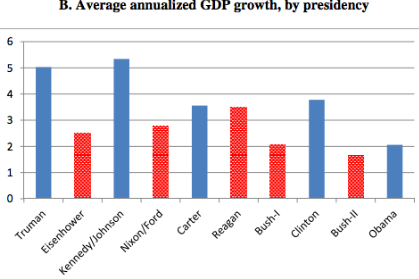
In his usual provocative manner, Paul Krugman reminded us yesterday that, according to a recent study by Alan Blinder and Mark Watson, ever since President Truman the economy has grown faster under Democratic presidents than under Republican presidents.  There are a lot of different explanations for this, not necessarily demonstrating better economic policies by Democratic presidents.  Nevertheless, it is a noteworthy finding which fiscally conservative, fix-the-economy types, need to be aware of.
CaptureAmong other things, Republican presidential candidates must become more credible about their economic policies than they have been so far.  They have all proposed big cuts in tax rates to stimulate the economy. But their plans lose trillions of dollars in tax revenue.  At a time of huge deficits and a rapidly growing national debt this is simply unacceptable.
In today’s Omaha World Herald, the economics journalist, Robert Samuelson, reports on a new Brookings Institute study about the effect of raising the top individual tax rate from 39.6% to 50%.  Such a tax hike would raise as much as $100 billion per year.

  • However, if used to lower deficit spending, it would cover less than ¼ of current deficit spending ($439 billion in 2015, for example).
  • If used to reduce income inequality for the poorest 1/5 of Americans, it would give such households an average of $2,650, and the overall effect on income inequality would be very modest.

The point is that neither costly tax cuts to boost economic growth nor a sizable tax increase on the wealthiest Americans represents a viable program to straighten out our economic problems. What we need to grow the economy is:

  • Revenue neutral tax reform, lowering rates across the board, paid for by closing loopholes and shrinking deductions.
  • Lightening the regulatory burden at least on small and mid-size businesses in order to speed up business growth and entrepreneurship.
  • Trade expansion and immigration reform to increase productivity.

Fiscal conservatives are badly needed to implement such policies effectively but neither party can get the job done alone. It will take both parties working together to make progress.

                                Follow me on Twitter: https://twitter.com/jack_heidel
                      Follow me on Facebook: https://www.facebook.com/jack.heidel.3
It’s Easy to be Pessimistic about America’s Future


As I remind readers from time to time, this blog is concerned with America’s fundamental fiscal and economic problems: a slow economy, massive debt, and increasing income inequality. Largely because of these apparently intractable problems, more and more people are becoming pessimistic about the future of our country.
CaptureAlthough I am by nature an optimist, these matters weigh on me as well:

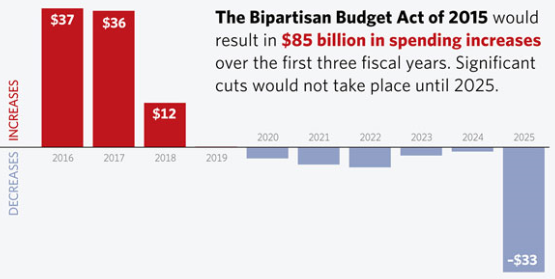
  • The just introduced “Bipartisan Budget Act of 2015” is a sell-out to the status quo. It breaks the agreed upon sequester spending limits by $112 billion over two years with essentially no attempt to create long term spending restraint.
  • As pointed out recently by the Washington Post’s Robert Samuelson, the presidential candidates are talking mainly about new entitlements (the Democrats) or tax cuts (the Republicans). In both cases this represents a flight from reality.
  • Entitlements: The number of people aged 65 or older will increase from 15% of the population today to 22% of the population in 2040. The cost of Social Security, Medicare and Medicaid will jump from 6.5 % of GDP today to 14% of GDP in 2040. We simply must control these costs by raising eligibility ages for SS and Medicare and increasing premiums for wealthier recipients.
  • Economic Growth: Annual growth has averaged only 2% of GDP since the end of the Great Recession in June 2009. Slow growth means weaker gains in wages, more unemployment and larger spending deficits. This can be fixed long term with honest tax reform, but not with unrealistic tax cuts.

Conclusion: Isn’t it obvious that we need political candidates who will speak forthrightly with the people about the need for addressing these humongous problems? Americans aren’t dumb.  They will respond to straight talk from their supposed leaders.   

Follow me on Twitter: https://twitter.com/jack_heidel
                    Follow me on Facebook: https://www.facebook.com/jack.heidel.3
The Budget Deal: A Win for the Big Spenders


A tentative budget deal has just been reached by Congress and the President to 1) suspend the debt limit until March 2017, and 2) loosen the budget sequester caps by $112 billion over the next two years.  $80 billion of the increased spending will be balanced by spending cuts elsewhere in the budget with details to be worked out later by various appropriations committees.  Specifically:

  • The current debt ceiling of $18.1 trillion will be lifted until March 2017, after a new president takes office. This will allow an expected increase in the debt of about $900 billion to take place over the next 1½ years.
  • Both military and discretionary non-military spending will increase by $40 billion each over the next 2 years with the military receiving an additional $32 billion for Overseas Contingency Operations.

The problem is that such a deal essentially just maintains the budget status-quo. It does nothing to begin shrinking annual deficits in order to put our accumulated national debt on a downward path as a percentage of GDP.  Our current debt of 74% of GDP is very high by historical standards and simply must be brought down significantly in the near term.
Capture1As I explained in my last post, Congressional Republicans, with majorities in both the House and the Senate, should be able to apply much more leverage than was used in the deal just reached, as follows:

  • Yes, extend the debt ceiling for two years. We need to pay our debts. But insist on spending discipline from now on.
  • Allow only brief temporary budget extensions at current levels until a plan is adopted to put deficits and debt on a downward path. The Republican ten year plan for a balanced budget would be a good place to start.

It’s time for fiscal conservatives to stand up and be counted!

Follow me on Twitter: https://twitter.com/jack_heidel
                       Follow me on Facebook: https://www.facebook.com/jack.heidel.3

Resolving the Current Budget Impasse in Congress


Congress is facing two critical fiscal deadlines in the very near future. Our current debt ceiling of $18.1 trillion will be exceeded by November 4.  A temporary 2016 budget was passed that will fund the federal government at its current level through December 11.  There is much pressure on Congress to lift the sequester limits for discretionary spending which have been in effect since early in 2013.  The Republican majorities in Congress should use their leverage to promote fiscal responsibility in the following way:

  • Extend the debt ceiling by $1 trillion or enough to last about two years at our current rate of deficit spending. Control over the debt ceiling gives Congress an important tool with which to remind the voters of the urgency of shrinking the national debt. Make it clear that in return for supporting payment of existing obligations, Republicans will insist on far more spending restraint in the future.
  • For example, Congress should agree to only additional short term extensions of this year’s budget at current spending levels, including sequester limits, until a long-term budget plan is locked into place along the lines of:Capture
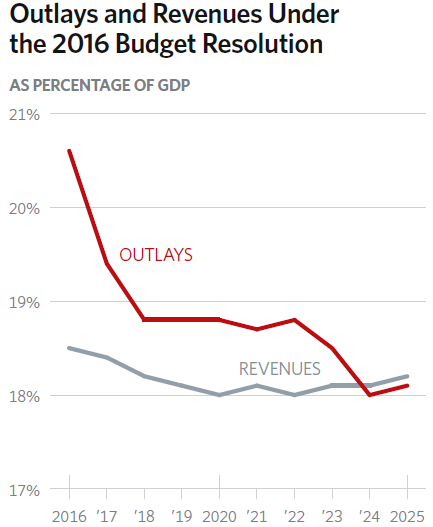
  • The ten year budget plan adopted by Congress last Spring produces a balanced budget by 2025. Perhaps surprising to many people, it still allows spending to increase by 3.3% annually which is approximately double the current rate of inflation.

Such a plan of indefinite short term budget extensions at current levels will get the focused attention of all big spenders including conservatives who want more military spending as well as the President and his Democratic allies in Congress.  Everything should be on the table: entitlement reform, tax reform, immigration reform, etc.  There need be no deadline for agreement; the current budget could simply be renewed at short term intervals until a mutually acceptable plan was achieved.  No plan, then no budget increases.  Take your pick.
Conclusion: a national debt of 74% of GDP is in fact a fiscal crisis and the Republicans have enough leverage to force a showdown in a sensible way.  They should use it!

Follow me on Twitter: https://twitter.com/jack_heidel
Follow me on Facebook: https://www.facebook.com/jack.heidel.3

A Fiscal Conservative with a Social Conscience


My last two blogs were “Why racism exists in America” and “Educare and the Academic Achievement Gap.”  I often describe myself as a fiscal conservative but it would be more accurate to say that I am a fiscal conservative with a social conscience.
Capture0By this I mean:

  • First and foremost I want to shrink our annual federal budget deficits enough so that our national debt begins to decline as a percentage of GDP. Right now the public debt (on which we pay interest) is at 74% of GDP which is the highest it has been since the end of WWII. This high level of debt is unsustainable and will inevitably lead to a new and much worse financial crisis if it is not put on a downward path.
  • Closely related to the first goal is the need to get our economy growing faster than the 2% average rate of growth since the end of the Great Recession in June 2009. This will have the twin benefits of producing more tax revenue which will make it easier to shrink our annual budget deficits as well as creating more and better paying jobs for everyone.
  • A third goal is to reduce income inequality. The best way to do this is not with more income redistribution from those with higher incomes to those with lower incomes but rather by achieving faster economic growth which will raise incomes for all. Yet another critical way of making American society more equal is to focus on:
  • Reducing social inequality. There are many different forms of social inequality  in our society but let’s focus on one of the most severe aspects: black-white racism.  America will be a more peaceful and prosperous country if we can reduce the glaring inequalities between the two races.

I am sufficiently optimistic to think it is possible to make progress on all of these fronts at the same time. It won’t be easy but momentum is slowly but surely building in this direction.

Donald Trump’s Tax Plan: More Bad than Good


Republican presidential candidate Donald Trump has just released his tax plan. Some of its basic features are:

  • Lowering and consolidating seven current tax brackets into three: 10%, 20% and 25%.
  • The corporate tax rate would be cut from the current level of 35% to just 15%.
  • The income tax on all businesses would be cut to 15% as well.
  • Taxing carried interest at ordinary income tax rates instead of at the lower capital gains rate.
  • Eliminating the Alternative Minimum Tax as well as the Estate Tax.
    Capture8

The nonpartisan Tax Foundation has analyzed the Trump plan and predicts the following positive long term effects:

  • 11.5% higher GDP,
  • 29% increase in capital investment,
  • 6.5% higher wages and
  • 5.3 million more full-time equivalent jobs.

The tax Foundation also performed an analysis of Jeb Bush’s tax plan and found roughly similar economic benefits except for a lesser number, 2.7 million, of new jobs created. But the Tax Foundation also predicts that the Trump plan would cut tax revenue by $11.98 trillion over ten years on a static basis or $10.14 trillion on a dynamic basis (accounting for economic growth effects of the plan). This compares with a loss of revenue of $3.6 trillion over ten years (static) or $1.6 trillion over ten years (dynamic) for the Bush plan.
In other words, for a substantially larger growth in new jobs under the Trump plan, there is an enormous cost in additional deficit spending.
Conclusion: I have previously criticized the Bush plan for increasing deficit spending and therefore adding to the debt when we should be shrinking it. The Trump plan is much, much worse in this respect, running annual deficits of over $1 trillion per year, moving in exactly the wrong direction.
The Bush tax plan, while needing changes to make it revenue neutral, is far superior to the Trump plan, which simply blows off any concern for deficits and debt.